Type B vs Type K Plugs: Differences & Compatibility
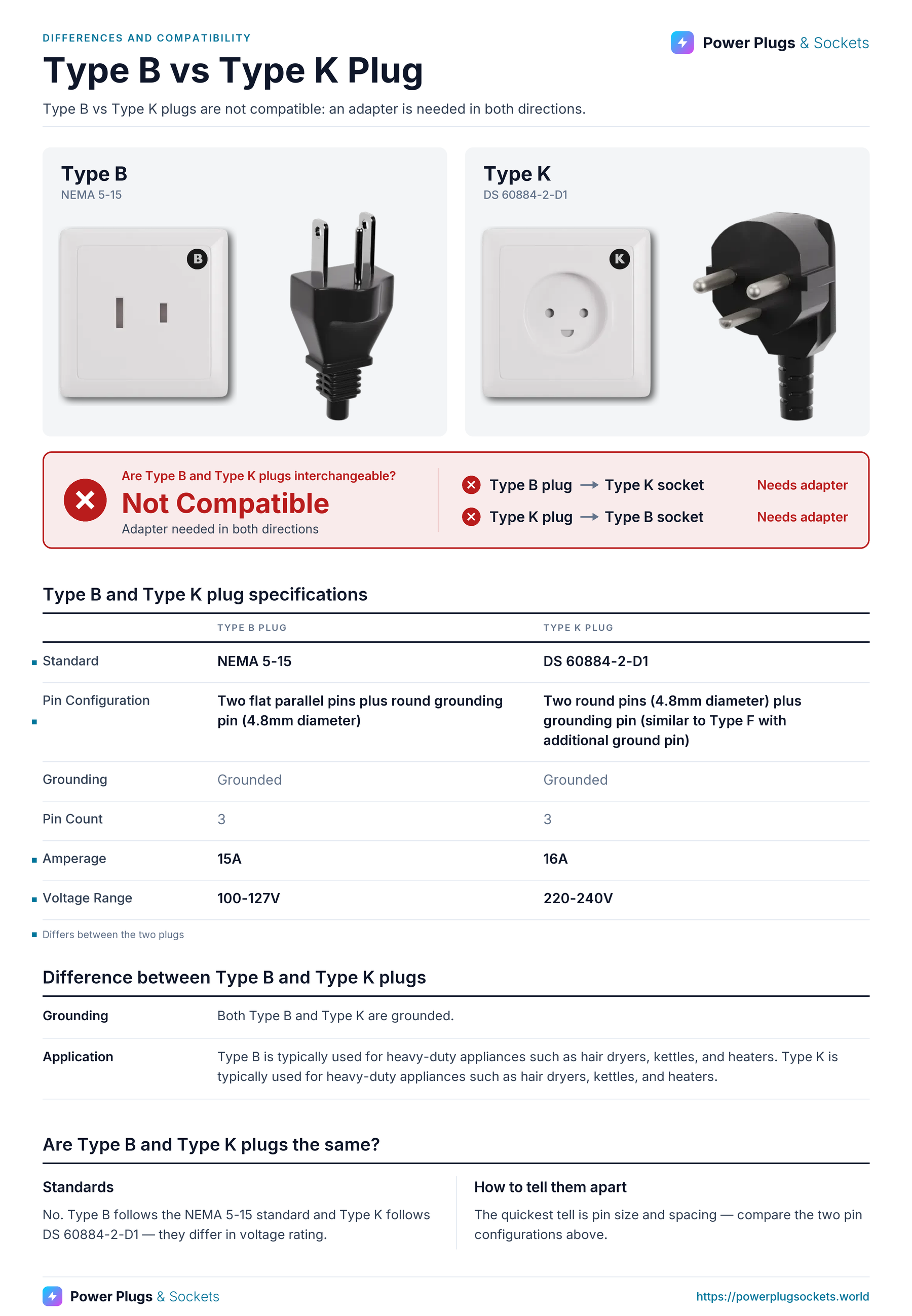
Type B vs Type K plugs are not compatible: an adapter is needed in both directions. Type B is a 3-pin, grounded plug rated 15A at 100-127V, while Type K is a 3-pin, grounded plug rated 16A at 220-240V. The two differ mainly in voltage, amperage and pin design, which is what decides compatibility — whether a Type B plug fits a Type K socket, and vice versa. Compare this with how the pin configuration of a type F plug differs from a type I plug.
Swipe to compare
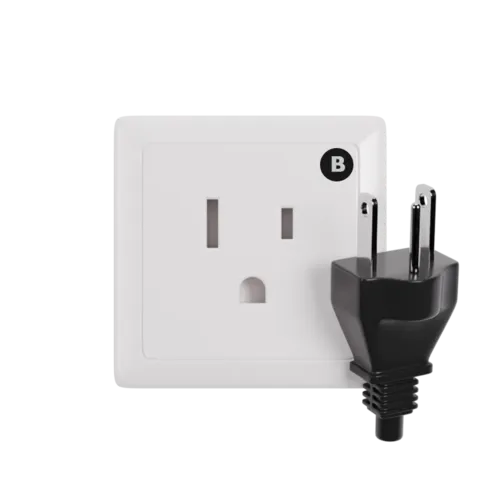
Type B
|
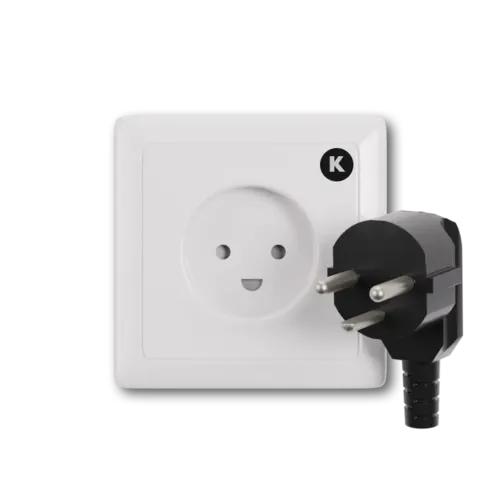
Type K
|
|
|---|---|---|
| Standard | NEMA 5-15 | DS 60884-2-D1 |
| Pin Configuration | Two flat parallel pins plus round grounding pin (4.8mm diameter) | Two round pins (4.8mm diameter) plus grounding pin (similar to Type F with additional ground pin) |
| Grounding | Grounded | Grounded |
| Pin Count | 3 | 3 |
| Amperage | 15A | 16A |
| Voltage Range | 100-127V | 220-240V |
Packing for Copenhagen with a North American charger? The type B vs type K plug question comes down to pin shape, how each power plug reaches earth, and the voltage and frequency of the electricity behind the wall.
Neither fits the other's electrical outlet, and the right plug adapter keeps your device grounded between these two kinds of power sockets.
Type B vs Type K Plug at a Glance
The North American version adds a round ground prong under two flat blades, while the Danish version adds a half-round earth under two round pins. Few socket types are further apart.
The table sets the two standard specifications side by side; the contact shapes and the mains supply matter most when travelling.
| Feature | American (NEMA 5-15) | Danish (107-2-D1) |
|---|---|---|
| Live and neutral contacts | Two flat blades | Two round pins, 4.8 mm wide |
| Earth contact | Round or U-shaped ground prong | Half-round earth pin on the plug |
| Rated current | 15 A | 16 A |
| Rated voltage | 125 V | 250 V |
| Mains supply | 100 – 127 V, 60 Hz in most countries | 220 – 240 V, 50 Hz |
| Polarized receptacle | Yes, wider neutral slot | Yes, live on the left with earth at the bottom |
| What the sockets accept | Type A and Type B adapters | Europlug (Type C), contour plug and the Danish plug |
| Main countries | United States, Canada, Mexico, Japan | Denmark, Faroe Islands, Greenland |
The American Grounded Plug (NEMA 5-15) Explained
The North American grounded plug follows a National Electrical Manufacturers Association standard: 5-15 means configuration 5 at 15 amps. The type b plug is why most outlets there have three openings.
Type B outlets are standard in the United States, Canada and Mexico, and across Central America and the Caribbean, so every device there needs an adapter for Danish sockets. Japan's JIS C 8303 earthed plug is almost identical, but its 100 V supply sits further from Denmark's.
The live and neutral contacts are flat parallel blades, with the ground pin below them. The grounding pin is longer, so it touches the earth contact first and leaves last, giving a fault current a path other than through you.
The hot blade carries the live supply at about 120 V.
Polarized Sockets and the NEMA 1-15 Plug
The two-pin NEMA 1-15 plug, which the ITA calls Type A, fits a NEMA 5-15 outlet. Most two-blade plugs are polarized: the wider neutral blade means the plug goes in one way only.
The Danish Plug and Its Earthing Pin
Denmark wrote its own standard rather than adopting the German or French systems. The danish standard plug is described in Section 107-2-D1, and its key feature is the earthing pin, part of the plug itself, unlike the side clips on Schuko sockets.
It keeps the 16 A rating. The standard provides child-resistant shutters, and traditional sockets carry a switch so you cannot touch live pins; a socket outlet without a switch must be recessed.
Earthed sockets have been required in new Danish installations since the early 1990s, so older two-hole sockets may have no earth.
Round Pins and a D-Shaped Earth
The round pins are 4.8 mm thick and 19 mm long, 19 mm apart; the D-shaped earth is 14 mm long. Danish homes run at 230 V and 50 Hz, and the plugs and sockets are rated 16 A. Some Danish offices use a computer socket variant with angled pins for IT equipment only.
Type K Plugs in Denmark, the Faroe Islands and Greenland
Type K plugs are used in Denmark, the Faroe Islands and Greenland. Visitors may also meet Danish ties and older installations.
New Danish buildings may also mix in Schuko (CEE 7/3) and French (CEE 7/5) sockets.
Power Plug Compatibility: Can One Fit the Other?
No. Flat blades can't enter round holes, so there is zero compatibility in either direction: an American plug won't go into a type k socket. Danish sockets do accept the two-pin family built on 4.8 mm round pins. For a related pairing, see does a type C plug fit into a type E socket.
Danish sockets safely take the Europlug (CEE 7/16), rated 2.5 A, and the unearthed contour plug (CEE 7/17), rated up to 16 A, so a CEE 7/17 plug on a German lamp works. Earthed Type E and Type F plugs are a different story.
North American sockets accept none of these, so the Europlug is the only common ground, through an adapter. Neither the Europlug nor the contour plug has an earth, so nothing is lost.
Danish sockets physically accept the earthed Schuko plug (CEE 7/4), the French plug and the CEE 7/7 hybrid, but no earth connection is made, and a faulty appliance can cause electric shocks. Many travel adapters sold for Europe have Schuko-style output that quietly drops the earth.
Voltage and Frequency: Travel Adapter or Voltage Converter?
A travel adapter changes only the plug shape. Going from American to Danish roughly doubles the supply to 220 – 240 V and changes 60 Hz to 50 Hz, so the device label decides whether you also need a voltage converter.
Dual Voltage Electronics Only Need an Adaptor
An input line such as "100-240 V, 50/60 Hz" means dual voltage, and a simple adaptor is enough. Almost every laptop, mobile phone and camera charger is built this way, as are most electrical devices with an external brick.
Single-Voltage Appliances Need a Converter
A hair dryer, kettle or travel steamer rated 120 V only needs a dual-voltage version or a step-down converter rated above its wattage. Motors also run about 17% slower at 50 Hz.
Wattage Limits: 15 A at 120 V Against 16 A at 230 V
Power is voltage times current: a North American circuit gives 120 x 15 = 1,800 W, a Danish 16 A circuit 230 x 16 = 3,680 W. A 1,500 W 120 V dryer on 230 V would draw about 5,510 W and burn out.
Choosing a Plug Adapter for Safety and Travel
The right plug adapter depends on the two plug types and whether your device has an earth pin. Safety decides: the wrong adapter can remove the earth without any visible sign. Also see what adapter converts a type A plug to a type I socket.
A two-blade plug can use any adapter with a Europlug output. For a three-prong plug choose a dedicated Danish adapter with the half-round earth pin rather than a universal adaptor with Schuko-style output, and check its 10 A or 16 A rating.
Remember an adapter is a shape changer only, so the 15 A limit of a North American electrical outlet still applies. Carrying several devices?
Extension cords and power strips help: one adapter feeding a power strip turns a wall socket into several sockets, but many North American strips and power cords are marked 125 V, not enough for 230 V. For a laptop with a detachable cable, a local extension cord or power cord with the right wall plug keeps the earth intact; travel adaptors are cheap, so buy one that does, and consider an adapter with built-in USB ports to charge a phone and a watch at the same time.