Type C vs Type K Plugs: Differences & Compatibility
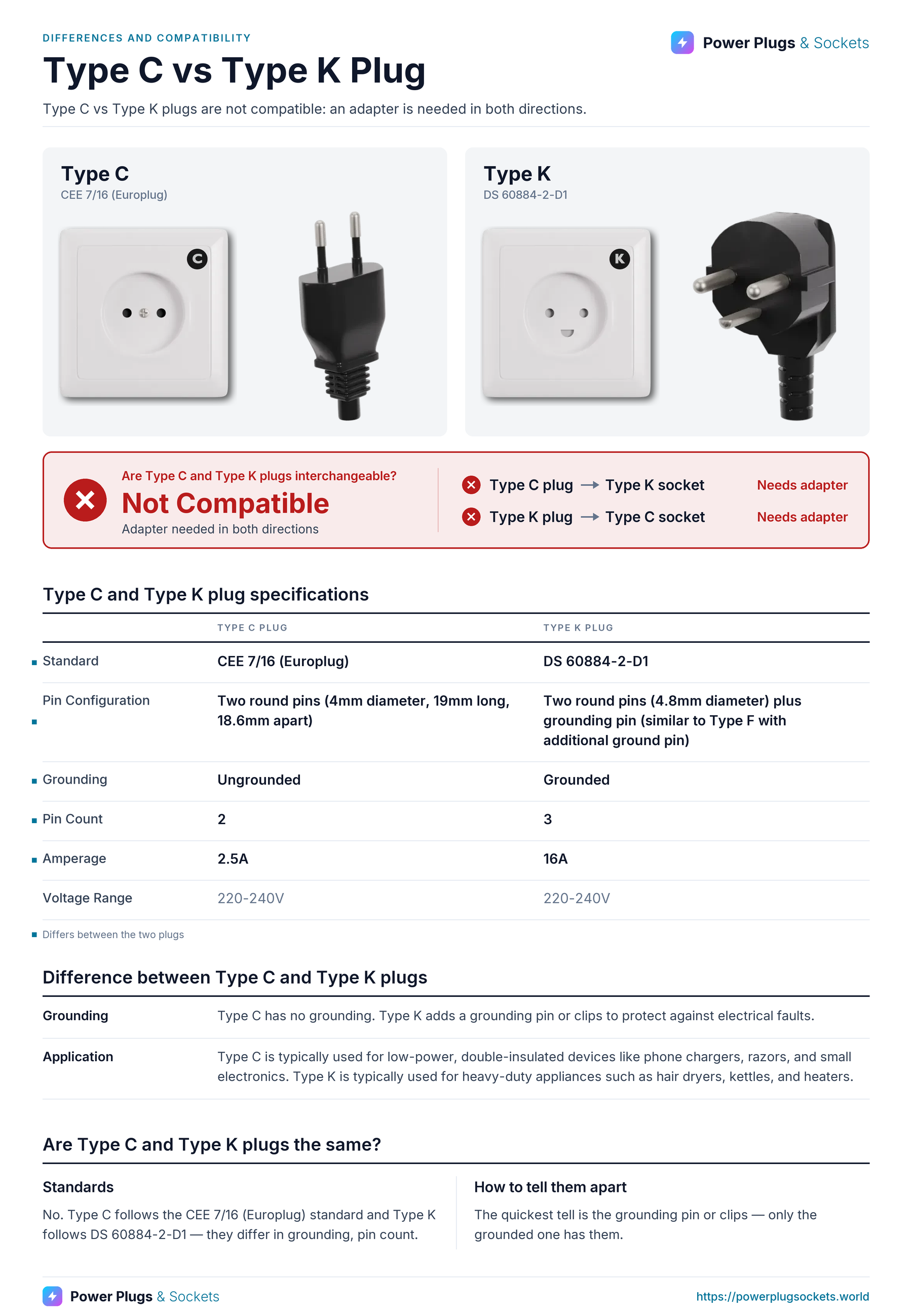
Type C vs Type K plugs are not compatible: an adapter is needed in both directions. Type C is a 2-pin, ungrounded plug rated 2.5A at 220-240V, while Type K is a 3-pin, grounded plug rated 16A at 220-240V. The two differ mainly in grounding, amperage and pin design, which is what decides compatibility — whether a Type C plug fits a Type K socket, and vice versa. For a related pairing, see how do i tell a type C plug apart from a type G plug.
Swipe to compare
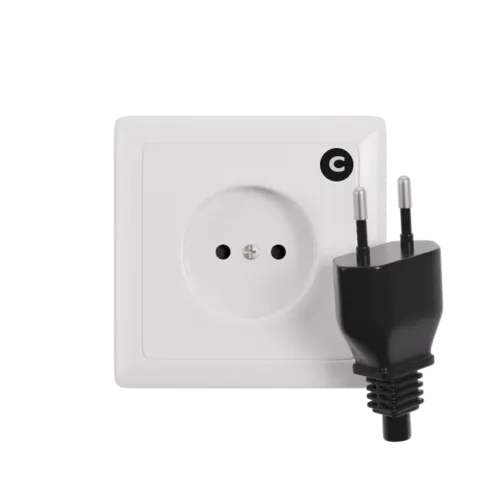
Type C
|
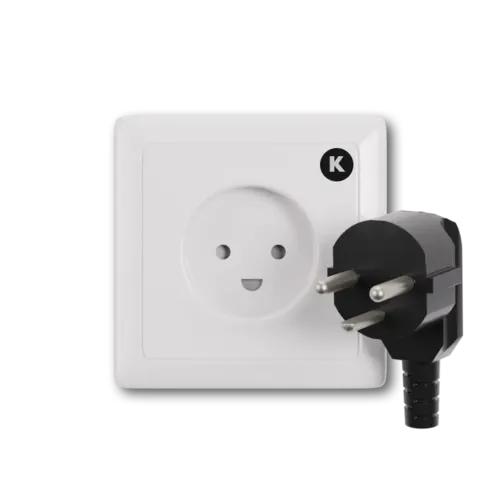
Type K
|
|
|---|---|---|
| Standard | CEE 7/16 (Europlug) | DS 60884-2-D1 |
| Pin Configuration | Two round pins (4mm diameter, 19mm long, 18.6mm apart) | Two round pins (4.8mm diameter) plus grounding pin (similar to Type F with additional ground pin) |
| Grounding | Ungrounded | Grounded |
| Pin Count | 2 | 3 |
| Amperage | 2.5A | 16A |
| Voltage Range | 220-240V | 220-240V |
Packing a charger for a trip to Copenhagen, or bringing a Danish lamp home to the rest of Europe? The type C vs type K plug question comes down to one thing: the slim two-pin Europlug slides into a Danish socket safely, but the three-pin Danish plug almost never fits a socket anywhere else.
This guide shows which combinations keep your devices grounded.
Type C vs Type K Plug at a Glance
The plug types C & K share the same geometry: two round power pins, 19 mm long and 19 mm apart. Type C is the unearthed CEE 7/16 plug, a Class II plug for double-insulated devices; the Danish design in sheet 107-2-D1 adds a half-round earth pin on the plug.
The IEC letters are only names and do not tell you which socket accepts which plug.
| Feature | Type C (Europlug) | Danish three-pin |
|---|---|---|
| Standard | CEE 7/16, EN 50075 | 107-2-D1 |
| Pins | 2 pins, round, 4 mm | 3 pins: two round power pins plus a half-round earth pin |
| Grounding | None, not grounded | Through the plug's own earth pin |
| Current rating | 2.5 A | 16 A |
| Voltage rating | 250 V | 250 V |
| Maximum load at 230V | 575 W | 3,680 W |
| Polarized socket | No dedicated socket exists | Yes, live and neutral fixed |
| Fits which power socket | C, E, F, H, J, K, L, N, O | K only, plus a few Danish hybrid sockets |
The load figures follow from \(P = V \times I\): 230 V times 2.5 A gives 575 W, and times 16 A gives 3,680 W. A 65 W notebook charger is far inside either limit, but a 2,200 W kettle draws almost four times what a Europlug can carry.
What Makes the Europlug Different
The Europlug is the most widely used plug in the world for small devices. Its thin pins enter almost every round-pin socket, including every Type F socket, so it is the default on chargers, a shaver or a radio across Europe, Africa, South America and parts of Asia.
Type C plugs, or plug type C, carry two round pins on a flexible cord. The pins are partly insulated so live pins stay covered, and Europlugs have no prongs for earth ground or earth clips.
A round contour plug is the 16 A cousin, and the earthed CEE 7/6 is a different plug.
Where Type C Sockets Still Appear
Most countries no longer install the unearthed type C socket in new buildings, but a power outlet type C is still the only power socket in Angola, Gabon, Mauritania, Paraguay and Togo, and shares the wall in Switzerland and Italy. All run at 220V to 230V and 50Hz, the same frequency as the Danish grid, so a type C device works in each.
How the Danish Plug Is Built
The Danish standard plug is of Danish origin and used almost nowhere else. Its two round pins are 4 mm to 4.8 mm across, and below them sits the earthing pin, a half-round pin on the plug itself rather than the socket.
Danish outlets are polarized and may have child-resistant shutters, and the plug is rated 16 A and 250 V. Older Danish offices have computer sockets on a surge protected circuit, and the standard sheet defines each pattern. For safety, an electrical outlet here switches off before you touch the plug.
The D-Shaped Earthing Pin
The half-round earth pin is 14 mm long and offset 13 mm from the line between the power pins. That is why a Danish socket takes an unearthed two-pin plug, and why a grounded foreign plug finds no earth contact there.
Where the Danish System Reaches Beyond the Mainland
The type K socket is also standard in Denmark's autonomous territories, the Faroe Islands and Greenland, and appears alongside other sockets in Bangladesh, Guinea, Madagascar, the Maldives, Senegal and Saint Vincent and the Grenadines. A power outlet type K in these places still accepts a two-pin plug, but outside them a Danish-pattern power socket is the exception.
Europlug Compatibility with Danish Sockets
Compatibility runs one way: every Danish socket compatible with the two-pin type C plug takes it safely, but the reverse is not true. A type C plug also fits socket types E, F, H, J, L, N and O. A 10 A socket delivers 2,300 W, so the plug's own 2.5 A is the weak point.
Why a Europlug Fits Danish Sockets Safely
A type C plug has no earth to lose, so plugging it into a Danish socket costs nothing: its 4 mm pins sit in the larger holes and the earth hole stays empty. The CEE 7/17 plug works too, so you need no adapter in Denmark.
Schuko and French Plugs Without an Earth Connection
A Schuko plug, CEE 7/4 or Type F, from Germany and a Type E plug from France physically enter a Danish socket, but no earth connection is made, and the CEE 7/7 hybrid behaves the same. On a faulty metal-cased kettle the case can become live and cause electric shocks.
A double-insulated charger is harmless, but a washing machine or heater is not. A German or French plug in a Danish socket gives partial and unsafe compatibility, and the electric shock risk is real.
Danish plugs rarely fit elsewhere: the D-shaped earth pin cannot enter a Schuko CEE 7/3 socket, and it collides with the earth pin in a French CEE 7/5 socket. Elsewhere the plug needs an adapter that connects its earth pin, or a new cord.
Grounded or Unearthed: Earthing Rules Behind the Danish Standard
An earthed plug sends fault current down an earth wire so the breaker trips; an unearthed one relies on the device's insulation. Type C is always unearthed, and the Danish three-pin is earthed by design, with 3 pins where the Europlug has two. Next, check is it safe to use a type B device on a type C socket.
By 1 July 2008 every Danish installation had to be protected by earth-fault interrupters, which cut the mains electricity quickly if current leaks. It is a backstop, not a replacement for earthing.
A Class I appliance, such as a metal-cased toaster, needs an earth. A Class II device, marked with a double square, has double insulation and no earth wire, the only kind a two-pin type C is allowed on.
IEC 60083 lists every plug and socket type covered here.
Travel Adapter Advice for Europlug Users in Denmark
A phone or laptop charger with a type C plug goes straight into a Danish wall socket. A travel adapter is needed only for grounded appliances or plugs from outside the round-pin family; pick a plug adapter that passes the earth through and is rated for the current your device draws. Next, check which countries use type G plugs versus type I plugs.
Adapter or Voltage Converter
On international travel, plug shape and power supply are two separate checks: an adapter changes the plug shape, not the voltage. Danish outlets deliver 230V at 50Hz like most of Europe, Africa and South America, so no converter is needed between these plugs.
A dual voltage label reading 100-240 V needs only the right plug; a 120 V-only device needs a voltage converter.
Taking Danish Appliances Abroad
The simplest fix for Danish appliances abroad is a new cord, or a CEE 7/7 plug that fits both Type E and Type F sockets and keeps the earth. Avoid cheap adapters that ignore the earth pin: they turn an earthed appliance into an unearthed one.