Type H vs Type J Plugs: Differences & Compatibility
Type H vs Type J plugs are not compatible: an adapter is needed in both directions. Type H is a 3-pin, grounded plug rated 16A at 220-240V, while Type J is a 3-pin, grounded plug rated 10A at 220-240V. The two differ mainly in amperage and pin design, which is what decides compatibility — whether a Type H plug fits a Type J socket, and vice versa. Compare this with how the CEE 7/4 (Schuko) standard for type F compares to AS/NZS 3112 for type I.
Swipe to compare
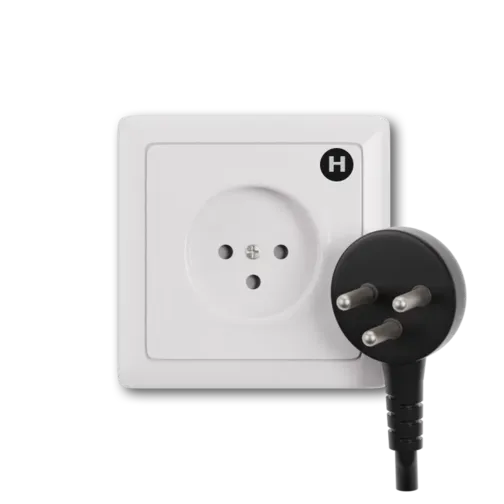
Type H
|
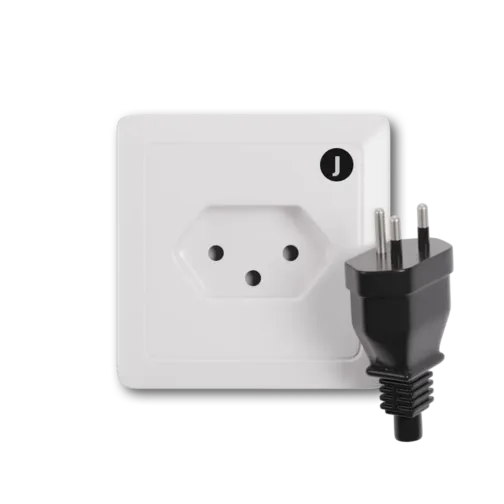
Type J
|
|
|---|---|---|
| Standard | SI 32 | SEV 1011 |
| Pin Configuration | Three pins in V-shape arrangement (round 4.5mm or flat pins, 19mm length) | Two round pins (4mm diameter) plus offset grounding pin (center pin 10mm from others) |
| Grounding | Grounded | Grounded |
| Pin Count | 3 | 3 |
| Amperage | 16A | 10A |
| Voltage Range | 220-240V | 220-240V |
Packing for Tel Aviv one week and Zurich the next? The type H vs type J plug question comes down to where the earth pin sits and how much current each socket is built for, because both countries run the same mains electricity for domestic appliances.
If you travel abroad often, the good news is that one slim two-pin plug works in both sets of outlets, and the chart above shows you exactly why.
Type H vs Type J Plug: The Core Differences
The type H plug belongs to Israel and the type J plug belongs to Switzerland. Each country wrote its own electrical standard decades ago, so the plugs look related (three pins, a triangle layout) but the sockets will not swap.
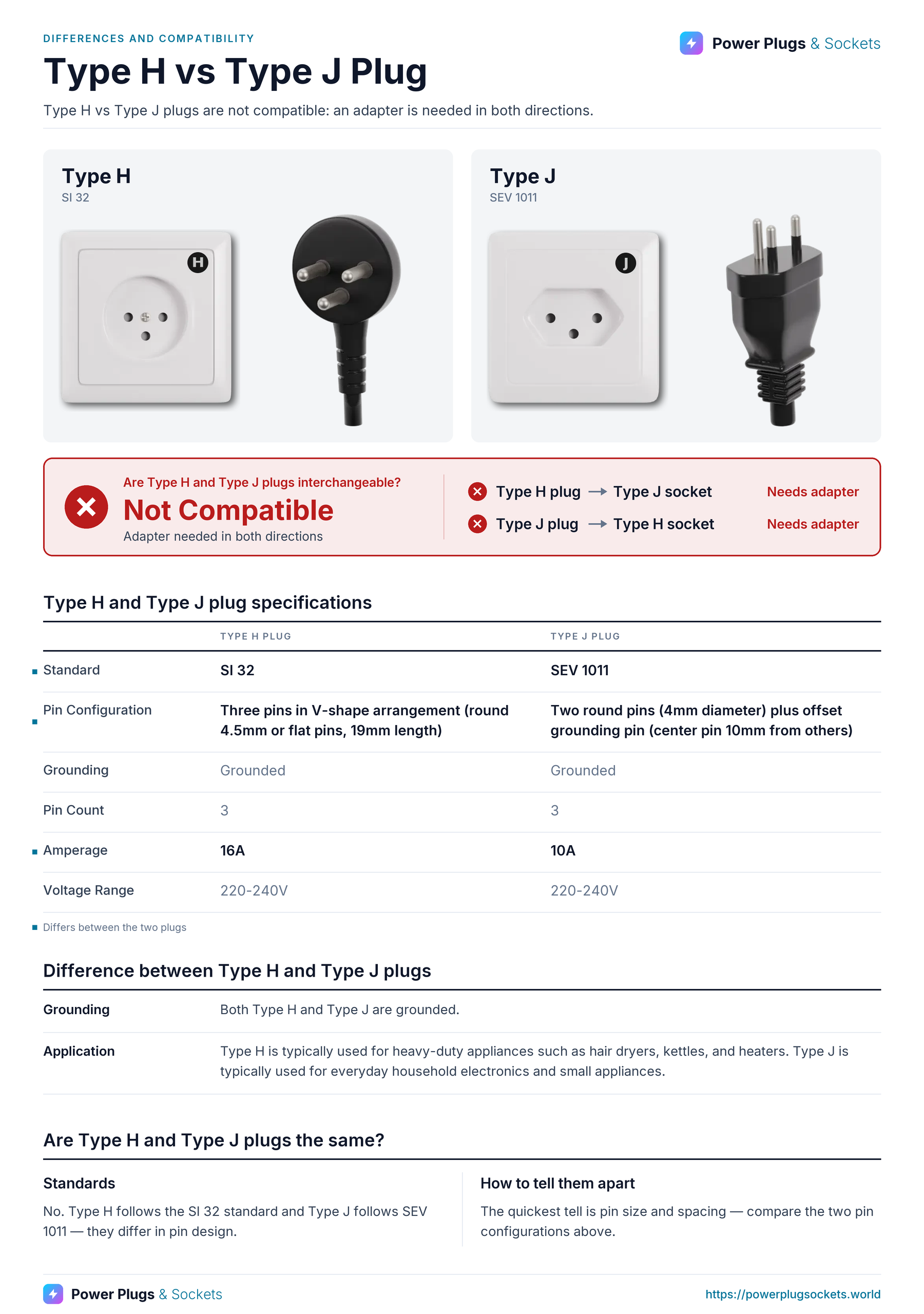
The table below sums up the comparison country by country.
| Feature | Type H (Israel) | Type J (Switzerland) |
|---|---|---|
| Pins | 3 pins, live and neutral in a V shape | 3 pins, round, earth offset by 5 mm |
| Pin diameter | Flat on older versions, round today | 4.0 mm |
| Live to neutral spacing | Takes a 19 mm Europlug | 19 mm |
| Rated current | 16 A | 10 A (16 A on newer sockets) |
| Voltage and frequency | 230V, 50Hz | 230V, 50Hz |
| Grounded | Yes | Yes |
| Also compatible with | Type C | Type C |
Type H: Three Pins in a V Shape
The original Israeli design used two flat prongs angled into a V shape, with a third flat earth blade below them. Viewed head-on, the three flat prongs look like an upside-down Y. These V-shaped plugs were rated at 16 A, a little higher than most European domestic plugs.
In 1989 Israel revised the design: the pins became round and the socket holes were reshaped so that a two-pin Europlug could slide in as well. Older versions of the plug lacked any insulation on the pins, so a half-inserted plug could leave live metal exposed, a real electrocution risk you still meet in some older flats.
Today Type H plugs & outlets are standard in Israel and Palestine.
Type J: Three Round Pins With an Offset Earth Pin
The Swiss plug is defined by SEV 1011. It has three round pins, each 4 mm across and 19 mm long, with the line and neutral pins on a horizontal line and the earth pin set below them.
That earth pin offset is the signature detail: the earth sits 5 mm off the centre line between the other two pins, which is why the Swiss plug only enters a socket one way round.
Modern Type J plugs carry 10 mm insulated sleeves on the live and neutral pins, while unsleeved older versions are still found in drawers and on old appliances. Type J plugs are rated for loads up to 10 amps on the standard socket; above that, equipment has to be wired in permanently or use an industrial connector.
Pin Diameter and Pin Spacing Side by Side
Most compatibility questions come down to two numbers: pin diameter and pin spacing.
- Swiss pins are 4.0 mm thick, with 19 mm between the live and neutral pins.
- Israeli sockets made since 1989 also take 4.0 mm pins at 19 mm spacing, which is what lets a Europlug in.
- The grounding pin is where the two part ways: Type J offsets it slightly, while Type H drops it much lower in a triangular layout.
- Both designs enforce polarity, so live and neutral cannot be reversed by turning the plug.
Because the third pin sits in a different place, a full three-prong plug from one system will never seat in the other. Type J plugs & outlets only mate with each other, and the same goes for the Israeli pair.
Where Each Plug Type Is Used
Neither plug type travels far beyond its home country. That makes both easy to plan for, but it also means a generic Europe adapter rarely solves the problem on its own.
Israel, the West Bank and the Gaza Strip
Power outlet type H is found in Israel, the West Bank and the Gaza Strip, and almost nowhere else. You will also meet Type C outlets in Israeli homes, and heavy appliances such as ovens and air conditioners sometimes use the larger Type M socket instead.
For travel purposes, though, the wall outlet in a hotel room or rental flat will almost always be Type H.
Switzerland and Liechtenstein
Type J is used in Switzerland and Liechtenstein, and nowhere else in Europe. Switzerland built out hydroelectric power early, and its electrotechnical association (SEV) settled on its own plug, later published as SEV 1011, long before neighbours agreed on theirs.
When the IEC catalogued national plugs in IEC 60083 in the 1960s, the Swiss standard was simply given the letter J. Liechtenstein shares the same grid rules, so power outlet type J is all you will find there too, and the Type J standard is not going anywhere.
Why the Brazilian Type N Looks Similar
The Brazilian Type N plug also has three round pins in a triangle and looks almost identical to the Swiss plug. It is still incompatible: on Type N the earth pin sits closer to the centre line.
A Type N plug will not go into a Type J socket, and travelers who switch between Brazil and Switzerland need to keep the two apart.
Plug Types That Fit Swiss Outlets and Israeli Sockets
Since the sockets differ, the useful question is which plug types fit both. The short answer: one (Type C) fits cleanly, a few are partly compatible, and the most common European one is refused outright.
Why a Type C Plug Fits Both
The Type C plug, better known as the Europlug (CEE 7/16), has 2 pins, each 4.0 mm thick and 19 mm apart. Those dimensions match the live and neutral holes in Swiss sockets and in post-1989 Israeli sockets, so a Europlug is compatible with both and goes straight in without an adapter.
Most phone and laptop chargers sold in Europe already use this shape.
The Europlug is ungrounded and rated at only 2.5A, which is plenty for chargers (a 100 W laptop brick draws well under half an amp at 230V) but not for a kettle or heater. Think of Type C as the common key both countries cut into their locks.
Why Schuko and Type F Plugs Are Refused
A Schuko plug (Type F, CEE 7/4) has 4.8 mm pins and a round body about 34 mm wide. Swiss Type J sockets have 4.0 mm holes inside a recess of about 26 mm, so the pins cannot enter and the body cannot seat in the socket recess.
The CEE 7/7 hybrid that fits French and German outlets has the same 4.8 mm pins and fails in exactly the same way. In Israel a Type F plug may be forced partway into a Type H socket, but that is a poor contact with no earth and should be avoided.
This is the classic trap: an adapter sold as "Europe" is often a Schuko shape, and it will not fit a Swiss socket.
Type E and Type L: Partial and Risky Fits
A Type E plug from France shares the 4.8 mm pin problem, so it will not enter Swiss Type J sockets either, and Israeli sockets treat it the same way as Type F. A Type L plug from Italy (10 A version) uses 4.0 mm pins and can look like a near match, but its earth pin sits dead centre rather than offset. It may partly enter a Swiss socket with an unreliable earth contact or none.
For safety, never treat partial fits as a substitute for the correct plug.
Voltage, Current and Grounding Under the Swiss Standard
Electrically the two systems are twins. Israel and Switzerland both supply 230V at a frequency of 50Hz, inside the 220 – 240 V band that most of Europe and the Middle East use. Next, check comparing type C and type E plugs for international travel.
That means voltage is rarely the issue when you travel between Israel and Switzerland; current ratings and grounding are.
Rated Current: 16 A Versus 10 A
The rated current is where Type H pulls ahead. Israeli sockets are rated at 16 A, while the classic Swiss sockets (T12 for two pins, T13 for 3 pins) are rated at 10 A. Since about 2017, new Swiss buildings install T23 and T25 sockets, rated at 16 A and wired for it.
Older 10 A plugs fit those newer sockets, but 16 A Swiss plugs will not fit old T13 sockets, so a high-load appliance cannot overload old wiring. In practice that matters only for something like a hair dryer or space heater pulling close to 2,300 W.
- T12 socket: 2 pins, 10 A
- T13 socket: 3 pins, 10 A, standard Swiss Type J
- T23 and T25 sockets: 3 pins, 16 A, accept older plugs
If a circuit breaker trips when you run two heaters, the socket rating is the first thing to check.
When You Need a Voltage Converter
You need a voltage converter only for devices built for 110-120 V rather than 220 – 240 V, such as older North American hair dryers. Type H and Type J wall points deliver the same supply, so the converter decision is identical for both.
Check the label: if it reads 100-240V, the device is wide-voltage and needs just a plug shape change, and a Europlug fits either socket. Almost every phone, tablet and laptop charger sold today is wide-voltage, so for most travelers to either country a voltage converter would be dead weight in the travel bag.
Grounded and Ungrounded Devices
Both Type H and Type J outlets are grounded, but a Type C Europlug adapter passes no earth through. That is fine for Class II devices, which rely on double insulation (look for a square inside a square on the label).
It is not fine for Class I devices, such as some CPAP machines or a desktop computer with a metal case, which need an earth connection for grounding. For those, bring a proper three-pin adapter into the correct plug type.
- Class II, no earth needed: phone chargers, laptop chargers, cameras, shavers
- Class I, earth needed: metal-cased devices and anything with a three-pin cord
Choosing a Travel Adapter for the Swiss Plug and Israeli Outlets
Because both countries accept the Europlug, a single travel adapter with a slim Type C output can cover the whole trip. What changes is how bulky the adapter is and whether you need an earth.
Picking the Right Plug Adapter
Before buying a plug adapter, decide what you are powering:
- Phones and laptops only: a slim Type C charger or adapter is enough in Swiss Type J outlets and Israeli sockets alike.
- A grounded device: buy a travel adapter for Switzerland with a real Type J outlet earth pin, and a separate one for Israel.
- Many countries on one trip: a universal adapter can work, but check its Europe output is compatible with a 26 mm recess.
A bulky universal adapter often has pins that line up but a body too wide for the recessed Swiss Type J outlet, so it wobbles and loses contact. Slim single-plug adapters avoid that.
Power Outlet Mistakes to Avoid
- Assuming a "Europe" Schuko travel adapter covers Switzerland. It does not; look for a Type C output.
- Counting on universal outlets in hotels. Even good hotels usually have one or two, and every other Swiss outlet is plain Type J.
- Running a heater or kettle through a 2.5A Europlug adapter.
- Forcing a Type F or Type E plug into a power outlet in Israel.
Get these right and the type H vs type J plug difference never touches your trip: one slim Type C charger, a single grounded adapter for anything with metal casing, and nothing else in the bag.