Type A vs Type J Plugs: Differences & Compatibility
Type A vs Type J plugs are not compatible: an adapter is needed in both directions. Type A is a 2-pin, ungrounded plug rated 15A at 100-127V, while Type J is a 3-pin, grounded plug rated 10A at 220-240V. The two differ mainly in grounding, voltage, amperage and pin design, which is what decides compatibility — whether a Type A plug fits a Type J socket, and vice versa. Compare this with is it safe to use a type C device on a type J socket.
Swipe to compare
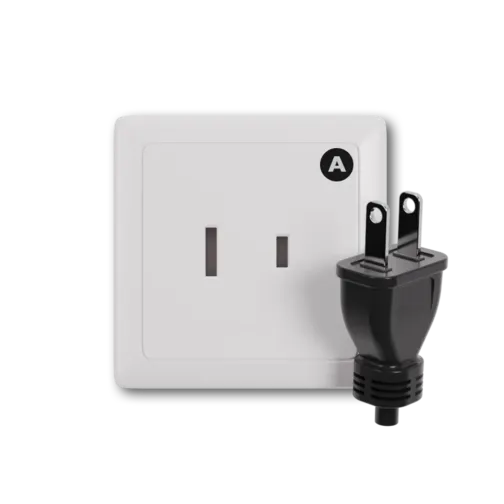
Type A
|
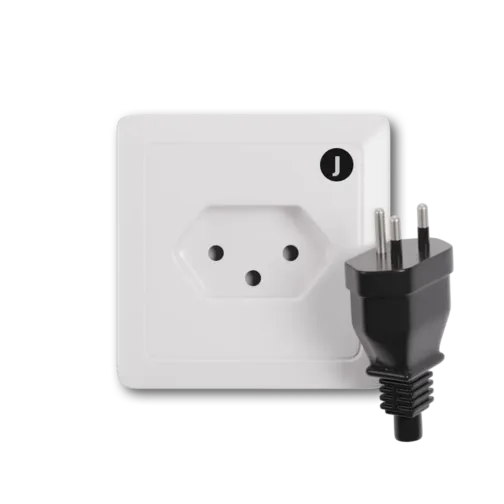
Type J
|
|
|---|---|---|
| Standard | NEMA 1-15 | SEV 1011 |
| Pin Configuration | Two flat parallel pins (15.9mm apart, 15.9mm long, 6.3mm wide) | Two round pins (4mm diameter) plus offset grounding pin (center pin 10mm from others) |
| Grounding | Ungrounded | Grounded |
| Pin Count | 2 | 3 |
| Amperage | 15A | 10A |
| Voltage Range | 100-127V | 220-240V |
Packing for Zurich with American chargers? Travellers face this often.
The type A vs type J plug question comes down to pin shape, grounding and voltage. The flat two-blade power plug from North America will not fit a Swiss wall outlet, so you need a travel adaptor at minimum, and a voltage converter for any device that only runs on 120 volts.
Type A vs Type J Plug at a Glance
Both plugs connect devices to mains electricity but follow different standards: NEMA in North America and the Swiss standard SN 441011. The IEC's World Plugs list gives each design a letter.
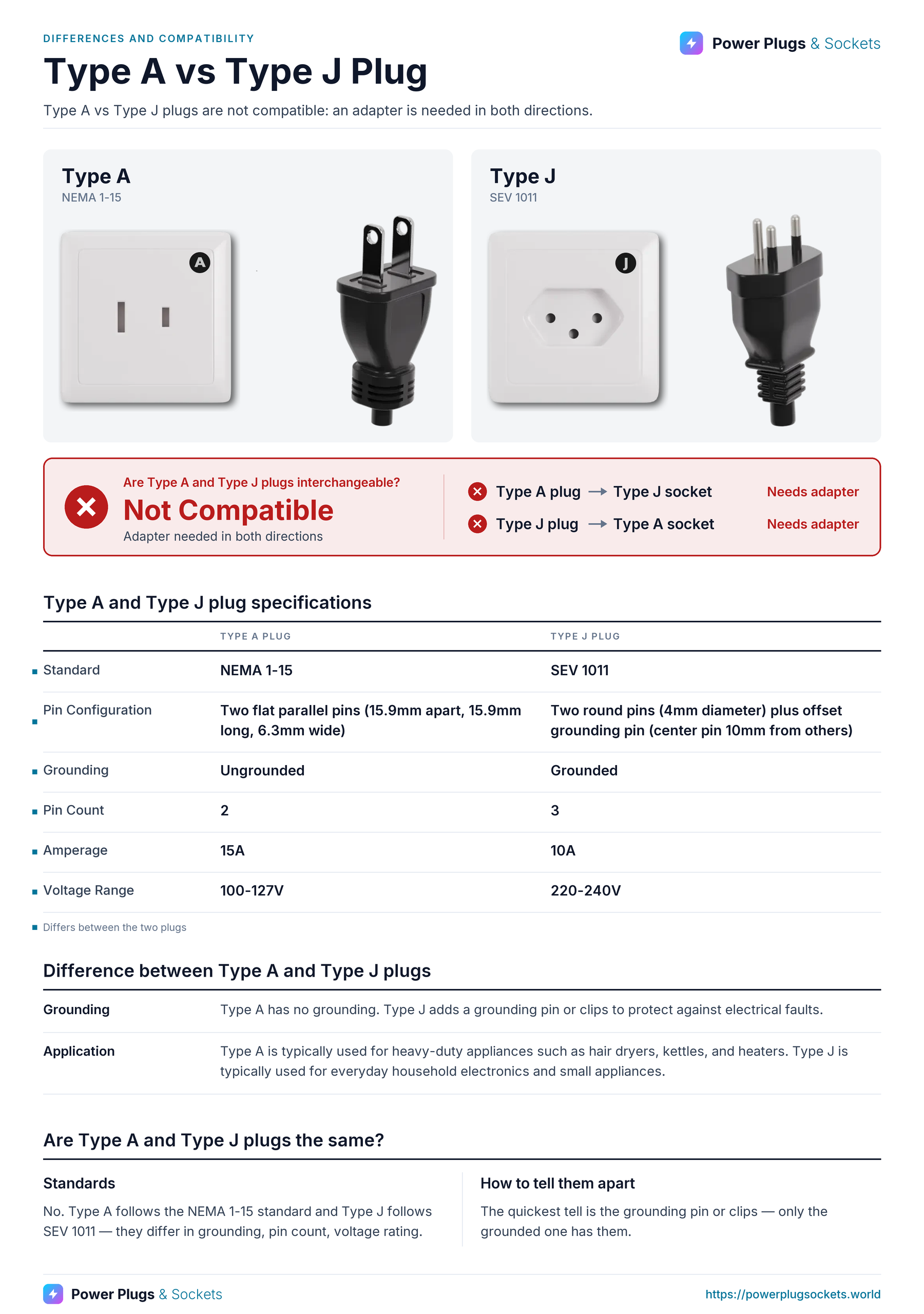
The American plug is rated 15 A and 125 V and is polarized when the neutral blade is wider; the Swiss plug has no 120-volt tolerance.
| Feature | Plug A (NEMA 1-15) | Type J (SN 441011) |
|---|---|---|
| Pins | 2 flat parallel blades | 3 round pins, 4 mm diameter |
| Pin spacing | 12.7 mm between blades | 19 mm between live and neutral |
| Earth contact | None (unearthed) | Earth pin offset 5 mm from the centre line |
| Rating | 15 A, 125 V | 10 A, 250 V |
| Polarized | Optional (wider neutral blade) | Yes, fits one way only |
| Insulated pins | No | Yes, on current plugs |
| Socket accepts Europlug | No | Yes |
| Main countries | USA, Canada, Mexico, Japan, China | Switzerland, Liechtenstein, Rwanda |
SN 441011: Three Round Pins With an Offset Earth
The Swiss design, first published as SEV 1011, uses three round pins 4 mm in diameter and 19 mm long. The earth pin sits 5 mm off the line joining live and neutral, and the household version carries up to 10 amps at 250 V.
Where Each Plug Type Is Used
The flat-blade family covers most of the Americas and parts of East Asia, while the round-pin family is used in only a handful of countries, so its sockets are rare elsewhere. Flat-blade sockets are standard across North and Central America, from Canada to Panama, in the United States, and Japan, China and Taiwan use similar plugs. Next, check type K plugs run on 220-240V while type L plugs run on 220-240V.
Many older Japanese and North American sockets have two slots only.
Switzerland and Liechtenstein (Plus Rwanda)
The round three-pin system is the national standard in Switzerland and Liechtenstein, where it shares sockets with two-pin Europlugs; Rwanda uses it too. If a shop offers a "Switzerland plug" adapter, this is the plug they mean.
Pin Layout of the Swiss Plug and the American Plug
Every socket needs a live pin that brings power to the device and a neutral pin that carries it back, and many add an earth connection. Flat-blade polarization comes from blade width, with a polarized neutral blade about 7.9 mm wide.
The Swiss plug has two round pins plus the earth pin, is polarized by that offset, and its live and neutral pins have insulated sleeves. A polarized plug also has a wider neutral blade than its hot blade, while a 2-prong plug has no ground and a 3-prong plug adds the earth.
Each wall socket is a recessed socket, unlike most flush North American sockets, which is why neither plug fits the other's socket.
Grounding and Safety Differences Between the Two Plug Types
The biggest functional gap is earthing. A grounding pin connected to earth ground gives fault current a safe path, and the Swiss socket always offers one.
The flat-blade plug never has it, so unearthed appliances must use double insulation (Class II), which is how most phone chargers and hair dryers manage without it, and it decides your protection from electric shock if insulation fails.
The Grounded NEMA 5-15 (Type B) Option
A grounded American appliance, which needs a three-hole receptacle at home, uses NEMA 5-15, IEC letter B: the same two blades plus a round grounding pin. In Switzerland it keeps its earth connection only through a grounded adapter that links the round pin to the Swiss earth pin.
Voltage, Current and Frequency Behind Each Power Plug
An adapter changes the shape of the connection, never the voltage, so check the electricity behind the wall before you plug in abroad.
120 V at 60 Hz vs 230 V at 50 Hz Supply Voltage
North America supplies 120 volts at 60 cycles per second; Switzerland, Liechtenstein and Rwanda deliver 230 volts at 50 cycles. A 120-volt-only device would receive nearly twice its rated voltage there.
The frequency gap matters less, though 60-cycle motors run about 17% slower.
Dual Voltage Devices vs Single-Voltage Appliances
Check the label for the input voltage. "INPUT: 100-240V ~ 50/60Hz" means the device is dual voltage and needs only an adapter, as most laptop and phone chargers do.
Electrical appliances such as hair dryers, kettles and travel irons are often single-voltage and need a voltage converter.
Worked Example: Current Drawn on Each Supply
Current equals power divided by voltage. A 1,450 W travel kettle draws 6.30 A at 230 volts, inside the Swiss 10 A rating, and 12.08 A at 120 volts.
A 2,050 W hair dryer needs only 8.91 A in Switzerland but would need 17.08 A at 120 volts, beyond any 15 A plug. A 65 W laptop charger draws just 0.28 A at 230 volts.
Cross-Compatibility: Europlug, Type N and the Swiss Socket
Neither plug is compatible with the other's socket; each is incompatible with it without an adapter, but the Swiss socket is more forgiving of other European plugs. Flat-blade plugs and Swiss three-pin plugs need an adapter in each other's sockets, and Brazilian plugs do not fit despite the similar look. For a related pairing, see will a type D plug work in a type L socket without an adapter.
Why the Europlug (Type C) Fits a Type J Socket
The two-pin Europlug (CEE 7/16) has round pins at 19 mm centres, the same as the live and neutral holes in the Swiss socket, so it slides straight in, and most laptop chargers and phone chargers fit a Type J outlet without an adapter. Thicker 4.8 mm plugs such as German Schuko need their own adapter.
Type N Looks Similar but Will Not Fit
Brazil's NBR 14136 plug also has three round pins 19 mm apart, but its earth pin sits only 3 mm off the centre line, not 5 mm. Do not trust a visual match; check the plug letter on the packaging.
Choosing a Travel Adapter for American Devices in Switzerland
Choose a travel adapter that accepts your two blades and presents round Swiss pins, rated at least 10 A and 250 V. Carry a grounded pass-through for NEMA 5-15 plugs. A plug adapter only reshapes the connection, while a voltage converter or step-down transformer turns 230 volts into 120 volts; heating appliances over about 1,000 W are rarely worth converting, and a dual-voltage model is cheaper and safer.
Plug the converter straight into the wall, never into a power strip loaded with heaters, because the 10 A rating covers everything on that socket.
Bringing Swiss Appliances to Type A Power Sockets
The reverse trip is harder. A Swiss appliance on 120 volts has heating appliances running at roughly 27% of rated power and motors may stall, so only dual-voltage devices work properly.
North American power sockets have no Swiss-style earth contact, so use unearthed Class II devices unless the adapter maps the earth pin to the grounding hole.