Type C vs Type F Plugs: Differences & Compatibility
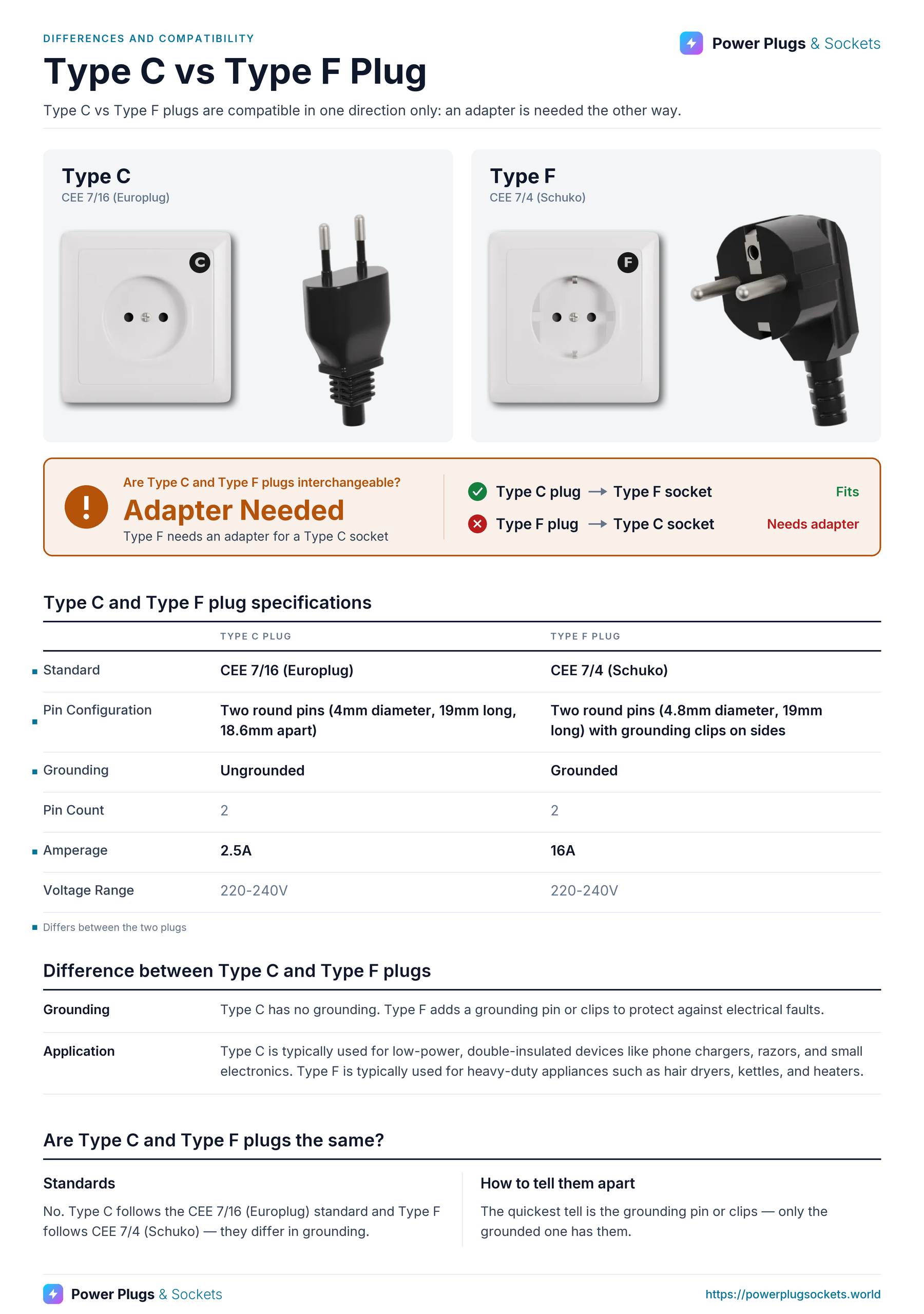
Type C vs Type F plugs are compatible in one direction only: an adapter is needed the other way. Type C is a 2-pin, ungrounded plug rated 2.5A at 220-240V, while Type F is a 2-pin, grounded plug rated 16A at 220-240V. The two differ mainly in grounding, amperage and pin design, which is what decides compatibility — whether a Type C plug fits a Type F socket, and vice versa. For a related pairing, see does a type D plug fit into a type G socket.
Swipe to compare
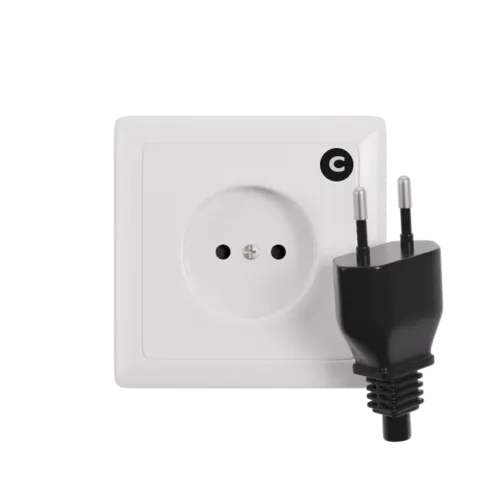
Type C
|
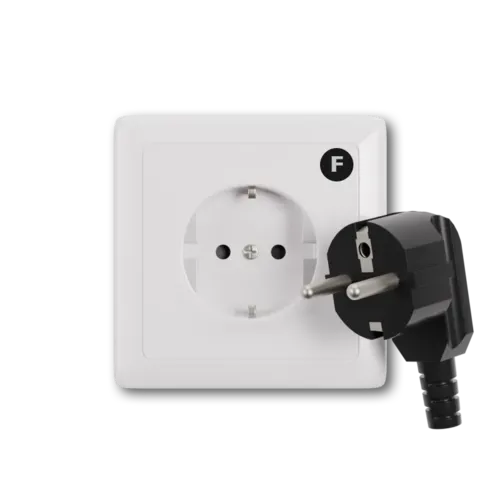
Type F
|
|
|---|---|---|
| Standard | CEE 7/16 (Europlug) | CEE 7/4 (Schuko) |
| Pin Configuration | Two round pins (4mm diameter, 19mm long, 18.6mm apart) | Two round pins (4.8mm diameter, 19mm long) with grounding clips on sides |
| Grounding | Ungrounded | Grounded |
| Pin Count | 2 | 2 |
| Amperage | 2.5A | 16A |
| Voltage Range | 220-240V | 220-240V |
Two cylindrical pins, nearly the same spacing, and yet one is a slim two-prong plug while the other is a chunky connector with an earth: that is the whole type C vs type F plug question in a sentence. If you are packing for travel in Europe, the short answer is that a slim Type C fits almost every Type F wall socket, but not the other way around, so the right plug adapter depends on whether your gear needs an earth.
Here is how the two compare across power sockets, outlets and the electricity behind them.
Type C vs Type F Plug: Pins, Shape and Safety Side by Side
Both plug types come from the same continental family, which is why a single outlet style can often take both. The differences that matter for your devices are these:
- Earth: Type C has none; Type F carries an earth through metal clips.
- Current rating: Type C is limited to 2.5 A; Type F handles 16 A.
- Body: Type C is flat and slim; Type F has a round, wide body that sits inside a recessed socket.
The Type C Plug: An Ungrounded 2 Pin Plug With Two Round Pins
The Type C plug is a small, ungrounded 2 pin connector with two round pins about 4 mm thick, partly sleeved in plastic and angled slightly toward each other so they grip any socket in the family. Standards tables often label it simply plug C.
Because it has no earth and a 2.5 A limit, it is used for low-power electronics: phone chargers, camera batteries, shavers and many laptop charging bricks, including USB-C power bricks that are double-insulated. You will see it in South America and Asia as well as across the continent.
The Schuko Plug: Earthing Clips, 4.8 mm Pins and 16 Amps
The Schuko plug (standardised as CEE 7/4, and often written plug F) is the heavier half of the pair: 4.8 mm pins, 19 mm long, set 19 mm apart, against the thinner 4 mm pins of Type C. Instead of a third pin, it is earthed through metal earthing clips sitting in indentations at the top and bottom of the plug face, which touch springs inside the socket; Type C has nothing in that position. Plastic notches on the sides steady heavy plugs such as ones with built-in transformers.
The name is short for Schutzkontakt, meaning protection contact or safety contact, and that earth is exactly what Type C lacks. Albert Büttner designed it, a Siemens engineer refined it, the 1929 patent followed, and RWE spread it across German homes.
Like Type C, it inserts either way round, so the system is unpolarised: line and neutral land at random. Where Type C stops at 2.5 A, it covers loads up to 16 amps; anything bigger moves to IEC 60309 connectors.
Germany still treats it as the default.
Type C and F Outlet Compatibility: Which Plug Fits Which Socket
Outlet compatibility runs one way. Slim plugs fit wide sockets, but a wide plug needs a matching socket and an earth to be safe.
Most Type C/E/F sockets are close enough to be treated as interchangeable for a two-pin charger.
Compatibility Table and Ground Connection Notes
| Plug | Type C outlet | Type E outlet | Type F outlet |
|---|---|---|---|
| Type C (2.5 A) | Fits | Fits | Fits |
| Type F (CEE 7/4) | Fits, no ground connection | Does not fit | Fully compatible |
| Type E/F plug (CEE 7/7) | Fits, no earth | Fits | Fits |
A plug that can physically fit is not always a safe match. When an earthed appliance such as a kettle or hair dryer goes into a socket without an earth, it works but loses its fault protection.
The good news: the socket face is recessed about 15 mm, so a half-inserted plug never exposes live pins, which removes the shock hazard of the older flat sockets. A standalone two-hole Type C receptacle is rare today.
Where Type E Fits In: The Earth Pin and the Hybrid E/F Plug
Type E is the French and Belgian variant: the socket has a male earth pin sticking out of the wall outlet, and the plug needs a matching hole. Poland, France and Belgium use it.
The original Type F had no earthing hole, so it could not enter a French socket. The fix is the hybrid E/F plug, CEE 7/7, which carries side clips plus a female contact (a pinhole) for the pin.
Almost every European appliance sold today ships with it, so both socket styles take the same cord.
Grounding Pin vs Grounding Clips: Why Some Older Plugs Do Not Fit
If a plug will not go in, check the face. A plug with clips but no grounding hole is the obsolete pure Type F, phased out in favour of the hybrid, and it is blocked by a Type E socket's grounding pin.
Look for a socket with a grounding knob versus side clips before forcing anything. A grounded adapter with both features fits either.
Choosing a Travel Adapter for Type C and Type F Countries
Match the adapter to what you plug in, not just the destination.
Countries That Use Type C Outlets and Type F Sockets
- Spain, Portugal, the Netherlands, Austria and Sweden: Type F sockets that also accept Type C plugs.
- Russia and most of Eastern Europe: Type F and Type C side by side.
- France, Belgium and Poland: Type E, which takes Type C and hybrid plugs.
- Parts of South America and Asia: mainly Type C, sometimes Type F.
Older buildings may still carry a different outlet style per room, so pack for the wider plug.
Power Adapters, Universal Adapters and What Hotels Provide
Plain Type C adapters are the smallest power adapters and are enough for phones and tablets. If you carry a laptop with a three-prong cord, choose a grounded adapter with a hybrid E/F face so the earth actually connects in a Type F socket.
Most universal adapters only have a Type C output, so check before relying on one. Hotels often have only one free outlet near the bed, which makes a multiplug strip worth packing.
Plug Adapter or Voltage Converter for Your Devices
An adapter changes the shape only; it does not change the voltage or frequency. Type C and Type F countries share the same 230 V, 50 Hz mains, so picking between the two plugs is only about shape and earth, never about power.
Check the label: if it reads 100-240 V, the device is dual voltage and needs no converter. Single-rated 120 V items, mostly heating appliances, need a converter or should stay home.