Type D vs Type M Plugs: Differences & Compatibility
Type D vs Type M plugs are not compatible: an adapter is needed in both directions. Type D is a 3-pin, grounded plug rated 5A at 220-240V, while Type M is a 3-pin, grounded plug rated 15A at 220-240V. The two differ mainly in amperage and pin design, which is what decides compatibility — whether a Type D plug fits a Type M socket, and vice versa. Next, check comparing type C and type L plugs for international travel.
Swipe to compare
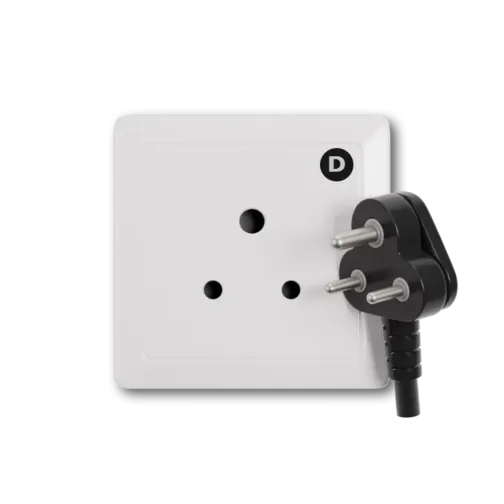
Type D
|
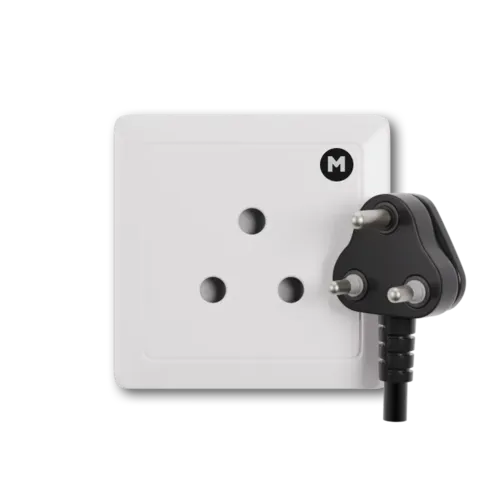
Type M
|
|
|---|---|---|
| Standard | BS 546 | BS 546 (15A) |
| Pin Configuration | Three large round pins in triangular pattern (ground pin 7.1mm, live/neutral 5.1mm diameter) | Three large round pins in triangular pattern (earth 8.7mm diameter, live/neutral 7.1mm diameter) |
| Grounding | Grounded | Grounded |
| Pin Count | 3 | 3 |
| Amperage | 5A | 15A |
| Voltage Range | 220-240V | 220-240V |
Standing in front of a wall with three round holes, you may wonder whether your charger fits or you need a plug adapter. The type D vs type M plug question comes down to size: both are domestic power plugs with the same triangle of round pins, but the M version carries roughly three times the current, so neither fits the other's power sockets.
Type D vs Type M Plug Comparison at a Glance
Both come from the same old British family of plugs and sockets and are earthed, grounded three-pin designs rated 250 V. A type D plug is the 5 A to 6 A version for lamps and chargers, while a type M plug is the 15 A to 16 A version for heavier loads. The IEC counts about 40 countries using Type D sockets and about 15 using Type M.
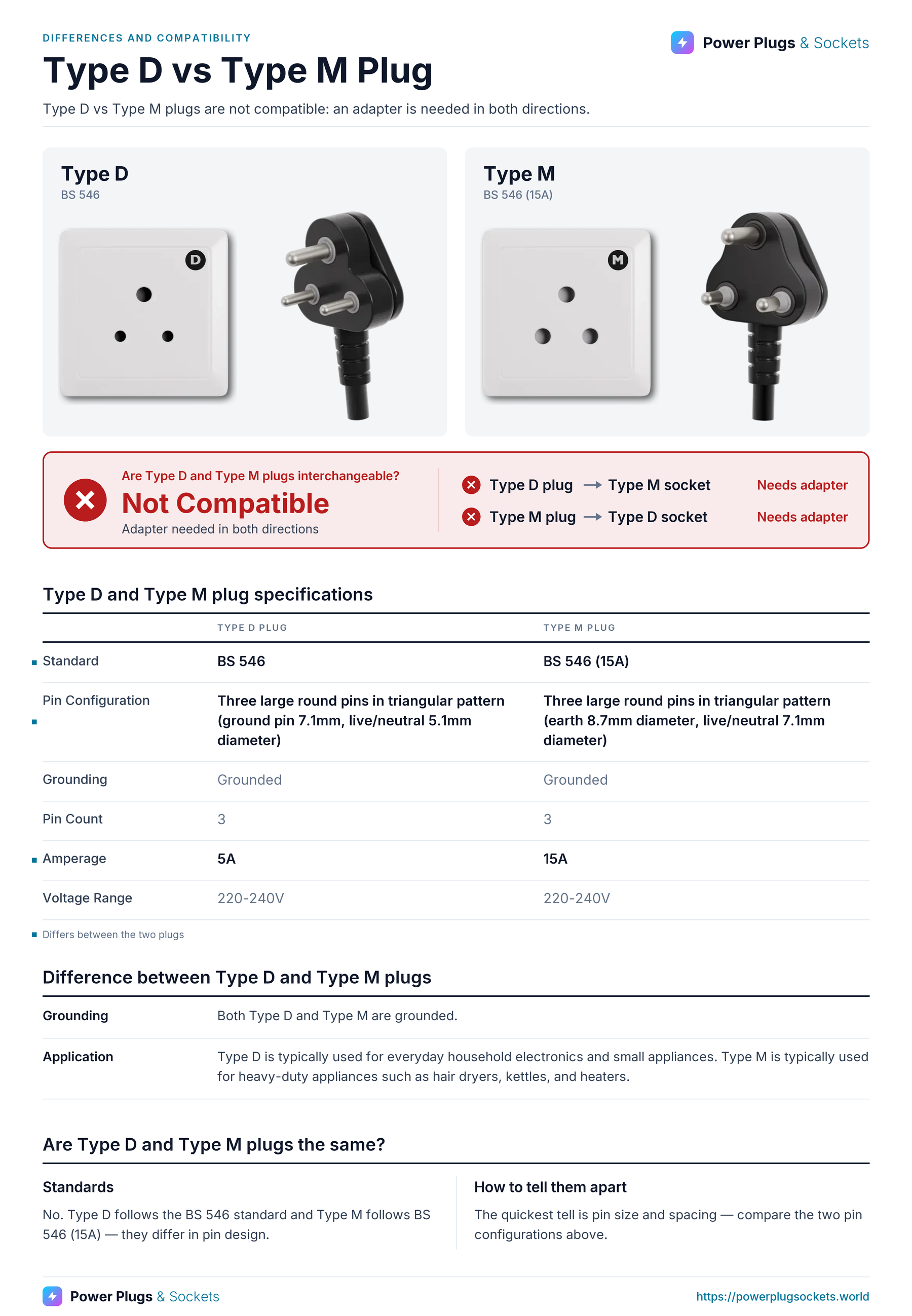
| Feature | Type D | Type M |
|---|---|---|
| Standard | BS 546 (5 A), IS 1293 (6 A) | BS 546 (15 A), IS 1293:2005 and SANS 164-1 (16 A) |
| Rated current | 5 A / 6 A | 15 A / 16 A |
| Rated voltage | 250 V | 250 V |
| Live and neutral pin diameter | 5.1 mm | 7.1 mm |
| Earth pin diameter | 7.1 mm | 8.7 mm |
| Pin centres (live to neutral) | 19.1 mm | 25.4 mm |
| Earthed / polarized | Yes / yes | Yes / yes |
| Fuse in plug | Optional | Optional |
| Insulated pins | Optional (often bare) | Optional (often bare) |
| Recessed socket | No | No |
| Main countries | India, Nepal, Sri Lanka | South Africa, Lesotho, Swaziland |
Both are earthing designs, and both use three round pins in a triangular pattern (three round prongs): line and neutral power pins at the bottom and a thicker earth pin on top. The plugs are polarized but unfused, and the pins are not insulated.
The current rating differs: 5 A or 6 amp against 15 A or 16 A, so the big plug handles about three times the amps at the same 250 V.
BS 546 Round-Pin Family Behind Both Plugs
Both plugs are defined in BS 546, a British Standard from 1934 covering 2 A, 5 A (Type D), 15 A (Type M) and 30 A sizes, used in Great Britain and the United Kingdom before BS 1363 arrived in 1947; a few 5 A sockets remain in older hotels, wired to a light switch or dimmer for lamps. India and South Africa kept the round-pin standard and wrote national versions.
The IEC letter is only a label, so the national standard number fixes the exact pin sizes and rating of the mains plugs.
6 Amp vs 16 Amp Pin Dimensions
The 6 amp and 16 amp plugs differ in every millimetre. Live and neutral centres are 19.1 mm apart on Type D and 25.4 mm on Type M, a 6.3 mm gap that makes the socket-outlets mechanically incompatible.
The earth pin, or grounding pin, is 20.6 mm long and 7.1 mm across on the small plug, and 28.6 mm and 8.7 mm on the large one; it touches first and leaves last.
Larger Pins on the Live and Neutral Contacts
Type M plugs use larger pins for live and neutral: 7.1 mm thick and 18.6 mm long, against 5.1 mm and 14.9 mm on Type D plugs. The big plug's power pins are exactly as thick as the small plug's earth pin, yet the triangle never lines up, so the plug will not seat.
At 230 V a 6 A plug carries 1,380 W and a 16 A plug 3,680 W. A 1,850 W kettle draws about 8.04 A, beyond the small plug but inside the large one, while a 65 W laptop charger draws about 0.28 A and a 1,800 W hairdryer also belongs on the big socket. So the small plug suits phones, routers and other devices, and larger appliances such as kettles, geysers and air conditioners need the bigger plug.
IS 1293 and SANS 164-1: Where Each Plug Is Used
IS 1293 in India covers both the 6 A and 16 A sizes, and SANS 164-1 in South Africa covers the 16 A size. Many Indian homes and hotels have universal combination sockets with a small triangle nested inside a large one that accept both, though the shared earth hole can feel loose.
India, Nepal and Sri Lanka
In Nepal and across most Indian homes, the 6 A socket is the everyday fitting and the 16 A socket sits beside it for kitchens and air conditioning. Sri Lanka uses round-pin sockets alongside type G, and Bangladesh and Pakistan use both sizes.
The 16 A plug is also standard in South Africa, Lesotho and Swaziland (Eswatini), where the SANS 164-2 type N system now sits beside it; it has been reported in Israel for heavy appliances.
D Socket Compatibility with Other Plug Types
A D socket only properly accepts its own plug, but several other plug types can be pushed in, and some combinations are dangerous. The type C Europlug and the type F Schuko plug are the usual visitors.
Why Plug D and Plug M Are Not Compatible
Plug D and plug M are not compatible in either direction: the small pins are too thin and close together for the large socket, and the large pins are too thick and wide for the small one. Only a combination socket or a proper adaptor lets one size into the other.
Europlug in a D Outlet
A two-pin Europlug (type C) often goes into a type D outlet because its flexible pins are close to the 19.1 mm spacing. It cannot be fully inserted, since its 19 mm pins are longer than the 14.9 mm the receptacle expects, so the contact is poor and can spark or cause a short-circuit.
Treat it as a stopgap for a low-power phone, since sparking can trip the circuit breaker. Type E and F plugs are a real safety hazard here: they have no earth contact, are forced in, and leave about 4.1 mm of live pin exposed, risking an electric shock.
The bare pins and unrecessed sockets of both plugs stay live when pulled halfway out, so a child risks electrocution; newer sockets add shutters.
Travel Adapter and Voltage Converter Tips for Plug D and Plug M
Check the electrical rating first. A travel adapter only changes the plug shape, and a voltage converter changes the voltage.
You usually need the first and only sometimes the second.
Worldwide Travel Adapters Often Skip the Larger Plug
Most worldwide adaptors used by travellers include a small round-pin option but leave out the large 16 A size, whose pins are too bulky. For Lesotho or Namibia, buy a dedicated adaptor with an earth pin and the 250 V marking.
Voltage and Frequency in Round-Pin Countries
Both main round-pin markets supply electricity at 230 V and 50 Hz, in the 220 – 240 V band. A label reading 100-240 V and 50/60 Hz, true of most phone and laptop chargers, needs only a plug adapter, while a single-voltage 110-120 V device needs a voltage converter.
Between the two plugs, voltage never decides; the real choice is the current your device draws, 6 A or 16 A.
Which Power Outlet You Will Meet
On the Indian subcontinent the small power outlet is the one you will use most; in southern Africa the big round-pin outlet and the newer type N sockets dominate. Once plugged in, check what you have; pack for the country's national standard, not just the IEC plug letter.