Type C vs Type L Plugs: Differences & Compatibility
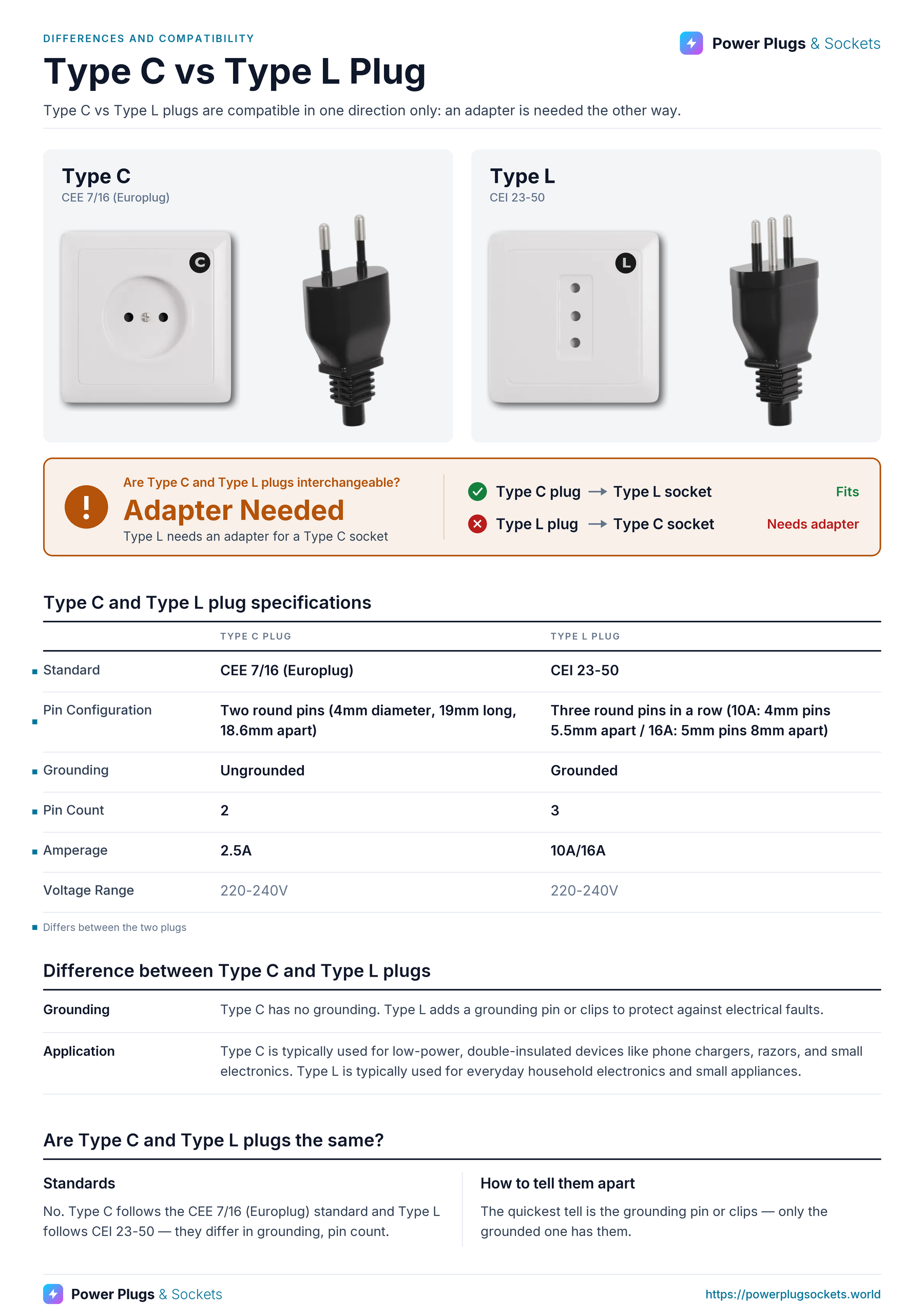
Type C vs Type L plugs are compatible in one direction only: an adapter is needed the other way. Type C is a 2-pin, ungrounded plug rated 2.5A at 220-240V, while Type L is a 3-pin, grounded plug rated 10A/16A at 220-240V. The two differ mainly in grounding, amperage and pin design, which is what decides compatibility — whether a Type C plug fits a Type L socket, and vice versa. Also see type C plugs run on 220-240V while type G plugs run on 220-240V.
Swipe to compare
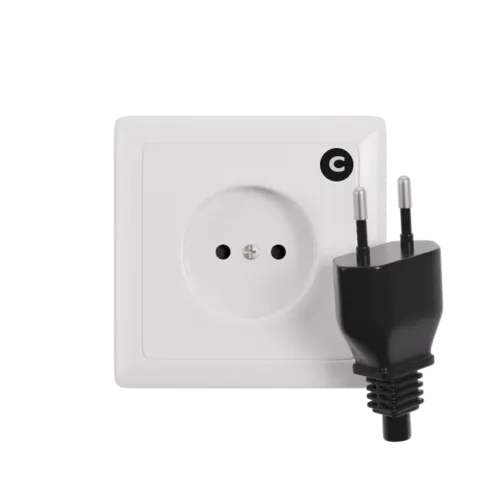
Type C
|
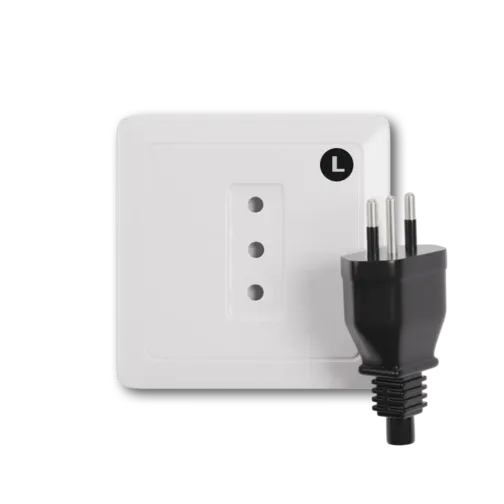
Type L
|
|
|---|---|---|
| Standard | CEE 7/16 (Europlug) | CEI 23-50 |
| Pin Configuration | Two round pins (4mm diameter, 19mm long, 18.6mm apart) | Three round pins in a row (10A: 4mm pins 5.5mm apart / 16A: 5mm pins 8mm apart) |
| Grounding | Ungrounded | Grounded |
| Pin Count | 2 | 3 |
| Amperage | 2.5A | 10A/16A |
| Voltage Range | 220-240V | 220-240V |
Standing in front of an Italian wall socket with the wrong plug in your hand is a quick way to lose a night of charging. The type C vs type L plug question comes down to one difference: the two-pin Europlug fits almost every type C socket and most Italian power points, while the three-pin type L adds an earth contact that only Italian-style holes will take.
Work out which one your electronic devices actually need and you can buy the right plug adapter before you pack, since the electricity on the other end is the same 230-volt mains power used across most of Europe.
Type C vs Type L Plug: Round Pins Compared
Both plugs use round pins rather than flat blades, and that shared shape is why travellers mix them up. The type C is the ungrounded two-pin standard used across the continent and far beyond it, while the type L is of Italian origin and comes in two sizes, a 10 A version and a 16 A version.
The table lines up the specifications that decide what plugs into what.
| Feature | Type C | Type L (10 A) | Type L (16 A) |
|---|---|---|---|
| Contacts | Two prongs, no earth | Live, earth and neutral in a row | Same layout, wider |
| Pin diameter | 4.0 to 4.8 mm | 4 mm | 5 mm |
| Outer pin spacing | 19 mm | 19 mm | 26 mm |
| Grounding | None | Centre earth pin | Centre earth pin |
| Rated current | 2.5 A | 10 A | 16 A |
| Fits a type C outlet | Yes | No | No |
| Outlet style it needs | C, E, F, J, K, L, N and more | 10 A type L or bipasso | 16 A type L or bipasso |
The row that matters most is spacing. The 10 A type L shares the two-pin plug's spacing, so a type C slides straight into its outer holes, while the 16 A version's wider gap and thicker 5 mm contacts accept neither.
Power draw matters too: a type C tops out at 2.5 A, plenty for a laptop or a phone charger but not for a kettle. Check the outlet style where you're staying before you decide which plug to carry.
Why Type L Plugs Have Three Prongs and a Ground Connection
The middle contact on a type L is the earth. If insulation fails, it gives the fault current a path back to the panel instead of through the metal case you're holding, which is why Italian wiring puts it on appliances with conductive housings.
A plain type C has no grounding contact at all, so manufacturers only fit it to double-insulated gear marked with the square-inside-a-square symbol.
Which Type L Socket and Wall Socket Accept a Europlug?
Most modern power points in Italian homes and hotels are the bipasso design: three holes in a row with figure-eight outer openings that take a 10 A plug, a 16 A plug or a two-pin plug. That's why type C plugs are the safe default for a short trip.
They fit the bipasso, the plain 10 A type L socket and almost every electrical socket on the European continent. The reverse isn't true: a three-pin Italian plug has nowhere to put its earth contact in a two-hole power socket, so it only works where the power outlet was built for it.
Older flats can still have 16 A-only Italian sockets, whose wider holes grip a slim two-pin plug loosely or not at all.
Schuko and Type F Outlets in Italian Homes
Many an Italian kitchen also has a wider power outlet with side clips: the Schuko, or type F (France and Belgium use the similar type E), used for high powered appliances such as ovens and washing machines. Travel shops sell type E/F hybrid plugs, with fatter prongs and a pinhole for the French earth pin, labelled as fitting Italy.
They do fit that kitchen power outlet, but their thick contacts won't enter the bipasso or a 10 A receptacle in your bedroom. A type C fits that one too, so it covers both rooms.
Type C or Type L Adapter Plug for Italy
The packing decision usually takes under a minute. Look at the end of each cord you plan to bring:
- A two-blade US or Japanese charger for phones or cameras: a two-pin type C converts it for Italy, Chile and the rest of the type C world.
- A three-blade cord with an earth pin, such as a desktop power supply: choose a grounded type L so the earth carries through.
- A USB charging brick: either plug type works, and a model with built-in USB ports frees up a power outlet.
Most people pack one compact type C travel adapter for low amps electronics and add a single type L only if something they bring has a third pin. Italian outlets rarely sit beside the bed in older buildings, so a short power strip with an Italian plug earns its space.
For safety, never force a plug into a power outlet it doesn't match, and never snap off an earth pin to make it fit.
When Your Power Plug Is Grounded
If your power plug has a third pin, the maker wanted that equipment earthed, and a two-pin type C can only accept it through a cheater that drops the earth. A three-pin type L keeps that connection intact, and for a metal-cased printer or a desktop computer that's worth the bulkier plug.
Voltage Converter or Plug Adapter for Type C and Type L Plugs
Neither plug changes the power; each only changes the shape. Italian mains power runs at 230 V and 50 Hz, roughly double the North American 110 to 120 V at a lower frequency. Next, check will a type D plug work in a type M socket without an adapter.
Read the label on your power brick: if it says 100-240 volts and 50-60 Hz, it's a dual-range power supply and needs nothing more than the right plug.
A US hair dryer, a curling iron or some medical equipment such as an older CPAP power unit expects 110 V and will overheat on 220 volts whichever plug you carry. For those you need a voltage converter rated above the device's wattage, because cheap plug adapters don't convert anything.
Countries That Use the Type C Plug and Type L Standard
The type L is rare beyond its home country. Italian plugs also turn up in San Marino, Vatican City, South America and parts of North and East Africa, almost always alongside the two-pin type C. The two-pin plug is the opposite: it fits power sockets in well over 100 countries, which is why it's the one to pack if you only take one. Next, check how do i tell a type K plug apart from a type O plug.
| Country | Voltage | Frequency | Power socket types |
|---|---|---|---|
| Italy | 230V | 50Hz | Type C, Type F, Type L |
| San Marino | 230V | 50Hz | Type C, Type F, Type L |
| Vatican City | 230V | 50Hz | Type C, Type F, Type L |
| Chile | 220V | 50Hz | Type C, Type L |
| Uruguay | 220V | 50Hz | Type C, Type F, Type I, Type L |
| Libya | 230V | 50Hz | Type C, Type D, Type F, Type L |
| Ethiopia | 220V | 50Hz | Type C, Type E, Type F, Type L |
| Eritrea | 230V | 50Hz | Type C, Type L |
| Syria | 220V | 50Hz | Type C, Type E, Type L |
| Germany | 230V | 50Hz | Type C, Type F |
| France | 230V | 50Hz | Type C, Type E |
| Spain | 230V | 50Hz | Type C, Type F |
| Greece | 230V | 50Hz | Type C, Type F |
| Netherlands | 230V | 50Hz | Type C, Type F |
| Austria | 230V | 50Hz | Type C, Type F |
| Belgium | 230V | 50Hz | Type C, Type E |
| Switzerland | 230V | 50Hz | Type C, Type J |
| Turkey | 230V | 50Hz | Type C, Type F |
| India | 230V | 50Hz | Type C, Type D, Type M |
| Brazil | 127V / 220V | 60Hz | Type C, Type N |
| South Korea | 220V | 60Hz | Type C, Type F |