Type E vs Type F Plugs: Differences & Compatibility
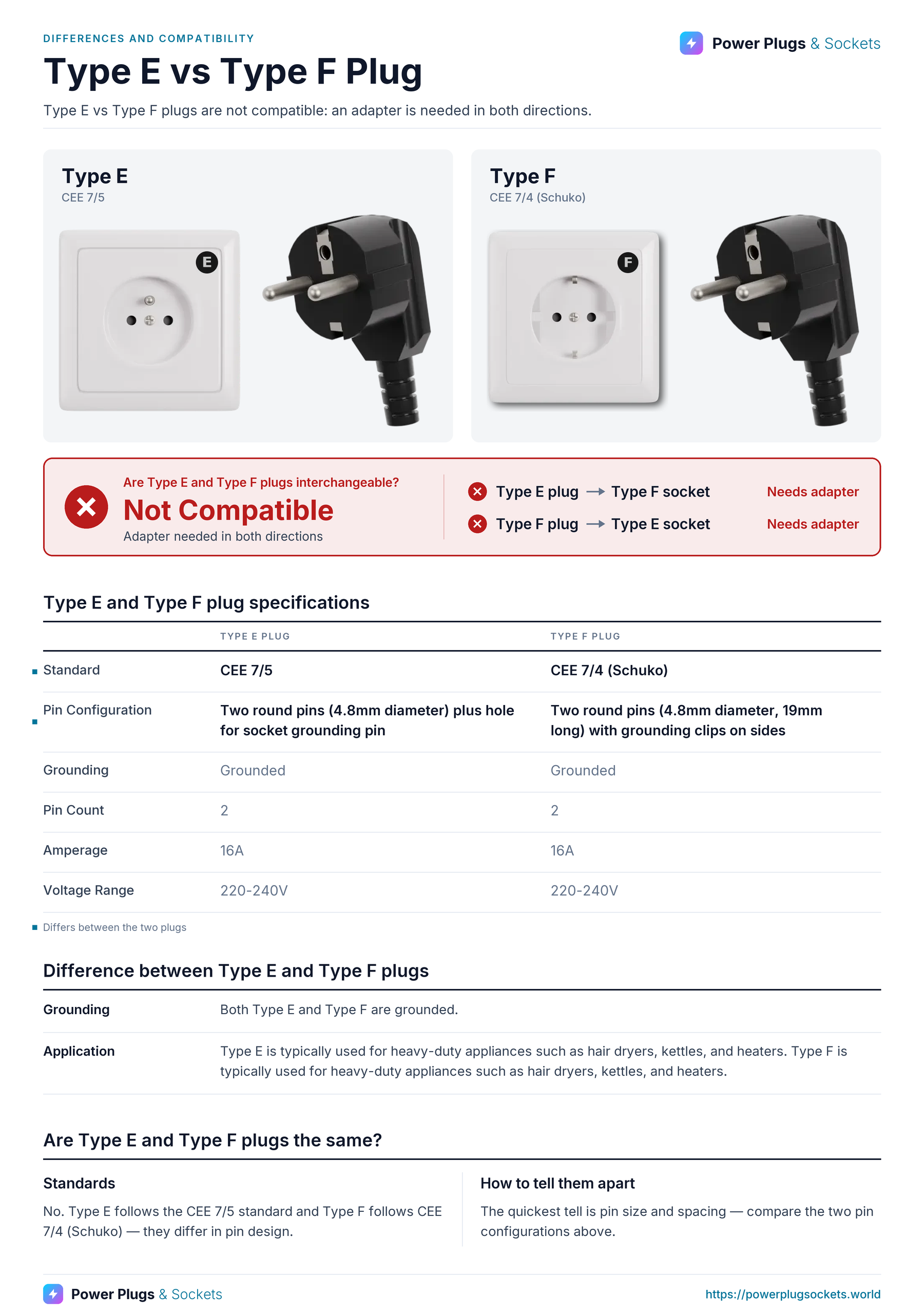
Type E vs Type F plugs are not compatible: an adapter is needed in both directions. Type E is a 2-pin, grounded plug rated 16A at 220-240V, while Type F is a 2-pin, grounded plug rated 16A at 220-240V. The two differ mainly in pin design, which is what decides compatibility — whether a Type E plug fits a Type F socket, and vice versa. Compare this with should you choose type F or type L for an international travel adapter.
Swipe to compare
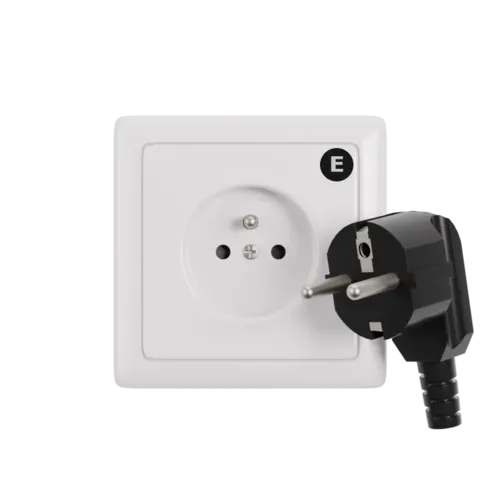
Type E
|
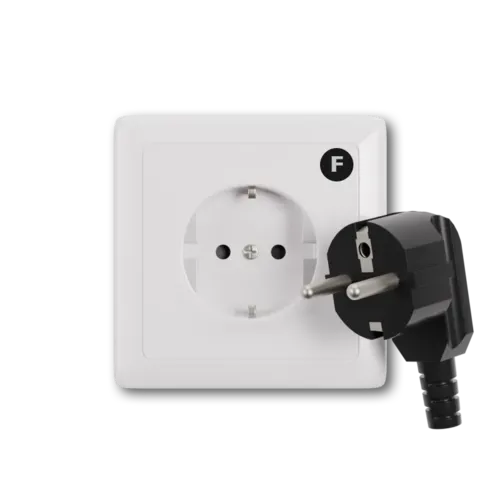
Type F
|
|
|---|---|---|
| Standard | CEE 7/5 | CEE 7/4 (Schuko) |
| Pin Configuration | Two round pins (4.8mm diameter) plus hole for socket grounding pin | Two round pins (4.8mm diameter, 19mm long) with grounding clips on sides |
| Grounding | Grounded | Grounded |
| Pin Count | 2 | 2 |
| Amperage | 16A | 16A |
| Voltage Range | 220-240V | 220-240V |
If you have ever stood in a Paris hotel holding a German hair dryer, you know the type E vs type F plug question is about one small piece of metal: where the earth connection lives. Both systems use the same pins and 230 V power sockets, but the French Type E puts its earth in the wall while the German Type F puts it on the plug's sides, and that choice decides which plug fits which socket.
Type E vs Type F Plug at a Glance
The two standards share pins, ratings and mains supply, and differ only in how the plug is earthed. Both are grounded systems rated at 16 A and 250 V, on mains networks at a voltage of 220 – 240 V and a frequency of 50 Hz.
| Feature | Type E (French / Belgian) | Type F (German) |
|---|---|---|
| Socket standard | CEE 7/5 | CEE 7/3 |
| Plug standard | CEE 7/6 | CEE 7/4 |
| Earth connection | Male earth pin fixed in the socket | Two spring clips at top and bottom of the recess |
| Power pins | Round, 19 mm long | Round, 19 mm long |
| Rating | 16 A, 250 V | 16 A, 250 V |
| Polarity | Fixed by the earth pin | Reversible |
| Universal plug that fits both | Type E/F hybrid | Type E/F hybrid |
Shared Dimensions: Round Pins on 19 mm Centres
Each plug carries two round pins 4.8 mm thick and 19 mm long, with a pin spacing of 19 mm centre to centre, so a power pin from one system lines up with the holes of the other. Both sockets are also recessed about 15 mm, so a partially inserted plug leaves no exposed metal, a real shock hazard defence and a big reason these sockets are considered safe for households with children.
How the Type E Socket Earths a Plug
The French and Belgian design is the CEE 7/5 socket paired with the CEE 7/6 plug, the standard in France and Belgium. A stubby round male earth pin, about 14 mm long, is fixed in the type E socket, offset 10 mm from the power holes.
This grounding pin touches the plug's earth before the energized contacts do. The matching plug needs a female contact and has no clips; this earth contact is why old round appliances still survive on lamps and tools.
Because the pin sits off-centre, any plug goes in one way up and is polarised, though installers do not always wire live to the same side.
How the Schuko Plug and Type F Socket Earth Through Clips
Type F is the German CEE 7/3 socket with the CEE 7/4 plug, better known as Schuko, short for Schutzkontakt ("protective contact"), standard in Germany and most of mainland Europe. The socket has no pin, only two metal earthing clips (earth clips) on the top and bottom edges of the circular recess that grip matching strips on the plug's sides, making the protective earth connection before the power pins reach their contacts.
Two plastic notches on the plug body line up with ridges in the socket. A pure CEE 7/4 plug has no grounding hole, so it cannot enter a French socket.
An Unpolarized Design by Default
With clips at top and bottom the plug goes in either way round, so the system is unpolarized and live and neutral swap when you flip it. Single-pole switches on cheap lamps may leave the bulb holder live when off.
Type E and Type F Compatibility: The CEE 7/7 Hybrid Plug
The CEE 7/7 plug, often called the E/F plug, has the German side earth strips and a hole for the French earth pin, so nearly every earthed device sold in Europe ships with it. Both connectors are defined on the CEE 7 standard sheets first published in 1951, so the old split between type E and type F rarely matters for a new appliance.
"With earth" means the earth connection is made.
| Plug | Type E outlet (CEE 7/5) | Type F outlet (CEE 7/3) |
|---|---|---|
| Round Type E plug | Fits, with earth | Does not fit |
| CEE 7/4 | Does not fit | Fits, with earth |
| Hybrid E/F | Fits, with earth | Fits, with earth |
| CEE 7/17 (contour) | Fits, no earth | Fits, no earth |
| Europlug (Type C) | Fits, no earth | Fits, no earth |
Where the Europlug and Type C Fit In
The two-pin Europlug, or type C, on most phone and laptop chargers has 4 mm pins rated 2.5 A at 250 V on the same 19 mm centres, so it fits either socket with no earth, for double-insulated devices only. The CEE 7/17 contour plug is round with cutouts, rated 10 A or 16 A, also unearthed.
Older appliances with the original round CEE 7/6 plug should get a CEE 7/7 rather than forcing it. Replace an old round CEE 7/6 plug with a CEE 7/7 rather than forcing it.
Countries That Use Each Type E/F Standard
Because the CEE 7/7 plug fits both sockets, retailers group the two under one label, but the wall socket still differs by country:
- Type E sockets: France, Belgium, Poland, Slovakia, the Czech Republic, Tunisia and Morocco.
- Type F sockets: Germany, the Netherlands, Austria, Spain, Portugal, Sweden, Norway, Finland and Russia.
- Both allowed: Denmark, alongside its own Type K.
If you are comparing 16 A systems, note that the two sockets are never the weak point. Schuko is also common across Eastern Europe, Central Asia, South Korea and Uruguay.
The clip system was patented in the late 1920s, associated with Siemens, so manufacturers owed royalties, while the free Type E design by the Belgian maker Vynckier was chosen by Czechoslovakia and Poland.
Universal Sockets That Accept Both Without Earthing
Some "universal" power sockets in Thailand, China and hotels take French and Schuko plugs but have no pin or clips, so the earth is never connected. Treat them as unearthed, for chargers and double-insulated devices only, since a loose fit can leave live pins exposed while the plug is half out.
Choosing a Travel Adapter for Schuko and French Sockets
From North America, the UK or Australia, one adapter with a CEE 7/7 style output covers both sockets, as both deliver the same mains voltage. Plain round two-pin adapters also fit both but are unearthed, suitable only for chargers.
A German Schuko plug already works across most of the region; just add a hybrid if you are moving to a Type E country.
Plug Adapter vs Voltage Converter
A plug adapter changes only the shape; the electricity behind both sockets is 230 V at 50 Hz. Most chargers read "100–240 V", meaning dual voltage, so they need only the adapter.
A 120 V-only device, such as some American hair straighteners, needs a voltage converter or it will overheat at twice its intended supply.
Load Limits for 16 Amps Grounded French and German Sockets
Both sockets share the limit of 16 amps at 250 V, so the weak point is the adapter, often marked 10 A. Divide wattage by 230 V: a 1,850 W travel iron draws about 8.0 A, while a 2,600 W kettle draws about 11.3 A and can overheat a lightweight adapter. Anything above 16 A uses IEC 60309 industrial connectors.