Type F vs Type L Plugs: Differences & Compatibility
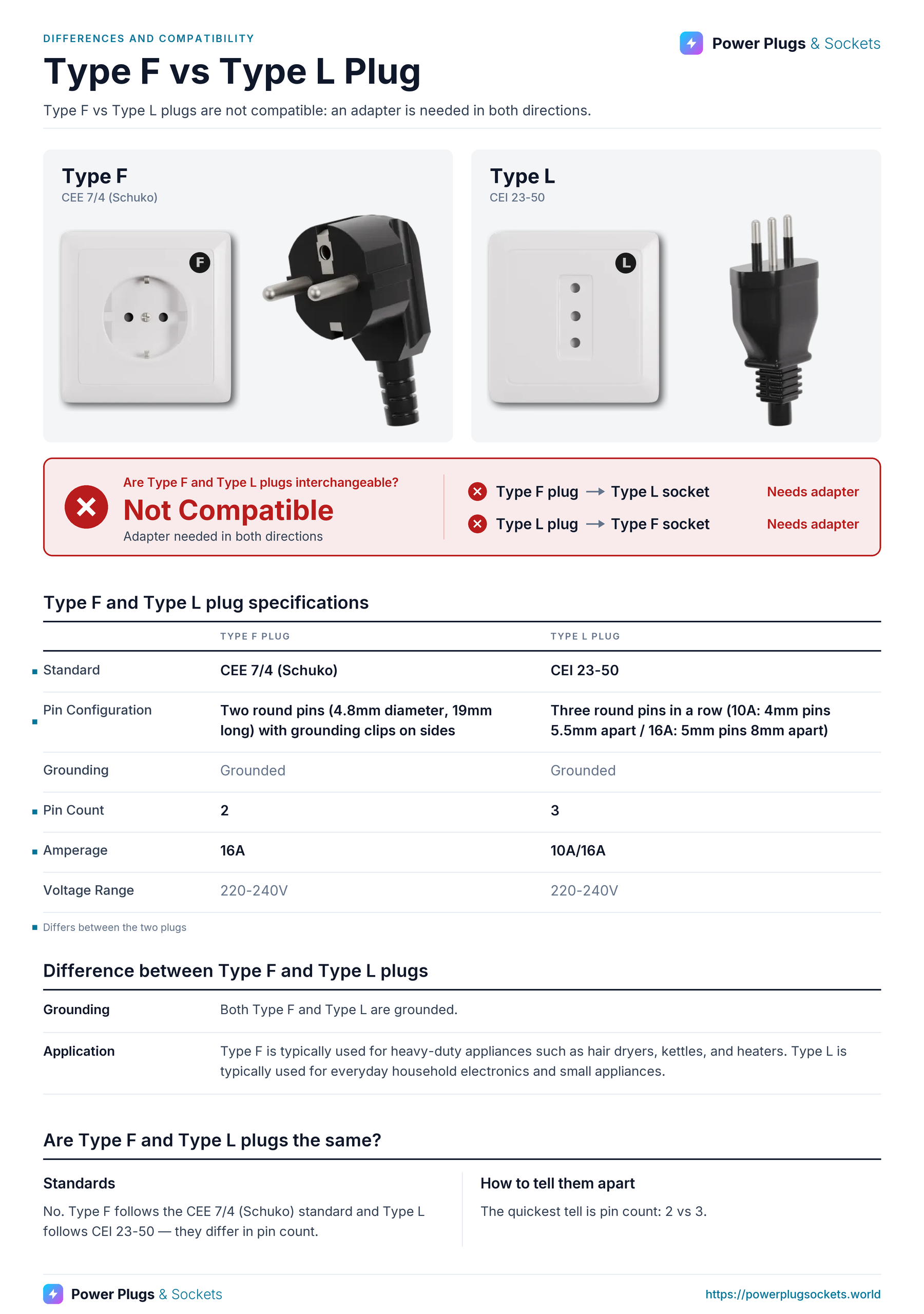
Type F vs Type L plugs are not compatible: an adapter is needed in both directions. Type F is a 2-pin, grounded plug rated 16A at 220-240V, while Type L is a 3-pin, grounded plug rated 10A/16A at 220-240V. The two differ mainly in amperage and pin design, which is what decides compatibility — whether a Type F plug fits a Type L socket, and vice versa. Compare this with type A versus type C plug shape and socket design compared.
Swipe to compare
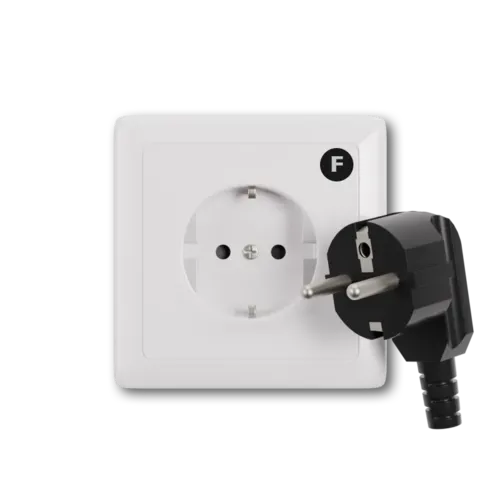
Type F
|
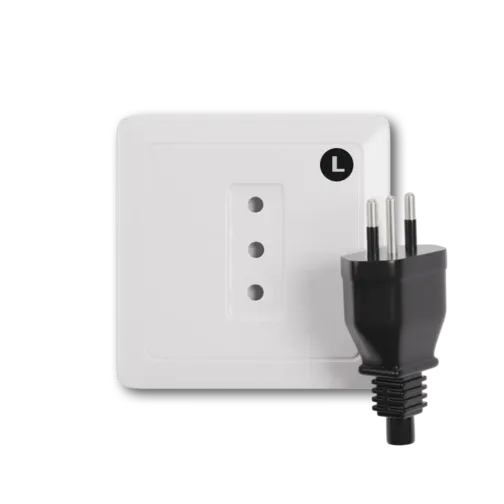
Type L
|
|
|---|---|---|
| Standard | CEE 7/4 (Schuko) | CEI 23-50 |
| Pin Configuration | Two round pins (4.8mm diameter, 19mm long) with grounding clips on sides | Three round pins in a row (10A: 4mm pins 5.5mm apart / 16A: 5mm pins 8mm apart) |
| Grounding | Grounded | Grounded |
| Pin Count | 2 | 3 |
| Amperage | 16A | 10A/16A |
| Voltage Range | 220-240V | 220-240V |
Travellers between Germany and Italy find that a type F plug (the Schuko) and type L plugs differ by more than looks. Travelling there, the type F vs type L plug question is about more than looks: one is the round, clip-earthed Schuko, the other a slim Italian design, and neither fits the other's socket.
Each domestic electrical outlet differs, yet both run on the same 230 V mains, so a simple plug adapter usually solves it without a converter.
Type F vs Type L Plug: The Differences Side by Side
The German plug carries two round pins and earths through metal clips on the sides of a recessed socket; the Italian plug uses three prongs set in a row with the earth in the middle, in two sizes. Also see type E vs type F plug.
| Outlet style | German | Italian |
|---|---|---|
| Defining standard | CEE 7, the European standard | Italian national standard |
| Pins | Two round pins, plus side clips | Three in-line pins, earth in the centre |
| Pin size | 4.8 mm thick | 4 mm (small size) or 5 mm (large size) |
| Pin centre spacing | 19 mm | 19 mm (small) or 26 mm (large) |
| Current rating | 16 A | 10 A or 16 A |
| Earthing | Side clips in the socket | Centre pin |
| Polarity | Unpolarized, reversible | Symmetrical, reversible |
| Voltage | 220 – 240 V | 220 – 240 V |
| Accepts the Europlug | Yes | Yes (small and twin-gauge sockets) |
A German outlet is a round well with two holes; an Italian outlet is a flat plate with three holes in a line, sometimes figure-8 shaped to fit both sizes.
Reading the Outlet Style Chart
The letters for plug types such as Type C and Type E come from the US International Trade Administration, and the IEC records the national standards in IEC TR 60083. Pin diameter and spacing decide whether a plug enters at all; the earthing row decides whether it is protected.
The French Type E socket has a grounding knob instead of clips, so a German plug needs its hybrid version there. When a row differs, as the spacing does, you need an adapter rather than a gentle push.
Inside the Schuko CEE 7/4 Design
The name is short for Schutzkontakt, "protective contact". Siemens patented it in 1929 and it became part of CEE 7 in 1951, with the plug as CEE 7/4 and the socket as CEE 7/3.
Each country adds its own rules, such as child-resistant shutters in new outlets. The power pins measure 4.8 by 19 mm with 19 mm pin spacing, shared with the Europlug and the Italian 10 A plug, but the thicker pin diameter keeps the German plug out of an Italian socket.
The German socket has a circular recess with two earthing clips that touch strips on the plug before the power pins, giving a protective earth first. With no earth pin the plug is unpolarized, so live and neutral can swap.
The CEE 7/5 socket handles earthing the opposite way, with a pin in the socket. Safety rules vary by plug type and by country, and power sockets in hotels are the usual surprise.
Countries That Use the Schuko Socket
The German socket is found in Germany, Austria, the Netherlands, Spain, Portugal, Greece, the Nordic countries, Eastern Europe, Russia, South Korea, Indonesia and Turkey, and alongside Italian outlets in Uruguay.
The Italian CEI 23-50 Standard Explained
Italian plugs follow the national CEI 23-50 standard, with two sizes sharing an in-line layout. The small plug is rated at 10 A with 4 mm pins at the German spacing; the large plug is rated at 16 A, with 5 mm diameter pins and centres 26 mm apart.
Both are symmetrical and reversible, and a 16 A plug cannot enter a 10 A socket. The split goes back to the twentieth century, when many homes had separate lighting and power supplies.
Lamps and chargers use the small size, heaters and washing machines the large one: about 2,300 W against 3,680 W at 230 V.
Modern installations use the presa bipasso, a twin-gauge socket whose figure-8 holes take both sizes and the Europlug. The larger P40 version also accepts German round plugs, so appliances sold in Italy with a CEE 7/7 plug only fit this hybrid socket.
Chile also uses the Italian system, though older buildings there may have single-gauge outlets, so plan for an adapter or a P40 outlet in a hotel room.
Will a Schuko Plug Fit an Italian Socket?
Not unless the socket is the P40 hybrid. A Schuko plug's 4.8 mm pins are too thick for the 4 mm holes, and the earth would connect to nothing.
An Italian plug cannot enter a German socket because the centre earth pin hits the recess. Forcing a fit between these plug types is an electric shock and fire risk, so use an adapter.
The Europlug (Type C, EN 50075) is a flat two-pin plug rated 2.5 A that fits German, French, Italian 10 A and twin-gauge sockets. The CEE 7/7 is the German-French hybrid, fitting CEE 7/3 and CEE 7/5 sockets, and among Italian sockets only the P40.
The CEE 7/17 contour plug is an unearthed round plug, rated 10 A or 16 A, with the same rule.
Socket Compatible Plug Types by Outlet
- German CEE 7/3 socket: socket compatible with CEE 7/4, CEE 7/7, CEE 7/17 and Europlug (plugs C, E hybrid and F)
- Italian 10 A socket: the Italian 10 A plug and the Europlug (plug C)
- Italian 16 A socket: the 16 A plug only
- Italian P40 socket: every plug above
Choosing a Plug Adapter for German and Italian Outlets
A travel adapter converts plug shapes, not voltages, which is all you need because both systems run at 230 V and 50 Hz. Wall plug adapters come in 10 A and 16 A versions. For a related pairing, see does a type E plug fit into a type L socket.
A 10 A adapter suits a laptop or a 2,000 W hair dryer (about 8.7 A), but a 2,400 W kettle draws 10.4 A and would overload it; a 3,000 W heater needs a 16 A adapter. Multi-socket adapters share one rating, so add up the current of everything you plug in.
Voltage Converter or Adapter Plug?
Between these systems you need only an adapter plug, never a voltage converter, because neither voltage or frequency differs. Traveling with a heater or other appliance means checking the rating in ampere (A).
Devices from North America run on 120 V, and a 120 V hair dryer on Italian mains will burn out, so read the label. Most phone chargers and laptop AC adapters say 100–240 V, 50 or 60 Hz, so they work anywhere; single-voltage electronics need a converter between regions with different electricity supplies.
Earth sits in different places on the two plugs, so a German-Italian adapter must link the side strips to the centre hole, or the grounding protection for Class I appliances is lost. Check that the earth contacts are metal, not dummy plastic.
Class II double-insulated devices, marked with a square inside a square, need no earth, and heat at the pins means a loose contact or too high a current, so unplug that adapter.