Type F vs Type J Plugs: Differences & Compatibility
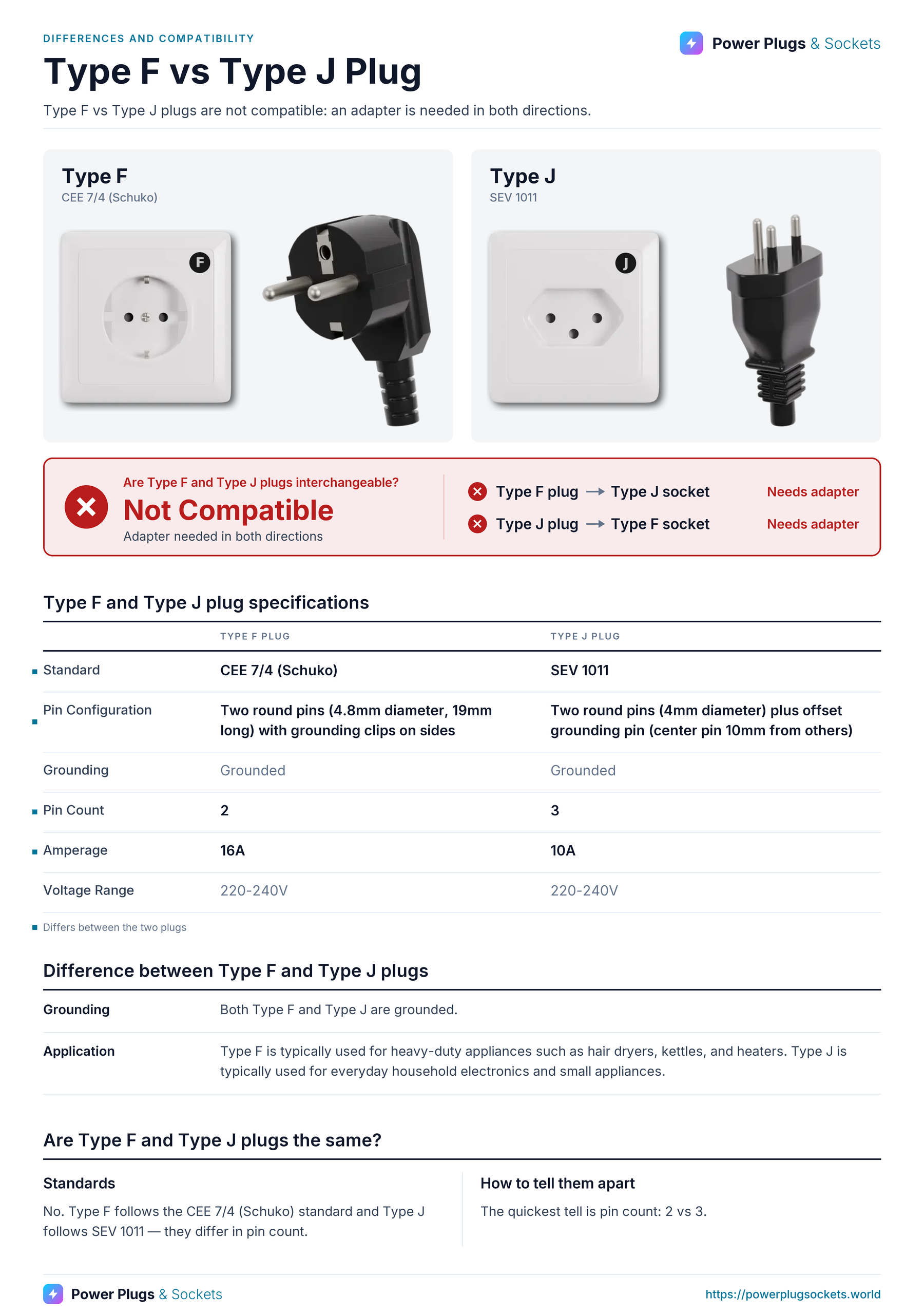
Type F vs Type J plugs are not compatible: an adapter is needed in both directions. Type F is a 2-pin, grounded plug rated 16A at 220-240V, while Type J is a 3-pin, grounded plug rated 10A at 220-240V. The two differ mainly in amperage and pin design, which is what decides compatibility — whether a Type F plug fits a Type J socket, and vice versa. Compare this with how the CEE 7/16 (Europlug) standard for type C compares to SEV 1011 for type J.
Swipe to compare
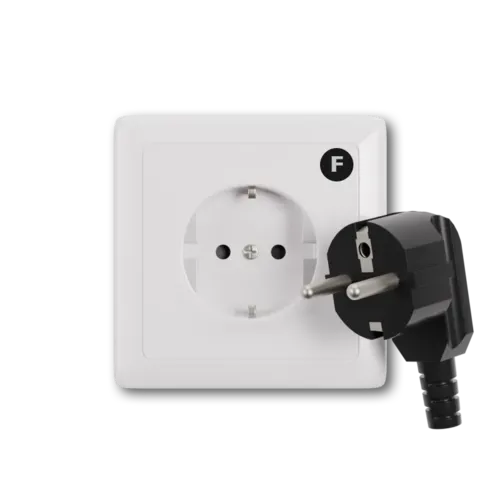
Type F
|
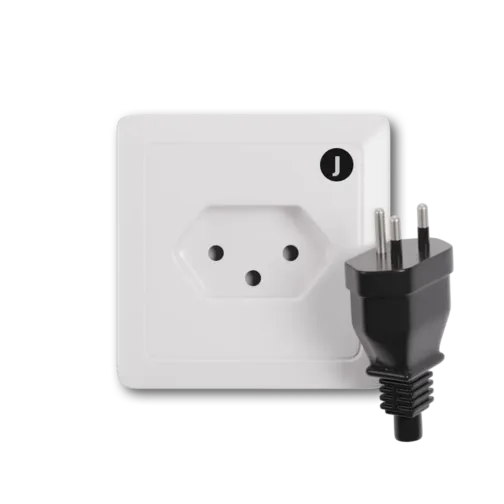
Type J
|
|
|---|---|---|
| Standard | CEE 7/4 (Schuko) | SEV 1011 |
| Pin Configuration | Two round pins (4.8mm diameter, 19mm long) with grounding clips on sides | Two round pins (4mm diameter) plus offset grounding pin (center pin 10mm from others) |
| Grounding | Grounded | Grounded |
| Pin Count | 2 | 3 |
| Amperage | 16A | 10A |
| Voltage Range | 220-240V | 220-240V |
Taking a German hair dryer to Zermatt, or a Swiss laptop charger to Berlin? The type F vs type J plug question comes down to one fact: neither grounded plug fits the other's socket, even though both run on the same electricity.
A small plug adapter or travel adaptor fixes it, and this guide shows which power plugs and power sockets you will meet abroad, and when an appliance needs more.
Type F vs Type J Plug: Round Pins and Grounding Pin Compared
The Schuko plug earths through metal clips in the socket rim. The Swiss plug has three pins placed closely together, the third being a grounding pin set 5 mm below the other two prongs. Next, check how the DS 60884-2-D1 standard for type K compares to TIS 166-2549 for type O.
Both systems run at 230 V and 50 Hz, so the difference is purely physical.
| Feature | Type F (Schuko) | Type J (Swiss) |
|---|---|---|
| Pins | Two round pins, 4.8 mm, 19 mm apart | Three round pins, 4 mm |
| Earthing | Socket clips meet a slot on each side of the plug | Third pin offset 5 mm below centre |
| Rated current | 16 A | 10 A |
| Outlet style | Deep round recess | Shallow hexagonal recess |
How the Schuko Clips Differ from a Grounding Knob
A French type E outlet earths through a grounding knob, a male pin in the socket, so the plug needs a pinhole. Most type F plugs sold today are the hybrid CEE 7/7, with clips and a pinhole, so they fit type E too.
Neither outlet style takes the offset third prongs of a Swiss plug.
Which Countries Use Each Plug Type
Schuko is the continent's most widespread design. Germany, Austria, the Netherlands, the Nordic countries, Spain, Portugal, Greece and Russia all use type F outlets, as do South Korea and Indonesia. Also see what is the difference between type D and type L electrical sockets.
The Swiss system covers just three places: Switzerland, Liechtenstein and Rwanda, where Europlug sockets also turn up. Check each destination country before you pack, as a border can change the plug types on the wall.
Outlet Types and Outlet Styles Across Europe
The world's outlet types run from A to O. Most European countries share the round-pin family, but France and Belgium use type E, Italy uses type L and Denmark uses type K, so a receptacle that looks familiar in one country can reject your plug in the next. A hybrid German plug still works in France, but neither it nor the Swiss plug fits Italian or Danish walls, so a route through those needs more than one adapter.
Schuko Plug Compatibility with Swiss Sockets
A Schuko plug will not go into a Swiss outlet: its 4.8 mm pins are too thick for the 4 mm holes, and its round body is wider than the hexagonal recess. The reverse fails too, because the Swiss earth pin strikes the Schuko face first.
No grounded plug is compatible both ways, so three-pin electrical devices and appliances need an adapter in either direction.
Watch for look-alikes: plug N from Brazil resembles the Swiss design, but type N sets its earth pin closer to the line, so it will not fit. Danish type K, with a semi-circle earth pin, differs again.
Europlug: The Two-Wire Plug That Fits Both
The ungrounded Europlug (type C) is the exception. This flat two-wire plug slides into both, so phone chargers and small electronics with plug C need no adapter at all.
Choosing a Travel Adapter or Adapter Plug for Switzerland
For grounded gear, buy a dedicated type F to type J adapter, since many universal travel adapters skip the Swiss earth pin. Good type F adapters are lightweight and compact, rated at 250 volts and 10 amps, and some carry a lifetime warranty.
With several grounded chargers, pack two plug adapters.
Do You Need a Voltage Converter or Transformer?
No. Both systems share the same supply voltage and frequency, so a 220-240V appliance needs only an adapter. Voltage converters and transformers matter for 120 V devices from North America: check the maximum power rating in watts, because an undersized transformer can overheat and start a fire.
An adapter changes the shape, not the voltage, so read the safety label on each electrical appliance when traveling.
Power Strips and Power Cords on a Swiss Receptacle
One adapter can feed a Schuko strip, which keeps your other plugs connected. Keep the total load on power strips under 10 amps, about 2,300 watts at 230 V, since that is the Swiss socket's limit.
Detachable power cords with a type J plug end suit a desktop PC that is staying put.