Type K vs Type O Plugs: Differences & Compatibility
Type K vs Type O plugs are not compatible: an adapter is needed in both directions. Type K is a 3-pin, grounded plug rated 16A at 220-240V, while Type O is a 3-pin, grounded plug rated 16A at 220-240V. The two differ mainly in pin design, which is what decides compatibility — whether a Type K plug fits a Type O socket, and vice versa. Compare this with how the NEMA 1-15 standard for type A compares to BS 546 (15A) for type M.
Swipe to compare
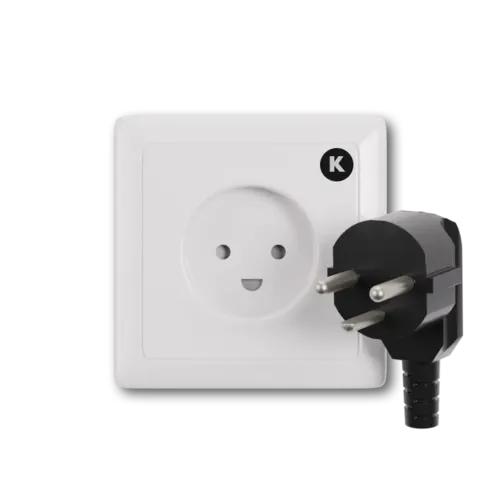
Type K
|
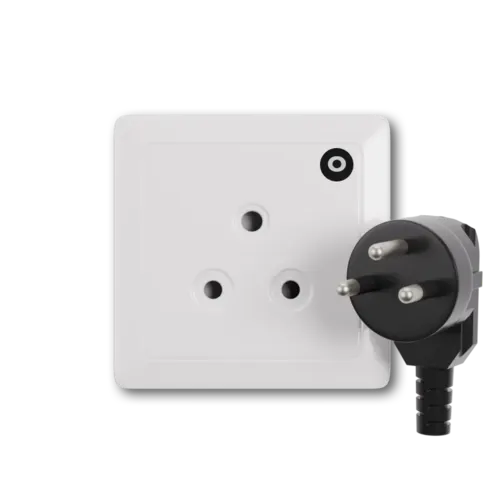
Type O
|
|
|---|---|---|
| Standard | DS 60884-2-D1 | TIS 166-2549 |
| Pin Configuration | Two round pins (4.8mm diameter) plus grounding pin (similar to Type F with additional ground pin) | Three round pins in triangular pattern (4.8mm diameter power pins, 4mm grounding pin) |
| Grounding | Grounded | Grounded |
| Pin Count | 3 | 3 |
| Amperage | 16A | 16A |
| Voltage Range | 220-240V | 220-240V |
If you are packing for a trip between Copenhagen and Bangkok, the Type K vs Type O plug question comes down to where each design puts its earth pin. The Danish plug, Type K, and the Thai plug, Type O, share the same round power pins and mains supply, yet neither plug fits the other country's earthed socket.
Type K vs Type O Plug: Key Differences at a Glance
Both plug types belong to the 15-letter system that the US International Trade Administration (ITA) started and the IEC now uses on its World Plugs pages. Each plug type letter says nothing about electrical standards.
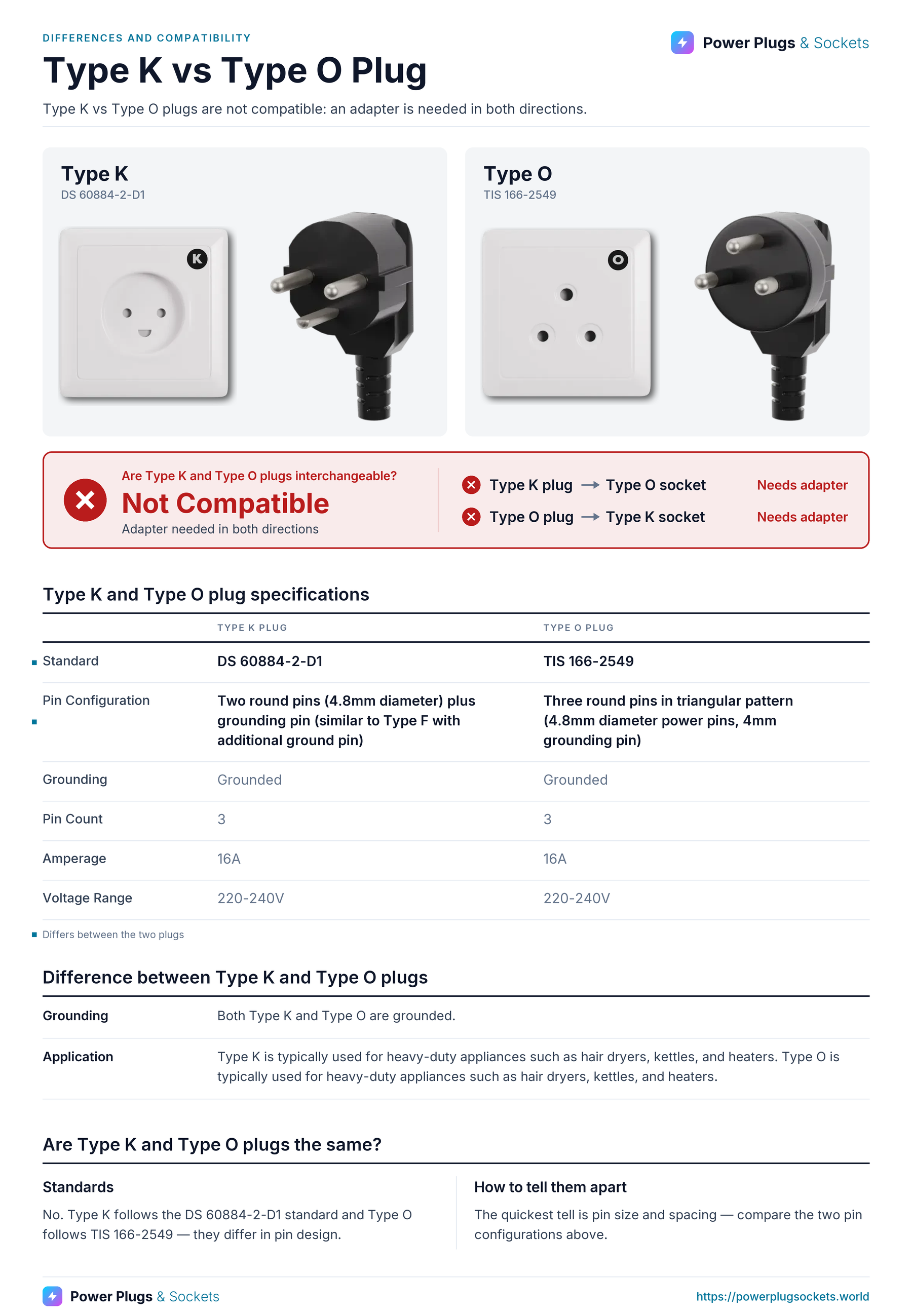
Type K is Danish and type O is Thai; both are earthed 3-pin designs for domestic and household use on 220 – 240 V supplies.
| Feature | Type K (Denmark) | Type O (Thailand) |
|---|---|---|
| Governing standard | DS 60884-2-D1 (standard sheet 107-2-D1) | TIS 166-2549 (update of TIS 166-2547) |
| Pins | 3 pins, earthed | 3 pins, earthed (2 pins on the unearthed version) |
| Earth pin shape | D-shaped, half-round, on the plug | Round, same diameter as the power pins |
| Rated current | 16 A | 16 A (both versions) |
| Rated voltage | 250 V | 250 V |
| Electrical supply voltage | 220 – 240 V (230 V nominal) | 220 – 240 V (230 V nominal) |
| Frequency | 50 Hz | 50 Hz |
| Polarized socket | Yes | Yes |
| Socket compatible with | Types C and K (E and F: partial, unsafe) | Types C and O (E and F: partial, unsafe) |
The rating is identical and each socket accepts the Europlug, but the earth pins block any direct swap: the difference is mechanical, not electrical.
Type K Plug: How the Danish Standard Is Built
The type K plug follows the Danish standard DS 60884-2-D1 and older guides call it the Danish 3-pin plug. Type K plugs use round pins as power pins: 4.8 mm across, 19 mm long and 19 mm apart. For a related pairing, see should you choose type F or type J for an international travel adapter.
A type K electrical plug is a French plug turned inside out: the French design puts the earth pin in the socket, the Danish one on the plug.
D-Shaped Earth Pin on the Plug, Earth Hole in the Socket
The earth pin is D-shaped, 13 mm below the power pins and 14 mm long, sometimes called a spade grounding pin. The socket has a matching half-round earth hole, so Europlugs still fit.
Polarized, Recessed Sockets with Child-Resistant Shutters
Danish sockets are polarized: with the earth hole at the bottom, live is on the left. The standard provides child-resistant shutters, and a socket without a switch must be recessed to keep fingers from live pins.
A computer socket (DK 2-5a) serves surge protected office circuits, and a variant serves hospital equipment.
Countries and Territories Using Danish Sockets
Danish sockets are standard in Denmark, the Faroe Islands and Greenland, where a type K electrical outlet sits in hotels and offices. Reference lists also mention a type K electrical receptacle in Bangladesh, the Maldives, Senegal, Guinea, Madagascar and Tunisia, but a type K receptacle is rare there, and Danish receptacles are seldom found outside Denmark.
Thai Plug Design Under TIS 166-2549
The Thai plug is set by the Thai Industrial Standards Institute: TIS 166-2547 (2004) introduced it and TIS 166-2549 (2006) is the current revision. Only Thailand uses Type O plugs as its national plug.
Earthing Pin Length and Insulated Pins
The Thai earthing pin is round, 4.8 mm across and 21.4 mm long, longer than the 19 mm power pins so it connects first. The live and neutral pins are insulated pins, with a sleeve on the first 10 mm.
The grounded three-pin version is the usual Type O. The ungrounded two-pin version looks like a taller Europlug for double insulated electrical appliances, yet it is rated 16 A against the Europlug's 2.5 A.
Thai Socket Types: Hybrid Socket, Dual Socket and NEMA 5-15
TIS 166-2549 defines a plain three-round-pin socket and a hybrid socket that also accepts American NEMA 1-15 and NEMA 5-15 plugs, which are Types A and B. Hotels often fit a dual socket faceplate. The trap is voltage: a US plug slides in but gets 230 V instead of 120 V. Thailand plans to phase out the hybrid socket.
Type K Socket Compatibility with Europlug, Schuko and CEE 7 Plugs
A type K socket and a Thai socket share 19 mm pin spacing. A Danish outlet is socket compatible with Type C and K plugs, and a Thai outlet with Type C and O plugs.
Swiss and Italian 10 A plugs fit neither. The CEE 7/16 Europlug and the round CEE 7/17 contour plug are unearthed and moulded on a flexible cord, so they are outlet compatible with both sockets and safe, with no earth to lose.
German Schuko (CEE 7/4), French CEE 7/6 and hybrid CEE 7/7 plugs from Germany and France slide into Type K and Type O sockets, but they make no earth connection, whether through side clips or the CEE 7/5 socket pin. That is partial and unsafe compatibility: a metal case is not grounded, and a fault can cause electric shocks or fire, and a single shock can be serious.
Type K Electrical Plug in a Thai Outlet, and the Reverse
A Danish plug will not go into a Thai outlet, nor the reverse, because the third pin has no matching hole. Fit a proper type K adapter or the local plug, and never force the pins.
Spade Grounding Pin Versus Thailand's Round Earth Prong
The Danish grounding pin is flat and half-round; the Thai pin is round, 11.89 mm below the power pins. Cheap universal sockets may take both but rarely meet plug retention requirements.
Type K Electric Plug Voltage and Frequency in Denmark and Thailand
Both countries, in Europe and Asia, supply electricity at 230 V and 50 Hz, so a type K electric plug appliance and a Type O appliance expect identical mains power; a 2,000 W kettle draws about 8.7 A in either.
When You Need a Converter or Transformer
An adapter passes the supply through. You need a voltage converter or transformer only for a 120 V-only device; "100–240 V, 50/60 Hz" means none is needed.
One Travel Adapter for Both Plug Types
From Denmark to Thailand you need a travel adapter, and a type K travel adapter sold for Denmark will not help in Bangkok. Travelers can carry a Europlug cable that fits both sockets. You might also want how the pin configuration of a type C plug differs from a type L plug.
A good plug adapter, an earthed Danish-to-Thai adapter, carries the earth through; a two-pin adapter drops it, so use it only for Class II devices. Avoid universal multi-socket adaptors, which can expose live pins.
Grounding and Safety Rules Behind the Thai Industrial Standard and DS 60884-2-D1
Both standards treat earthing as the main safety feature, and electrical safety depends as much on a building's age as on the standard.
Not Grounded Outlets in Older Buildings
Denmark has required grounded sockets in new installations since the early 1990s and, since 1 July 2008, an earth-fault breaker (RCD or GFCI). In Thailand, older two-hole and hybrid wall outlets are common, so use only Class II devices where there is no earth hole.