Type F vs Type K Plugs: Differences & Compatibility
Type F vs Type K plugs are not compatible: an adapter is needed in both directions. Type F is a 2-pin, grounded plug rated 16A at 220-240V, while Type K is a 3-pin, grounded plug rated 16A at 220-240V. The two differ mainly in pin design, which is what decides compatibility — whether a Type F plug fits a Type K socket, and vice versa. Also see type D plugs run on 220-240V while type J plugs run on 220-240V.
Swipe to compare
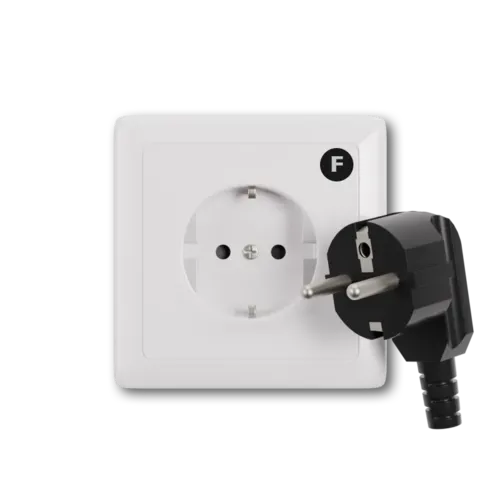
Type F
|
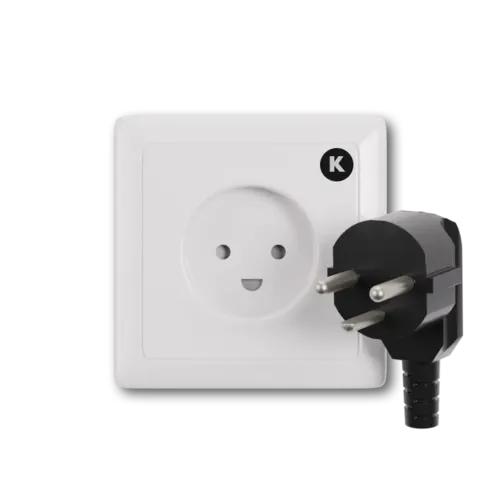
Type K
|
|
|---|---|---|
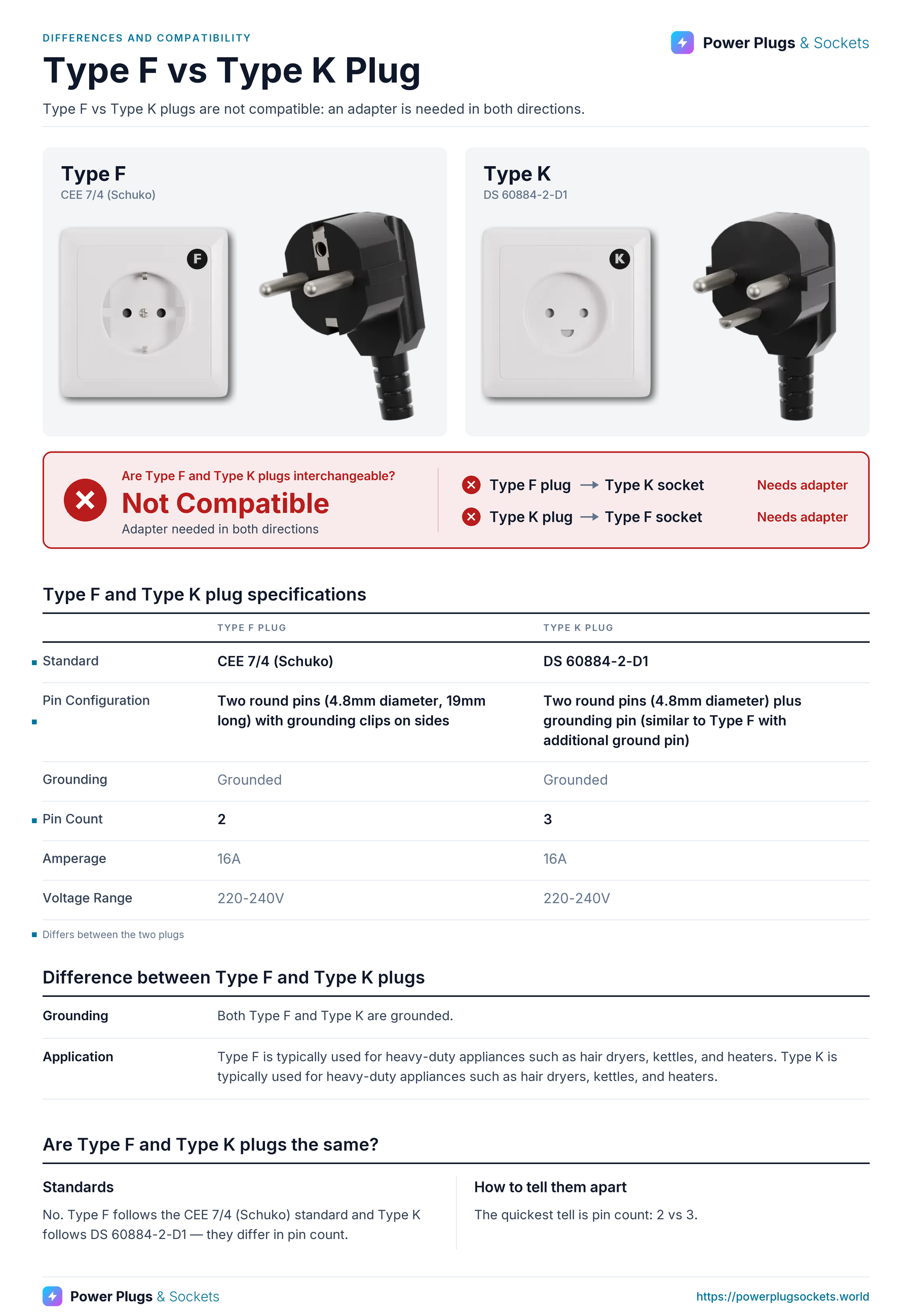
| Standard | CEE 7/4 (Schuko) | DS 60884-2-D1 |
| Pin Configuration | Two round pins (4.8mm diameter, 19mm long) with grounding clips on sides | Two round pins (4.8mm diameter) plus grounding pin (similar to Type F with additional ground pin) |
| Grounding | Grounded | Grounded |
| Pin Count | 2 | 3 |
| Amperage | 16A | 16A |
| Voltage Range | 220-240V | 220-240V |
Packing for Copenhagen with a German hair dryer, or moving to Denmark with appliances bought in Berlin? The type F vs type K plug question looks simple, because a Schuko plug slides straight into a Danish wall socket, but the earth (ground) connection does not come with it.
Here is how these plugs and sockets differ, which power sockets accept which plug, and how to keep your electricity supply earthed. A type K outlet is found almost nowhere outside the Danish realm.
Type F vs Type K Plug: How the Two Standards Differ
In the IEC letter system (IEC TR 60083 and the IEC World Plugs pages) these plug types are separate; type F outlets and type K sockets are matched to their own plugs. The type F plug is the German Schuko connector used across continental Europe; the type K plug is the Danish standard.
Both run on the same mains electricity, 230 V at a frequency of 50 Hz, with a voltage rating of 250 V, so the difference is purely mechanical: where the earth lives.
| Feature | Type F (Schuko) | Type K (Danish) |
|---|---|---|
| Plug standard | CEE 7/4 plug | DS 60884-2-D1 |
| Socket standard | CEE 7/3 socket | DS 60884-2-D1 socket outlet |
| Power pins | 2 round pins, 4.8 mm, 19 mm long | 2 round pins, 4.8 mm, 19 mm long |
| Earth design | Two clips in the socket, contact strips on the plug | D-shaped earth pin on the plug, hole in the socket |
| Current rating | 16 A | 16 A |
| Polarized | No | Yes |
| Main regions | Germany and most of Europe | Denmark, Greenland, Faroe Islands |
A Schuko connection has no earth pin at all: the socket has two spring clips and the plug two metal side strips. The Danish earth pin is on the plug and the socket has only a hole, whereas the French Type E socket carries the pin.
For a Class I appliance, that decides whether grounding works.
The power pins are identical, 4.8 mm across and 19 mm long, spaced 19 mm apart, and both are rated at 16 A, roughly 3,680 W at 230 V. That shared geometry is why the plugs cross over so easily.
Inside the Schuko Plug and CEE 7/3 Socket
The Schuko plug takes its name from Schutzkontakt, "protective contact" or safety contact, patented by Siemens-Schuckertwerke in 1929. Its formal names are the CEE 7/4 plug and CEE 7/3 socket.
The socket is a circular recess, and the plug fits either way up, so it is unpolarized. Type F plugs are standard in Germany, Austria, the Netherlands, Sweden, Norway, Finland, Spain, Portugal, Russia and most of Eastern Europe, so live and neutral can swap.
Two earthing clips (grounding clips) meet the plug's side strips before the power pins go live, so the earth contact is made first and broken last. A Schuko socket always has the clips; a Danish socket never does.
A plain CEE 7/4 plug cannot enter a French Type E socket, so the CEE 7/7 hybrid adds a rear hole for the French pin. It fits Danish sockets as well but arrives there unearthed.
Inside the Danish Plug and DS 60884-2-D1 Socket
The Danish plug, in DS 60884-2-D1 (older documents cite 107-2-D1), is used in Denmark, Greenland and the Faroe Islands. Its outlet looks like a smiling face, and older rented flats often have unearthed two-hole versions. Next, check how does the amperage rating of a type K plug compare to a type M plug.
The Danish standard plug keeps the 4.8 mm, 19 mm power pins and adds a D-shaped (sometimes U-shaped) earth pin 14 mm long, offset by 13 mm. Child-resistant shutters are provided for, and the system is polarized: with the earth at the bottom, live is on the left, so live and neutral always land in the same place.
By 1 July 2008 every socket had to be protected by earth-fault interrupters.
The Earthing Pin Lives on the Plug, Not the Receptacle
The earthing pin is part of the plug, so a Danish socket can connect earth only to a plug bringing its own male pin. Side strips or a rear hole give it nothing to grab.
Schuko and Danish Socket Compatibility Chart
Compatibility is lopsided: most European plugs enter a Danish socket, but little goes the other way. Use this chart to check a plug.
| Plug | Into a Schuko (F) socket | Into a Danish (K) socket |
|---|---|---|
| Europlug (C, CEE 7/16) | Fits, compatible | Fits, compatible |
| Schuko (F, CEE 7/4) | Fits, earthed | Fits, no earth connection |
| Hybrid (E/F, CEE 7/7) | Fits, earthed | Fits, no earth connection |
| French (E, CEE 7/6) | Does not fit | Fits, no earth connection |
| Danish earthed (K) | Does not fit | Fits, earthed |
Which Plugs Fit a Type K Socket
A type K socket accepts the Europlug, the CEE 7/17 contour plug, the Schuko, French and hybrid plugs, but only the Danish earthed plug and the two-pin unearthed plugs work as intended.
Which Plugs Fit a Type F Socket
A type F socket takes the Schuko plug, the CEE 7/7 hybrid, the Europlug and the contour plug. An earthed Danish plug will not go in, so bring an adapter rather than force it.
Europlug and Type C: Compatible Almost Everywhere
The flat two-pin Europlug (Type C, CEE 7/16, 2.5 A) is compatible with both outlets without a safety trade-off. It is reserved for Class II equipment with double insulation, such as chargers and shavers.
Why Schuko Appliances in Denmark Lose Their Grounding Connection
An appliance with a Schuko plug enters a Danish wall outlet easily, but it gets no grounding connection, and the user usually has no idea.
The Missing Male Grounding Pin
A Danish socket needs a male grounding pin on the plug. Schuko and French plugs have none, so the protective conductor is never connected, even through an adapter without its own male ground pin.
Buzzing Appliances and Electric Shock Risk
Metal-cased appliances leak a small current to their casing, and earth normally carries it away. People in Denmark report a buzzing sensation from a dishwasher, a toaster or a laptop, and an insulation fault can cause electric shocks, even a life-threatening electric shock.
An earth-fault interrupter is a backup, not a substitute.
Until the early 1990s, earthed appliances sold in Denmark had to carry a Danish plug; the European Union ruled that an obstacle to free movement of goods, so appliances arrived with Schuko plugs and ran without earth ground. The Danish Safety Technology Authority now explicitly allows Schuko and French sockets in homes.
Choosing a Travel Adapter for Schuko and Danish Outlets
Between Germany and Denmark you do not need a big universal travel adapter: plugs already fit and voltage is identical, so earthing is the concern. Check the wall outlet when you arrive, since hotel outlets in Denmark are increasingly Schuko. You might also want do you need a type J to type N plug adapter.
When a Plug Adapter Is the Safe Choice
Class II chargers go straight into either socket. For an earthed Schuko kettle or heater in Denmark, buy a Schuko-to-Danish plug adapter with its own male earth pin, or have an electrician fit Schuko sockets.
Cheap multisocket adaptors that skip the earth path defeat the purpose.
Do You Need a Voltage Converter?
No. Germany, Denmark and Greenland all run at 230 V, 50 Hz, so a voltage converter is needed only for 120 V North American equipment not rated 100-240 V.