Type K vs Type M Plugs: Differences & Compatibility
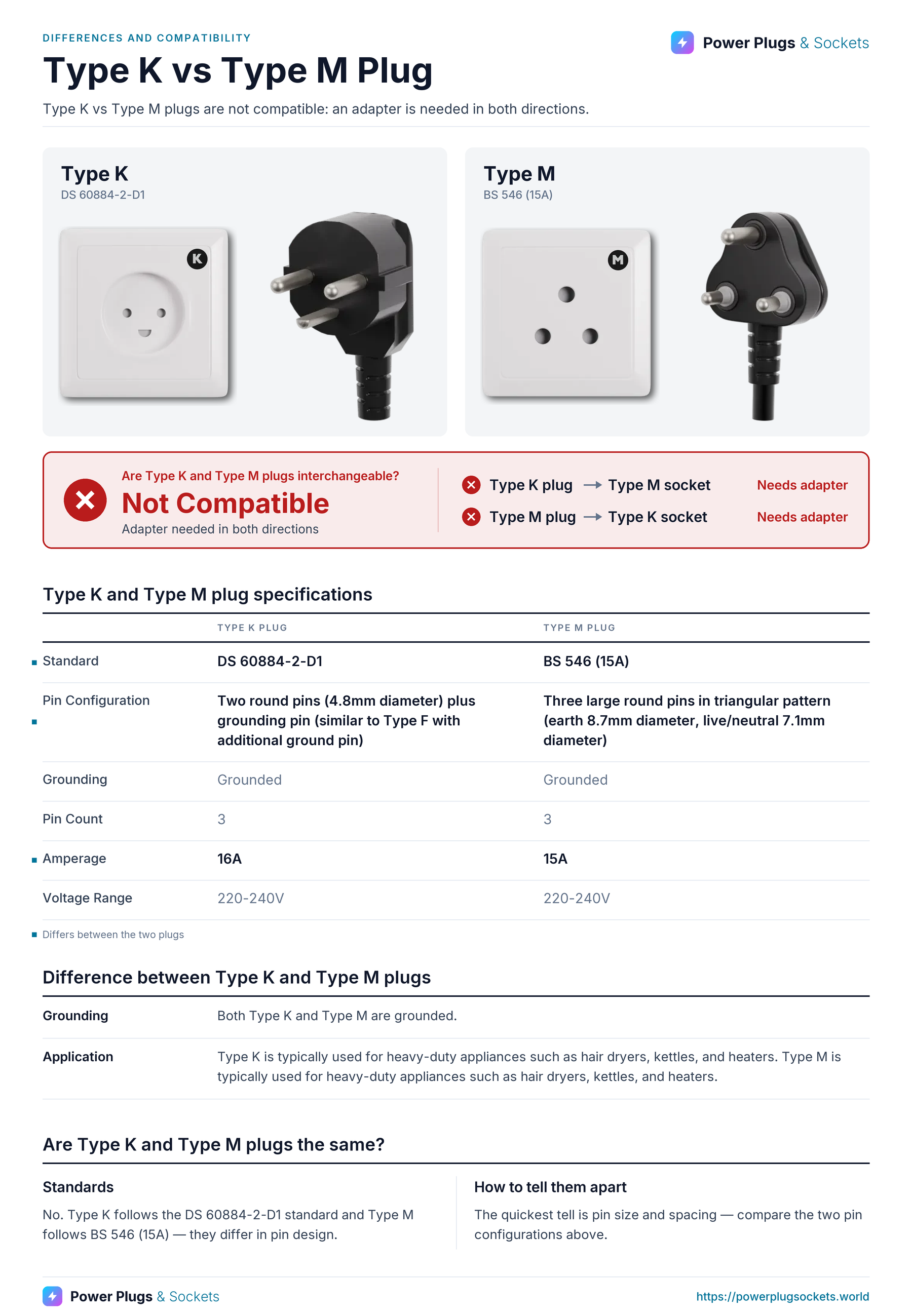
Type K vs Type M plugs are not compatible: an adapter is needed in both directions. Type K is a 3-pin, grounded plug rated 16A at 220-240V, while Type M is a 3-pin, grounded plug rated 15A at 220-240V. The two differ mainly in amperage and pin design, which is what decides compatibility — whether a Type K plug fits a Type M socket, and vice versa. Compare this with type J vs type N plug.
Swipe to compare
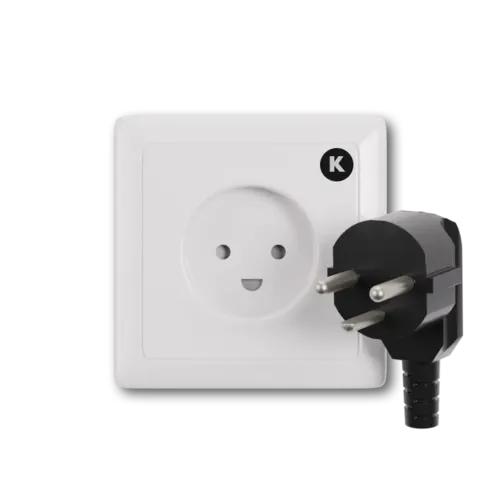
Type K
|
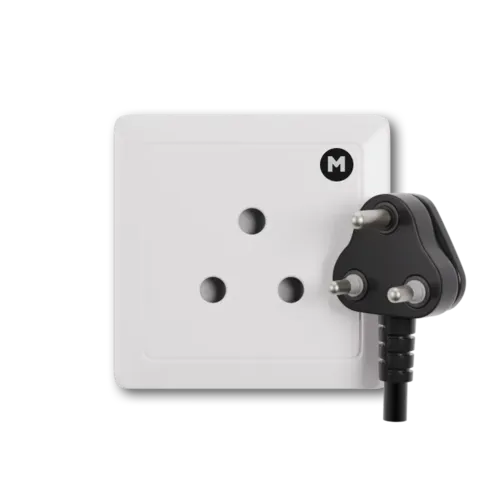
Type M
|
|
|---|---|---|
| Standard | DS 60884-2-D1 | BS 546 (15A) |
| Pin Configuration | Two round pins (4.8mm diameter) plus grounding pin (similar to Type F with additional ground pin) | Three large round pins in triangular pattern (earth 8.7mm diameter, live/neutral 7.1mm diameter) |
| Grounding | Grounded | Grounded |
| Pin Count | 3 | 3 |
| Amperage | 16A | 15A |
| Voltage Range | 220-240V | 220-240V |
Packing between Copenhagen and Cape Town, the type K vs type M plug question has a short answer: these domestic power plugs share nothing but the mains supply behind them. The Danish plug has slim pins and a half-moon earth, the South African one three thick cylindrical prongs, so you need a plug adapter, but never a voltage converter, because both power sockets deliver the same electricity at the same frequency.
Type K vs Type M Plug at a Glance
Both are grounded, three-pin systems rated for 250 V, and both are polarized. The table compares the two families of plugs and sockets using published standard values. Also see comparing type H and type L plugs for international travel.
| Feature | Type K (Danish) | Type M (South African) |
|---|---|---|
| Defining standard | 107-2-D1 / DS 60884-2-D1 | BS 546 (15 A), SANS 164-1 and IS 1293 (16 A) |
| Rated current | 16 A | 15 A / 16 A |
| Rated voltage | 250 V | 250 V |
| Pin layout | 2 round power pins + D-shaped earth | 3 round pins in a triangle |
| Earthed | Yes, earth pin on the plug | Yes, earth pin on the plug |
| Polarized | Yes | Yes |
| Fused plug | No | Optional |
| Insulated pins | Not required | Optional |
| Recessed socket | Required when the socket has no switch | No |
| Socket accepts the Europlug | Yes | No |
| Main countries | Denmark and its territories | South Africa and its neighbours |
Reading the Comparison Table
The shared rows describe how the plug protects you; the differing rows describe size and what else fits. The letters come from the International Electrotechnical Commission World Plugs list, but the national standard fixes the pin sizes and current.
Denmark, Greenland and the Faroe Islands
The K socket is of Danish origin and used in Denmark and its autonomous territories, Greenland and the Faroe Islands, also spelled Faeroe Islands. Directories file it under Type K plugs & outlets, and type K plugs and sockets follow strict electrical rules.
A typical spec line for power outlet type K reads: 3 pins grounded, 16 A, 220 – 240 V, socket compatible with plug types C and K, with partial and unsafe compatibility for type E and type F plugs.
South Africa, Lesotho and Swaziland
The big round-pin socket is the classic fitting in South Africa, Lesotho and Swaziland, now called Eswatini. It is also used in Namibia, Botswana and Mozambique, and about 15 countries use it.
In India and Israel it serves larger appliances such as air conditioners and geysers. Directories file it under Type M plugs & outlets.
A typical spec line for power outlet type M reads 3 pins grounded, 15 A or 16 A, outlet compatible with type M plugs only, with no partial fit for any European plug.
Danish Plug Design and Its D-Shaped Earth Pin
The K plug looks like a Europlug with a third pin below. Unlike French and Schuko systems, the earthing pin is part of the plug, and it is D-shaped, which stops you inserting it upside down.
Section 107-2-D1 fixes the two power pins at 4.8 mm in diameter and 19 mm long, while the earth pin is 14 mm long and offset 13 mm below them. Because the grounding pin is on the plug, an unearthed plug still fits, but an earthed plug with grounding clips or earth clips finds nothing to connect to.
Live and neutral pins are spaced 19 mm apart. The Danish rules provide child-resistant shutters, and a socket without a switch must be recessed.
Computer and Hospital Variants of Danish Plugs
Standard DK 2-5a is a plug for surge protected computer sockets, which a normal plug deliberately cannot enter. A variant with a rectangular left pin serves hospital life support devices.
BS 546 and the Large Plug of South Africa
The South African plug is the 15-amp size of a 1934 British standard defining round-pin plugs in 2 A, 5 A, 15 A and 30 A sizes. Former territories kept it and wrote their own versions, such as SANS 164-1, rated at 16 A. The plug M is much larger than any European plug, with three cylindrical pins: three round pins in all, or three prongs, made of two power pins and a longer, thicker earth pin that connects first.
Both systems are polarized: in a Danish socket the live pin is on the left with earth at the bottom, while in a round-pin socket the earth hole is at the top. It is the plug for heavy appliances such as kettles and stoves, at 15 amps in Britain and 16 A in South Africa and India.
Larger Pins Than the Type D Plug
The type D plug has the same layout at a 5-amp or 6-amp size. The large plug has larger pins (7.1 mm instead of 5.1 mm) and wider spacing (25.4 mm instead of 19.1 mm), so a type D charger cannot enter it.
16 A vs 15 A Pin Dimensions Side by Side
The Danish pins are 4.8 mm thick on 19 mm centres, against 7.1 mm on 25.4 mm centres, and the round-pin earth pin is 28.6 mm long against 14 mm, so a 7.1 mm pin cannot enter a 4.8 mm hole at all. At 230 V a Danish 16 A plug carries 3,680 W and a 15 A round-pin plug 3,450 W, so the electric current rating rarely decides; pin geometry does.
Compatibility of Danish Sockets with Other Plug Types
A Danish socket is generous and a round-pin socket strict, so compatibility questions about these plugs and sockets come from the Danish side. Europlugs (CEE 7/16) and contour plugs (CEE 7/17) fit a type K socket safely, like any type C plug. You might also want how does the amperage rating of a type F plug compare to a type K plug.
Earthed Schuko (CEE 7/4, type F), French (CEE 7/6, type E) and hybrid CEE 7/7 plugs have partial and unsafe compatibility: they go in, but no earth connection is made. News sites have warned of noticeable electric shocks, which can be dangerous and even life-threatening, a real danger on a faulty appliance.
For that reason Danish rules now allow type E and type F socket-outlets alongside the K socket.
Why a Type M Outlet Only Takes One Plug
Its 7.1 mm holes are too wide to grip a 4.8 mm European pin and the spacing is wrong for every two-pin plug, so the round-pin sockets stay single-purpose.
K and M Plugs Are Not Compatible Either Way
The plugs are not compatible in either direction. A K plug cannot reach the earth hole of a round-pin socket, and a round-pin plug is far too large for Danish sockets.
Never wedge one into the other.
Round Pins and the Travel Adapter You Need
For travellers, any trip between the two regions needs a travel adapter. Both countries supply 230 V at 50 Hz, so a Danish hairdryer needs no converter.
Heading to Johannesburg, buy a power plug adapter with three large prongs; most worldwide travel adapters, even universal ones, leave out the large round-pin plug.
SANS 164-2 Sockets in Newer South African Buildings
South Africa adopted SANS 164-2, its version of IEC 60906-1 (type N), in 1992 and made it the preferred standard in 2013. A type N socket takes a Europlug but not an earthed K plug, so the old round-pin sockets will stay common for years.
Safety and Earthing Rules in the Danish Standard
Both systems are earthed. Danish safety is built around earthing and residual current protection, while the round-pin system relies on the building's breakers; the round-pin plug is unfused unless optional and often has bare pins.
Earth-Fault Protection in Danish Homes
New Danish installations have used earthed sockets since the early 1990s, and by 1 July 2008 every socket had to be protected by earth-fault interrupters, so an ungrounded appliance still sits behind a device that cuts the power on leakage.