Type J vs Type L Plugs: Differences & Compatibility
Type J vs Type L plugs are not compatible: an adapter is needed in both directions. Type J is a 3-pin, grounded plug rated 10A at 220-240V, while Type L is a 3-pin, grounded plug rated 10A/16A at 220-240V. The two differ mainly in amperage and pin design, which is what decides compatibility — whether a Type J plug fits a Type L socket, and vice versa. Next, check how do i tell a type G plug apart from a type O plug.
Swipe to compare
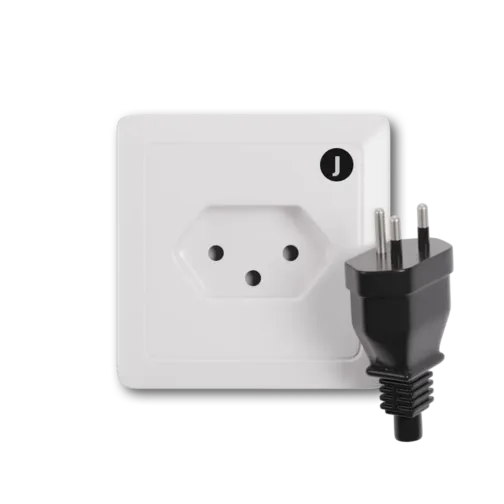
Type J
|
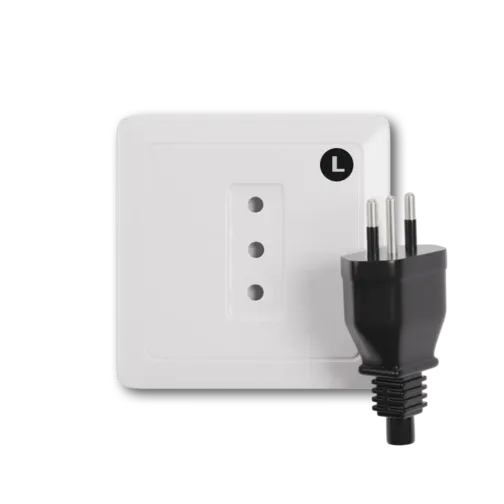
Type L
|
|
|---|---|---|
| Standard | SEV 1011 | CEI 23-50 |
| Pin Configuration | Two round pins (4mm diameter) plus offset grounding pin (center pin 10mm from others) | Three round pins in a row (10A: 4mm pins 5.5mm apart / 16A: 5mm pins 8mm apart) |
| Grounding | Grounded | Grounded |
| Pin Count | 3 | 3 |
| Amperage | 10A | 10A/16A |
| Voltage Range | 220-240V | 220-240V |
Swiss and Italian sockets sit a short train ride apart, yet a plug from one will not go into the other. This type J vs type L plug guide shows why: where each earth pin sits, how thick and how far apart the pins are, and which plugs and sockets on each side of the Alps accept your devices.
It also covers which power sockets suit your devices and how the local electricity compares with home for international travel across Europe.
Type J vs Type L Plug: The Key Differences
Both plugs are earthed, three-pin, round-pin designs, labelled by the IEC in IEC TR 60083. Swiss type J plugs put the earth pin off to one side of the power pins, while the Italian plug lines all three up on one centre line.
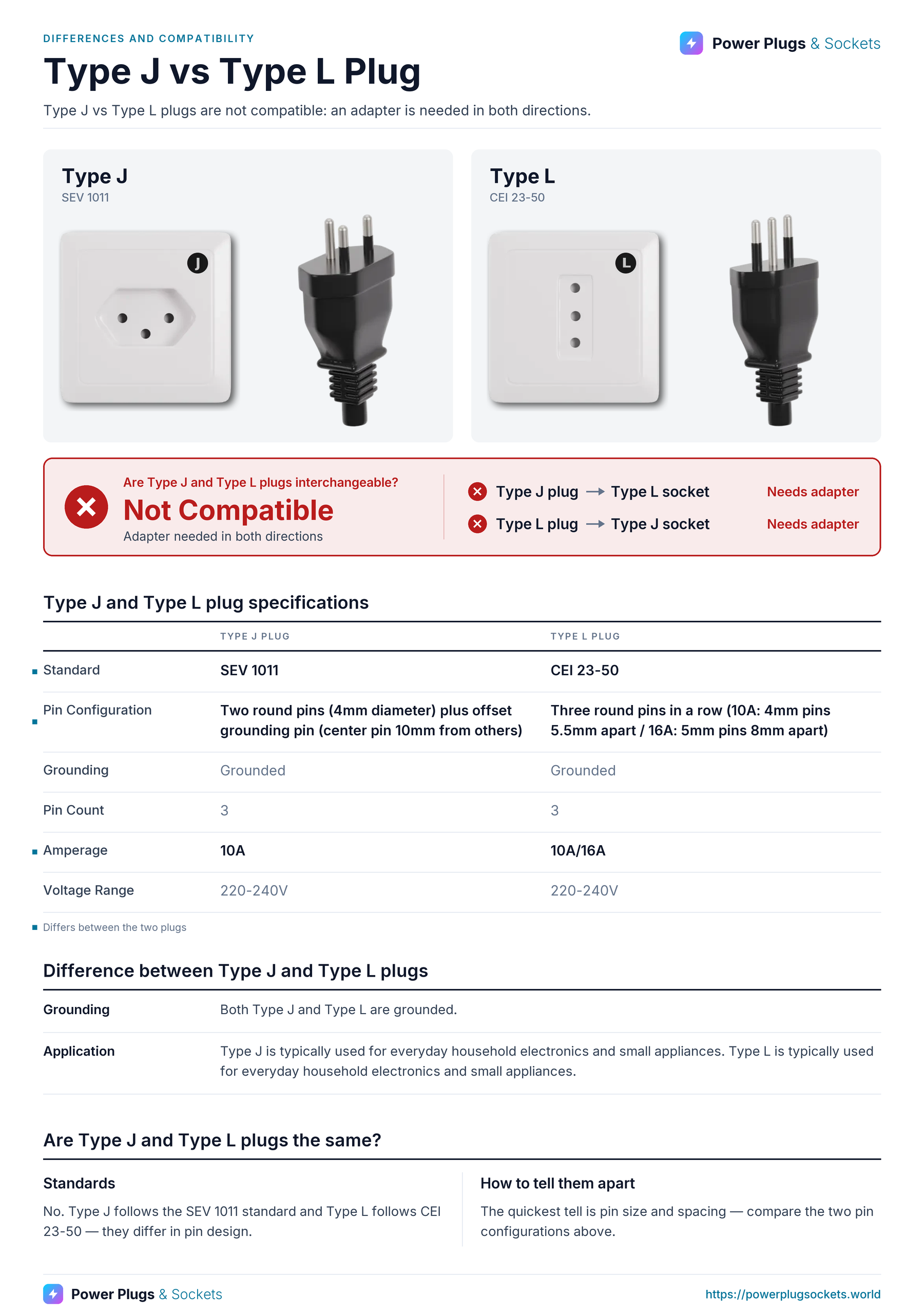
The Swiss system has a single 10 A size; the Italian system has two, 10 A and 16 A, that are not interchangeable.
| Feature | Swiss system (J) | Italian system (L) |
|---|---|---|
| Outlet style | Three round pins in a flat triangle, recessed hexagonal socket | Three prongs in a row, flat-faced socket |
| Standard | SN 441011 (formerly SEV 1011) | CEI 23-50 (formerly CEI 23-16) |
| Main countries | Switzerland and Liechtenstein, plus Rwanda | Italy and Chile, plus Uruguay |
| Pin diameter | 4 mm | 4 mm (10 A) or 5 mm (16 A) |
| Live-to-neutral spacing | 19 mm | 19 mm (10 A) or 26 mm (16 A) |
| Earth position | Centre pin offset by 5 mm | Centre pin on the same line |
| Rating | 10 A, 250 V | 10 A or 16 A, 250 V |
| Polarized | Yes | No |
| Socket accepts Europlug | Yes | 10 A socket yes, 16 A socket no |
Both systems are rated at 250 V, so the real differences are mechanical. On the J plug the earth pin is offset by 5 mm, so the plug goes in one way and is polarized.
The Italian grounding pin sits dead centre, so the plug is symmetrical and live and neutral swap. Earthing works the same way in both countries, carrying the protection IEC Class I appliances rely on, but where the earth meets the wall makes the sockets reject each other's plugs.
Three Round Pins in a Triangle vs Three Prongs in a Row
Face-on, the Swiss plug has a shallow triangle of pins. The Italian plug has pins in a line, the earth in the middle and the live and neutral contacts either side; line and neutral never swap places for the Swiss plug.
Their plug shapes keep each out of the other socket.
Pin Diameter and Spacing in Millimetres
Swiss round pins are 4 mm thick and 19 mm long, centres 19 mm apart. The 10 A Italian plug matches; the 16 A version has 5 mm pins 26 mm apart and will not enter a 10 A socket.
How the Swiss Standard SN 441011 Defines Each Plug
The Swiss standard, SN 441011, formerly SEV 1011, covers household plugs and socket-outlets; a socket accepts any plug with the same or fewer pins. Liechtenstein uses it too.
Equipment above 10 A uses an industrial connector.
The Type J Plug and Its Type 13 Socket
The IEC letter refers to the earthed type 12 plug and the recessed type 13 socket, the 10 amps, 250 V three-pin version only. A power outlet type J has three round holes in a hexagonal recess.
The type 11 plug is the unearthed two-pin version, and type 15 adds flat pins for a three-phase supply while accepting single-phase plugs. Modern plugs have insulated pins with 10 mm insulated sleeves; older unsleeved pins partially inserted are a shock hazard, which the recessed socket mostly fixes (an electric shock risk otherwise), though Swiss sockets lack child protective shutters.
Italian Plugs Under the CEI 23-50 Standard
Italian plugs are defined by CEI 23-50, which replaced CEI 23-16. The same plug type L plugs follow is used in Chile and Uruguay and parts of North Africa.
A power outlet type L in older homes takes one size only; a 1960s Magic Security alternative never displaced it.
10 A and 16 A Plug Sizes
The small S11 is rated at 10 A and takes lamps, chargers and small electronics; the large S17 is rated at 16 A with 5 mm pins 26 mm apart, for heaters, washing machines and ovens. Italian plugs go in either direction, since the plug is symmetrical and grounded.
The Twin-Gauge Hybrid Socket
Most Italian walls now have the CEI 23-50 P17/11 socket, the presa bipasso, with a round centre hole and two figure-8 holes taking 10 A pins in the upper loop and 16 A pins in the lower, plus a Europlug. The larger P40 adds a Schuko recess with earth clips for CEE 7/4, CEE 7/7 and CEE 7/17 plugs, making it a universal socket and a hybrid socket in one.
A CEE 7/4 plug needs an adapter at a P17/11.
Swiss Plug and Italian Socket Cross-Compatibility
A Swiss plug does not fit an Italian socket, nor an Italian plug a type J socket, because the earth contact is in the wrong place. Forcing a plug damages contacts and weakens plug retention.
Italy's two sizes date from separate lighting and appliance supplies, such as 127 V and 220 V, while the Swiss settled on one everyday 10 A size.
The Europlug Fits Both
The two-pin Europlug (CEE 7/16, the type C plug) is rated 2.5 A and fits Swiss 10 A and Italian 10 A outlets and the hybrid sockets. It suits IEC Class II, double-insulated devices such as a laptop charger, but not an Italian 16 A socket, so it is compatible only partly.
Using a Type L Plug in a Swiss Outlet, and the Reverse
A small Italian plug has 4 mm pins 19 mm apart like the Swiss power pins, but its centre earth pin meets solid plastic in a Swiss socket, while the Swiss off-line earth pin finds no hole in an Italian one. French type E and German type F plugs go into the larger Italian outlet but need an adapter in Zurich.
Type N and Type K: Lookalikes That Do Not Fit
The Brazilian type N (IEC 60906-1) looks like the Swiss design but its earth pin sits closer to the line, so it is incompatible. The Danish type K takes a Europlug but neither the Swiss nor the Italian earthed plug fits it.
The British type G shares nothing with either system.
Travel Adapter and Voltage Tips for Swiss and Bipasso Outlets
Most travelers need only an adapter plug, since voltage and frequency match; a plug adapter changes the shape only, and domestic appliances need no more. Travel gadgets with a Europlug output work in both countries, though not in an Italian 16 A socket. Next, check how do i tell a type A plug apart from a type G plug.
Do You Need a Voltage Converter?
Both countries supply 230 V mains at 50 Hz, and South American countries using the Italian plug supply 220 V. Most electronics read “100-240 V”, meaning dual voltage. A hair dryer reading only 110-120 V needs a voltage converter, since a 230 V outlet burns it out in seconds.
Picking a Worldwide Adapter That Covers Both Countries
The Swiss output needs an earth pin offset below the power pins; the Italian output needs it in line. Cheap units with a two-pin Europlug output fit both walls but drop the earth, and most skip the 16 A Italian size; USB ports are a bonus.
Never run a 16 A Italian heater through an adapter into a 10 A Swiss socket, and buy a reputable, earthed adapter for safety.