Type G vs Type O Plugs: Differences & Compatibility
Type G vs Type O plugs are not compatible: an adapter is needed in both directions. Type G is a 3-pin, grounded plug rated 13A at 220-240V, while Type O is a 3-pin, grounded plug rated 16A at 220-240V. The two differ mainly in amperage and pin design, which is what decides compatibility — whether a Type G plug fits a Type O socket, and vice versa. Also see does a type J plug fit into a type L socket.
Swipe to compare
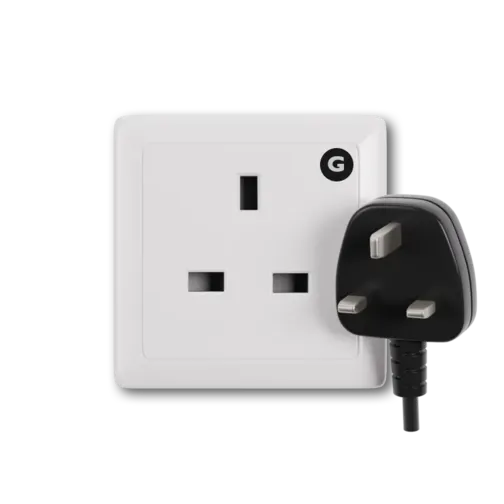
Type G
|
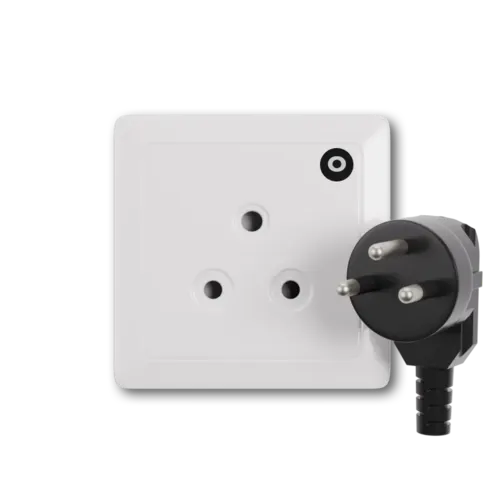
Type O
|
|
|---|---|---|
| Standard | BS 1363 | TIS 166-2549 |
| Pin Configuration | Three rectangular pins in triangular pattern (live/neutral 6.35x3.18mm, earth 3.18x7.92mm) | Three round pins in triangular pattern (4.8mm diameter power pins, 4mm grounding pin) |
| Grounding | Grounded | Grounded |
| Pin Count | 3 | 3 |
| Amperage | 13A | 16A |
| Voltage Range | 220-240V | 220-240V |
Packing for London to Bangkok? The type G vs type O plug question comes down to what you can see at once: the British plug has three rectangular pins and a fuse inside, while the Thai plug has three round pins and no fuse.
Both are grounded and run on 230 V mains electricity, so you need a plug adapter, not a voltage converter.
Type G vs Type O plug at a glance
The IEC World Plugs guide gives each household plug family a letter. Type G is the British BS 1363 system; Type O is the Thai system defined by TIS 166-2549 and used only in Thailand.
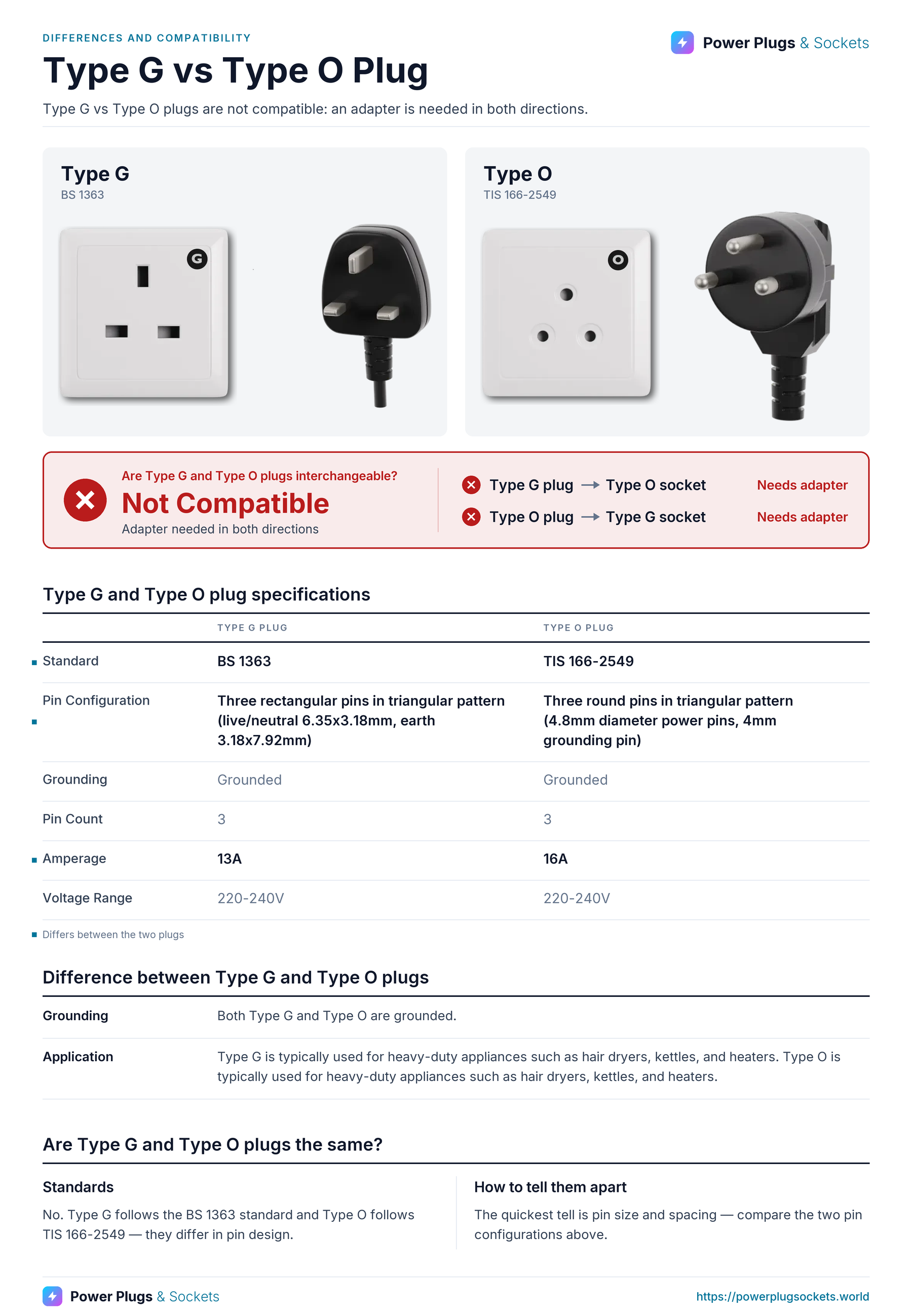
The table compares the plug and the power socket.
| Feature | Type G (BS 1363) | Type O (TIS 166-2549) |
|---|---|---|
| Country of origin | United Kingdom | Thailand |
| Pin shape | Three rectangular pins | Three round pins |
| Plug rating | 13 A, 250 V | 16 A, 250 V |
| Grounded | Yes, always | Yes (a two-pin unearthed version also exists) |
| Polarized | Yes | Yes |
| Fused plug | Yes, cartridge fuse inside | No |
| Insulated pins | Yes, live and neutral sleeved | Yes, power pins sleeved for 10 mm |
| Recessed socket | No | No |
| Socket accepts Europlug | No | Yes |
The British power socket-outlet is the only common one whose standard requires a fused plug. Its flat rectangular pins form a triangular pattern, 22.2 mm apart with a longer earth pin above, while Thai power pins are round and 19 mm apart.
That pin spacing alone means neither plug can enter the other's socket, whichever type G outlet or plug type G you have. Both are domestic three-pin systems.
Voltage and current rating of each system
Both systems suit 220 – 240 V supplies at 250 V maximum, and the UK and Thailand both supply 230 V at 50 Hz, so voltage and frequency match. A Type G plug is rated 13 A and a Type O plug 16 A, the difference between 2,990 W and 3,680 W of continuous load at 230 V.
How the British plug is built under BS 1363
The BS 1363 system is standard in the United Kingdom and over 50 countries, with national versions such as IS 401 in Ireland, MS 589 in Malaysia and SS 145 in Singapore. Type G plugs also appear in Malta, Cyprus, Hong Kong, Kenya and across the Arabian Peninsula. Next, check what is the difference between type D and type I electrical sockets.
Every plug holds a BS 1362 cartridge built-in fuse that gives each cord overcurrent protection, typically a 3A fuse (red) or 13A fuse (brown), while the Thai plug has no fuse and relies on the breaker. An instant water heater drawing 15.22 A exceeds 13 A, so it has no Type G fuse option.
Three rectangular pins and a longer earth pin
The earth pin is longest, so it connects first and breaks last, and the earth hole sits at the top of the socket-outlet, where the pin opens the shutters over the live and neutral contacts. A BS 1363 plug cannot work without it, even on double-insulated devices.
Shutters, insulated pins and child protection
British sockets have shutters that stay closed until the earth pin opens them, blocking foreign objects and giving built-in child protection, so a Europlug will not go in unless forced open with a pointy object, a dangerous trick. Since the mid-1980s new plugs carry insulated sleeves on the live pins and neutral pin, cutting the risk of electric shock.
How the Thai plug works under TIS 166-2549
The Thai Industrial Standard TIS 166-2547 and its update TIS 166-2549 (2006) replaced earlier rules based on NEMA 1-15 and NEMA 5-15 plugs, which let 120 V appliances meet a 230 V supply. The IEC lists the Thai plug as Type O, and the type O plug is used only in Thailand. Also see type A vs type G socket.
The standard defines a plain socket for Thai plugs and a multi-standard hybrid socket that also takes type A, type B and type C plugs; the plain socket is meant to replace the hybrid. Unlike a universal socket, which meets no official standard, the hybrid is defined, yet a fit does not mean safety, since a 120 V appliance still gets 230 V.
Round pins and a grounded earthing pin
The grounded Thai plug has two round power pins, 4.8 mm across and 19 mm long, plus a longer earthing pin that connects first. It resembles the Israeli SI32 plug but is not interchangeable.
The two-pin unearthed version for Class II appliances
Thailand also has a two-pin unearthed plug, an ungrounded plug that looks like a Europlug but is rated 16 A against 2.5 A. It suits Class II appliances with double insulation; every BS 1363 plug has three pins.
Plug types compatibility: which sockets accept which plugs
Plug types compatibility between these two systems is none, physically: a Type G plug will not enter a Type O electrical outlet or the reverse. A Type G socket accepts only Type G plugs, while a hybrid Type O outlet also takes type A, B and C plugs and gives partial and unsafe compatibility with type E and type F plugs.
Why the Europlug fits one and not the other
The Europlug (type C) has two round 4 mm pins, and Thai sockets are built for its 19 mm spacing. A British socket has no round holes and its shutters stay shut, so it will not go in.
Schuko and French plugs push into a hybrid Thai socket but their earth never connects, so use an earthed adapter.
Polarized wiring in both systems
Both systems are polarized, so live and neutral always sit on fixed sides and a switch breaks the live side. A cheap adapter that lets a plug go in either way loses this protection, so prefer a polarized, grounded adapter.
Travelling between UK electrical socket and Thai socket countries
Between a UK electrical socket country and Thailand the mains electricity is the same, 230 V and 50 Hz, so only the plug shape matters. A travel adaptor changes only the pin shape.
For travellers, a dual voltage label reading 100–240 V or 220 – 240 V needs only an adapter; any appliance marked 110–120 V only needs a voltage converter. From the UK choose a Type G to Type O adapter that keeps the grounding connection; from Thailand, the adapter must hold a fuse.
Where you will find each socket type
Type G is spread across former British territories including the UK, Ireland, Malta, Cyprus, Malaysia, Singapore, Hong Kong, Saudi Arabia, the United Arab Emirates and Kenya, mostly at 230 V and 50 Hz; Saudi Arabia runs at 60 Hz. Type O is used only in Thailand, alongside older Type A, B, C and F fittings.
Running 13 A and 16 A loads safely
A 3,500 W heater draws 15.22 A, fine on a 16 A Thai plug but over the 13 A ceiling of a British socket. A British kettle runs within a Thai socket's limit, but avoid stacking heavy appliances on one adapter, since its own rating sets the limit.