Type B Power Plug & Socket
Type B plugs have two flat parallel pins plus a grounding pin. This is the grounded version of Type A and is the standard in North America. Also check Australia electrical outlet type.
Standard: NEMA 5-15
Pin Configuration: Two flat parallel pins plus round grounding pin (4.8mm diameter)
Usage Notes: Type B is backward compatible with Type A outlets for ungrounded devices. The grounding pin provides additional safety for appliances.
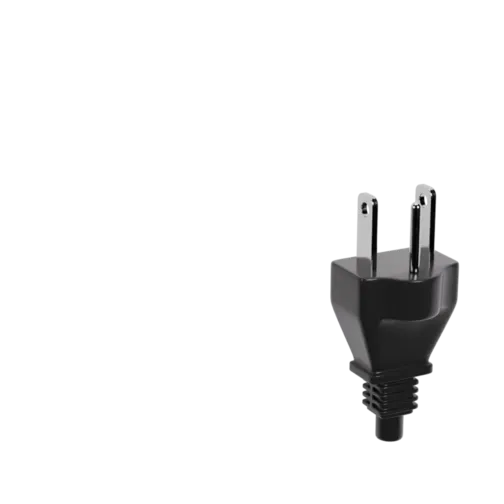
Plug
Type B
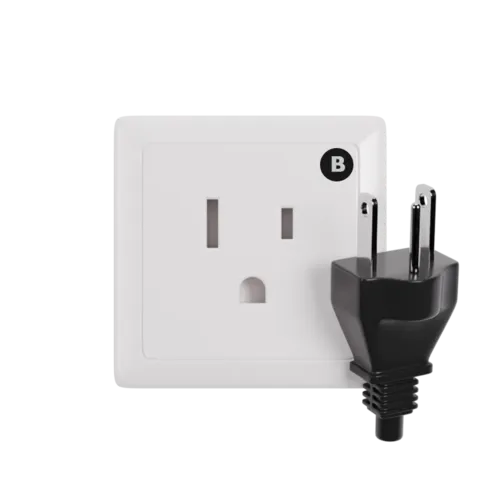
Plug & Socket
Type B
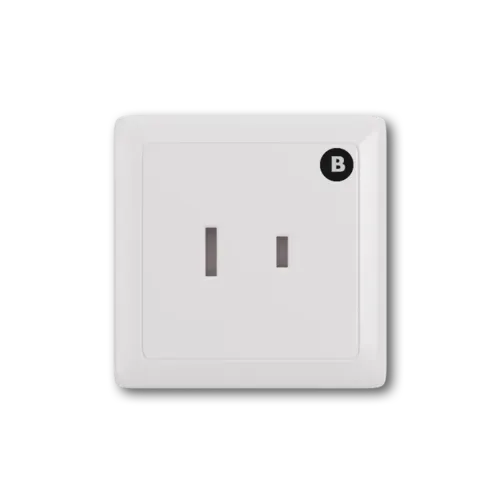
Socket
Type B
If a device came with a three-prong cord, you are almost certainly holding plug type B, the earthed plug used across the United States, Canada and much of the Americas. The type B electrical socket takes two flat parallel pins plus a round earth pin, and electricians know it by its NEMA code, 5-15.
What Plug Type B Looks Like: Flat Parallel Pins and an Earth Pin
The plug is defined by the National Electrical Manufacturers Association, so every North American plug and socket carries a NEMA code. A NEMA 5-15R is a configuration 5 receptacle rated for 15 amps, and IEC 60906-2 recommends the same socket for 120-volt, 60 Hz installations.
Known as parallel blade with ground, or an Edison or Hubbell plug, it is the standard way to take mains electricity from a wall socket in a North American home.
- Pins: 3 pins, two flat blades and one earth pin.
- Rating: 15 A, 125 V.
- Socket compatible with: the same three-prong plug and two-blade plugs.
- Typical supply: 100 to 127 V at 50 or 60 Hz.
The two live and neutral blades carry current, and the longer ground pin touches first, so the casing is grounded before the power arrives. That ground connection, also called grounding, and earthing send fault current to earth and trip the breaker instead of causing an electric shock.
Class I equipment needs it; devices with double insulation do not, which is why many phone chargers have only two blades.
The socket has a slightly wider neutral blade slot and a D-shaped ground hole, so an older polarized plug goes in only one way and polarity stays intact. Most homes use a duplex socket, two outlets on one plate, mounted with the ground-down orientation, though some hospitals mount it ground-pin up.
Since the late 2000s, new construction in the US usually requires tamper-resistant sockets, whose spring-loaded shutters open only when both blades push at once, protecting children.
NEMA 5-15 Ratings on a 120V, 60Hz Supply
The US supplies nominally 120 volts at 60 cycles per second, and the NEMA 5-15 plug is built for up to 125 volts. Other countries using the same socket run at 100, 110, 115 or 127 volts, and a few at 50 Hz. You may also need Singapore power socket.
The socket shape tells you nothing about the electricity behind it, so check the local supply at each power socket before you plug in anything that is not universal.
What 15 A at 125 Volts Means for Your Appliances
The plug is rated 15 A, designed for currents up to 15 A on a 15-amp branch circuit. Divide watts by volts to find current:
$$I = \frac{P}{V}$$
| Appliance | Power (W) | Current at 120 V (A) |
|---|---|---|
| Hair dryer | 1,250 | 10.42 |
| Microwave oven | 900 | 7.50 |
| Both together | 2,150 | 17.92 |
Together they draw 17.92 A, over the circuit's 15-amp limit, so the breaker trips. The US code expects 80 per cent of 1,800 W for long loads, 1,440 W, and large air conditioners and clothes dryers move to 240 V plugs.
A thin power cord or extension cord marked for lower current can overheat first. A NEMA 5-20 receptacle is the 20-amp version with a T-shaped neutral slot, found where a power strip feeds several tools.
Grounded Plug Compatibility With Type A and Other Plug Types
The two-blade plug type A is the grounded plug without the earth pin, so it is socket compatible with a Type B power socket, but not the reverse. Other plug types use different pins, so none fits without an adapter. Next, look at brunei plug.
The types travellers meet most often:
- Type A (NEMA 1-15): 2 pins, no earth, 15 A, 100 to 127 V.
- Type C Europlug: two round pins, no earth, 2.5 A, 220 to 240 V.
- Type F Schuko: two round pins with side earthing clips, 16 A; a Schuko plug cannot enter a NEMA socket.
- Type G British: 3 pins grounded, fused plug, 13 A at 230 V.
- Type I (Australia, China, Argentina): 3 pins grounded in the earthed version, 10 A; its socket compatible plugs are Type I only.
What Each Grounded Outlet and Socket Accepts
A grounded outlet takes both local plugs: it accepts anything with fewer pins in the same pattern, never more. An old two-slot wall plate cannot take a three-prong plug, and a "cheater" adapter loses the earth path, so for safety have an electrician fit grounded or GFCI-protected outlets instead.
Type B sockets also take two-blade plugs.
The Japanese JIS C 8303 Version
Japan's two-blade Class II JIS C 8303 plug looks identical to NEMA 1-15, but the supply is 100 V, at 50 Hz in eastern Japan around Tokyo and 60 Hz in western Japan around Osaka. NEMA 1-15 plugs are normally Class II, double insulated, and early versions were unpolarized with two equal blades.
Ungrounded outlets still turn up in older buildings. A so-called universal socket meets no official standard and may leave live pins exposed, while hybrid sockets in Thailand take American plugs on a 220V supply.
Countries That Use the 3-Prong Plug
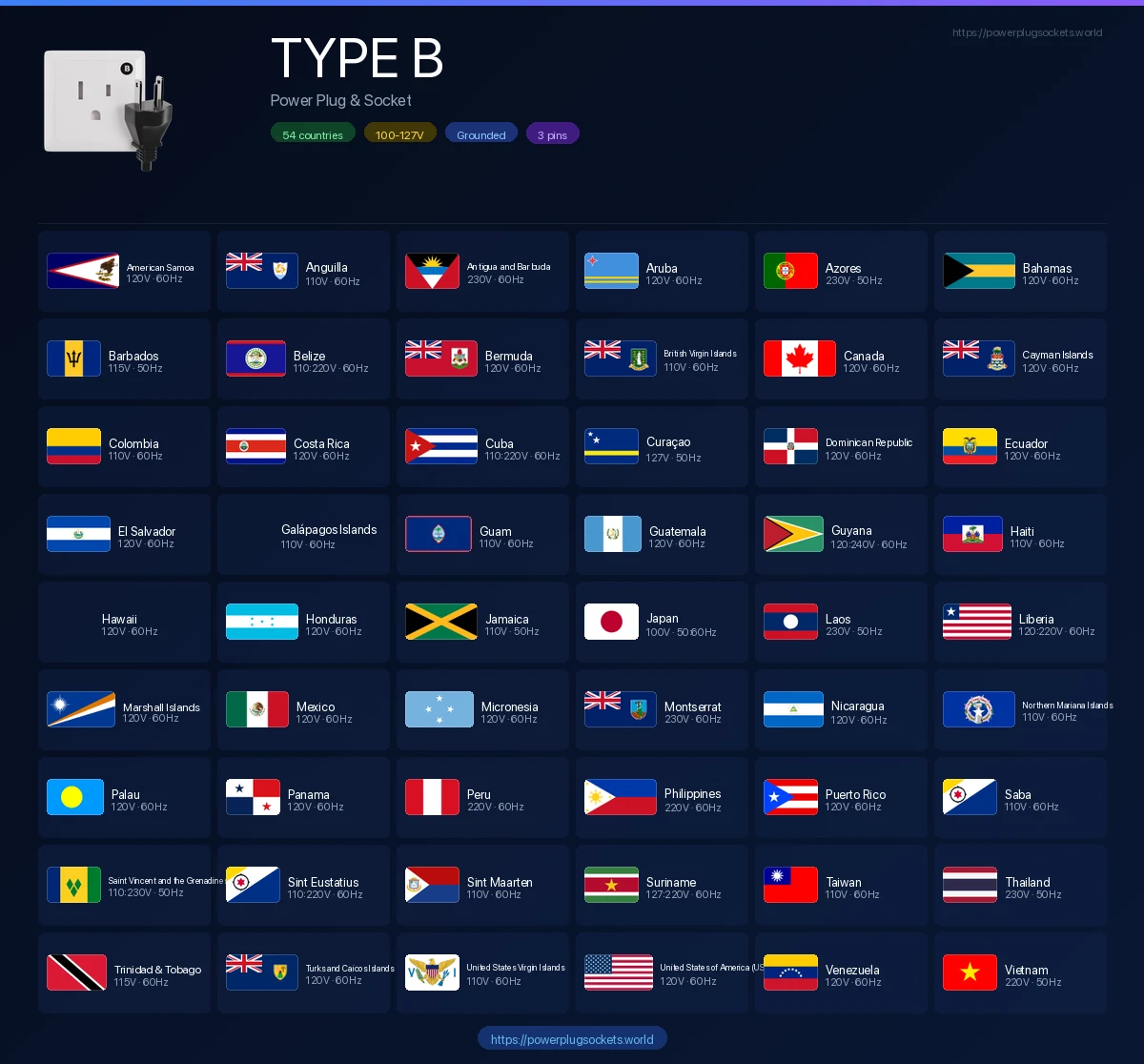
On a world map, the grounded North American socket spans a band from the north through Central America into the northern Andes, with outposts in Asia and the Pacific. The table lists main places with their mains supply.
| Country | Supply | Frequency | Power socket types |
|---|---|---|---|
| United States | 120V | 60Hz | Type A, Type B |
| Canada | 120V | 60Hz | Type A, Type B |
| Mexico | 127V | 60Hz | Type A, Type B |
| Puerto Rico | 120V | 60Hz | Type A, Type B |
| Jamaica | 110V | 50Hz | Type A, Type B |
| Japan | 100 V | 50Hz / 60Hz | Type A, Type B |
| Taiwan | 110V | 60Hz | Type A, Type B |
| Philippines | 220V | 60Hz | Type A, Type B, Type C |
Read the supply before the socket: a power socket in the Philippines delivers nearly double Puerto Rico's, so a hair straightener built for one supply will burn out.
North America and Central America
The socket is universal across the US and Mexico, and also in Bermuda, Guatemala, Honduras and Panama. El Salvador runs at 115V.
South America and Asia
In South America it is standard in Colombia, Ecuador, Venezuela and Costa Rica, at 110 to 120 volts and 60 Hz, while Brazil moved to its own three-pin standard.
Travelling With an American Standard Device
A device bought in the US has an American standard plug built for a 120 V supply. Travellers leaving the Americas must bridge the plug shape and the mains supply: a travel adapter solves the first, and only the device's own rating, or a converter, solves the second.
Travel adaptors plus a small US power strip run several devices from one power socket, but avoid stacking them and keep multisocket adaptors under the plug's 15-amp limit.
Choosing a Travel Plug Adapter
Visitors to the Americas, where type b sockets are standard, need a travel plug adapter that presents a Type B plug to the wall, ideally with a universal input socket that keeps a grounded connection. A good USA type B adapter lists max.
amps of at least 10 A and max. voltage of 250 V, has USB ports, and offers an adapter cable option for one cord.
Built-in surge protection is useful but not essential, and a plug adaptor that claims to change the supply is really a converter.
Dual-Rated Chargers or a Converter
Check the charger label. Most laptop chargers, cell phone chargers and other electronics say "Input: 100-240V, 50/60 Hz", so they are dual voltage and need only an adapter.
If the input voltage range is only 110 to 120 V, as on many hair dryers, you need a voltage converter rated above its wattage on a 230 V supply.