Type C Power Plug & Socket
Type C plugs have two round pins. Also known as the Europlug, it's one of the most widely used plug types in the world, compatible with many socket types. See also do i need a voltage converter for Cambodia.
Standard: CEE 7/16 (Europlug)
Pin Configuration: Two round pins (4mm diameter, 19mm long, 18.6mm apart)
Usage Notes: Type C plugs fit into Types E, F, J, K, L, and N sockets. This makes it very versatile for international travel.
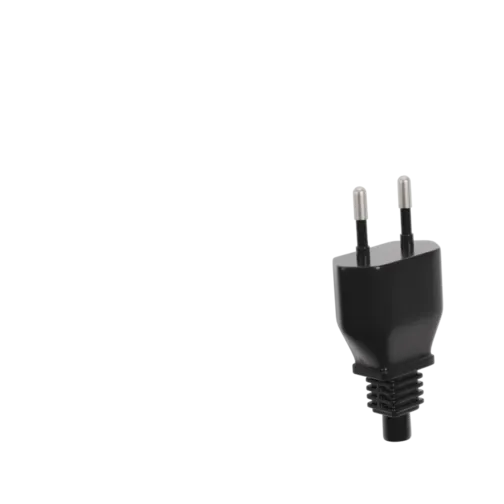
Plug
Type C
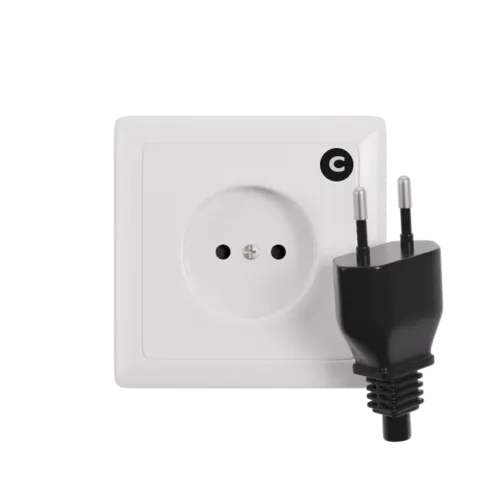
Plug & Socket
Type C
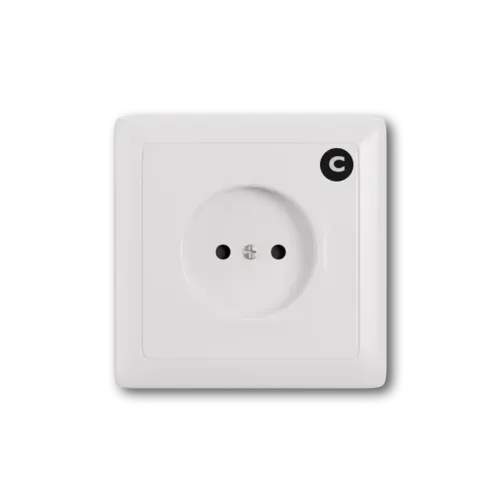
Socket
Type C
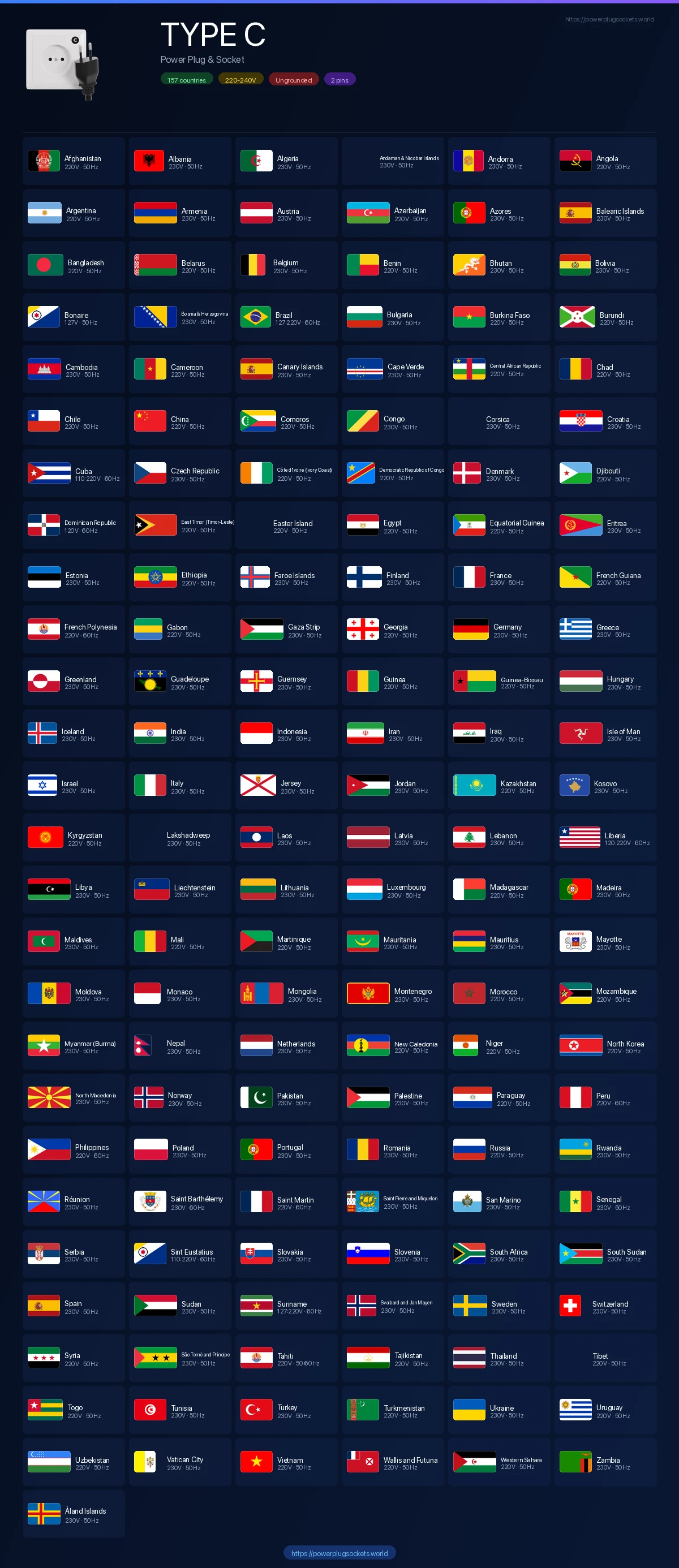
Pack for almost any trip across Europe and the one plug you're sure to need is plug type C, the slim two-pin design that fits power outlets from Lisbon to Moscow. Outside the United Kingdom, Ireland, Malta and Cyprus, a Type C plug works in nearly every wall you'll meet.
What you get here is which sockets accept it, where it's used, and when your electronics need more than a simple adapter for travel.
What Is Plug Type C? The Europlug Explained
The Europlug is the most widely used electrical power plug worldwide. It's a two-wire, two-pin unearthed plug with two round prongs, written into the international standard CEE 7/16.
It's a European 2-pin design most neighbouring sockets accept.
Two Round Pins and Their Dimensions
The plug has two round pins, each 4 mm thick and 19 mm long. Their centres sit 19 mm apart at the base and narrow to 17.5 mm at the tip, so the pins converge slightly.
Because the pins are flexible, they bend just enough to fit any socket with round pins of 4.0 to 4.8 mm on 17.5 to 19 mm centres.
Ungrounded, Unpolarised and Unearthed
Type C is ungrounded and unpolarised: there's no earth pin, so the plug fits either way up, and it's meant only for double-insulated class II devices that need no earthing. Each pin has 10 mm insulated sleeves.
Those sleeves stop your fingers reaching live metal while the plug is half-inserted, and they're a quick way to recognise a genuine Type C plug.
CEE 7/16 vs CEE 7/17: Two Versions of the Type C Plug
Two plugs share the Type C label. Their pins are the same length but they're rated for very different power loads, so check which one your appliance carries before relying on it.
The 2.5 A Europlug for Low-Power Devices
The common CEE 7/16 version is rated at 2.5 A and 250V. That 2.5 amps ceiling suits low energy-consuming appliances such as phone chargers, electric toothbrushes and radios. Heavier appliances draw too much power for its thin pins and would overheat them.
The Contour Plug for Heavier 10 A and 16 A Loads
The CEE 7/17, sometimes called the contour plug, is rated at 10 A or 16 A. Its 4.8 mm pins have no sleeves and sit in a round plastic or rubber base, with holes for the side contacts and earth pins of grounded sockets. High energy-consuming appliances that need more power but no earthing use it: hair dryers, vacuum cleaners and bathroom heaters.
Which Sockets Accept a Type C Electrical Plug
A Type C electrical plug is built to fit far more than its own power socket. Most European power sockets are the Type C electric socket's grounded successors, so receptacles across the continent keep that 4 mm round-pin spacing.
A true Type C receptacle, or Type C electrical receptacle, is only the older socket covered below.
Type E, Type F and Schuko Sockets
The 2.5 A version slides into Type E sockets in France and Type F Schuko sockets in Germany, along with the grounded Type H (Israel), Type J (Switzerland), Type K (Denmark), Type L (Italy) and Type O (Thailand). The thicker contour plug fits Type E and Type F, but its round base won't go into the narrower Swiss, Danish or Italian sockets.
Type N Sockets in Brazil and South Africa
Type N sockets in Brazil and South Africa are recessed and hexagonally-shaped. The slim version fits them, but the 16 A Type C version doesn't, the one gap in a Type C electrical socket's family.
Why the Type C Socket Gave Way to Grounded Sockets
The plug is everywhere, but the Type C socket itself is rare. It is the older, non-grounded ancestor of the Type E, F, J, K, L, N and O designs.
Since most countries now require grounded sockets in new buildings, installing Type C sockets has become illegal almost everywhere. Only the sockets were phased out; the plug stays legal, and any Type C electric outlet or Type C power outlets you still find are usually in older housing.
A two-pin wall plug still fits the E/F sockets that replaced them.
Countries Using Type C Plugs
Type C plugs are standard across continental Europe and much of the developing world, as well as in the Middle East, South America, Central Asia, Africa and the former Soviet republics. The table lists a selection of countries with their mains voltage, frequency and the other power sockets that accept the Type C plug type.
| Country | Voltage | Frequency | Power socket types |
|---|---|---|---|
| Germany | 230V | 50Hz | Type C, Type F |
| France | 230V | 50Hz | Type C, Type E |
| Italy | 230V | 50Hz | Type C, Type F, Type L |
| Spain | 230V | 50Hz | Type C, Type F |
| Netherlands | 230V | 50Hz | Type C, Type F |
| Belgium | 230V | 50Hz | Type C, Type E |
| Poland | 230V | 50Hz | Type C, Type E |
| Czech Republic | 230V | 50Hz | Type C, Type E |
| Switzerland | 230V | 50Hz | Type C, Type J |
| Denmark | 230V | 50Hz | Type C, Type E, Type F, Type K |
| Greece | 230V | 50Hz | Type C, Type F |
| Turkey | 230V | 50Hz | Type C, Type F |
| Russia | 230V | 50Hz | Type C, Type F |
| Ukraine | 230V | 50Hz | Type C, Type F |
| Kazakhstan | 220V | 50Hz | Type C, Type F |
| Israel | 230V | 50Hz | Type C, Type H, Type M |
| Kuwait | 240V | 50Hz | Type C, Type G |
| Egypt | 220V | 50Hz | Type C, Type F |
| Morocco | 220V | 50Hz | Type C, Type E |
| India | 230V | 50Hz | Type C, Type D, Type M |
| Indonesia | 230V | 50Hz | Type C, Type F |
| Vietnam | 220V | 50Hz | Type A, Type C, Type F |
| South Korea | 220V | 60Hz | Type C, Type F |
| Brazil | 127V / 220V | 60Hz | Type C, Type N |
| Chile | 220V | 50Hz | Type C, Type L |
| Argentina | 220V | 50Hz | Type C, Type I |
| Peru | 220V | 60Hz | Type A, Type B, Type C |
Most of Asia and Africa on this list run at 220V or 230V, but Brazil mixes 127V and 220V by city, so check the local power supply before plugging in.
Voltage, 230V and Frequency at a Type C Electrical Outlet
The plug shape tells you nothing about the power behind it. A Type C electrical outlet can supply power at anything from 127V to 240V, at a frequency of 50 or 60 hertz (cycles per second).
The Type C electric plug fits all of these outlets. Whether your device survives depends on its power rating, not on the outlet.
Voltage Compatibility and Dual Voltage Chargers
Voltage compatibility is the first check before you travel. North America runs at 110-120 volts, while power grids in Type C countries mostly supply 220-240 volts.
Look at the label on your devices' power supplies: "100-240V" means dual voltage, as on almost all laptop chargers and phone bricks, and a plain plug adapter is enough. A single-voltage 120V device plugged straight into a 230V outlet can burn out within seconds.
When a Voltage Converter or Transformer Is Needed
High-power, single-voltage hair tools or kettles need a voltage converter or step-down transformer, not a Type C plug converter. A plug converter only changes the pin shape.
No adapter changes the frequency either, so 60 Hz clocks and motors may run poorly at 50 Hz.
Choosing a Type C Travel Adapter
A Type C travel adapter lets travelers plug a foreign power cord or charger, such as a US NEMA 5-15P, into a European wall. Look for a travel adapter that accepts your home plug shape.
A universal adapter covers more countries. Since a Type C adapter has no earth pin, pick a combo pack with a Type E/F option for grounded laptops.
Many Type C adapters also add USB ports. These output 5V whatever the mains power behind them, so cell phones, tablets and power banks charge without a converter, and high-power fast charging cuts the wait for your devices.
A compact, lightweight adapter saves room in your travel luggage.
Surge Protection and Safety Certification
Match the rating to your heaviest load: an adapter built for under 16 A can't safely run a hair dryer. Choose CE-marked adapters, ideally certified by an independent test lab.
Surge protection, short-circuit protection and over-current protection add a layer of safety in hotels with unstable power or older wiring.