Type D Power Plug & Socket
Type D plugs have three large round pins in a triangular pattern. This is an old British standard still used primarily in India. See also will my charger work in Taiwan on 110V.
Standard: BS 546
Pin Configuration: Three large round pins in triangular pattern (ground pin 7.1mm, live/neutral 5.1mm diameter)
Usage Notes: Type D is being phased out in favor of Type M in many regions. Some multi-socket outlets in India accept both Type D and Type M.
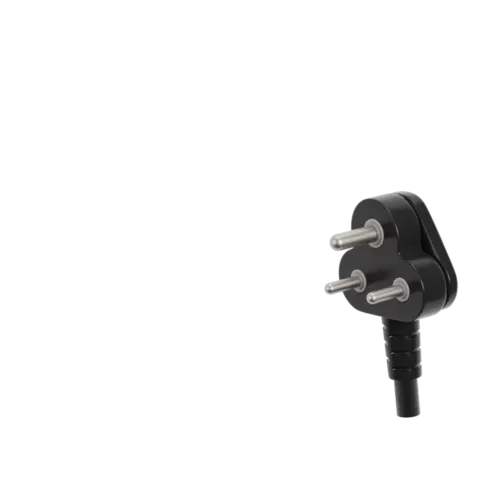
Plug
Type D
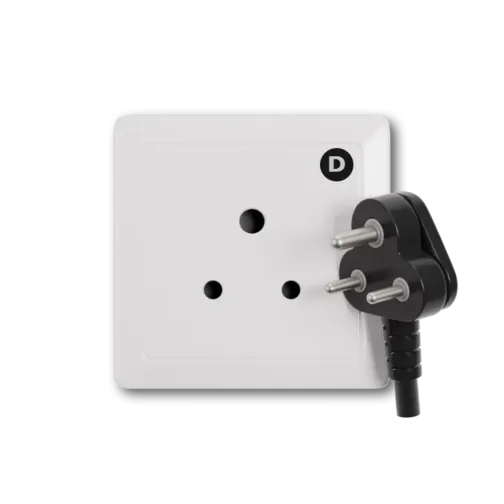
Plug & Socket
Type D
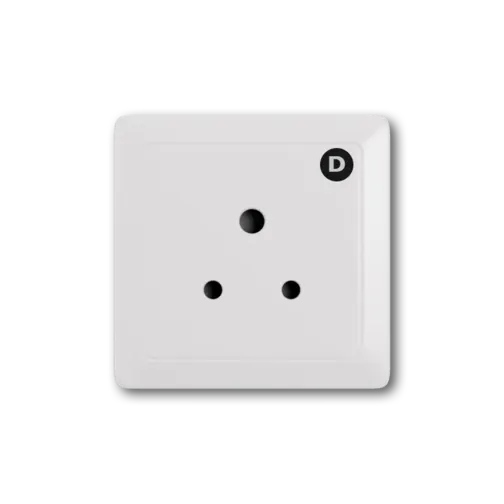
Socket
Type D
Heading abroad and found three fat round holes in a hotel wall? That is plug type D.
This guide covers the Type D electrical plug, its pins, its voltage, the countries that use it and when Type D adapters are enough for your devices.
What Is Plug Type D? The Old British Plug Explained
The Type D plug is a three-pin, earthed connector, a Type D plug type rated at 5 or 6 A and 250 volts. Most guides call it the old British plug, and the IEC (International Electrotechnical Commission) adopted its letter.
A plug D socket has three round holes, two small ones for live and neutral and a larger one above for earth, and Type D plugs are mainly found on the Indian subcontinent.
Look at a Type D electric plug and you will see three round pins in a triangular configuration. The thicker, longer top pin is the earth, so the plug is polarized.
The original British standard is BS 546, with 2 A, 5 A, 15 A and 30 A sizes, and India's IS 1293 rates the small plug at 6 A. Each size fits only its own socket, and the round prongs are not flat blades like British plugs.
History of the 3-Prong Plug in India and Britain
Britain introduced the round-pin system in 1934 and replaced it with the fused BS 1363 system from 1947. Former British colonies such as India, Nepal, Sri Lanka and Pakistan kept the round-pin system, while South Africa later moved to Type M and Type N. Roughly 40 countries still use it for some plugs.
Type D Plug Dimensions in mm
Measurements matter more than shape when you check a plug.
| Part | Diameter | Length | Spacing |
|---|---|---|---|
| Earth pin (top) | 7.1 mm | 20.6 mm | Offset 22.2 mm |
| Live and neutral pins | 5.1 mm | 14.9 mm | 19.1 mm between centres |
Type D Earth Pin Size and Offset
The earth pin (grounding pin) is thicker and longer than the other prongs, so grounding and earthing connect first and breaks last when you pull the plug out.
Line and Neutral Pins Spacing
The line and neutral pins are spaced evenly apart, as the table shows. Their bare pin shanks and close spacing let several foreign plugs enter these sockets unsafely.
Type D Socket Voltage, Frequency and 6 Amp Rating
Where Type D power sockets are found, the electricity supply from the mains is 220 to 240 volts, so a Type D adapter only helps devices built for that range. The current rating of 6 A at 230 V allows about 1,380 watts of load. See also Switzerland electrical outlet type.
Electrical power at that level suits a laptop charger, but a 2,000 W kettle and other larger appliances belong on a Type M socket.
250 V and 50 Hz Supply
The plug is rated at 250 V, covering 230 V in India and Nepal and 220 V in Bangladesh, all at 50 Hz, or 50 cycles per second (hertz). Check the input voltage on your charger: "100-240 V, 50/60 Hz" electronics accept the full range.
Why 5 A in Britain but 6 Amp in India
The geometry is identical, but the British version rates the small plug at 5 A and IS 1293 rates it as a 6 amp plug, which is 1,150 against 1,380 watts. Either way, these sockets suit lamps, fans and chargers.
Countries That Use BS 546 Round-Pin Sockets
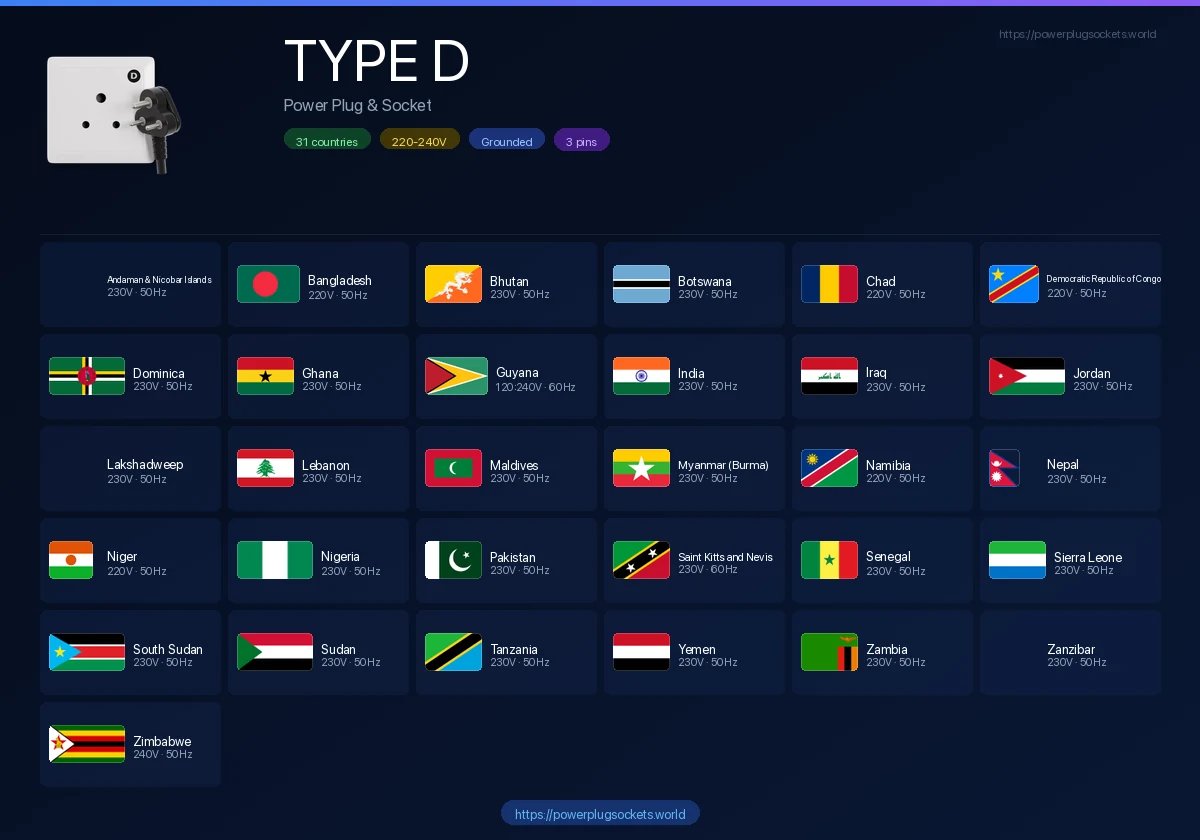
According to the IEC, around 40 countries use Type D sockets in some form, often only in older buildings. The likeliest are India, Nepal, Sri Lanka and Pakistan, plus Bangladesh, the Maldives and Bhutan.
Burma, Namibia and Botswana have it too, at 220 V or 230 V and 50 Hz.
India, Nepal and Sri Lanka
India is the plug's real home, with a small round-pin socket in almost every room beside a larger Type M socket. Nepal is similar, and Sri Lanka has mostly moved to Type G, and Hong Kong has done the same.
Pakistan, Bangladesh and African Countries
In Pakistan and Bangladesh, D sockets sit beside Europlug sockets. Namibia and Botswana still use the plug.
Older buildings in Ghana, Kenya, Nigeria, Mauritius and Sudan may have it. The same goes for parts of Zambia, Zimbabwe, Tanzania and Afghanistan, so pack an India travel adapter that covers both socket types.
Type D vs Type M, Europlug and Other Plug Types
Several plug types look similar, and a few will enter the socket without being safe in it. Travelling on? Check China wall socket type.
| Plug | Rating | Fits a D socket? |
|---|---|---|
| Type D | 5-6 A, 250 V | Yes |
| Type M | 15-16 A, 250 V | No |
| Type C (Europlug) | 2.5 A, 250 V | Loosely, poor contact |
| Type E / F (Schuko) | 16 A, 250 V | Only when forced, unsafe |
| Type G | 13 A, fused | No |
Type M and Its 16 Amps Pins
Type M is the same triangle scaled up, rated 15 A under the older British rules and 16 amps in India. Its thick pins cannot enter a D socket.
Europlug and Type C Plugs in a D Socket
A two-pin Europlug slides in but seats loosely, with poor contact and the odd spark or short-circuit. It is workable for a low-power charger, not recommended.
Why Schuko Type E and F Plugs Are Risky
Thicker pins on Type F plugs can only be forced in. The plug is then ungrounded, and sparking, a tripped circuit breaker and electric shock become real hazards.
Type D Electrical Outlet Safety
A Type D receptacle is one of the less safe designs still in use. Its prongs have no insulated pins or sleeves, so bare metal can stay live when a plug is half out, and the wall socket is unfused and not recessed and not recessed. You may also need check if your appliance is compatible with Saint Kitts and Nevis's power sockets.
Where children are around, fit shutter-type covers. Insulation on the plug itself is minimal, and electrical outlets in older homes may lack a shutter.
In older buildings the earthing wire behind a Type D electrical receptacle is not always connected, so carry a socket tester.
Choosing a Type D Travel Adapter
For most travellers, a Type D travel adapter is all you need, in single-plug, multi-socket or universal form, and a Type D plug adaptor with a grounded outlet is the safest. Travel adapters with an earthed outlet keep a 3-prong laptop plug earthed.
Choose one rated for 250 V and at least 6 A, and never stack adaptors in a Type D electric outlet.
A plug adapter changes only the plug shape, while a voltage converter changes 230 V to 110-120 V, using a transformer, as a Type D plug converter would. Phone and camera electronics are usually dual voltage, so a plain plug suffices.
Single-voltage items such as many US hair straighteners need a converter.
Universal Sockets, USB Ports and Power Plug Ratings
A universal socket takes US, UK, EU and Australian plugs and often adds USB ports. A universal outlet can have loose contacts, so it suits chargers better than heavy loads.
Treat surge protection claims on cheap units with caution.
Round-Pin Outlet Wiring in the UK Today
You may still find a round-pin outlet, a Type D electric socket, in British hotels, theatres and older offices. These Type D outlets are usually 2 A or 5 A sockets on lighting circuits, controlled by a light switch or dimmer, and some older buildings used direct current for them.
A Type D electrical socket or Type D outlet like this is not for your phone charger, since BS 7671 still lists the old standard for this use.