Type F Power Plug & Socket
Type F plugs have two round pins with grounding clips on the sides. Also known as the Schuko plug, it's the most common in continental Europe. Save your travel adapter checklist in online notes at Notepadly. Also check travel adapter for Mexico.
Standard: CEE 7/4 (Schuko)
Pin Configuration: Two round pins (4.8mm diameter, 19mm long) with grounding clips on sides
Usage Notes: Type F is electrically compatible with Type E. Many modern European plugs are hybrid E/F designs that work in both socket types.
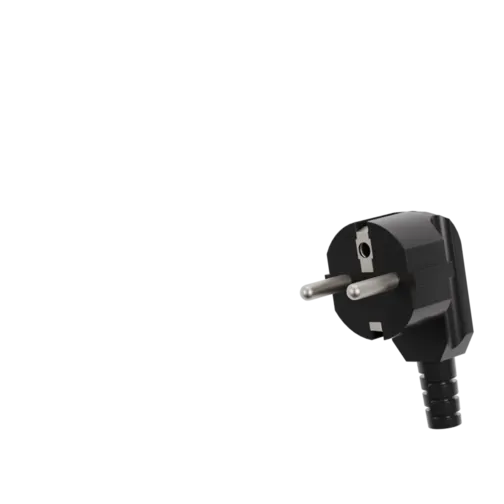
Plug
Type F
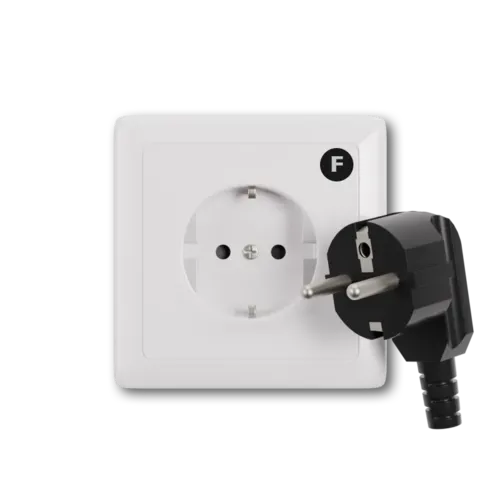
Plug & Socket
Type F
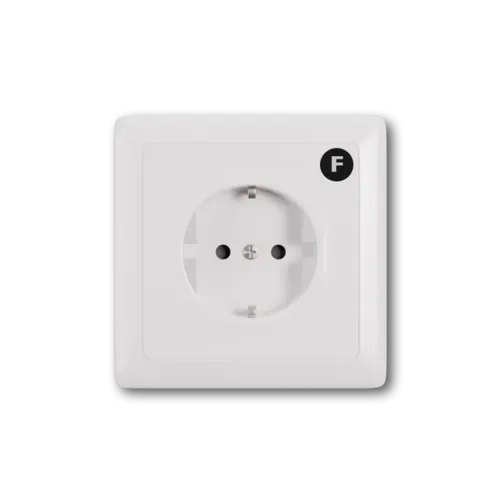
Socket
Type F
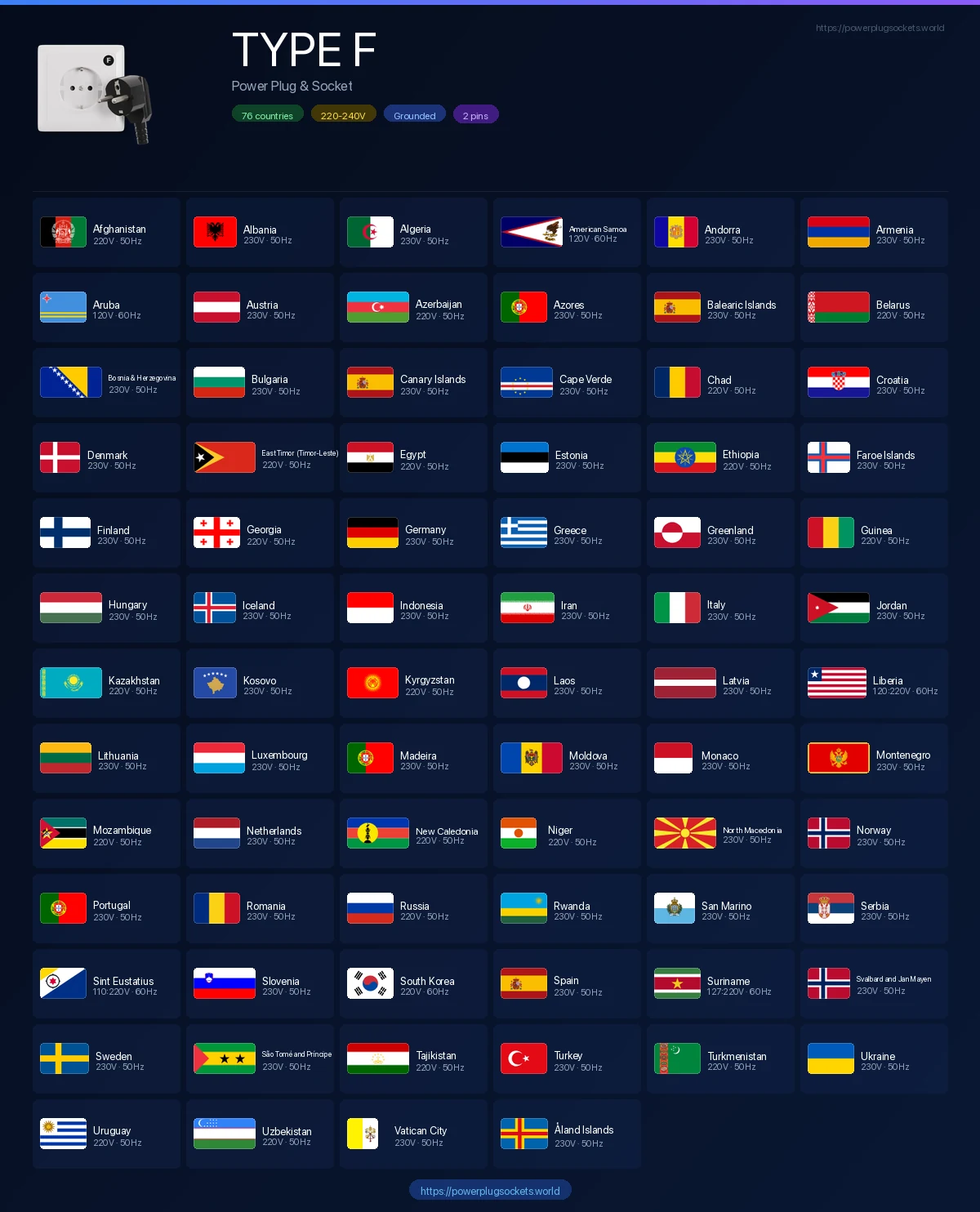
If you have ever plugged a hairdryer into a wall in Berlin, Oslo or Madrid, you have used plug type F, better known as the Schuko plug. It is the round, side-earthed connector behind most of the power plugs and sockets in Continental Europe, built for the region's 230 V electricity supply at a frequency of 50 Hz.
Below you will find exactly how it is built, which sockets it fits safely, and when you need an adapter or a converter.
What Is Plug Type F? The Schuko Plug Explained
The name Schuko shortens the German word Schutzkontakt, which means "protective contact" or "safety contact". It describes the earth connection that sets this design apart from older two-pin mains plugs.
In the CEE 7 family of AC power plugs, the Schuko plug is defined as CEE 7/4 and its matching socket as CEE 7/3. The standard rating is 16 A at 250 volts.
Round Pins and Earthing Clips: Schuko Dimensions
The plug carries two round pins, each 4.8 mm thick and 19 mm long, with their centres 19 mm apart. Instead of a third pin, it has two flat metal earth clips on the top and bottom edges, set 16 mm from the line between the pins.
Two plastic guiding notches on the left and right sides lock into the socket and steady large and heavy plugs, such as chargers with built-in transformers. The socket itself is a circular recess about 15-17.5 mm deep, so the pins are already hidden inside a recessed well before they touch anything live.
That removes the shock hazard of a half-inserted plug.
Why the Schuko Connection Is Unpolarised
Because the plug is symmetrical, it goes into the receptacle either way up, so line and neutral reach the appliance in random order. This unpolarised design is convenient, but any device that needs to be polarised must switch both poles itself.
Polarisation was never part of the original idea. Above 16 amps, equipment has to be wired in permanently or use a heavier connector such as IEC 60309.
Schuko History: Büttner's Patent to European Standard
The design came out of Bavaria in the mid-1920s. It is credited to Albert Büttner, a maker of electrical accessories, whose company received German patent DE 489 003 in 1930 for a plug with an earthing device. You may also need plug sockets used in Palestine.
Siemens engineers refined the system further, and in 1930 the utility RWE told its customers to install the new sockets, which made it the default across Germany. Greece switched over around 1989, and versions of the plug are now used in more than 40 countries, from the Atlantic to Central Asia.
Schuko Socket Safety Features
A well-made Schuko socket protects you in two ways: it connects protective earth first, and it hides the live contacts. Next, look at Northern Ireland wall socket type.
Earthing Contact Before the Pins Go Live
The side clips are placed so the earthing contact touches the plug before either power pin does. An earthed appliance therefore has a working earth contact from the very first moment current can flow.
The plug face also covers the whole socket cavity, so your fingers cannot reach the pins. In older buildings, check that the socket actually has a grounding connection behind it.
Child-Proof Shutters and Socket Shutters
Portugal, Finland, Denmark, Norway and Sweden require child-proof shutters, which block the pin holes until both pins push in together. The German DIN 49440 standard does not demand them, so socket shutters are optional there, though many new sockets include them anyway.
Schuko Plugs and Compatibility with Other Plug Types
The plug shares its pin size and spacing with several other plug types, so compatibility depends on whether the earth connects. The table shows what you can expect when you insert each plug into a type F socket or a Type E one.
| Plug | Side-clip socket (CEE 7/3) | French socket, Type E (CEE 7/5) |
|---|---|---|
| Schuko CEE 7/4 | Fits, with earth | Does not fit (no hole for the earth pin) |
| Hybrid CEE 7/7 (Type E/F) | Fits, with earth | Fits, with earth |
| Two-pin CEE 7/16 | Fits, no earth needed | Fits, no earth needed |
| Contour plug CEE 7/17 | Fits, not grounded | Fits, no earth |
It can also be pushed into an unearthed CEE 7/1 socket, but then nothing connects the earth. Never force one into a UK BS 1363 socket: the pins make poor contact, which risks overheating and fire.
The IEC 60906-1 standard was drawn up as a replacement, but only South Africa and Brazil adopted it.
Type E and the CEE 7/7 Hybrid
France and Belgium use Type E sockets (CEE 7/5), which have a male earth pin instead of clips. The original plug F has no earthing hole, so it cannot enter them, and on molded cords that version is now largely obsolete.
Its successor, the CEE 7/7 hybrid, adds a female contact for the Type E pin while keeping the side clips. That makes it fully compatible with both sockets.
Most molded type F plugs sold today are CEE 7/7, and the same hybrid also replaces the French CEE 7/6 plug. If you rewire a cord, buy a rewireable hybrid replacement; the older rewirable CEE 7/4 version still turns up in DIY shops.
Europlug and Type C in Schuko Sockets
The thin two-pin Europlug (Type C, CEE 7/16) fits Schuko sockets because its pins are slimmer and set at the same spacing. The flat CEE 7/17 contour plug fits too, though it has no earth at all.
Phone and laptop chargers usually ship with one of these, so they work in any Schuko outlet without an adapter.
Countries That Use Schuko Outlets
These outlets are the everyday socket across much of Europe and beyond:
- Germany, Austria, the Netherlands, Spain, Portugal, Norway, Sweden and Finland
- Eastern Europe, including Hungary, Romania, Bulgaria, the Baltics and the Balkans
- Russia, where Soviet sockets were widened to take 4.8 mm pins
- Greece, Turkey and Iceland
- South Korea, which runs them at 60 Hz
- Indonesia, Vietnam and much of North and West Africa
Where several standards meet, the side-earthed socket is often kept for washing machines and other large loads.
European Countries Where Schuko Is Not the Norm
Ireland installed Schuko until the 1960s before moving to the British BS 1363 design. Switzerland uses Type J, and Italy uses CEI 23-50, though its P 30 sockets are type F sockets in all but name, and many power strips are sold with them.
In these places, look for a hotel adapter or a universal outlet: some hotels add a continental point beside the local sockets for visitors.
Travel Adapter and Voltage Converter Needs for Schuko
Coming from North America or the UK, you need a travel adapter to reach a Schuko socket. An adapter only changes the shape of the plug.
It does not change the supply, so check the label on your device first. Most chargers are dual voltage, with an input voltage of 100-240 V, and only need the adapter.
Appliances built only for 110-120 V need a voltage converter as well. A typical adapter is rated around 250V, so it carries the supply as it is.
Choosing a Grounded Plug Adapter
For a laptop or anything with a metal case, pick a plug adapter that is wired with a continuous earth from input to output: a Type E/F model with side clips and a pinhole. That way the adapter's own type F plug connects the earth in any socket you meet, whether in Lisbon or Prague.