Type G Power Plug & Socket
Type G plugs have three rectangular pins in a triangular pattern. Known for its built-in fuse, it's considered one of the safest plug designs. Next, look at is the Egypt plug the same as a type C plug.
Standard: BS 1363
Pin Configuration: Three rectangular pins in triangular pattern (live/neutral 6.35x3.18mm, earth 3.18x7.92mm)
Usage Notes: The built-in fuse (typically 3A or 13A) provides additional protection. Adapters for Type G sockets must be high quality to handle the fuse requirement.
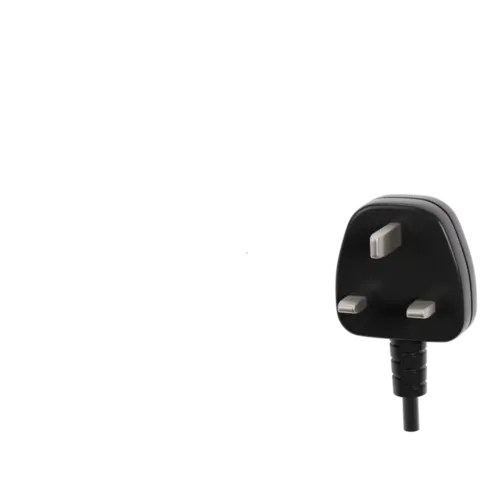
Plug
Type G
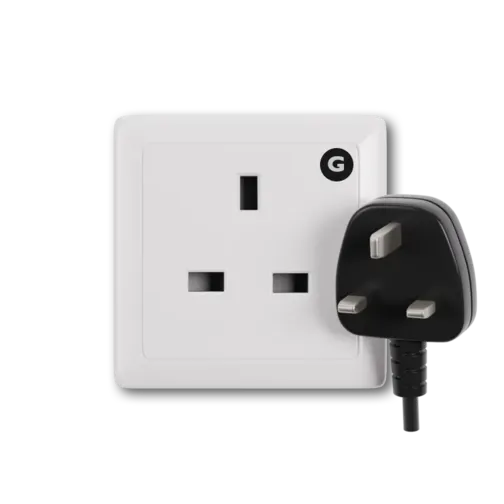
Plug & Socket
Type G
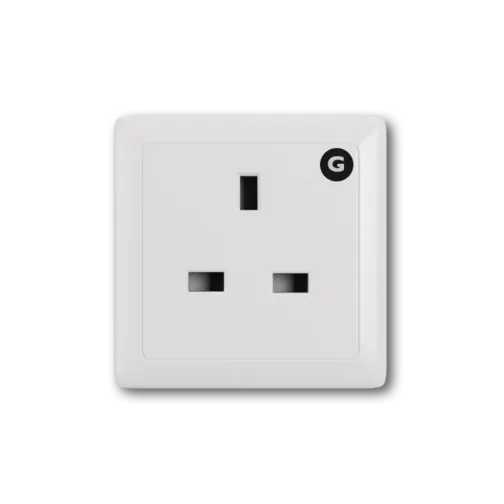
Socket
Type G
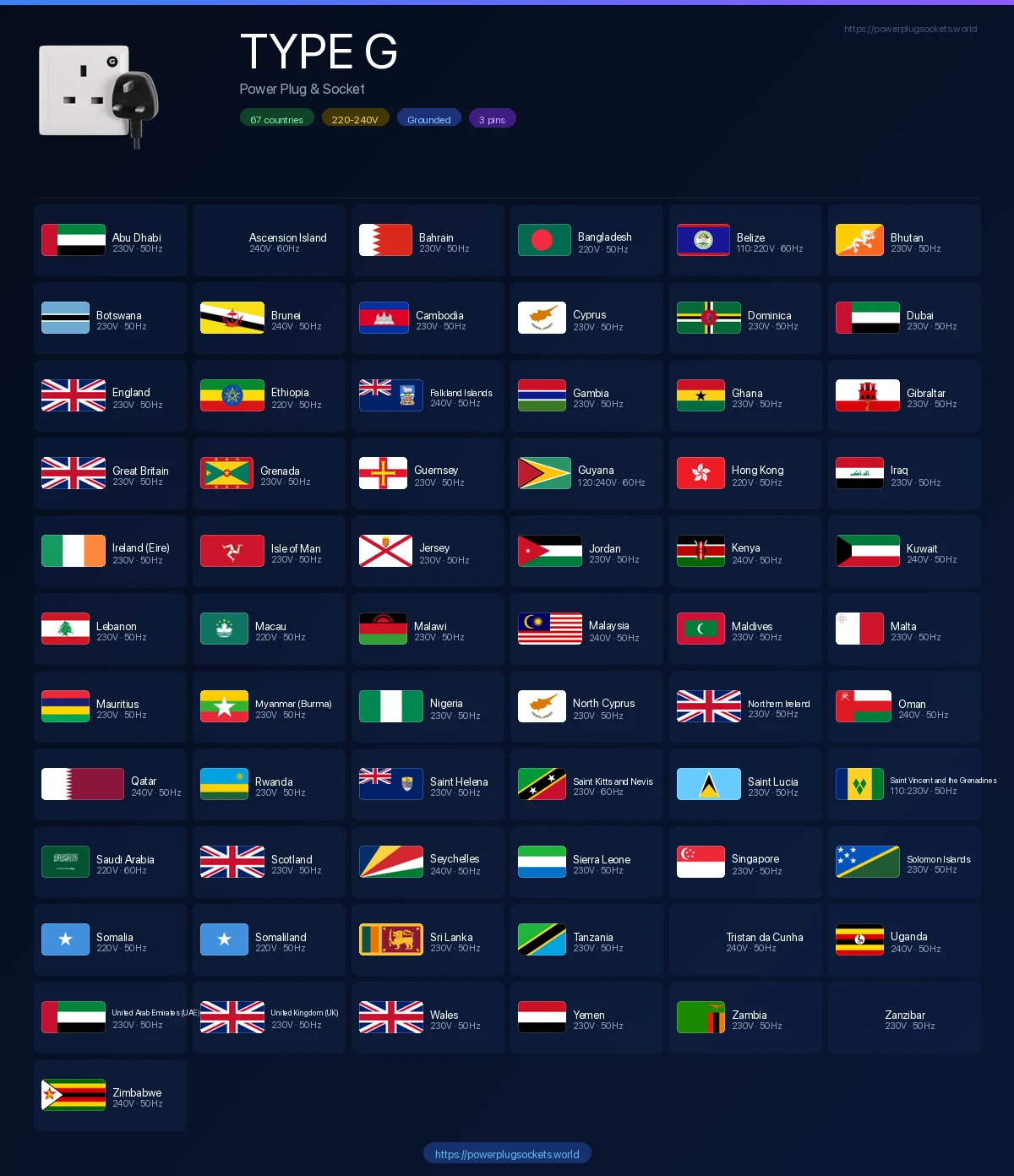
If you are packing for London, Dublin or Dubai, plug type G is the wall connection you will meet. The type G plug is the chunky British 13 amp plug with three flat pins and a built-in cartridge, the usual way equipment draws mains electricity across the United Kingdom and dozens of other countries.
What Plug Type G Looks Like: Pins, Sizes and Shutters
The plug can only go in one way, the earth connects first, and nothing live is exposed. That makes the British design one of the safest pairings in use, even if it is also one of the bulkiest. Next, look at is the Lakshadweep plug the same as a type C plug.
Three Rectangular Pins on a Type G Plug
The face shows three rectangular pins in an isosceles triangle: a longer, wider earth pin at the top and two shorter pins below for live and neutral. The layout is not symmetrical, so the plug cannot go in upside down, making it a true 3-prong plug.
Earth Pin Length and Power Pin Spacing
BS 1363 fixes every dimension, so any plug fits any compliant socket:
| Part | Cross-section | Length | Purpose |
|---|---|---|---|
| Earth (top pin) | 4 × 8 mm | 22.7 mm | Connects to earth before the power contacts touch |
| Line and neutral pins | 4 × 6.35 mm | 17.7 mm | Carry the supply current |
| Spacing of the two power pins | 22.2 mm centre to centre | — | Keeps plugs and the type G receptacle lined up |
Insulated Sleeves and Socket Shutters
Insulated sleeves on the power pins mean fingers touch only plastic if a plug is half pulled out. Spring-loaded shutters block the live and neutral holes until the earth pin opens them, keeping children and foreign objects like hairpins from live metal and lowering the risk of electric shock.
The flip side is a heavy plug that lands pins-up when dropped, which barefoot walkers compare to a caltrop.
Why Every British Plug Has a Fuse Inside
The feature that sets the british plug apart is the cartridge fuse clipped inside, beside the live pin. It protects the appliance's power cord rather than the building. Next, look at United Kingdom (UK) plug type.
Choosing a 3A Fuse or 13A Fuse
The rating should match the cord and the load, not the socket. Use 3 A for lamps, computers and mobile phone chargers up to about 700 watts, and 5 A for mid-sized loads.
Use 13 A for kettles, heaters, irons, washing machines and coffee makers. A plug carries 13 amps at most, and a thin flexible cord behind a 13 A cartridge could overload and overheat, so never fit a higher rating to stop a fuse blowing.
Ring Circuits Versus Radial Circuits
UK sockets are usually on ring circuits: one loop of cable from the consumer unit, round every socket, protected by a single 32 A breaker, far more than a slim lamp flex can survive. Most other countries use radial circuits with their own circuit breakers sized for the cable, so their plugs stay unfused.
Countries That Use UK Plugs and BS 1363 Sockets
The specification behind UK plugs is BS 1363, and the IEC says more than 50 countries use it, mostly former British territories. Many also have older or imported socket types beside the type G outlet.
| Country | Voltage | Frequency | Other plug types also found |
|---|---|---|---|
| United Kingdom | 230V | 50Hz | — |
| Ireland | 230V | 50Hz | — |
| Hong Kong | 220V | 50Hz | Type D |
| Singapore | 230V | 50Hz | Type C, Type M |
| Malaysia | 240V | 50Hz | Type C |
| Saudi Arabia | 230V | 60Hz | — |
| United Arab Emirates | 230V | 50Hz | Type C, Type D |
| Kenya | 240V | 50Hz | — |
Europe, the Arabian Peninsula and Africa
In Europe it is limited to Britain, Ireland, Malta, Cyprus and Gibraltar. It dominates the Arabian Peninsula, including Qatar, Kuwait, Bahrain and Oman.
It is everyday in Ghana, Uganda, Zambia, Zimbabwe and Nigeria, often beside older round-pin outlets. Saudi Arabia runs at 60 cycles rather than 50.
Singapore, Malaysia and the Rest of Asia
The same sockets appear in Brunei, Macau, Sri Lanka and the Maldives. Older buildings in Hong Kong and Sri Lanka may still have round-pin power sockets, and Guyana mixes it with North American fittings.
Travel Adapters for the UK Power Outlet
Plugs from North America, continental Europe or Australia do not fit a UK power outlet or wall socket without help. A type G adapter, the british type G travel adapter, changes only the plug shape, not the voltage.
Picking a Plug Adapter With USB Ports
Choose a travel adapter rated at least 13 A and 250V with a grounded path for three-pin power cords. Built-in usb ports let you charge a phone and a watch without a second brick, and surge protection helps in older hotels.
Do You Need a Voltage Converter?
Most laptop chargers and phone chargers are dual voltage, with an input voltage printed as 100-240V, so a plain adapter is enough in Britain. Single-voltage devices built for 110-120 V, such as many hair dryers, need a voltage converter, since a 220-240 V power supply will burn them out.
Fitting Type C and NEMA 5-15 Plugs Into UK Outlets
A two-pin Europlug or type C plug has no earth pin, so it cannot open a UK socket. The same goes for the American NEMA 5-15 three-prong plug, so you need an adapter with a real metal earth pin.
Power Strips and Extension Cords for Travel
An adapter plus a small power strip runs several dual-voltage devices from one hotel socket. The adapter and any extension cords are limited by their own current rating, and type G wall sockets are rated at 13 A in total.
British Standard History of the Fused Plug
The plug is younger than you might think: it was written in the rush to rebuild housing after the Second World War, when new ring mains wiring called for a new national standard for plugs and sockets.
From BS 546 and Type D to BS 1363
Before the war, British homes used round-pin plugs to BS 546; the 5 A version is now classed as type D. The rectangular-pin design appeared in 1946 and it was published in 1947. By the 1960s most older homes had been rewired to it.
Type D survives in theatres, older lighting circuits and India.
Related British Sockets: Type M and BS 4573 Shaver Units
The regulations, BS 7671, still cover type M, a large 15 A round-pin plug, and BS 4573 bathroom shaver supply units. A shaver socket feeds through an isolating transformer for low loads only.
Earthing and Safety Rules for the UK Electrical Socket
Every UK electrical socket is earthed, and plugs either carry an earth connection or are built so they do not need one.
Plastic Grounding Pins on Two-Wire Appliances
Appliances classed as Class II rely on double insulation, so they need only a two-wire cord. Their plugs often have a plastic grounding pin that exists only to open the socket shutters; avoid a metal-cased appliance on an adapter with no real earth path.
Polarized Wiring and the Circuit Protective Conductor
Type G plugs and sockets are fully polarized: the earth, called the circuit protective conductor, is at the top, live is on the right and neutral on the left. Switches and fuses therefore always sit on the live side, and reversed live and neutral in old installations are a genuine hazard.