Type H Power Plug & Socket
Type H plugs are unique to Israel with three pins in a V-shape. Modern Type H sockets also accept Type C plugs. Travelling on? Check Somalia power socket.
Standard: SI 32
Pin Configuration: Three pins in V-shape arrangement (round 4.5mm or flat pins, 19mm length)
Usage Notes: Since 1989, Israeli sockets accept both the old round-pin and new flat-pin Type H plugs, as well as Type C.
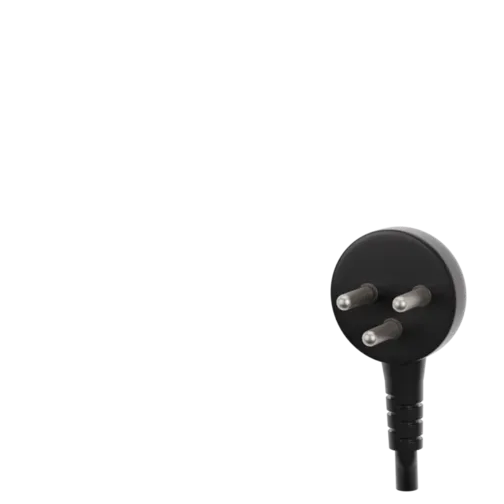
Plug
Type H
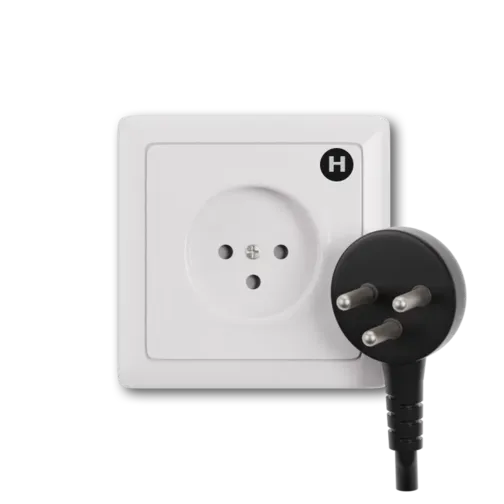
Plug & Socket
Type H
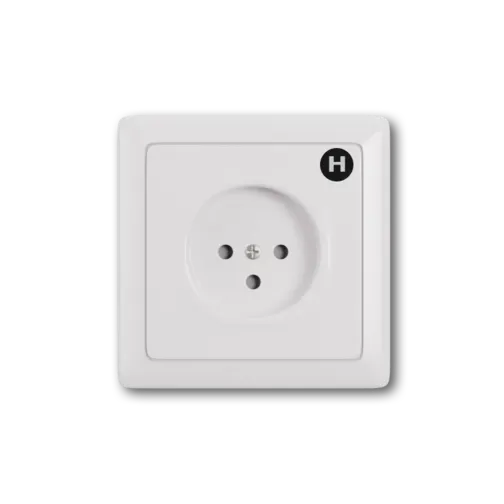
Socket
Type H
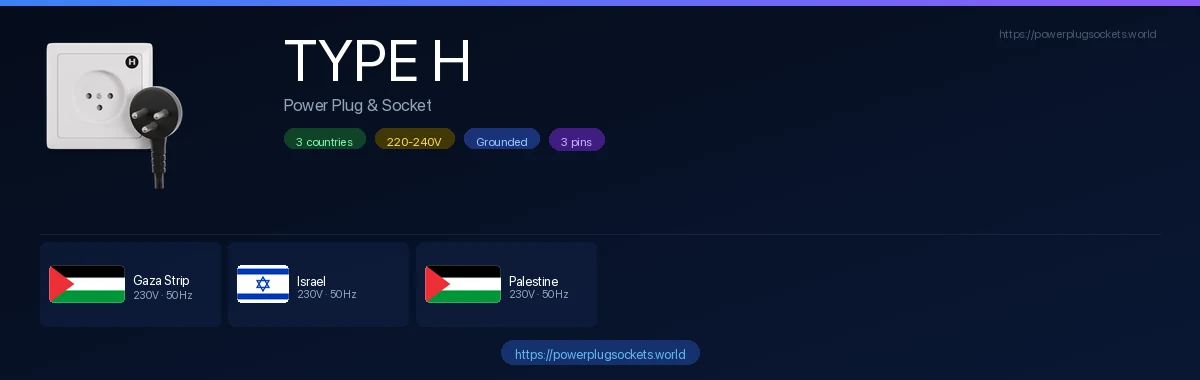
Packing for Israel? Plug type H is the power connector in almost every wall there, and it looks unlike the plugs used anywhere else in the Middle East or Europe.
This guide covers the pins, the electrical rating, the safety quirks and the adapter to carry, so you know which plugs fit and which need an adapter or a converter.
What Plug Type H Looks Like: Pins, Spacing and Rating
The plug follows the national standard SI 32, which the IEC lists as IS16A-R. It has three round prongs in a triangle: two power pins side by side and an earth pin below them.
The earth pin is centred beneath the power pins, and the socket has a third hole to receive it. The plug is polarized, so it goes in one way only, and the ground connection is made as soon as it is inserted.
Each type H plug is a full earthed connector.
The plug is rated at 16 A and 250 V, a 16 amp rating with 250V enough for a kettle drawing under 10 amps, and the third pin earths Class I appliances. Polarity matters, and few travellers own this plug.
Only Israel and Palestine use it.
Pin Diameter, Length and Spacing
The current version has round pins of 4.5 mm, each 19 mm long, with line and neutral centres 19 mm apart, the spacing most European plugs use. That is why a slim two-pin Europlug slides in without an adapter.
| Dimension | Value |
|---|---|
| Pin diameter | 4.5 mm, thinner than the 4.8 mm Schuko pins |
| Pin length | 19 mm |
| Live and neutral spacing | 19 mm between centres |
| Earth pin offset | 9.5 mm below the power pins |
| Current and voltage | 16 A at 250 V |
How the Israeli Plug Changed in 1989
The Israeli plug has had two versions. The old standard used flat prongs; a revision replaced those flat blades with round pins in the same positions, and the socket was reshaped to take both, and the flat-bladed version is now obsolete.
Flat Pins in a Y-Shape Before 1989
The pre-1989 plug had three flat pins in a Y-shape, with the live and neutral blades 19 mm apart and carrying the same 16 A. Sockets that accept only this old standard are rare, and the plug is incompatible with a modern Europlug.
Round Pins and Backward-Compatible Sockets
Modern type H plugs are all round-pin, and recent type H outlets use a hybrid design, an Israeli socket with a combined slot that takes either a flat blade or a round pin. A socket with narrow slots instead of round holes is the old style and will not take a modern plug.
Which Plugs Fit Israeli Sockets
Israeli sockets follow one standard design, not a multi-standard outlet, so Israeli plugs are not interchangeable with foreign plugs that look almost the same. The quick test: a plug with two thin pins and nothing else fits, while side clips, a third blade or flat blades need an adapter.
A 2-prong Europlug fits, whatever the appliance.
Europlug and Type C Plugs
The Europlug (CEE 7/16, Type C) is the one foreign plug that fits without help, since its 4 mm pins sit 19 mm apart. It is unearthed and rated for 2.5 A, so it suits chargers such as a cell phone charger and other Class II electronics with double insulation, though it may sit loosely.
The German Schuko plug, the French Type E plug (CEE 7/6) and the hybrid CEE 7/7 plug use 4.8 mm pins, so they do not fit properly. Do not force them in: their side earthing clips have nothing to touch, leaving no earth connection.
The Thai plug, or Type O, looks very similar, with the same 16 A rating, but its thicker 4.8 mm pins and earth pin about 11.9 mm away mean neither plug fits the other's sockets.
Safety Risks of the Israeli Outlet
The Israeli outlet works, but its design trails most of Europe in two ways that raise the risk of an electric shock, especially for a child. Next, look at Zanzibar wall socket type.
Uninsulated Pin Shanks
Most modern plugs are insulated near the base with insulating sleeves on the pin shanks. Plugs made to the Israeli standard have none, so a partially inserted plug leaves bare pins close to fingers, and a child risks electrocuting themselves.
Many parents fit covers over unused sockets.
A Wall Socket That Is Not Recessed
The socket sits flush with the wall plate, with no recess to shield a half-inserted plug. Shutters stop a hairpin entering a live contact but not the exposed pins of a loose plug, so push every plug fully in and pull it out by the body, never the cord.
Choosing an Israel Travel Adapter
Plug adaptors change the shape of your plug, not the electricity. For an Israel travel adapter, check that the output is marked Type H, the input matches your plugs, and it is grounded if a device has a third pin.
Most adaptors are rated 10A or 13 A at 250V, so they cover phones and computers but not heating appliances.
- From the US or Canada: Type A and Type B plugs need an adapter, so choose an adapter that accepts NEMA 1-15 and NEMA 5-15 plugs and outputs a grounded 3-prong plug.
- From the UK: you need an adaptor that takes the British 13 A plug.
- From Europe: two-pin Europlugs fit directly; Schuko and French plugs need an adapter, and a grounded plug adapter carries the ground through, unlike cheap universal socket adaptors. A short extension cord helps with low power outlets.
An adapter with built-in USB ports can charge several devices, and a power strip from home with surge protection plugged into one adapter covers a desk. Never chain adapters, since each joint adds a loose contact.
Voltage Converter or Dual Voltage Device
The mains electricity supply is 230 V at 50 Hz, and frequency matters too. A charger labelled 100-240V is a dual voltage, worldwide voltage device and needs only the adapter, as almost every laptop, cell phone and camera charger does.
A device marked 110-120 V only, such as many American hair dryers, needs a voltage converter rated for its wattage or it will overheat.
Where Type H Sockets Are Used: Israel, West Bank and Gaza Strip
These sockets are used in Israel, the West Bank and the Gaza Strip, and nowhere else. Neighbouring countries use other plugs: Jordan mixes several types, Egypt uses Europlug and Type F sockets, and Cyprus uses British sockets.
How SI32 Compares With Other Plug Types
The Israeli design (Israeli SI32) follows European standards and sits in the European family with 230 V mains, 19 mm pin spacing and a 16 A rating, but with its own earth position. The table shows whether each plug fits the local sockets as it is. Next, look at Iceland electrical outlet type.
| IEC type | Standard | Rating | Fits the local sockets? |
|---|---|---|---|
| Type H | Israeli SI 32 | 16 A, 250 V | Yes, native plug |
| C | Europlug, CEE 7/16 | 2.5 A, 250 V | Yes, directly |
| E / F | CEE 7/6, Schuko CEE 7/4 | 16 A, 250 V | No, pins too thick |
| K | Danish 107-2-D1 | 16 A, 250 V | No, earth pin elsewhere |
| O | Thai TIS 166-2549 | 16 A, 250 V | No, similar but not interchangeable |
| A / B | NEMA 1-15 / 5-15 | 15 A, 125 V | No, needs an adapter |
Only thin round prongs at 19 mm spacing with no side earthing clips fit. In these plugs the third pin is earthed in British and IEC usage and grounded in American usage; both mean the same grounding protection, and with no recess or sleeves a working earth is your main defence against a faulty device.