Type I Power Plug & Socket
Type I plugs have two angled flat pins in a V-shape, plus a grounding pin. The angled pins distinguish it from other flat-pin designs. You may also need what plug does Turkey use.
Standard: AS/NZS 3112
Pin Configuration: Two angled flat pins (8mm long, 6.5mm wide, 30 degree angle) plus vertical grounding pin
Usage Notes: Type I is used in several countries across different continents. Chinese outlets often accept both Type I and Type A plugs.
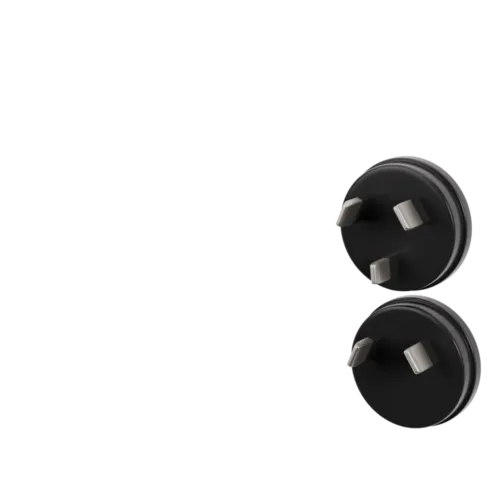
Plug
Type I
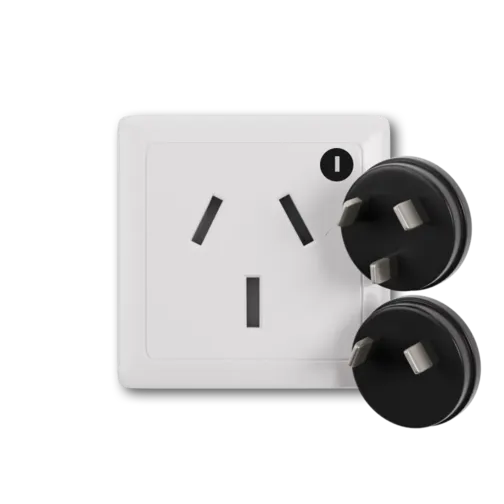
Plug & Socket
Type I
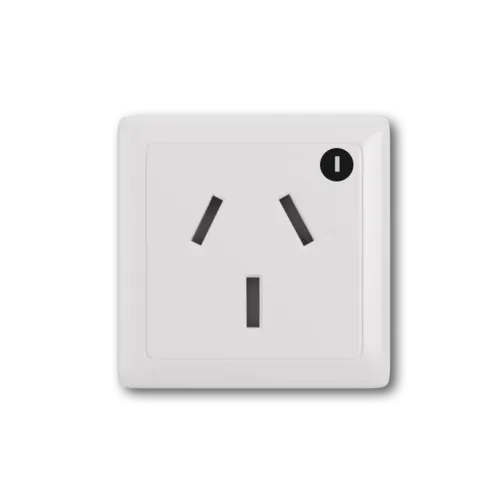
Socket
Type I
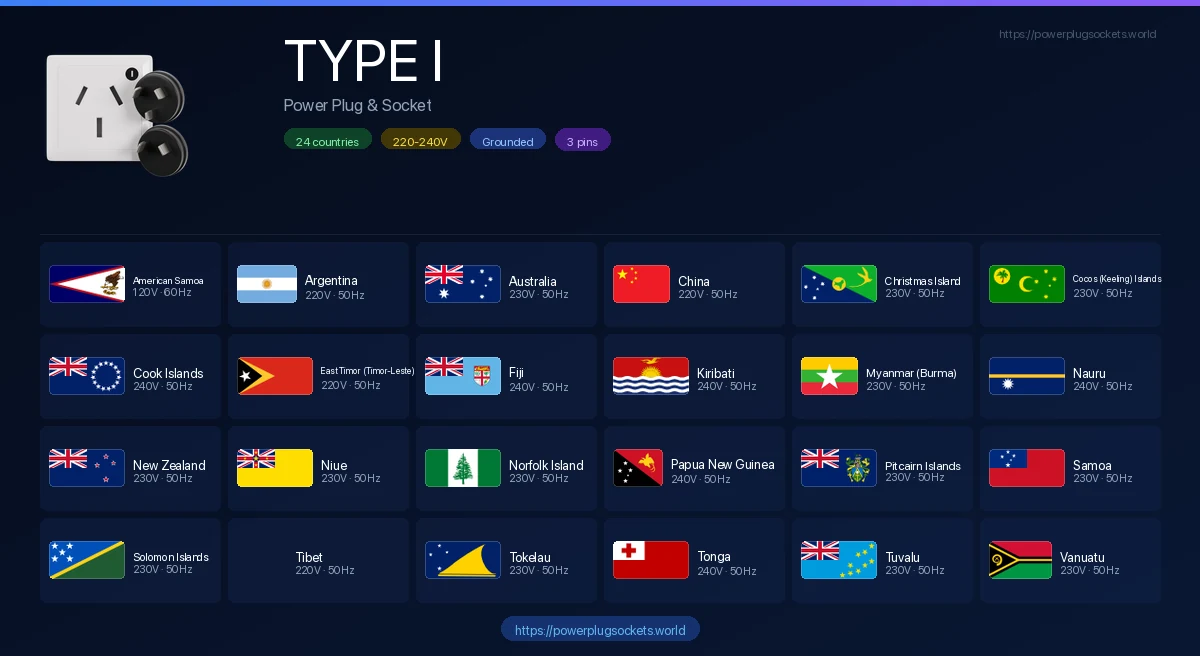
Heading to Australia, China or Argentina? The wall socket there takes plug type i: two flat blades angled into a V with a straight earth blade underneath, the same shape you will meet in New Zealand and Papua New Guinea.
Every power outlet in this family runs on 220-240 V, and the everyday plug has an amp rating of 10 A, so the two questions are whether your plug physically fits and whether your devices can take the supply.
What the Australian Plug Looks Like
The Australian plug has three flat pins: two angled blades at the top and one vertical blade at the bottom. The upper blades carry the live and neutral conductors that bring mains electricity to your devices and take it back, while the lower one ties exposed metal to earth.
Unlike the round pins of a European Type C plug, every blade is a flat rectangle. The two power pins sit at 30° to the vertical as an upside-down V, an inverted V, and the earth pin (also called the earthing pin or grounding pin) is longer, so it connects first and leaves last.
A type i plug therefore looks like a tilted North American flat-blade plug, and most homes have a rocker switch beside each point.
Pin Dimensions of the Flat Pins
These pin dimensions are the nominal sizes for the Australasian 10 A plug. Chinese and Argentine plugs differ by fractions of a millimetre, and a plug from any of the three fits the other two countries' 10 A sockets.
| Measurement | Nominal size |
|---|---|
| Power blade width | 6.3 mm |
| Power blade thickness | 1.6 mm |
| Power blade length | 17.3 mm |
| Earth pin length | 20 mm |
| Spacing between the two blade centres | 13.7 mm |
| Earth blade centre below the plug centre | 10.3 mm |
| Angle of each blade from vertical | 30° |
The Ungrounded Version for Double-Insulated Appliances
The ungrounded version keeps only the two angled blades and is fitted to double-insulated chargers, shavers and hair dryers, which are Class II. An appliance with an exposed metal body, such as a toaster, kettle or washing machine, is Class I and needs the full three-blade plug, relying on earthing instead of a second layer of insulation.
The two-blade unearthed version fits every three-slot socket. Newer plugs also have insulated pins, with insulating sleeves on half of each blade to prevent an electric shock, and some sockets add shutters or are recessed, though these features carry most of the safety burden only in some countries.
AS/NZS 3112 Amp Rating Ladder
AS/NZS 3112 defines plugs and sockets for 10 A, 15 A, 20 A, 25 A and 32 A loads. The ladder is one-way compatible: a 10 amp plug fits a 15 amp or 20 amp socket outlet, but a higher-rated plug never fits a lower socket. See also plugs and sockets in North Cyprus.
| Rating | What changes on the plug | Where you will see it |
|---|---|---|
| 10 A | Baseline blade sizes | Almost every household socket |
| 15 A | Taller earth blade | Large heaters, garages |
| 20 A | Wider current-carrying blades | Air conditioners, pool pumps |
| 25 A | Earth blade like an inverted L | Commercial equipment |
| 32 A | Earth blade like a sideways U | Heavy industrial loads |
To see what a load needs, divide its wattage by the supply: a 3,000 W heater draws 12.5 A at 240 V, which is why it ships with the 15 amp plug, and ducted air conditioners end up on 20 A circuits. Every country on this plug runs within a 220-240 V voltage range with a mains frequency of 50 Hz, and the plugs are marked 250 V as an insulation rating.
Most gear sold there suits that range.
Countries Using V-Shaped Prongs
Plugs with V-shaped prongs are one of the fifteen standard types lettered A to O, with three national electrical standards behind them: the Australasian, the Chinese and the Argentine.
The Australasian version also covers Fiji, Tonga, the Solomon Islands, Papua New Guinea and Kiribati. Kiwi shops still sell piggy-back plugs, and only licensed electricians may take a fitting off the wall.
China sets its plug in GB 1002, with blades about a millimetre longer and sockets often installed upside down, and its combination wall plate mixes two socket types, adding a two-slot opening for other plugs. Mainland China is separate from Hong Kong, which uses the British Type G. Argentine plugs follow the IRAM 2073 standard, and Argentine sockets are wired with live and neutral reversed, a difference of polarity that rarely matters to appliances but matters for older lamp wiring.
In Brazil the larger shape survives in older homes as the argentine plug, and newer installations use the Type N plug.
Plug Type I vs Type A, Type B and Other NEMA Designs
All the American flat-blade plug types resemble this one, and the NEMA catalogue includes a three-blade NEMA 10-20 shaped like the larger Argentine plug. This compatibility is only partial: nothing from North America or Europe goes into the wall outlets without an adapter, except that a Chinese combination wall plate takes a two-blade Type A plug or a Europlug. Next, look at Martinique electrical outlet type.
The design came from Harvey Hubbell's 1916 patent, the C112 standard followed in 1937, and AS/NZS 3112 replaced it in 1990.
Choosing a Plug Adapter for AS 3112 Sockets
A plug adapter changes only the shape of the connection, not the supply. Check the label on your devices: 100-240 V means only an adapter is needed, while 120 V only means a step-down converter too.
If your plug has an earth pin, buy a grounded adapter. Travellers from the US need a NEMA 5-15 adapter, those from the UK a BS 1363 adapter and those from Europe a Schuko or Europlug adapter.
The type i plug & socket pairing is the same across the Pacific, China and Argentina, and type i plugs bought in Sydney work in Shanghai too.
Single-Region Adapters
Single-region travel adapters convert one home plug to the V-blade shape. They are the smallest and cheapest option for any type i plug & socket pairing, so if your trip stays inside the Pacific or China, this is the plug adapter to buy.
Multi-Region Travel Adapters
Multi-region travel adapters carry several pin sets on one body and suit itineraries that cross standards. Many add USB ports to charge phones and other devices from one socket, and most phone chargers are Class II, so a missing earth contact does not matter.
A heavy adapter can sag out of one that has no recess.
Universal Travel Adapter or Voltage Converter?
A universal travel adapter passes 230 V straight through, so a dual voltage straightener or a 110-240V charger works, while a 120 V-only kettle or curling iron needs a step-down converter. For anything that heats, buying a local version is usually safer.
If you use a power board with multisocket adaptors, keep to its 10 A rating, since a 2,000 W kettle and a 1,850 W hair dryer together draw about 16 A.