Type K Power Plug & Socket
Type K plugs have three round pins with the grounding pin positioned as a semicircular pin. Unique to Denmark and Greenland. Compare this with will my charger work in Mozambique on 220V.
Standard: DS 60884-2-D1
Pin Configuration: Two round pins (4.8mm diameter) plus grounding pin (similar to Type F with additional ground pin)
Usage Notes: Type K sockets accept Type C (Europlug) devices. Some Danish outlets also accept Type E and F plugs.
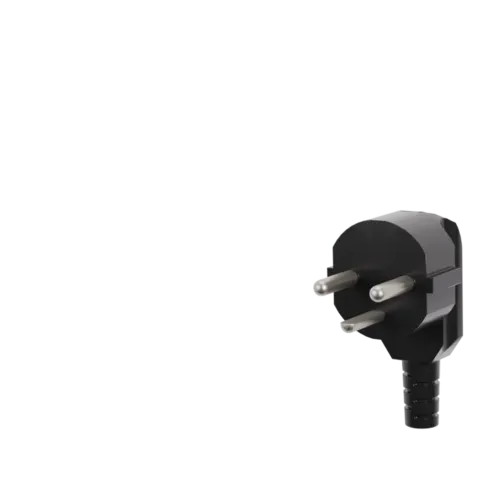
Plug
Type K
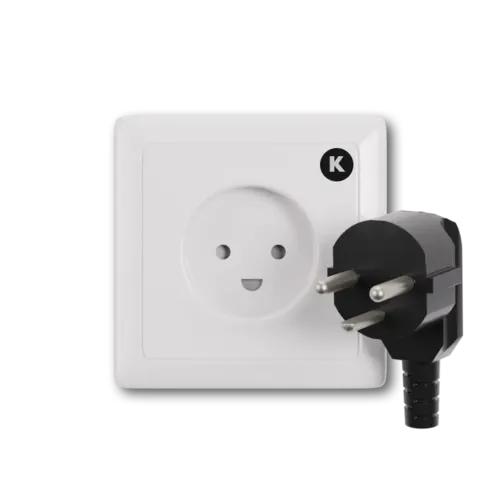
Plug & Socket
Type K
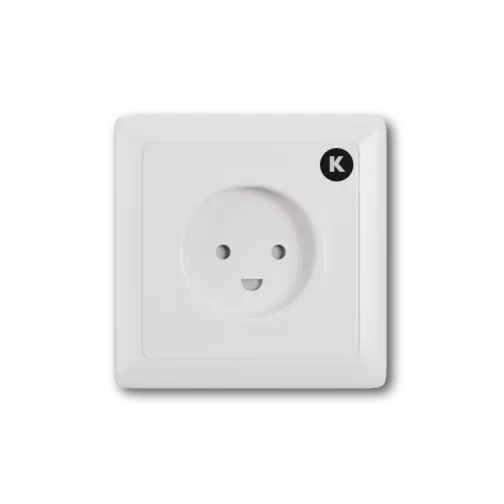
Socket
Type K
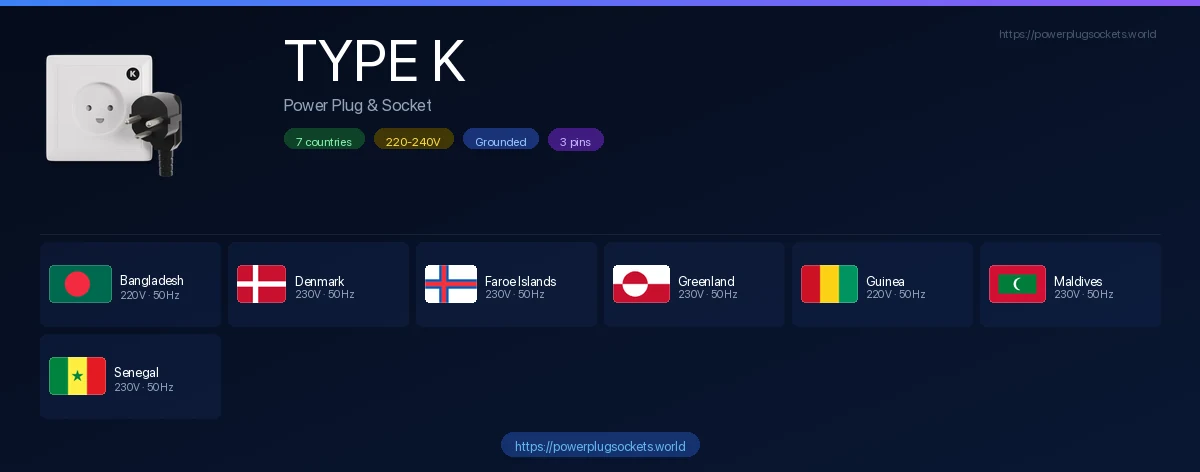
If you are packing for Copenhagen or wiring a holiday cabin in the north, plug type K is the outlet you will meet on the wall. The Type K plug is the Danish plug: two round power pins plus a third earthing pin on the plug itself, the opposite of most European designs.
What Is Plug Type K?
Plug type K is the IEC letter for the Danish mains connector in its world plug list (IEC TR 60083). The Type K electrical plug is a male connector with two round pins and a half-round earth pin below them, and the Type K electrical receptacle (the Type K receptacle in the wall) has three holes. See also plugs and sockets in Netherlands.
Unlike French and German systems, the earth pin rides on the plug. Type K plugs, the Type K electric plug and the Type K electric outlet are rated 16 A at 250V and suit IEC Class I appliances, while Class II devices with double insulation need only the two power pins.
Danish Plug Standards: 107-2-D1, SRAF 1962/DB and DS 60884-2-D1
The current national standard is DS 60884-2-D1, the Danish supplement to IEC 60884. Older documents still quote 107-2-D1 and SRAF 1962/DB, and shops sell the same connector as the "Danish 3-pin" plug, so any of these labels means a Type K plug, also called the Danish standard plug.
Where Type K Sockets Are Used
Danish-pattern sockets are standard in Denmark itself, Greenland and the Faroe Islands, all part of the Kingdom of Denmark. Elsewhere in Europe you will meet Type C, E and F sockets instead.
Type K Plug Dimensions and Pin Layout
The Type K plug follows the common European spacing for its power pins and adds its own earth pin:
| Part of the Type K plug | Dimension or rating |
|---|---|
| Line and neutral pins | 4.8 mm diameter, 19 mm long |
| Spacing between power pins | 19 mm centre to centre |
| Earth pin (spade, half-round) | 14 mm long, 4 mm thick, 6.5 mm wide |
| Wall socket rating | 16 A, 250 V |
The socket handles its full rating, but most compact travel adapters are rated for 10 A, which sets your limit.
Earth Pin Shape and Offset
The earth pin is a half-round, U-shaped or D-shaped spade with a flat face, offset 13 mm below the power pins. At 14 mm it is shorter than the power pins, and the grounding pin goes into a matching earth hole in the receptacle.
Power Pins: Live, Neutral and Line
The two power pins carry the current: one is the live (line or phase) pin and the other the neutral. They have no insulated sleeves, so recessed sockets matter.
Their spacing matches a Europlug, which is why many European plugs slide in.
Type K Socket Safety: Earthing, Shutters and Polarity
This design protects you with an earth contact, a barrier against touching the pins, and fault protection in the wiring. Earthing (grounding) sends fault current to earth rather than through you, but only if the plug has an earth pin too.
Sockets in new Danish electrical wiring all include an earth contact, on matching fused circuits.
Child-Resistant Shutters, Switches and Recessed Sockets
The Danish standard provides child-resistant shutters behind the socket holes. Sockets traditionally had a switch beside them, and today sockets without one must be recessed so fingers cannot reach the pins while they still touch the contacts.
Polarized Wiring and the Earth Connection
Danish sockets are polarized like British ones: with the earth hole at the bottom, the live contact is on the left. The Type K plug goes in one way only, while a 2-prong Europlug can go in either way, which is harmless for small double-insulated devices.
RCD Protection and Earthed Sockets in Older Homes
An earth contact has been required in all new electric installations since the early 1990s. Older unearthed sockets must be protected by an earth-fault RCD, called HFI or HPFI in Danish, a rule that has applied to every home since 1 July 2008.
Which Plugs Fit a Danish Socket?
A Danish socket accepts more plug types than you might expect, but fitting is not the same as being safe. The two-pin Type C Europlug (CEE 7/16) and the CEE 7/17 contour plug are safe because those devices never needed an earth.
Type F Schuko, Type E French and the CEE 7/7 hybrid plug fit, but rely on the socket for earth and lose it here.
| Plug you have | Fits a Type K socket? | Earthed? |
|---|---|---|
| Type K (Danish) | Yes | Yes |
| Type C Europlug (CEE 7/16) | Yes | Not needed (2-pin) |
| Type F Schuko (CEE 7/4) | Yes, physically | No: no earth pin on the plug |
| Type E French (CEE 7/6) | Yes, physically | No: no earth pin on the plug |
| Type A/B (NEMA 5-15) | No | Needs an adapter |
For a laptop charger the missing earth hardly matters, but a metal-bodied dishwasher, toaster or kettle is left unearthed, and a buzzing tingle warns of an electric shock; repeated shocks can be life-threatening. The fix is a Type K plug with its own earth pin on the power cord or a grounded adapter.
How Danish Plugs Lost Ground to Schuko in the EU
Danish law once required every imported appliance needing an earth to have a Type K plug, but the European Union dropped that rule in the early 1990s as a barrier to free movement of goods in the internal market. Manufacturers then shipped the same Schuko plug they used elsewhere.
The Danish Safety Technology Authority later permitted Type E sockets in 2008 and Schuko Type F sockets in 2011, so Type F will slowly replace it.
Special Type K Variants for Computers and Hospitals
One hospital variant has a rectangular left pin, so life support equipment connects only to its dedicated sockets and never to an ordinary wall outlet.
The DK 2-5a Computer Socket
The DK 2-5a plug is a Danish variation for surge protected computer circuits, with tilted, flattened power pins. It fits both the computer socket and a standard Danish wall socket, but normal plugs do not fit the computer socket, keeping kettles and heaters off the circuit.
Voltage and Frequency Behind the Type K Electrical Outlet
Every Type K electrical outlet supplies mains electricity at 230 V and 50 hertz, the same mains voltage and frequency as the rest of the EU. Visitors from the UK, Ireland or Australia need only the right plug shape. Next, look at do i need a voltage converter for Tonga.
From North America or Japan, where the supply is 100-127 V, check each device label; a motor or clock built for 60 Hz may run slow on 50 Hz.
Do You Need a Voltage Converter in Denmark?
An input range such as "100-240V, 50/60Hz" means the charger is dual voltage and needs only an adapter, as most phone, laptop and camera chargers do. A single-voltage 120 V hair straightener needs a step-down voltage converter, which is heavy for heating appliances, so buy locally instead.
An adapter plug never changes the voltage, and a transformer is the only fix.
Choosing a Type K Travel Adapter
A Type K adapter takes your home plug and presents a Type K plug for any Type K outlet. Check which compatible plugs it will accept, whether it carries an earth, and its rating.
Many universal adapters carry only two pins through, fine for chargers and bad for anything metal-cased. The Type K plug adapter suits a single country, and a universal travel adapter suits several stops.
Plug one heater or kettle in at a time.
What to Look for in a Denmark Travel Adapter
- A grounded outlet on the input side if you carry 3-prong plugs
- A real earth pin on the Type K side
- A rating of at least 10A at 250 V