Type L Power Plug & Socket
Type L plugs have three round pins in a row. There are two variants: 10A (smaller) and 16A (larger with wider pin spacing). See also plug types used across Middle East, including Turkey.
Standard: CEI 23-50
Pin Configuration: Three round pins in a row (10A: 4mm pins 5.5mm apart / 16A: 5mm pins 8mm apart)
Usage Notes: Type L sockets accept Type C (Europlug) devices. Be aware of the two sizes - some outlets only accept one variant.
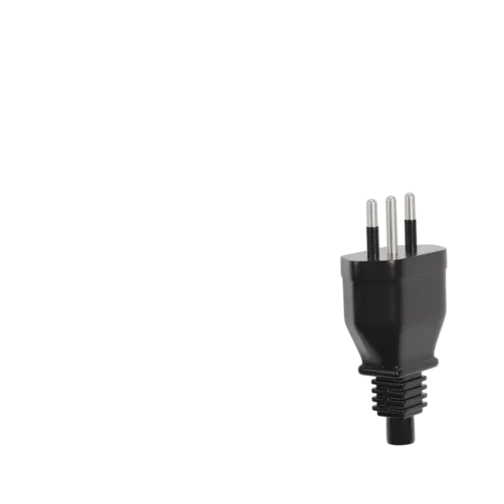
Plug
Type L
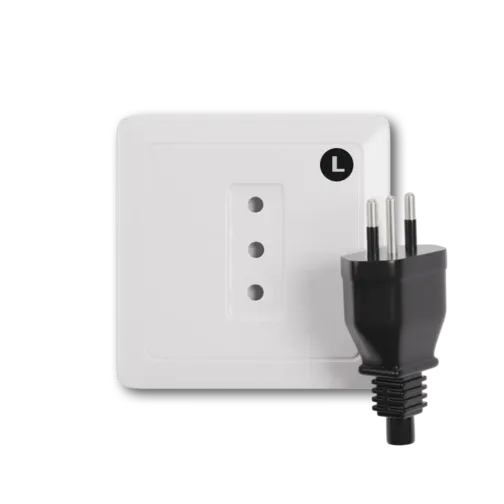
Plug & Socket
Type L
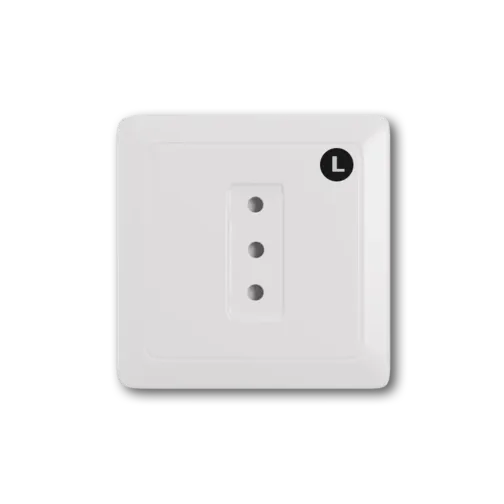
Socket
Type L
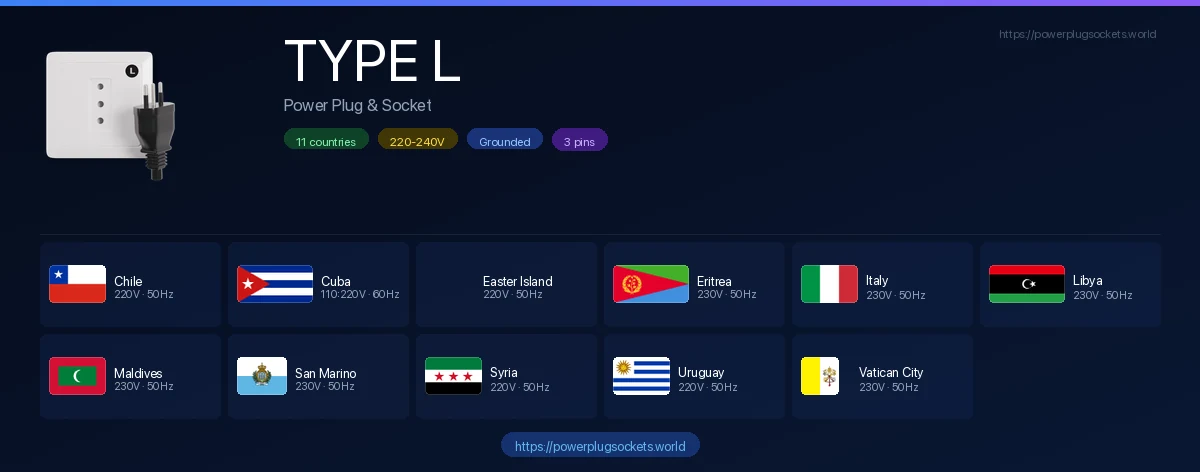
Packing for Rome or Santiago? Plug type L is the Italian three-pin design set out in CEI 23-16/VII (now CEI 23-50), and it comes in two sizes, a 10 A plug and a 16 A plug, that look alike but never fit each other's holes.
Below you'll find the exact dimensions of each Type L plug & socket, which other plugs share the outlet, and where you'll meet it, from Italy and Chile to parts of North Africa.
Plug Type L Specs: 10 A vs 16 A Amp Rating
Both versions use three rounded pins set in a straight line, with the earth in the middle, and both run on a 220-240 V voltage range. Size follows the amp rating: the slim 10 amp plug top suits lamps and chargers, while the 16 amp one serves heavier currents such as heaters. Compare this with will my charger work in Martinique on 220V.
Because thickness and spacing both change, the two sizes are incompatible: the large plug won't enter the small socket, and the small one sits loose in the large. The IEC lists both.
Round Pins, Pin Length and the Earth Pin
Diameter separates the two sizes; length does not change. The live and neutral prongs carry a 10 mm insulating sleeve at the base, so no bare metal shows while the plug is half inserted.
The earth pin sits exactly halfway between the other two, which is what lets the plug turn round without losing its earth.
| Measurement | Type L 10 A | Type L 16 A |
|---|---|---|
| Pin diameter | 4 mm | 5 mm |
| Pin length | 19 mm on both | |
| Live-to-neutral pin centres | 19 mm | 26 mm |
| Outer pin to earth (centres) | 9.5 mm | 13 mm |
| Clear gap between neighbouring pins | 5.5 mm | 8 mm |
Pin Centers and Ground Pin Spacing
Spacing is measured centre to centre, with the ground pin midway between the line and neutral pins. Subtract one pin's diameter from the outer-to-earth spacing and you get the clear gap between neighbours, just 5.5 mm on the small plug against 8 mm on the large one, which is why the small plug looks crowded on a plug plan drawing.
The layout is symmetrical, so the plug is unpolarised and goes in either direction. A socket elevation shows the matching three holes in one row.
Bipasso Socket Compatibility with Type C, Type E and Type F
The most common receptacle is the twin-gauge outlet: each hole is shaped like a figure eight, so it takes both sizes of type L plug as well as the two-pin Type C Europlug. Type C slips in because its thin prongs are compatible with the small spacing. See also check if your appliance is compatible with Ascension Island's power sockets.
A pure 16 amp electrical socket, now uncommon, accepts only the large Type L. Plugs with side earth clips need a different hole altogether.
The Schuko-Bipasso Socket
Newer Italian installations add a round, recessed power socket with a twin-gauge centre. It takes Type C, both Type L sizes, and the side-earth plugs used across Europe (Type F and the hybrid Type E/F), so appliances bought in Germany or France are compatible without an adapter.
Countries That Use the CEI 23-16 Plug
Italy is its home, and its small neighbours follow it. Elsewhere it shares the wall with other plug types, usually Type C:
- Italy, San Marino and Vatican City: 230V, 50Hz, the main standard
- Chile and Uruguay: both run at 220V
- Libya, Tunisia, Eritrea, Ethiopia and Syria: found next to other European sockets
- Maldives: one of several plug types in hotels and homes
Travel Adapter or Voltage Converter for an Italian Grounded Plug?
An adapter converts plug shapes, not voltages. Check the label on each charger first: most laptop and phone chargers say 100-240V, which means dual voltage and only a travel adapter is needed.
An appliance with a single 110-120V input voltage, such as a hair dryer from North America, will burn out on Italian mains without a converter. Plug type L adapters change only the pin layout.
Choosing a Plug Adapter for Italy and Chile
For short trips, a plug adapter with a slim 10 amp Type L output fits nearly every Italian wall socket you'll meet. Look for a grounded connection if you bring three-prong devices, and for built-in USB ports, ideally USB-C, so one adapter charges a phone and a tablet at once.
Cheap wall plug adapters rarely include surge protection, so don't rely on them for expensive electronics.