Type N Power Plug & Socket
Type N plugs have three round pins and come in 10A and 20A versions. Brazil's standard plug type since 2007. Compare this with power outlet type in Morocco.
Standard: IEC 60906-1
Pin Configuration: Three round pins in triangular pattern (4mm pins for 10A, 4.8mm pins for 20A)
Usage Notes: Type N sockets accept Type C (Europlug) devices. South Africa adopted Type N alongside Type M.
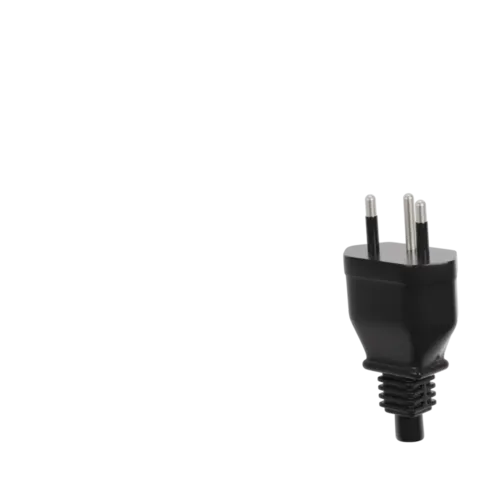
Plug
Type N
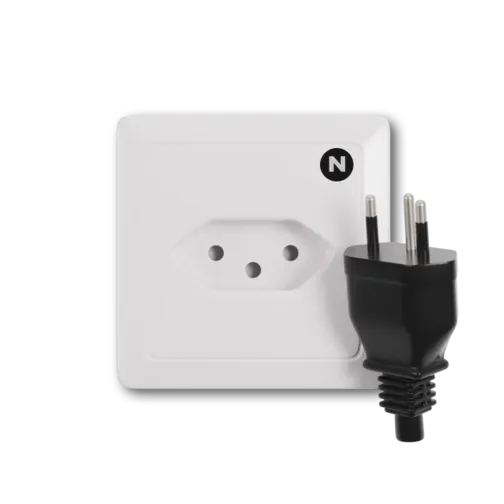
Plug & Socket
Type N
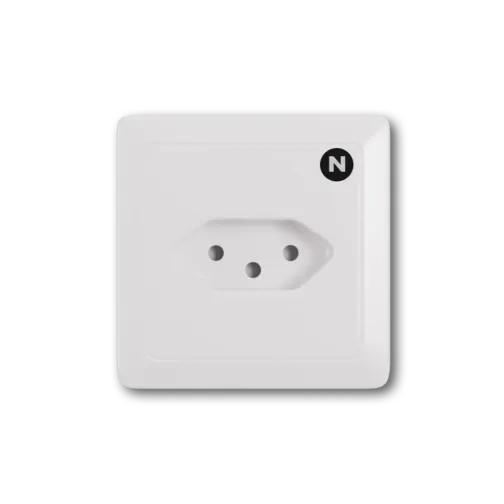
Socket
Type N
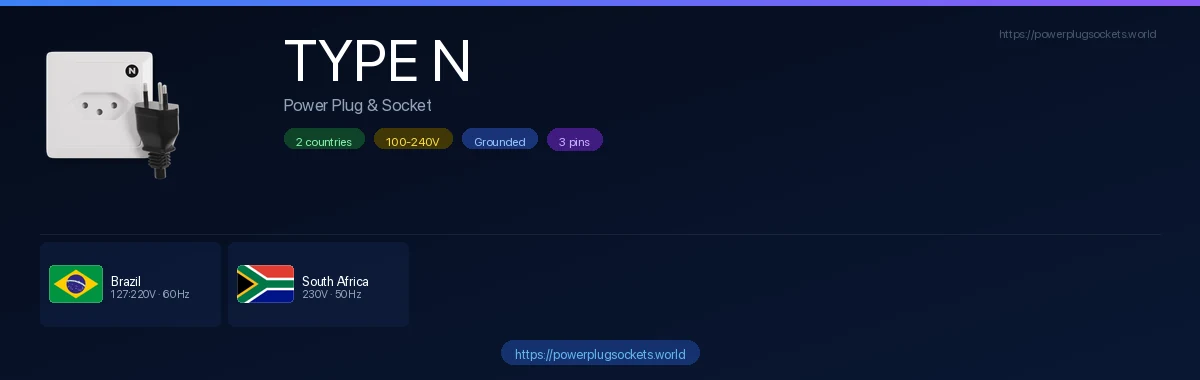
Heading to Brazil, or wiring a new room in a South African home? The three-hole outlet you'll find there is plug type N: two round power pins and an offset earth pin set in a small hexagonal pocket, made in 10 A, 16 A and 20 A versions.
This guide gives you the pin sizes, which plugs fit a Type N socket, and when your devices need more than a simple adapter.
What Is Plug Type N?
Type N is the IEC letter for a three-pin household plug and socket system built on IEC 60906-1, published by the International Electrotechnical Commission in 1986 as a 16 A, 250 V plug for nominal voltages between 200 V and 250 V. It was a bid at standardization for 230 V mains, but the push to make it the European common plug was shelved. The pins form a small triangle in a recessed hexagon, and the compact body comes from injection moulding. See also will my charger work in Afghanistan on 220V.
Insulated sleeves on the pins, so a partially inserted plug cannot touch live metal, shutters and a recessed face guard against electric shock and give strong electrical safety. Brazil adopted its own variant and South Africa the original, while Paraguay lists it as a voluntary national standard.
The plug shape alone does not tell you the electricity supply, the frequency, or whether the earthing behind the wall is wired.
Type N Sockets: Pin Dimensions and Layout
Every version shares one geometry. The line and neutral pins are 19 mm long and sit 19 mm apart, with the earth pin between them, and the live pin is on the right when the earth hole is offset upward.
| Socket version | Rating | Pin size | Receptacle accepts | Shutters |
|---|---|---|---|---|
| Brazil, 10 A | 10 A, 250 V | 4 mm | 10 A Type N plugs, Europlug | Not required |
| South Africa, 16 A | 16 A, 250 V | 4.5 mm | 10 A and 16 A Type N plugs, Europlug | Mandatory |
| Brazil, 20 A | 20 A, 250 V | 4.8 mm | All three plug sizes, Europlug | Not required |
Earth Pin Offset and Pin Diameter
The earth pin offset is just 3 mm from the line between the power pins, against 5 mm on the Type J plug from Switzerland. Pin diameter sets the rating, so a thicker plug, grounding pin included, can't enter a thinner receptacle.
The geometry itself stops a high-rated plug from going into a lower-rated socket-outlet.
NBR 14136: The Brazilian Standard at 10 A and 20 A
NBR 14136, adopted in 1998 and revised in 2002, replaced a mix of Europlugs and American plugs with one family. It became compulsory on 1 January 2010, and the sockets still accept Type C plugs.
Voltage is the part that catches visitors out, since many states supply 127-volt power and others 220-volt power, both at 60 Hz. NBR 14136 does not require shutters over the live and neutral holes, so a Brazilian socket may have open holes.
Many older homes had no earth conductor, so the third terminal may not be connected and a grounded outlet is not guaranteed. A loose flying earth tail on large appliances is worth having an electrician check, since grounding only protects you when the wiring behind it is earthed.
10 A and 20 A Sockets in Brazilian Homes
The 10 A socket is the everyday outlet for lamps, TVs and small electronics, while the 20 A socket has wider holes and suits microwaves, air conditioners and other larger appliances. A 10 A plug fits both, but the thicker plug won't enter the smaller socket.
SANS 164-2: The 16 A Version Used in South Africa
South Africa adopted the IEC design almost unchanged as SANS 164-2 in 1992, keeping the 16 A rating and shuttered holes, and in 2013 it became the preferred standard for new installations. It replaces the bulky Type M, which does not take the Europlug, and the smaller Type D. Supply there is 230 V at 50 Hz, close to European power.
Type N Plug Compatibility With Other Plug Types
Smaller pins go into bigger holes, never the reverse, so a Brazilian 10 A plug is compatible with every socket in the family. Because of tolerances, a 16 A plug may squeeze into a Brazilian 10 A socket and overload it.
Outside the family, the Europlug and any Type N plug of equal or lower rating fit, while Swiss, German, French, British and American plugs are not compatible and need an adapter, an incompatible fit that an adapter fixes only in shape. A so-called universal socket meets no official standard and can leave live pins exposed.
Type C Plugs and the Europlug
The Europlug's two pins, round pins rated 2.5 A at 250 V, slide into any Type N outlet, and its profile matches the hexagonal recess. Most phone and laptop chargers sold in Europe use it.
It gives no earth connection, so keep it to double-insulated devices.
Why a Swiss Type J Plug Will Not Fit
The Swiss plug has the same 19 mm spacing, but its larger earth offset lands where the socket has no hole. Don't force it, and pack an adapter instead.
Using a Type N Socket When You Travel
For travellers, the plug is only half the question, because two outlets in neighbouring Brazilian states can look identical and deliver different power. A travel adapter or plug adapter only changes the shape and does not convert electricity.
If your gear has an earth pin, pick a grounded, 3-prong model and check its rating, since many adaptors are limited to 10 A. Check each charger label: if the input voltage reads 100-240V, it's dual voltage and needs only the adapter, while a hair dryer or curling iron built for 120 volts needs a voltage converter.
Matching Appliance Load to a Type N Standard Rating
The rating on each outlet is a current limit in amps, and the current an appliance draws is its power divided by the mains voltage. Because some Brazilian states run at 127 volts, the same appliance pulls far more current there. Next, look at do i need a voltage converter for Bhutan.
| Appliance | Power | Current at 127 V | Current at 220 V | Fits a 10 A outlet? |
|---|---|---|---|---|
| Laptop charger | 65 W | 0.51 A | 0.30 A | Yes, anywhere |
| Microwave oven | 1,350 W | 10.63 A | 6.14 A | No on 127-volt, yes on 220-volt |
| Hair dryer | 1,850 W | 14.57 A | 8.41 A | No on 127-volt, yes on 220-volt |
| Electric kettle | 2,200 W | 17.32 A | 10.00 A | No; at the limit on 220-volt |
The 1,350 W microwave draws 10.63 A on a 127-volt circuit, just over the smaller socket's limit, and the kettle draws exactly 10.00 A at 220-volt supply, so leave headroom.
When a Grounded High-Current Type N Outlet Is Worth It
In a Brazilian kitchen or laundry, put the larger earthed outlets where the kettle, microwave and washing machine will go. On South African 230-volt supply the same kettle pulls only 9.57 A, so match the socket, the electrical cable and the breaker to the heaviest appliance.