Type A vs Type K Plugs: Differences & Compatibility
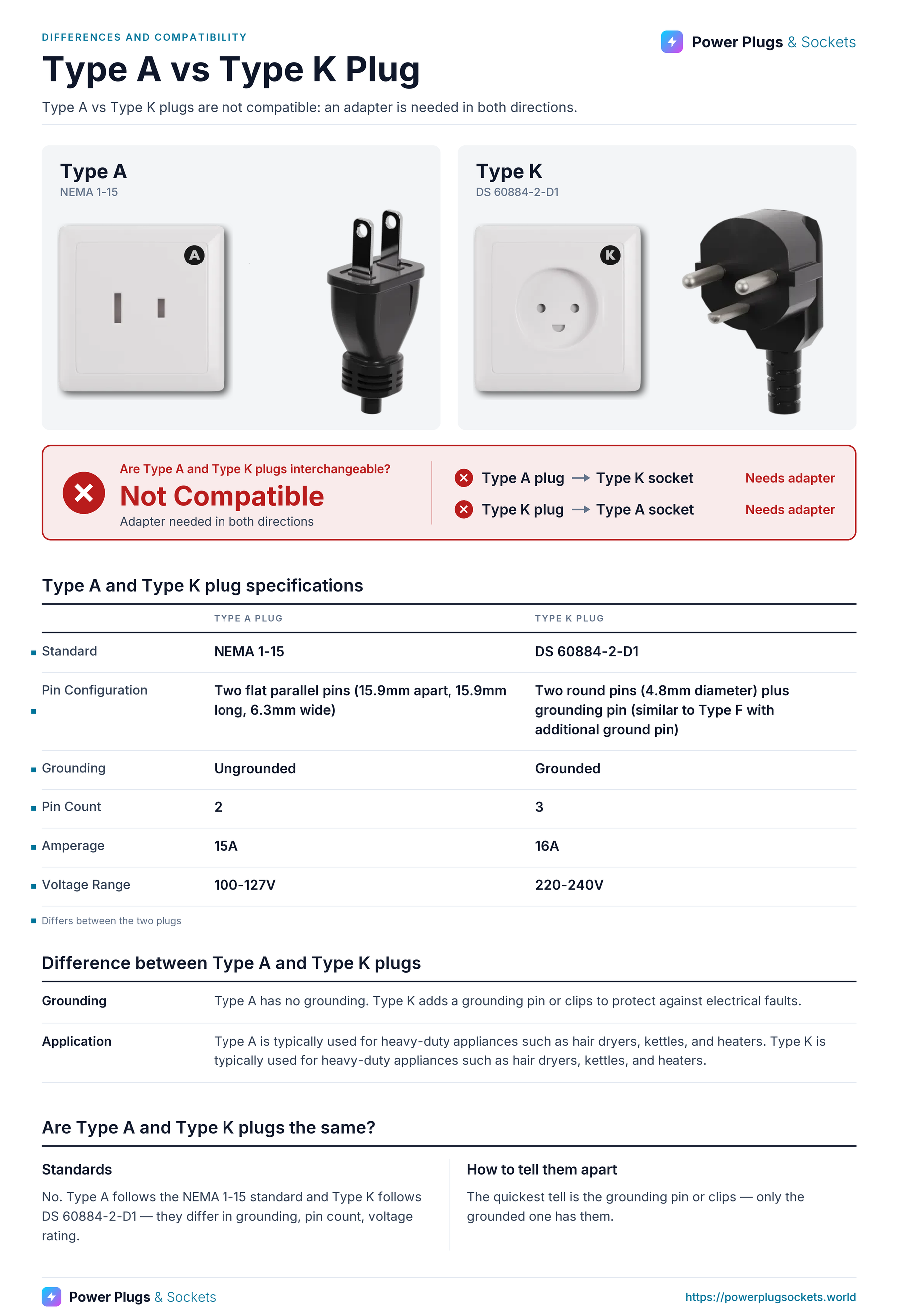
Type A vs Type K plugs are not compatible: an adapter is needed in both directions. Type A is a 2-pin, ungrounded plug rated 15A at 100-127V, while Type K is a 3-pin, grounded plug rated 16A at 220-240V. The two differ mainly in grounding, voltage, amperage and pin design, which is what decides compatibility — whether a Type A plug fits a Type K socket, and vice versa. Next, check packing an adapter for a trip that has both type H and type O sockets.
Swipe to compare
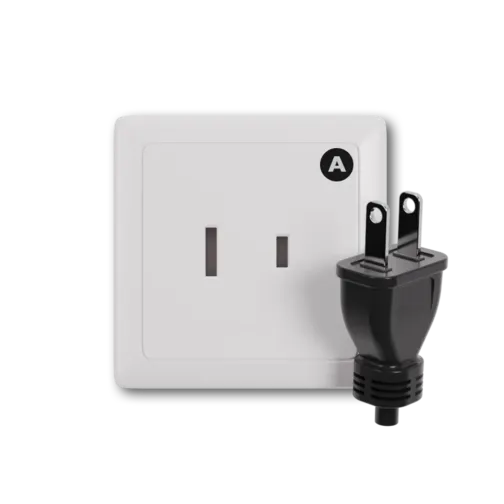
Type A
|
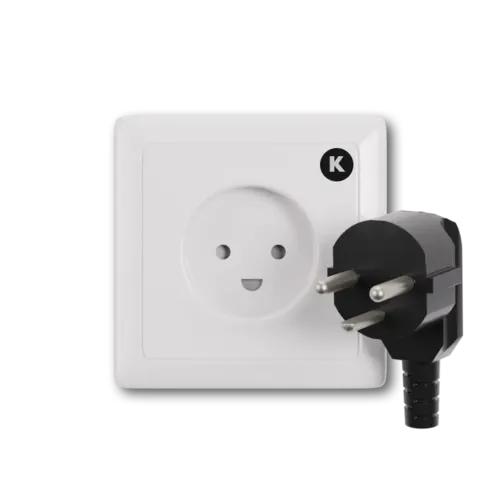
Type K
|
|
|---|---|---|
| Standard | NEMA 1-15 | DS 60884-2-D1 |
| Pin Configuration | Two flat parallel pins (15.9mm apart, 15.9mm long, 6.3mm wide) | Two round pins (4.8mm diameter) plus grounding pin (similar to Type F with additional ground pin) |
| Grounding | Ungrounded | Grounded |
| Pin Count | 2 | 3 |
| Amperage | 15A | 16A |
| Voltage Range | 100-127V | 220-240V |
The type A vs type K plug question comes down to one fact: the two share no physical compatibility at all. A two-blade American power plug and the round-pin Type K plug & socket used in Denmark and Greenland differ in shape, earthing, current rating and the voltage of the electricity behind them, so you need the right adapter abroad, and sometimes a converter.
Type A vs Type K Plug at a Glance: 15 A vs 16 A and Voltage
The International Electrotechnical Commission (IEC) letters are travel shorthand, and a matching letter never guarantees matching voltage. Type K is a European design on a 50 Hz supply, with round pins, a 16 A rating and an earth pin; the European Union later pushed Schuko instead, and across Europe Type K is the odd one out.
| Feature | Type A | Type K |
|---|---|---|
| Main standard | NEMA 1-15 (US and Canada), JIS C 8303 Class II (Japan) | DS 60884-2-D1, the Danish standard |
| Contacts | Two flat parallel blades, no earth | Two round power pins plus a half-round earth pin |
| Earthed | No (ungrounded) | Yes (grounded) |
| Polarized | Usually, via a wider neutral blade | Yes, fixed live and neutral positions |
| Amp rating | 15 A at 125 V | 16 A at 250 V |
| Typical mains voltage | 100-127 V | 220-240 V (nominally 230 V) |
| Main countries | United States, Canada, Mexico, Japan, parts of China | Denmark, Greenland, Faroe Islands |
| Compatible plugs | Nothing else; the socket is two slots | Europlug (Type C), CEE 7/17, and CEE 7/4 or Type E without an earth |
The 15 A vs 16 A ratings look similar, but a 16 A socket on 230 V delivers close to twice the power. Matching plug shape alone never makes an appliance safe; the device must accept the local supply.
Pin Dimensions of Each Power Plug
The pin dimensions explain why neither power plug fits the other socket. A Type A plug has two flat parallel blades on 12.7 mm centres, while the Danish live and neutral pins are 4.8 mm round and sit 19 mm apart, with a half-round, D-shaped (U-shaped) earth pin 14 mm long and 6.5 mm wide, 13 mm below the line of pin centers.
The NEMA 1-15 Plug Explained
The National Electrical Manufacturers Association names connectors with a code such as NEMA 1-15P: the first number is the pin configuration, the second the maximum current, and P or R marks a plug or receptacle. Type A plugs are an ungrounded parallel blade design rated 15 A at 125 V; they protect through double insulation and fit the grounded NEMA 5-15 receptacle in most modern American homes. For a related pairing, see is a type B plug compatible with a type M socket.
Polarization means the wider neutral blade enters only the wide slot, keeping the switch on the hot blade; an unpolarized plug has equal blades. Harvey Hubbell patented it for North America and Central America; a polarized plug of this kind suits 15 A at 125 volts and the 60 Hz supply; Japan uses JIS C 8303 at 100 V, and Class II chargers need no earth.
Type B and NEMA 5-15: The Grounded Cousin
Type B is the NEMA 5-15 plug: the two flat blades of Type A plus a longer round or D-shaped ground pin. Every Type A plug is compatible with this grounded receptacle, but not the reverse.
Ungrounded two-slot outlets are no longer allowed in new construction, though older buildings keep them. Type K's earth ground protects a Class I appliance after an insulation failure.
The Danish Plug and Its Earthing Pin
The Danish plug follows the Danish standard DS 60884-2-D1, an update of Section 107-2-D1. What makes it unusual is that the earthing pin is part of the plug, while French Type E puts a male pin in the socket and German Schuko uses side clips.
The neutral pin and live pin are two round pins carrying 220-240 V mains electricity, both plug and socket are rated 16 A, and child-resistant shutters and recessed sockets keep fingers from live pins. Since 2008 every Danish socket has to sit behind earth-fault interrupters, and the traditional socket switch is now optional.
Type K plugs also come in a computer socket variant on surge protection circuits.
Where Type K Is Used: Denmark, Greenland and the Faroe Islands
Type K is the most local plug in the IEC list, found in Denmark and its two self-governing territories. Most new appliances now arrive with a 16 A Schuko plug.
Socket Compatibility: Which Plugs Fit Each Outlet
Compatibility between the two families is a one-line answer: none, and Type A plugs and Type K plugs never mix. An American Type A socket accepts only Type A, its Type B partner accepts A and B, and a Type K socket is more forgiving, though not always safely.
Avoid a universal socket that claims every plug fits; such sockets meet no official standard and can skip the earth.
Europlug and Type C Plug in a Danish Socket
The two-pin Europlug (CEE 7/16, the flat type C plug) fits a Danish socket fully and safely, because it is unearthed. So does the round CEE 7/17 contour plug, rated up to 16 A.
Schuko and Type F Plug: Fits but No Earth Connection
A Schuko or type F plug (CEE 7/4) physically enters a Danish socket, but no earth connection is made, because Schuko earths through side clips and a Danish socket needs a male earth pin. This partial compatibility is unsafe: a buzzing sensation from a toaster or dishwasher casing is a sign of a live fault, and can be life-threatening.
The Danish Safety Technology Authority now allows Type F sockets.
Type E and CEE 7/7 Hybrids
The French Type E plug and the CEE 7/7 hybrid also fit but arrive unearthed.
Flat Blades Versus Round Power Pins
Flat blades 12.7 mm apart cannot enter round holes 19 mm apart, and the Danish plug has nowhere to go in a two-slot American outlet. Any connection needs an adapter.
Travelling With Either Plug: Travel Adapter or Voltage Converter
A travel adapter changes only the plug shape, while a voltage converter changes the voltage. Travellers should note that electrical appliances that heat, such as hair dryers, are where mistakes happen. For a related pairing, see how does the amperage rating of a type J plug compare to a type N plug.
Most dual voltage phone and laptop AC adapters read "100-240 V, 50/60 Hz" and need only a plug, but a 120 V-only device will usually burn out within seconds on the Danish frequency and supply.
Choosing a Plug Adapter for Denmark or the US
Heading to Denmark, choose a plug adapter with a Type K or Schuko output that carries an earth, or a Europlug adapter for two-pin chargers. For an earthed Danish appliance in the US, use a three-prong NEMA 5-15 output.
American multisocket adaptors, plug strip units and any extension cord are built for 15 A at 125 V, so use them only at home, not abroad.
Plug Safety: Electric Shocks From Mismatched Sockets
Most electric shock cases in a circuit come from mismatched standards: an unearthed Schuko or French plug in a Type K socket, or a 120 V device on 230 V through a cheap adapter. Treat any tingle from a metal appliance case as a warning to unplug devices.
Polarized Plugs and Live Pin Placement
The Danish socket places live on the left, earth at the bottom. An adapter can swap that orientation and leave a lamp's switch on neutral.
Grounding Pin Rules in New Wiring
Never remove or bend a grounding pin to make a plug fit. Cheater adapters that turn a three-prong plug into a two-blade plug defeat the earth unless their tab is screwed to a grounded outlet cover.