Type B vs Type M Plugs: Differences & Compatibility
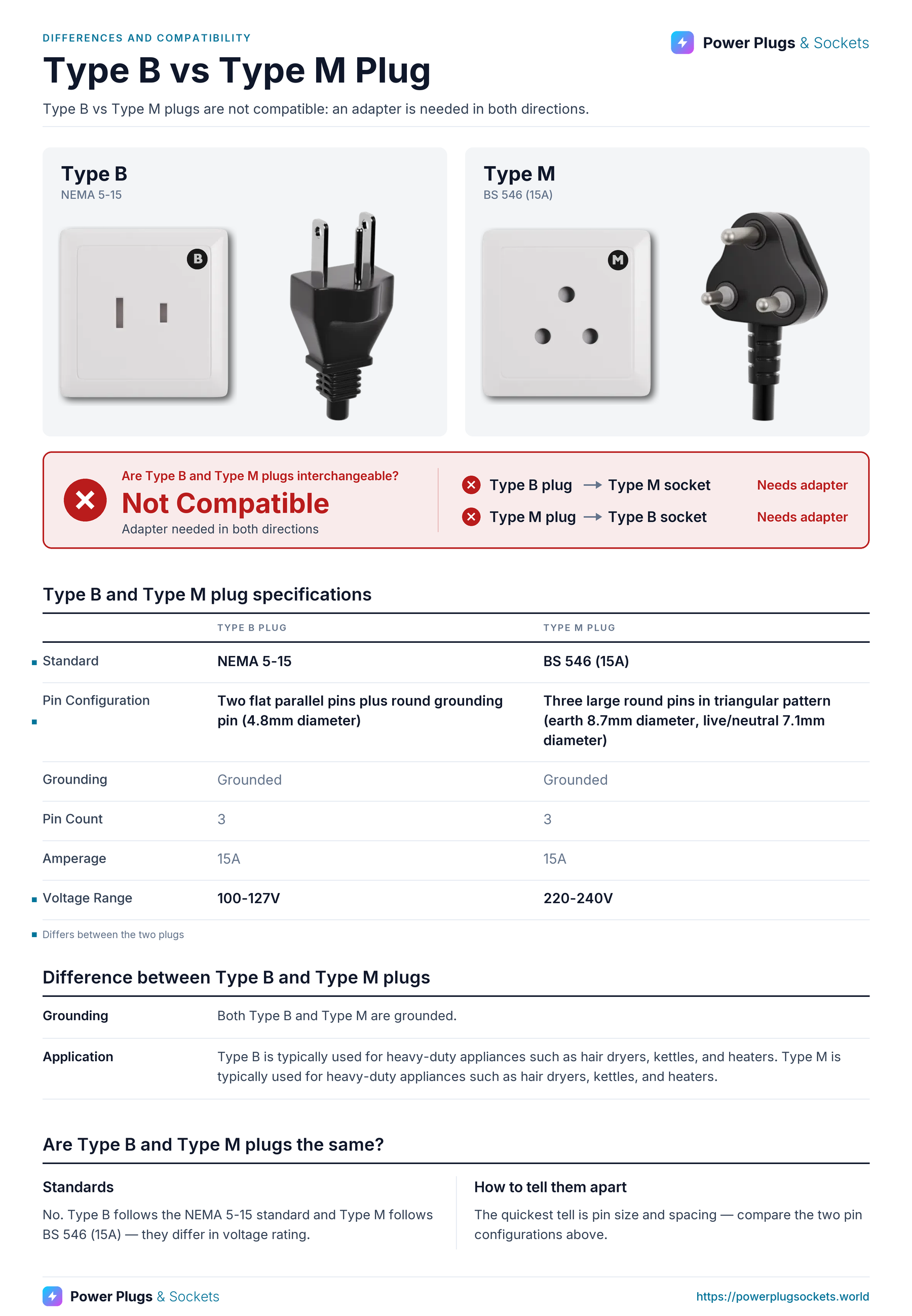
Type B vs Type M plugs are not compatible: an adapter is needed in both directions. Type B is a 3-pin, grounded plug rated 15A at 100-127V, while Type M is a 3-pin, grounded plug rated 15A at 220-240V. The two differ mainly in voltage and pin design, which is what decides compatibility — whether a Type B plug fits a Type M socket, and vice versa. Also see can i use a type J adapter with a type N socket.
Swipe to compare
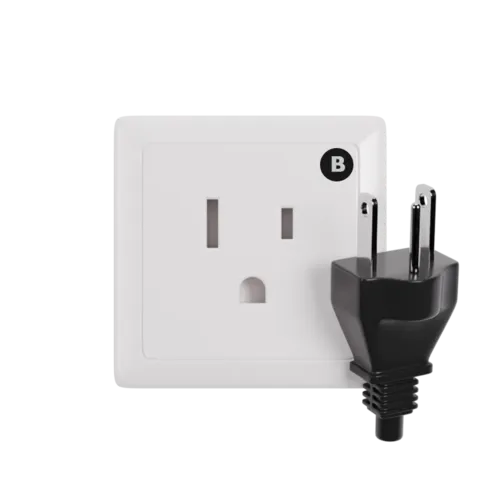
Type B
|
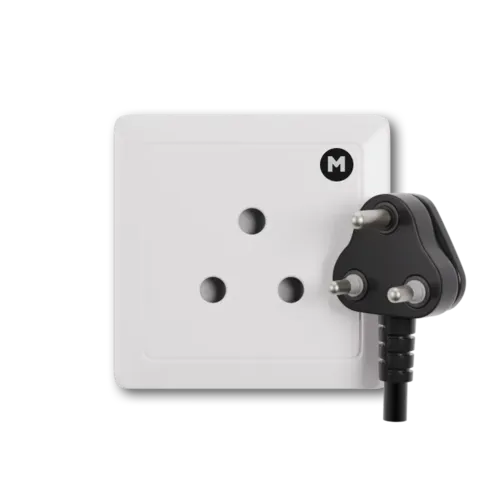
Type M
|
|
|---|---|---|
| Standard | NEMA 5-15 | BS 546 (15A) |
| Pin Configuration | Two flat parallel pins plus round grounding pin (4.8mm diameter) | Three large round pins in triangular pattern (earth 8.7mm diameter, live/neutral 7.1mm diameter) |
| Grounding | Grounded | Grounded |
| Pin Count | 3 | 3 |
| Amperage | 15A | 15A |
| Voltage Range | 100-127V | 220-240V |
Packing for a trip between North America and southern Africa or South Asia? The type B vs type M plug question pits two flat parallel pins plus a round earth pin against three thick round prongs in a triangle.
Neither fits the other's socket, and this page shows what you need to run devices safely on foreign electricity.
Type B vs Type M Plug at a Glance
Both are earthed three-pin designs. Type B is the grounded design NEMA standardised for North America; Type M is a heavy round-pin plug from Britain that carries mains electricity across southern Africa and South Asia.
The IEC reuses the letters, but the national standards matter more than the letter.
| Feature | Type B | Type M |
|---|---|---|
| IEC type letter | B | M |
| Main standards | NEMA 5-15 (North America), JIS C 8303 (Japanese) | BS 546 (British), SANS 164-1 (South African), IS 1293 (Indian) |
| Pins | Two flat blades plus a round or D-shaped third prong | Three round pins, earth at the top |
| Power pin spacing | 12.7 mm between blade centres | 25.4 mm between live and neutral centres |
| Pin size | Blades 6.3 mm wide, 1.5 mm thick | 7.05 mm power pins, 8.7 mm earth |
| Rating | 15 A, 125 V | 15 A (British) or 16 A, 250 V |
| Mains supply | 100 – 127 V, 60 Hz | 220 – 240 V, 50 Hz |
| Polarized | Yes, fixed by the third prong | Yes, fixed by the triangle |
| Fused plug | No | No, unfused |
| Power socket also accepts | Type A | No other plug |
| Typical use | Nearly every household outlet in North America | Large appliances, and general sockets in South Africa |
A Type B power socket also accepts the two-blade Type A plug, but a Type M socket takes nothing but its own plug, not even the Europlug.
Pin Shape: Flat Parallel Pins vs Three Round Pins
Type B puts two flat parallel blades 12.7 mm apart above a round or D-shaped contact; Type M uses 7.05 mm power pins and an 8.7 mm earth, all pins arranged in a triangle. That pin diameter gap alone makes the plugs incompatible.
Ratings: 15 A at 125 V vs 16 A at 250 V
The current rating is the plug's ceiling: Type B is 15 amps at 125 volts, about 1,800 watts on 120 V, while the South African and Indian Type M is 16 A at 250 V, roughly 3,680 watts on 230 V, so these socket-outlets serve geysers and air conditioners. Type B homes receive 100 – 127 V; Type M sockets sit on 220 – 240 V, double the voltage at a different frequency.
How the Type B Plug (NEMA 5-15) Is Built
The "5" is NEMA's code for a two-pole grounded configuration, "15" the amps, and the wall receptacle is a NEMA 5-15R; receptacles in the other direction are covered below. The narrower blade is live and the wider is neutral, with a matching wider neutral blade slot.
Since 2008 US code has required tamper-resistant sockets whose shutters open when both blades press at once.
Ground Pin Length and Polarity
The round ground pin is longer than the blades, so it connects first and releases last, and because it enters only one hole, a grounded plug is automatically polarized.
Countries That Use Type B Plugs
You'll meet Type B plugs in the United States, Canada, Mexico, Central America, the Caribbean, Taiwan and the Philippines, where the same power socket takes Type A. Japan has 100 V, South Africa and India 230 V, with Type M common in both South Africa and India.
Japan's Class I NEMA Version
Japanese plugs under JIS C 8303 are close to NEMA designs, with a Class I earthed version required in new homes since 2005, though older outlets take only Type A.
How Plug Type M (BS 546 15 A) Is Built
Type M comes from a 1934 British standard defining round-pin plugs at 2, 5, 15 and 30 amps, each non-interchangeable. Like Type B it is polarized by geometry, but it is unfused, so protection relies on the circuit breaker. You might also want how do i tell a type A plug apart from a type K plug.
Its long earth pin connects first and opens the shutters, and sleeved power pins cut the electric shock risk when the plug is partially inserted. The South African version, rated 16 A, is the country's familiar wall socket; the Indian IS 1293 version serves 16 A kitchens and bathrooms.
You also find it in Lesotho, Namibia, Mozambique, Nepal and Sri Lanka, while South Africa's newer SANS 164-2 system is IEC Type N.
Larger Pins Than Plug Type D
The smaller sibling, plug type D, uses 5.1 mm power pins, a 7.1 mm earth and 19.1 mm spacing, rated 5 A. Plug M uses larger pins and 25.4 mm spacing, so the two never interchange, though combination sockets for both are common.
Grounded Plug Compatibility Between B and M Outlets
There is none: flat blades won't enter round holes, and Type M pins are too thick for any NEMA slot. The mismatch is deliberate, so a 120-volt appliance cannot be plugged into a 230-volt circuit by accident.
Be wary of the universal socket in hotels, which can leave pins exposed, lack a proper earth and invite a voltage mismatch, a risk to electrical safety.
Which Plugs Are Socket Compatible With Each Type
- Type B power socket: socket compatible with NEMA 5-15 and NEMA 1-15, so Type B and Type A.
- Type M power socket (16 A): its own round-pin plug only.
- Europlug: fits neither, unless the socket has an extra two-pin opening.
An adapter solves shape only. A charger labelled 100–240 V is dual voltage, as phone and laptop AC adapters usually are, while a 120 V hair dryer can overheat within seconds on 230 V.
Travelling With Type B Adapters and Plug M Sockets
Travellers from North America to Johannesburg, Maseru or Mumbai meet Type M walls with Type B or Type A gear. Type B adapters are listed by country, but one for the 16 A Type M socket differs from Europlug or Type G models, so check the pin layout. For a related pairing, see type D vs type N plug.
Picking a Travel Adapter or Plug Adapter
Choose a plug adapter with a real metal earth contact rather than a plastic dummy pin, rated at least 10 A at 250 V; cheap travel adaptors often skip earth, fine for a two-pin charger but not a three-prong laptop brick. Never stack adapters.
When You Also Need a Voltage Converter
A voltage converter steps the supply down for single-voltage devices, sized at least 25% above the load, so a 1,200-watt iron needs 1,500 watts. It won't change the frequency.
Multisocket adaptors are limited by its total rating, and a North American power strip or extension cord on a Type M adapter is limited to the lowest rating in the chain, inviting overload; check power cords too.
Earthed Plug Safety and Grounding on Both Systems
Each is an earthed plug in the IEC sense: it connects metal-cased equipment to earth so a fault trips the breaker. That earthing works only if the socket is genuinely wired to earth, so test older outlets.
Two-pin chargers rely on double insulation instead, so they are safe in an adapter without earth; a microwave or power tool needs real earthing.