Type A vs Type O Plugs: Differences & Compatibility
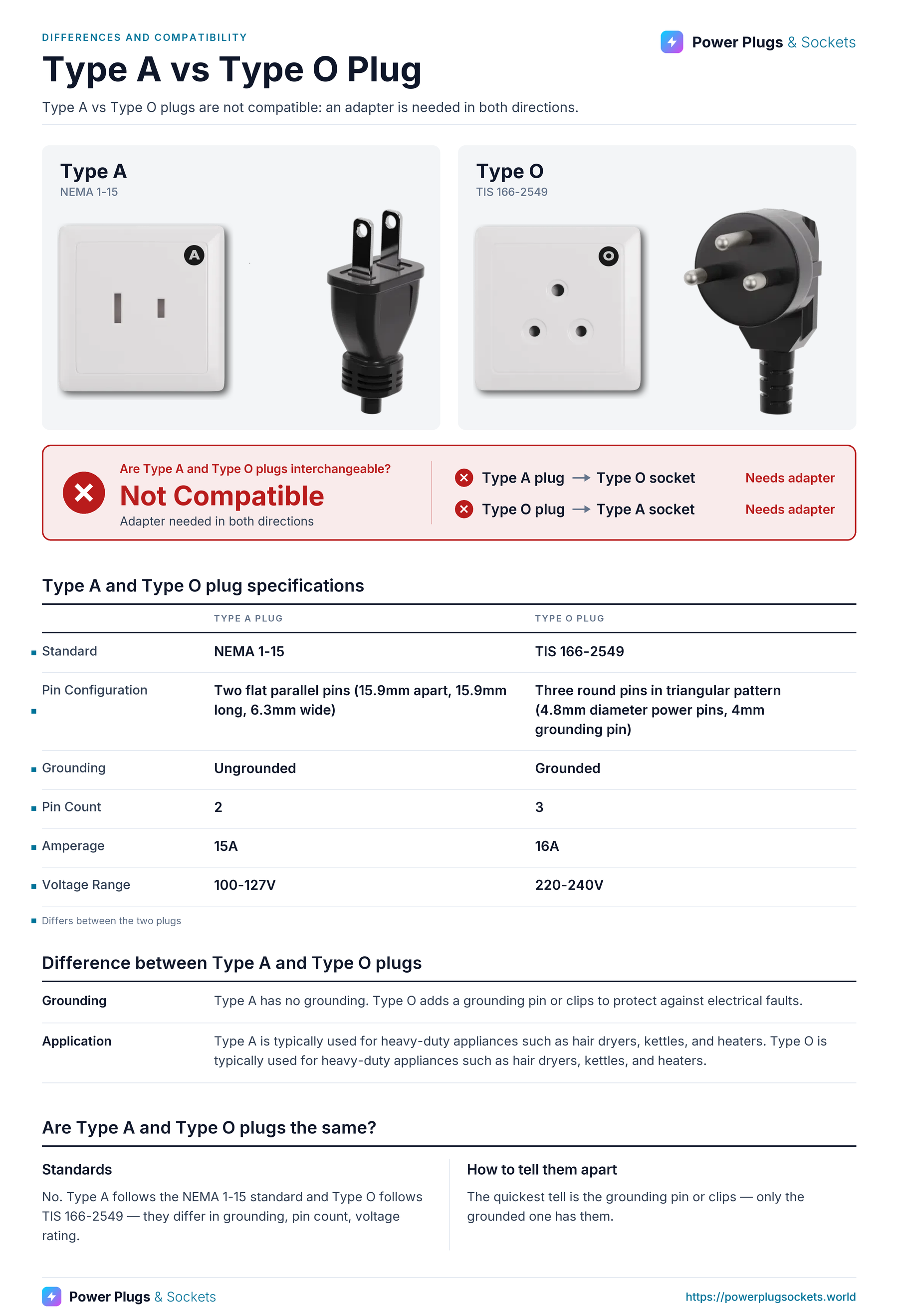
Type A vs Type O plugs are not compatible: an adapter is needed in both directions. Type A is a 2-pin, ungrounded plug rated 15A at 100-127V, while Type O is a 3-pin, grounded plug rated 16A at 220-240V. The two differ mainly in grounding, voltage, amperage and pin design, which is what decides compatibility — whether a Type A plug fits a Type O socket, and vice versa. Next, check type E versus type L plug shape and socket design compared.
Swipe to compare
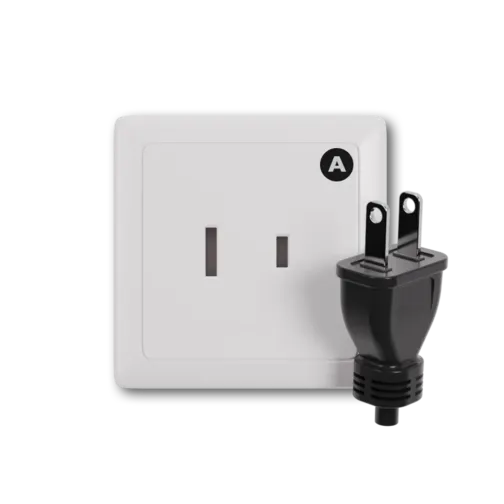
Type A
|
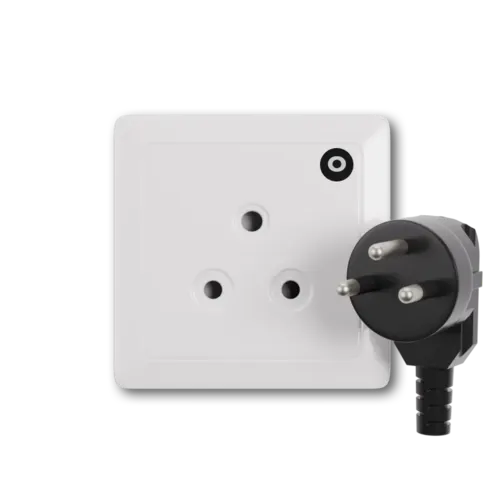
Type O
|
|
|---|---|---|
| Standard | NEMA 1-15 | TIS 166-2549 |
| Pin Configuration | Two flat parallel pins (15.9mm apart, 15.9mm long, 6.3mm wide) | Three round pins in triangular pattern (4.8mm diameter power pins, 4mm grounding pin) |
| Grounding | Ungrounded | Grounded |
| Pin Count | 2 | 3 |
| Amperage | 15A | 16A |
| Voltage Range | 100-127V | 220-240V |
Packing a charger for a trip between the United States and Bangkok? The type A vs type O plug question has two parts: the pin shape decides whether your plug fits the outlet, and the local electricity decides whether your devices survive.
This guide covers the pins, supply, frequency and when a travel adapter is enough or you also need a converter.
Type A vs Type O Plug at a Glance
The IEC World Plugs list gives each domestic plug and socket design a letter from A to O. Type A is the oldest and simplest, with two flat blades and no earth; type O is the newest, the Thai standard, with three round pins and a proper earth for a 230-volt grid. The letters are only labels; the engineering comes from a national standard. For a related pairing, see what adapter converts a type A plug to a type C socket.
The American plug is rated 15 A at 125 V on 100-127 V mains, the Thai plug 16 A at 250 V on 230 V at 50 Hz. These plugs and sockets differ in more than shape.
Many Thai sockets accept American flat-blade plugs, but no American outlet takes Thai round pins.
The American NEMA 1-15 Parallel Blade Plug
The formal name is NEMA 1-15: configuration 1, two-wire with no earth, rated 15 A. Its two flat blades sit 12.7 mm apart. A type A plug (plug type A, or type A plugs) is found across the United States, Canada and Mexico, where mains runs at 100-127 V and 60 Hz, and through Central America and parts of the Caribbean.
Most plugs are polarized, with a wider neutral blade so the switch sits on the live side, whereas the Thai socket enforces polarity with its earth pin. Japan uses the same shape under JIS C 8303 at 100 V, 50 Hz in the east and 60 Hz in the west.
The plug is meant for Class II double-insulated appliances; a metal-cased kettle needs the Thai three-pin plug.
The Thai Plug and the TIS 166-2549 Standard
Type O plugs are required on new appliances in Thailand. The Thai plug follows the Thai Industrial Standard TIS 166-2549, covering household plugs, sockets and socket-outlets with a rated voltage up to 250 V. Thailand previously relied on American-style plugs even though it runs at 230 V; the electrical standard was later listed by the IEC the new design as Type O. It defines a grounded three-pin plug and an ungrounded two-pin plug, both 16 A, a plain three-round-pin socket and the hybrid socket still found in most Thai homes.
Earth Pin and Power Pins Dimensions
The round power pins have a pin diameter of 4.8 mm, sit 19 mm apart and carry insulated pins for the first 10 mm. The earth pin, or ground pin, has the same diameter but is longer, 21.4 mm, so it connects first and lines up with the earth hole that older Thai sockets had for American grounded plugs.
The Two-Pin Type O Variant vs the Europlug
The two-pin Thai plug looks like the Europlug (type C) but is rated 16 A, against 2.5 A for the Europlug. A Thai socket accepts a type C plug, though only for light loads such as a phone charger.
Two-Pin and Three-Pin Plug Types Compared Spec by Spec
The plug rating is what the plug carries; the mains voltage is what the wall supplies, and it decides whether you need a converter. Compare this with can i use a type C adapter with a type I socket.
| Feature | Type A (NEMA 1-15) | Type O (TIS 166-2549) |
|---|---|---|
| Pins | Two-pin: flat parallel blades | Three-pin: two round power pins plus earth |
| Pin spacing | 12.7 mm between blades | 19 mm between power pins |
| Earth connection | Not grounded | Grounded (two-pin variant not grounded) |
| Plug rating | 15 A, 125 V | 16 A, 250 V |
| Mains voltage where used | 100-127 V | 220-240 V (230 V nominal) |
| Frequency | 60 Hz (50 Hz in eastern Japan) | 50 Hz |
| Polarized | Optional, by wider neutral blade | Yes, by the earth pin |
| Insulated pins | No | Yes, first 10 mm |
| Socket accepts | Type A only (NEMA 5-15 outlets also take Type B) | Type O, plus type C; hybrid sockets also take Type A and Type B |
| Main countries | United States, Canada, Mexico, Japan | Thailand |
A grounded plug gives fault current a path to earth, and the Thai standard builds earthing into the main plug; in North America that job falls to NEMA 5-15. The same outlet delivers almost twice the power at 230 V than at 120 V, roughly 3,680 W at 16 A against 1,800 W at 15 A, and a 120 V-only appliance on 230 V can burn out within seconds.
Many travel adapters are rated lower than either plug, often 10 ampere, so check before running a heater through one. The power supply of the wall, the mains electricity, is what a charger label must match.
Plug and Socket Compatibility in Thailand
A flat-blade American plug often fits a Thai socket; a round-pin Thai plug never fits an American outlet, so you need an adapter and usually a step-down converter. A plain three-round-pin Thai socket accepts only type O and type C plugs, so partial compatibility with older and hotel sockets causes most of the confusion.
Hybrid Socket and Dual Socket Wiring
The hybrid socket takes Thai round pins, the Europlug, flat American blades and the type B plug, because its earth hole sits where the American one does. A dual socket pairs a hybrid face with a plain Thai face.
These multi-standard faces are not a universal socket, which meets no official standard, and they still supply 230 V, so only dual voltage devices labelled 100-240 V are compatible.
Unsafe Fits With Type E and Type F
French type E and German type F plugs can be pushed into some hybrid sockets, but the fit is unsafe: neither makes earth contact. The plain Thai socket is recessed and has shutters that reduce this risk.
Safety Between the Two Socket Types
The American outlet is a flat face with exposed slots and uninsulated blades; newer sockets add tamper-resistant shutters, but the burden falls on the outlet. The Thai design adds insulated sleeves, an earth pin that connects first and shuttered contacts against electric shock.
Its weak point is the hybrid socket, which can run a metal-cased two-pin appliance with no earthing.
Travel Adapter or Voltage Converter for Each Outlet
A travel adapter changes only the pin shape; a voltage converter changes the voltage, and you need one whenever an appliance is not rated for the grid. Check the label first.
- 100-240 V, 50/60 Hz: dual voltage, so in Thailand you need no converter.
- 120 V only: a step-down converter rated above the appliance's wattage, plus any adapter.
- Thai 230 V appliance in the US: an adapter plus a step-up converter.
Choosing a Plug Adapter for Thailand
For a plain Thai socket, choose a plug adapter with flat blades on the front, round pins on the back and the earth passed through. Avoid travel adaptors that stack another adapter or an extension cord on top, a common cause of overheating.
The rating is printed on the charger or power cord tag, such as "Input: 100-240V ~ 50/60Hz". Laptop and phone chargers usually qualify; hair dryers and kettles often do not.