Type E vs Type L Plugs: Differences & Compatibility
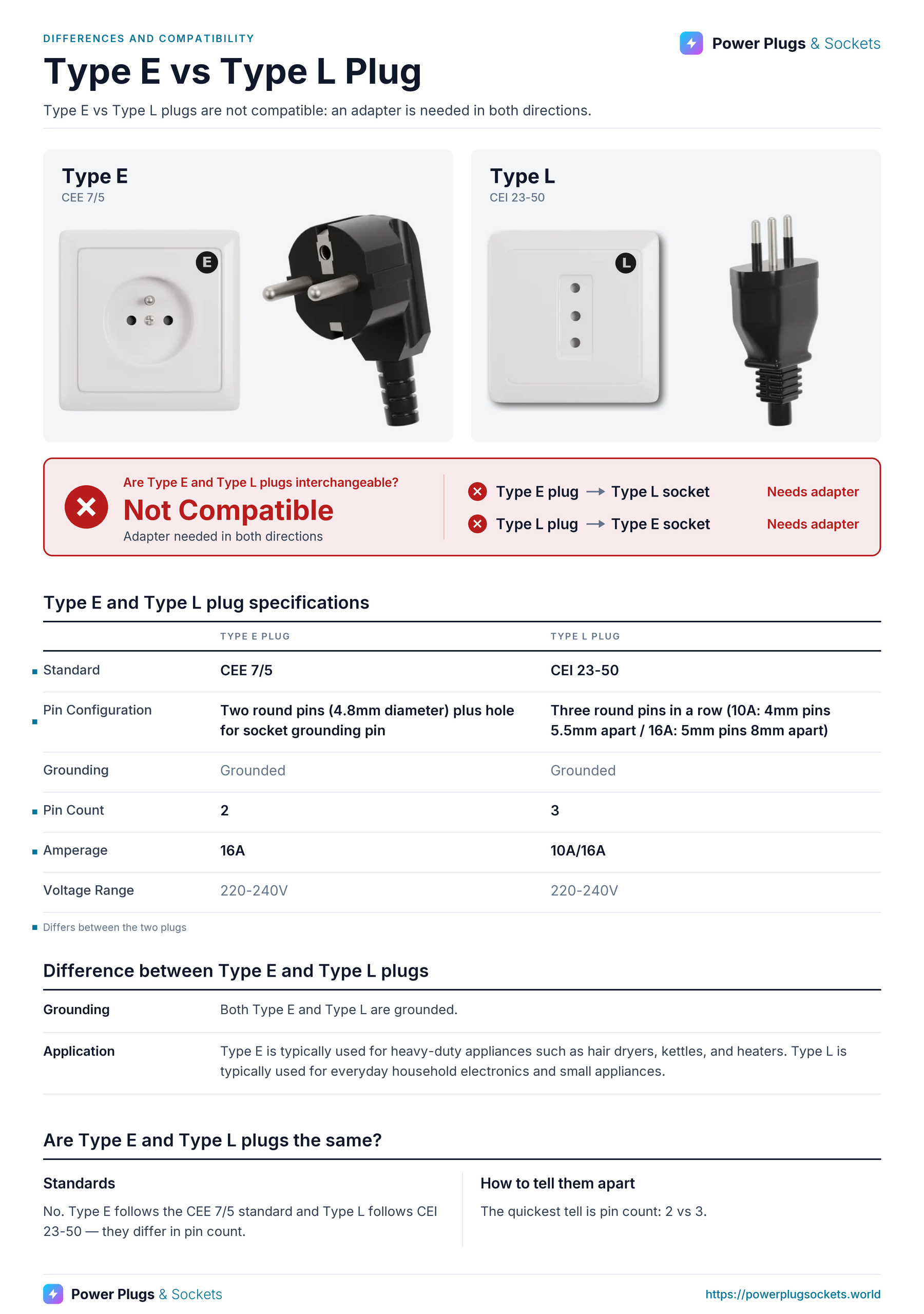
Type E vs Type L plugs are not compatible: an adapter is needed in both directions. Type E is a 2-pin, grounded plug rated 16A at 220-240V, while Type L is a 3-pin, grounded plug rated 10A/16A at 220-240V. The two differ mainly in amperage and pin design, which is what decides compatibility — whether a Type E plug fits a Type L socket, and vice versa. You might also want type G versus type K plug shape and socket design compared.
Swipe to compare
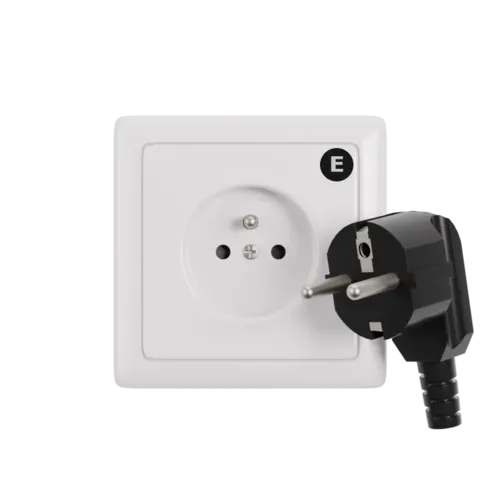
Type E
|
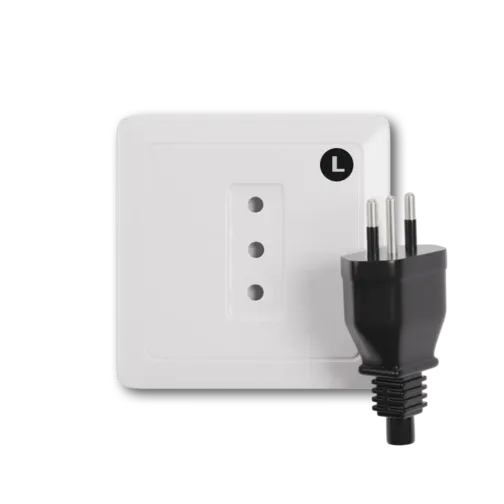
Type L
|
|
|---|---|---|
| Standard | CEE 7/5 | CEI 23-50 |
| Pin Configuration | Two round pins (4.8mm diameter) plus hole for socket grounding pin | Three round pins in a row (10A: 4mm pins 5.5mm apart / 16A: 5mm pins 8mm apart) |
| Grounding | Grounded | Grounded |
| Pin Count | 2 | 3 |
| Amperage | 16A | 10A/16A |
| Voltage Range | 220-240V | 220-240V |
Packing a hair dryer bought in France for a week in Rome? The Type E vs Type L plug question comes down to one thing: a type E plug is round with a hole for the earth pin that sticks out of the type E socket, while a Type L power plug from Italy lines up three pins in a straight row, so neither earthed plug fits the other's outlet without an adaptor.
Both systems run on the same 230 V electricity, so your appliances work fine once the shape problem is solved.
Type E vs Type L Plug: Side-by-Side Specifications
Type E is defined as CEE 7/5 (the socket) and CEE 7/6 (the plug) within the CEE 7 standard, while Type L follows the Italian national standard, which covers two sizes of plug. The IEC keeps the list of which country uses each letter. For a related pairing, see how the NEMA 1-15 standard for type A compares to TIS 166-2549 for type O.
| Feature | Type E (French/Belgian) | Type L (Italian) |
|---|---|---|
| Standard | CEE 7/5 socket, CEE 7/6 plug | Italian CEI standard, S10/S16 plugs |
| Pin layout | 2 round pins plus an earth hole | 3 pins in a straight line |
| Where the earth sits | Pin fixed in the socket | Middle pin on the plug |
| Pin size | 4.8 mm | 4 mm (10 A) or 5 mm (16 A) |
| Rating | 16 A | 10 A or 16 A |
| Socket face | Recessed by 15 mm | Flat or shallow, no deep recess |
| Accepts type C | Yes | Yes (10 A and twin-gauge sockets) |
| Accepts type F | Only E/F hybrids | Only in a P40 socket |
How the Type E Socket and CEE 7/6 Plug Are Built
The plug is round, with 2 pins of 4.8 mm and a round body that slides into the round recess of the wall outlet. The earth pin belongs to the power socket, not the plug: a round male pin projects from the CEE 7/5 face.
It sits offset by 10 mm from the line joining the power pins, with centres spaced 19 mm apart. The pin enters a grounding hole, a female contact, in the plug, so the earth contact closes first, and the 15 mm recess means a half-inserted plug is never a shock hazard.
Germany's Schuko system (type F, CEE 7/3 socket) earths through spring earthing clips instead. The CEE 7/7 hybrid E/F plug, rated at 16 amps, therefore carries clip contacts, plastic notches for the type F socket and a hole for the Type E pin.
It is polarised in a French or Belgian socket and common on Continental European appliances. Bigger loads use an IEC 60309 connector, and the original round plug is obsolete though still on older appliances.
The design is credited to the Belgian maker Vynckier around 1930. The Belgian/French standard was never patented, while Schuko was patented by Siemens with royalties.
France and Poland adopted it, and Italian makers kept their own in-line design.
How the Type L System Works
The Italian type L system has three round pins in a row: live and neutral outside, earth in the centre. It is also found in Chile, Uruguay and parts of North Africa such as Libya.
The earth is a grounding pin on the plug itself, and the plug is unpolarized, so live and neutral can swap sides. The national standard defines two sizes under the single letter L, which differ in pin diameter.
One is a 10 A plug with 4 mm pins and centres 19 mm apart for lamps and chargers. The other is a 16 A plug with 5 mm pins and 26 mm centres for washing machines and heaters.
Both are symmetrical, and a 16 A plug cannot enter a 10 A socket.
Most modern Italian homes use the presa bipasso, a twin-gauge socket (CEI 23-50 P17/11) with a central round hole flanked by two figure-8 holes, which takes both sizes and a Europlug, but not a round hybrid or German plug.
The CEI 23-50 P40 Hybrid Socket
The larger P40 receptacle merges the twin-gauge holes into a Schuko-style recess with side clips. This hybrid socket accepts both Type L sizes, the Europlug, CEE 7/4 and CEE 7/7 plugs and the unearthed CEE 7/17, so a French appliance with a hybrid plug goes straight in with its earth connected.
Type E and Type F vs Type L Compatibility
The earthed plugs don't cross over in either direction; the unearthed two-pin plugs, type C above all, link the two systems. Two plug shapes fit both without adaptors: the Europlug (CEE 7/16, type C), a flat plug that is not grounded and is rated 2.5 A, and the contour plug (CEE 7/17), rated 10 or 16 A, which fits Belgian and French sockets and a P40 but not a twin-gauge Italian socket. Also see is a type F plug compatible with a type L socket.
Phone chargers and most laptop bricks ship with a Europlug, which is why they work in both countries. Europlug pins are slightly flexible, which helps plug retention, and many new outlets have child-resistant shutters.
Plugging a Type L Plug Into a Type E Outlet
It is not compatible and will not go in. The middle earth pin meets the projecting earth pin of the French wall socket, and the 16 A version's wider spacing lines up with no hole.
Forcing it risks an electric shock and leaves the appliance with no earth. Use an Italian-to-French adaptor.
Plugging Type E Plugs Into Italian Sockets
A plain French plug or an E/F hybrid will not fit a standard 10 A Italian receptacle or a twin-gauge one: Type L sockets are flat, so the round plug body has nowhere to sit. Only the P40 socket takes a CEE 7/7 directly.
Avoid cheap unearthed adaptors for anything with a metal case.
Travel Adapter Guide for Type E Sockets and Type L Outlets
For a trip between type E sockets in Paris or Brussels and Type L outlets in Rome or Santiago, the plug only has to change shape, since every power socket on the route delivers the same voltage.
Voltage Converter or Plug Adapter?
No voltage converter is needed: all of these countries supply mains power within the same 220 – 240 V range at the same frequency. From North America, check the label: a device rated only for 110–120 V needs a converter whichever system you plug into.
Power Plug Safety: Keep the Earth Connected
Any grounded appliance, such as a kettle or iron, must stay earthed through the travel plug, so choose an adaptor that carries the earth contact from the Type E hole through to the Type L middle pin. For a heater or hair dryer, pick one rated 16 A, not 10 A, and don't stack adaptors: each joint adds heat.
Countries With Type E Plugs & Outlets and Type L Plugs & Outlets
Type E is used in France, Belgium, Poland, the Czech Republic and Slovakia, Tunisia and Morocco, usually alongside type C. Type L is used in Italy, Chile and Uruguay. Ethiopia and the Syrian Arab Republic are the two countries where you may meet a Type E and a Type L socket in the same building, so universal adaptors are the safer pick there.
Across Europe and beyond, each country supplies 230V, 50Hz or 220V, 50Hz.