Type B vs Type L Plugs: Differences & Compatibility
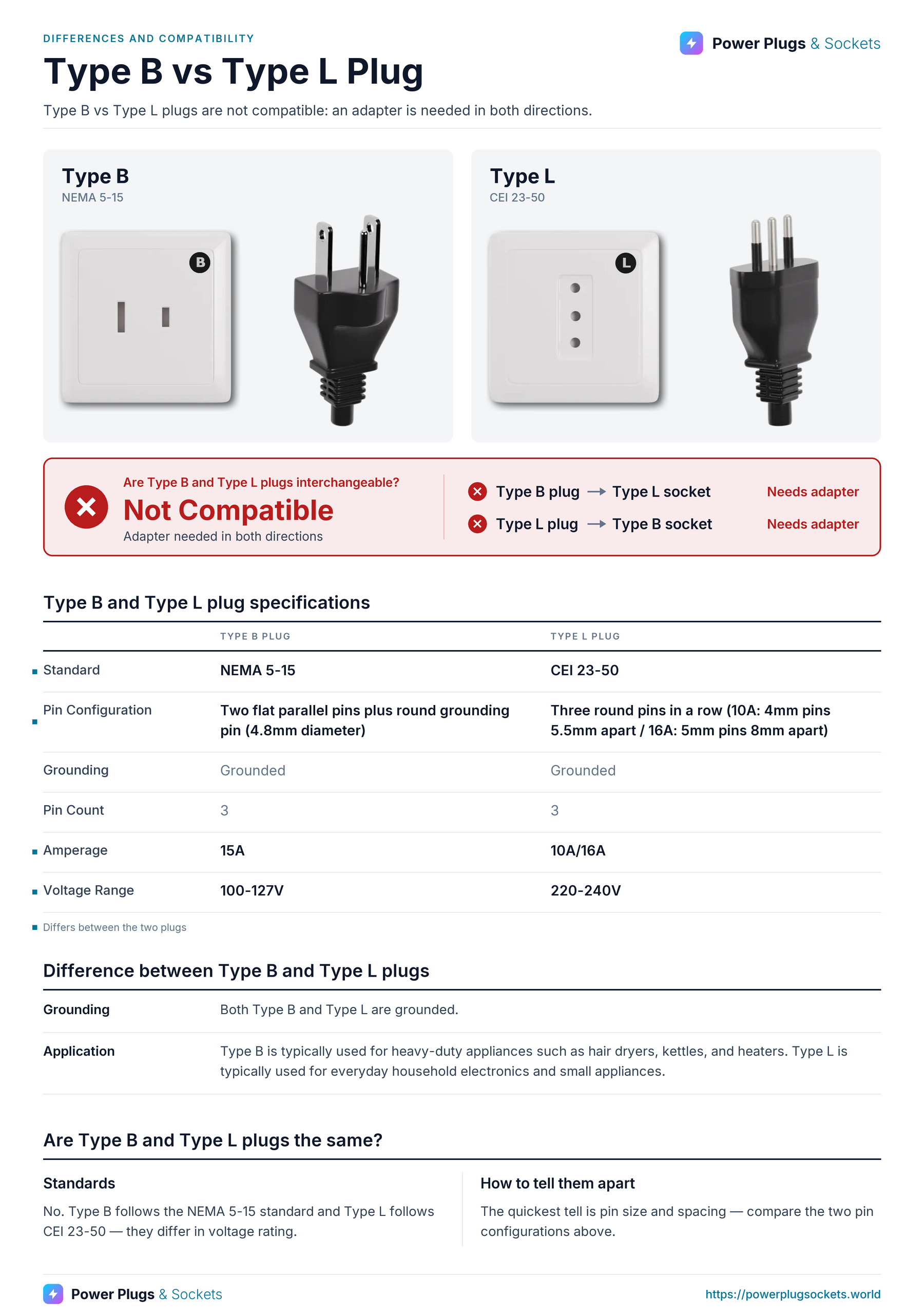
Type B vs Type L plugs are not compatible: an adapter is needed in both directions. Type B is a 3-pin, grounded plug rated 15A at 100-127V, while Type L is a 3-pin, grounded plug rated 10A/16A at 220-240V. The two differ mainly in voltage, amperage and pin design, which is what decides compatibility — whether a Type B plug fits a Type L socket, and vice versa. Compare this with type C versus type J plug shape and socket design compared.
Swipe to compare
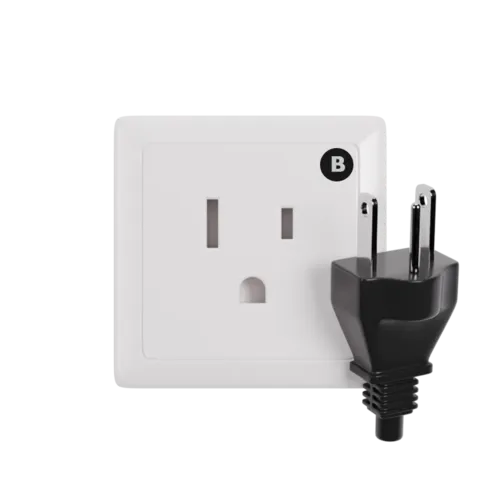
Type B
|
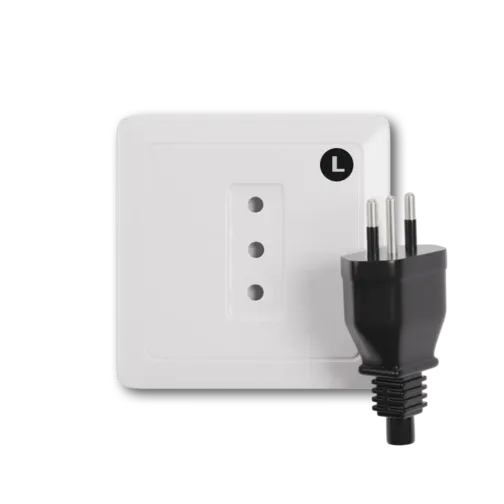
Type L
|
|
|---|---|---|
| Standard | NEMA 5-15 | CEI 23-50 |
| Pin Configuration | Two flat parallel pins plus round grounding pin (4.8mm diameter) | Three round pins in a row (10A: 4mm pins 5.5mm apart / 16A: 5mm pins 8mm apart) |
| Grounding | Grounded | Grounded |
| Pin Count | 3 | 3 |
| Amperage | 15A | 10A/16A |
| Voltage Range | 100-127V | 220-240V |
Packing a North American laptop, shaver or hair dryer for Rome or Santiago? The type B vs type L plug question comes down to one fact: neither plug fits the other's socket, and the two systems run on different mains voltages, so you need a power plug adapter at the very least before using any appliance abroad.
Type B vs Type L Plug: Key Differences at a Glance
Both are earthed three-pin connectors. The American design follows the NEMA standard with blades; the Italian design follows CEI 23-50 with three round pins in a line. For a related pairing, see type H vs type K socket.
The International Electrotechnical Commission (IEC) lists both, but its letters are only a naming convention; each power socket is tested against its own national standard.
| Feature | Type B power socket and plug | Type L power socket and plug |
|---|---|---|
| Governing standard | NEMA 5-15 (US and Canada), JIS C 8303 Class I (Japan) | CEI 23-50 (Italy), also used in Chile and Uruguay |
| Pins | Two flat blades plus a round or D-shaped earth pin | Three round pins in a row, earth in the centre |
| Rating | 15 A, 125 V | 10 A or 16 A, 250 V |
| Typical supply | 100-127 V, 60 Hz | 220-230 V, 50 Hz |
| Polarized | Yes, enforced by the earth pin | No, the plug inserts either way |
| Insulated pins | No | Yes |
| Recessed socket | No | No |
| Accepts the Europlug | No | Yes (10 A socket only) |
| Also accepts | Type A plugs | Type C plugs; hybrid sockets also take Schuko |
| What travellers need | Type B adapters with a ground pin | An adapter with three round pins or a Schuko face |
A Type B power socket is a polarized 15 A blade design, while every Type L power socket is unpolarized and comes in two current sizes. Type B plugs and type L plugs differ in every dimension, and a type b plug never suits an Italian outlet.
Pin Layout, Earth Pin and Current Rating Side by Side
Both plug types carry three pins for grounding, a safe outlet connection, but Type B places the earth pin below the two blades in a triangle, while Type L keeps all pins on one line. The American plug type is fixed at 15 A; the Italian comes in non-interchangeable 10 A and 16 A sizes.
Socket Compatibility: Can Either Plug Fit the Other Socket?
No. Flat blades cannot enter round holes, and Italian pins cannot enter blade slots, so no Type B power socket is socket compatible with an Italian plug. Across the electrical outlet world the only cross-fits are Type A plugs in Type B outlets and Europlugs in Italian sockets; check the plug standard on both faces of any adapter.
How the NEMA 5-15 Plug Is Built
The NEMA 5-15 plug comes from the National Electrical Manufacturers Association: "5" is the pin configuration and "15" the maximum amperes. It has two flat parallel pins 12.7 mm apart plus a round earth pin, an extra prong for grounding that is grounded before the power connects on insertion. Compare this with how does the amperage rating of a type K plug compare to a type L plug.
The neutral blade is wider than the hot blade, the ground hole is D-shaped, and the receptacle is rated 15 A at 125 volts, often tamper-resistant in new US homes.
Where the Type B Electrical Socket Is Used
The type B electrical socket is standard across North America and much of Central America and the Caribbean: the United States, Canada, Mexico, Japan, Taiwan, Colombia and Puerto Rico among them. Some 220-230 V countries such as the Philippines and Peru also fit Type B outlets, so check the voltage even where the plug fits.
Inside CEI 23-50 Italian Plugs
Italian plugs are defined by CEI 23-50, which covers two earthed sizes and the electrical sockets that accept them. The two sizes date from homes with separate lighting and power contracts, so an adapter must match the socket size as well as the pin shape.
10 A vs 16 A Versions: Pin Diameter and Pin Spacing
The 10 A version has 4 mm pins with 19 mm centre spacing, for lamps and chargers; the 16 A version has 5 mm pins at 26 mm, for washing machines and ovens. The 10 A spacing matches the Europlug, but a 16 A plug will not fit a 10 A socket.
Symmetrical Round Pins With No Fixed Polarity
The plug goes in either way up, so live and neutral can swap and only the central earth contact is fixed. Italian pins are partly insulated, reducing the chance of touching a live pin.
Countries Using Plug Type L: Italy, Chile and Uruguay
Plug type L is used in Italy, San Marino, Vatican City, Chile and Uruguay. In Europe, the common twin-gauge socket, or presa bipasso (P17/11), has a central round hole between two figure-8 holes and takes 10 A and 16 A plugs plus the Europlug.
The P40 hybrid socket adds a Schuko recess for CEE 7/4, CEE 7/7 and CEE 7/17 plugs, a universal socket of sorts.
Plug Adapter or Voltage Converter? Matching Each Power Socket
A plug adapter (a travel adapter) only changes pin shape; a voltage converter changes the supply voltage. Between these countries you always need the first, and the second for any appliance whose label does not cover local mains electricity.
A dual voltage charger, such as a domestic phone charger or laptop, uses AC adapters marked "100-240 V, 50/60 Hz" need only an adapter, while hair tools and kettles built for North America need a converter.
120 V vs 230 V and 60 Hz vs 50 Hz
North American outlets deliver about 120 V at 60 Hz, Japan 100 V, and Italian sockets 230 V at 50 Hz. These single-phase supplies differ, so check the voltage rating: a 120 volt hair dryer can burn out in seconds on Italian electricity, and clocks and motors can run wrongly on the other frequency.
Load limits follow from watts equal to volts times amps: 1,800 W on a 15 A US socket, 2,300 W on a 10 A Italian one and 3,680 W on a 16 A one.
Choosing Travel Adaptors for Italian Sockets
Choose travel adaptors that take a three-pin American plug and present three round Italian pins or a Schuko face. A cheap unearthed two-pin adapter fits most sockets but drops the earth, so use it only for double-insulated devices, and a 10 A adapter will not fit 16 A-only outlets.
Earthing and Safety Features of Each Grounded Plug
Both designs are a grounded plug that connects earth first. Italian pins are partly insulated while American blades are bare metal, but the NEMA receptacle is polarized and the Italian socket is not.
Neither includes a fuse, so the breaker is the only overcurrent protection against electric shock. Extension cords, power cords and a plug strip carry the rating of their weakest part, so an overload is possible and surge protection does not prevent it; power strips and multisocket adaptors are no different; never run an American power strip from an Italian socket through an adapter, since it would carry 230 volts against its 125-volt rating.
Class II Devices and Unearthed Plugs
Class II devices use double insulation and ship with unearthed two-pin plugs, so a two-pin adapter is as safe as a three-pin one. For everything else, the type B vs type L plug choice is really a choice of earthed adapter.