Type D vs Type N Plugs: Differences & Compatibility
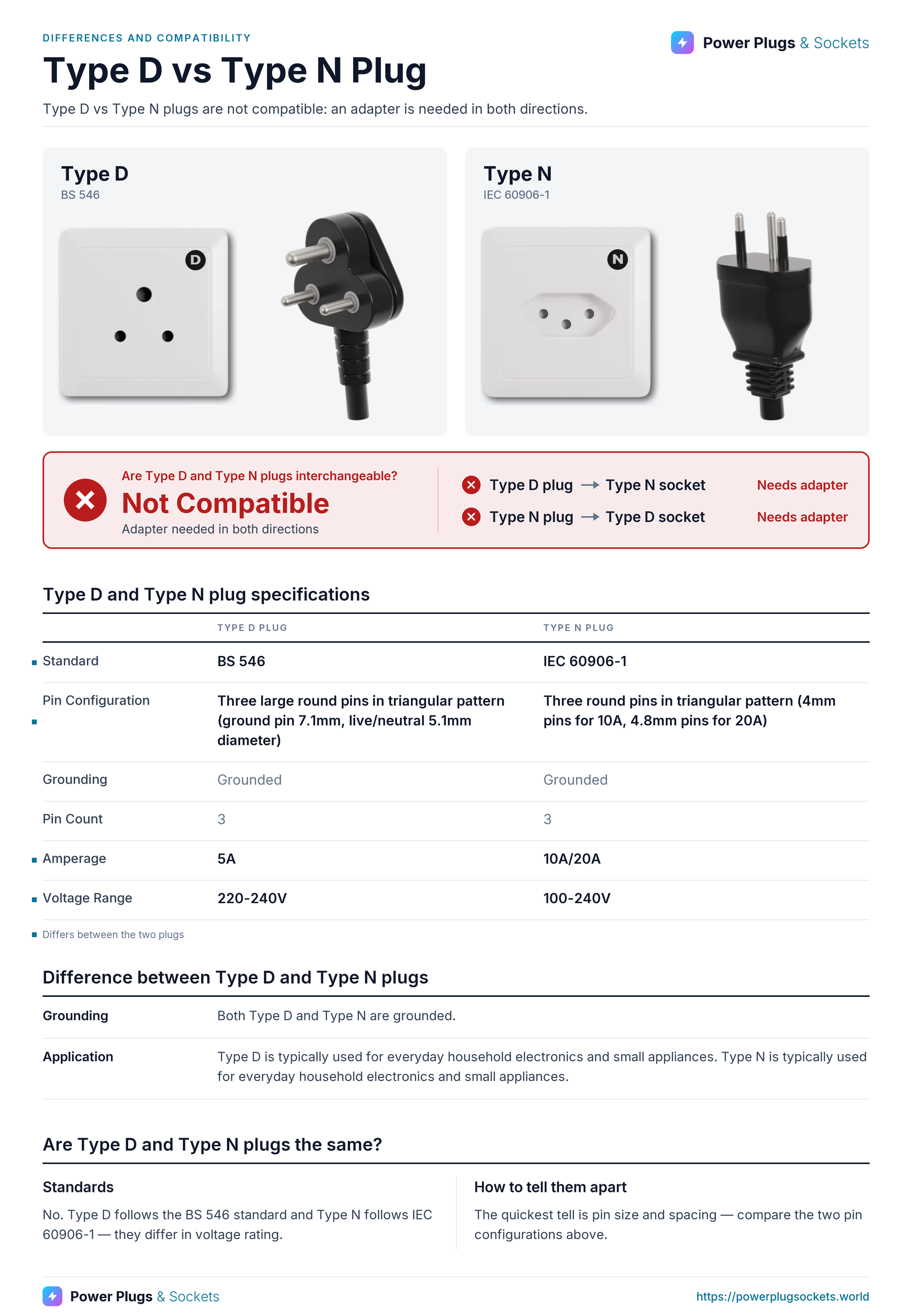
Type D vs Type N plugs are not compatible: an adapter is needed in both directions. Type D is a 3-pin, grounded plug rated 5A at 220-240V, while Type N is a 3-pin, grounded plug rated 10A/20A at 100-240V. The two differ mainly in voltage, amperage and pin design, which is what decides compatibility — whether a Type D plug fits a Type N socket, and vice versa. Compare this with is a type J plug compatible with a type N socket.
Swipe to compare
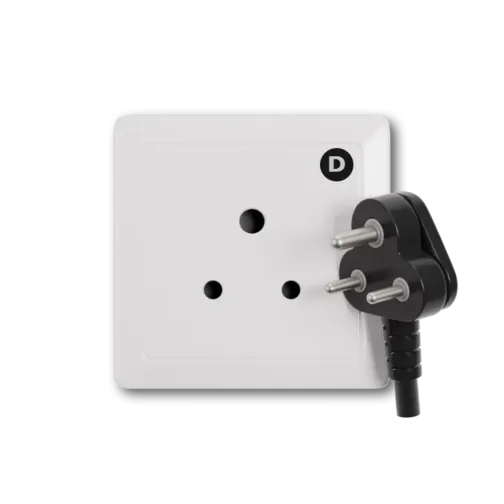
Type D
|
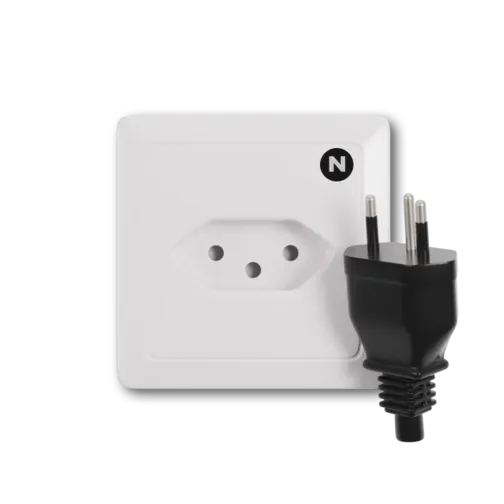
Type N
|
|
|---|---|---|
| Standard | BS 546 | IEC 60906-1 |
| Pin Configuration | Three large round pins in triangular pattern (ground pin 7.1mm, live/neutral 5.1mm diameter) | Three round pins in triangular pattern (4mm pins for 10A, 4.8mm pins for 20A) |
| Grounding | Grounded | Grounded |
| Pin Count | 3 | 3 |
| Amperage | 5A | 10A/20A |
| Voltage Range | 220-240V | 100-240V |
Packing for a trip from Mumbai to São Paulo raises one practical question: will my cord fit the wall? The type D vs type N plug answer is a firm no in both directions.
One is a 1930s British round-pin design still used across India; the other is a modern IEC layout used in Brazil and South Africa. This page covers how the pins, ratings, earthing and safety features of these plugs and sockets differ, and what travellers need.
Type D vs Type N Plug at a Glance
Both plug types are grounded, three-pin designs, but they share almost nothing up close. The older design puts a thick earth pin well above two thinner power pins in a wide triangle; the newer one keeps all three pins close together inside a small recessed socket.
| Property | Type D | Type N |
|---|---|---|
| Main standard | BS 546 (British), IS 1293 (Indian), SANS 164-3 (South African) | IEC 60906-1, with NBR 14136 (Brazil) and SANS 164-2 (South Africa) |
| Year introduced | 1934 | 1986 (IEC publication) |
| Current rating | 5 A (British), 6 A (Indian) | 10 A or 20 A (Brazil), 16 A (IEC and South Africa) |
| Voltage rating | 250 V | 250 V |
| Pin layout | Three round pins, large earth pin at the top of a wide triangle | Two power pins and an earth pin offset by 3 mm |
| Earthed | Yes | Yes (an unearthed two-pin version also exists) |
| Polarized | Yes | Yes |
| Fused | Optional | No |
| Insulated pins | Optional | Yes |
| Recessed receptacle | No | Yes |
| Accepts a Europlug | Not by design | Yes |
| Where it is used | India, Nepal, Sri Lanka and roughly 40 countries | Brazil and South Africa |
The current rating differs, the pin geometry makes the two mechanically incompatible, and only the newer receptacle is recessed and accepts the Europlug. The International Electrotechnical Commission letter describes only rough fit; the national standard sets the limits.
The BS 546 Design Behind Indian Wall Sockets
The older system began in the United Kingdom, where BS 546 was published in 1934 with 2 A, 5 A, 15 A and 30 A sizes. India adopted it as IS 1293, and a type D plug is now the everyday small-appliance connector in India, Nepal and Sri Lanka. Also see how the pin configuration of a type B plug differs from a type M plug.
Type D plugs and outlets sit next to the larger 15 A Type M for heaters and geysers.
Pin Diameter, Pin Length and the Triangle Layout
The plug has three round pins: the power pins are about 5.1 mm across with centres 19.1 mm apart, and the top earth pin, the CPC (circuit protective conductor), is thicker at about 7.1 mm and longer, so it enters first. That geometry is why it will not enter the newer socket.
5 A and 6 A Amp Rating Limits
The British standard rates this size at 5 A and the Indian one at 6 A, both at 250 V, roughly 1,380 W at Indian mains voltage. That suits a laptop, fan or phone charger but not most heaters, irons or kettles, which belong on Type M sockets.
Unfused, Polarized Sockets and Their Limits
The plug is polarized, so a switched appliance breaks the live side. BS 546 plugs are unfused, though an optional fuse is allowed, so protection depends on the breaker in the home's distribution board.
IEC 60906-1: The International Socket Design
The IEC published IEC 60906-1 in 1986 to replace the patchwork of plugs across Europe. The plan stalled, but the design survived outside Europe, and the type N plug & socket system is often called the most compact, robust and safest household plug; it came after injection moulding made small precise parts cheap.
The IEC version is rated 16 A and 250 V, with 4.5 mm pins on 19 mm centres, for 200 V to 250 V supplies. Brazil's NBR 14136 splits it into a 10 A plug with 4.0 mm pins and a 20 A plug with 4.8 mm pins, so a high-current appliance cannot overload a 10 A circuit.
South Africa adopted it as SANS 164-2; the transition is slow and most homes still have the 15 A Type M socket, with standardization and electrical safety as the goal. Many older Brazilian appliances had a flying earth wire; type N plugs carry the earth in the plug.
Insulated Sleeves and Mandatory Shutters
Each power pin on the newer plug has a 10 mm insulated sleeve, and the IEC standard and SANS 164-2 require child protective shutters in the socket-outlets, which open only when pins enter together, so accidental contact with a partially inserted pin is hard and an electric shock is unlikely.
How Type N Differs From the Swiss Type J
The layout looks close to the Swiss SN 441011 plug (Type J), but the earth pin offset is 3 mm on the IEC design and 5 mm on the Swiss one, so a Swiss plug will not fit a type N socket. Both accept the Europlug; the Swiss socket is hexagonal too, and Switzerland and Liechtenstein use it.
Paraguay has also adopted IEC 60906-1, though rarely installed.
Earthing and Electrical Safety in Each Plug and Socket
Both systems are grounded; the older relies on a long earth pin and an open socket face, the newer on a recessed socket, sleeved pins and shutters. Both allow unearthed two-pin plugs for Class II chargers.
Earthing protects you only if the house wiring is earthed too.
Where the Grounded Earth Pin Sits
On the older plug, the grounded earth pin is the largest and sits at the top, making contact first. On the newer plug it sits between the two power pins, offset 3 mm.
In both, the live and neutral pins (the line or phase pin is the live one) keep fixed positions, so no simple pin-swap makes one plug fit the other.
Compatible Outlets, Europlugs and Mixed Plug Types
Neither plug fits the other's outlet. The newer outlet takes the two-pin Europlug; the older takes its own plug by design, though many Indian outlets are universal sockets that accept several plug types loosely. Next, check type H versus type L plug shape and socket design compared.
The Europlug and Type C in Both Outlets
The Europlug (Type C) is the flat two-pin plug on most European phone chargers, rated 2.5 A, with 4 mm pins. It seats firmly in Brazilian and South African sockets, but in an Indian round-pin outlet contact is often loose and can overheat, so a proper adapter is better.
Travel Adapter and Voltage Converter Advice for These Sockets
You have two problems: the shape of the plugs and sockets, and the electricity the wall supplies. A travel adapter fixes only the first.
Choose a plug adapter with a real grounding pin contact for a three-pin power plug, and avoid stacking adaptors, since non-interchangeable plug type families add heat at each joint. Type N plugs fit only type N sockets, so carry a Brazil or South Africa adapter for your appliances and devices.
Voltage and Frequency by Country
India, Nepal, Sri Lanka and South Africa supply 230 V at 50 Hz; Brazil uses 127 V or 220 V at 60 Hz depending on the city. Most phone chargers and laptops are dual voltage, marked 100-240 V. A single-voltage 220-240 V appliance can burn out on a higher supply, so add a voltage converter rated above its wattage.