Type C vs Type H Plugs: Differences & Compatibility
Type C vs Type H plugs are compatible in one direction only: an adapter is needed the other way. Type C is a 2-pin, ungrounded plug rated 2.5A at 220-240V, while Type H is a 3-pin, grounded plug rated 16A at 220-240V. The two differ mainly in grounding, amperage and pin design, which is what decides compatibility — whether a Type C plug fits a Type H socket, and vice versa. For a related pairing, see is it safe to use a type E device on a type H socket.
Swipe to compare
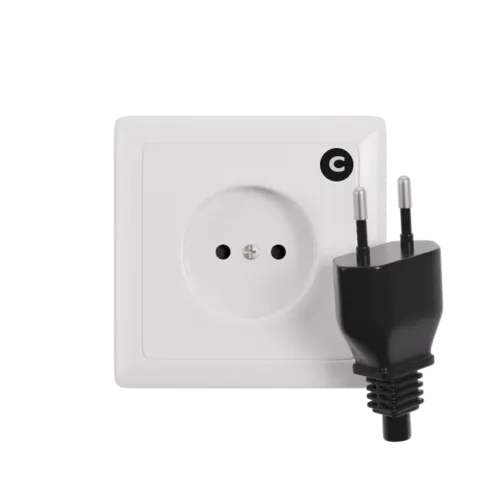
Type C
|
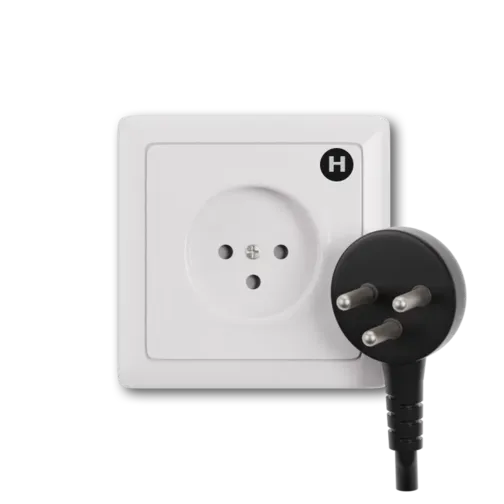
Type H
|
|
|---|---|---|
| Standard | CEE 7/16 (Europlug) | SI 32 |
| Pin Configuration | Two round pins (4mm diameter, 19mm long, 18.6mm apart) | Three pins in V-shape arrangement (round 4.5mm or flat pins, 19mm length) |
| Grounding | Ungrounded | Grounded |
| Pin Count | 2 | 3 |
| Amperage | 2.5A | 16A |
| Voltage Range | 220-240V | 220-240V |
Packing for Israel with a European charger raises the classic Type C vs Type H plug question: will the slim two-pin Europlug go straight into the wall? A modern Israeli socket accepts a Type C plug, but the reverse never works, and the two differ sharply in earthing, current rating and safety.
Type C vs Type H Plug at a Glance
Both plugs appear in the World Plugs guide of the International Electrotechnical Commission (IEC), which gives each plug family a letter; the letter is a naming convention, not a technical standard. Type C is a small, unearthed two-pin plug for low-power devices; Type H is a full 16 amp earthed plug with a third pin.
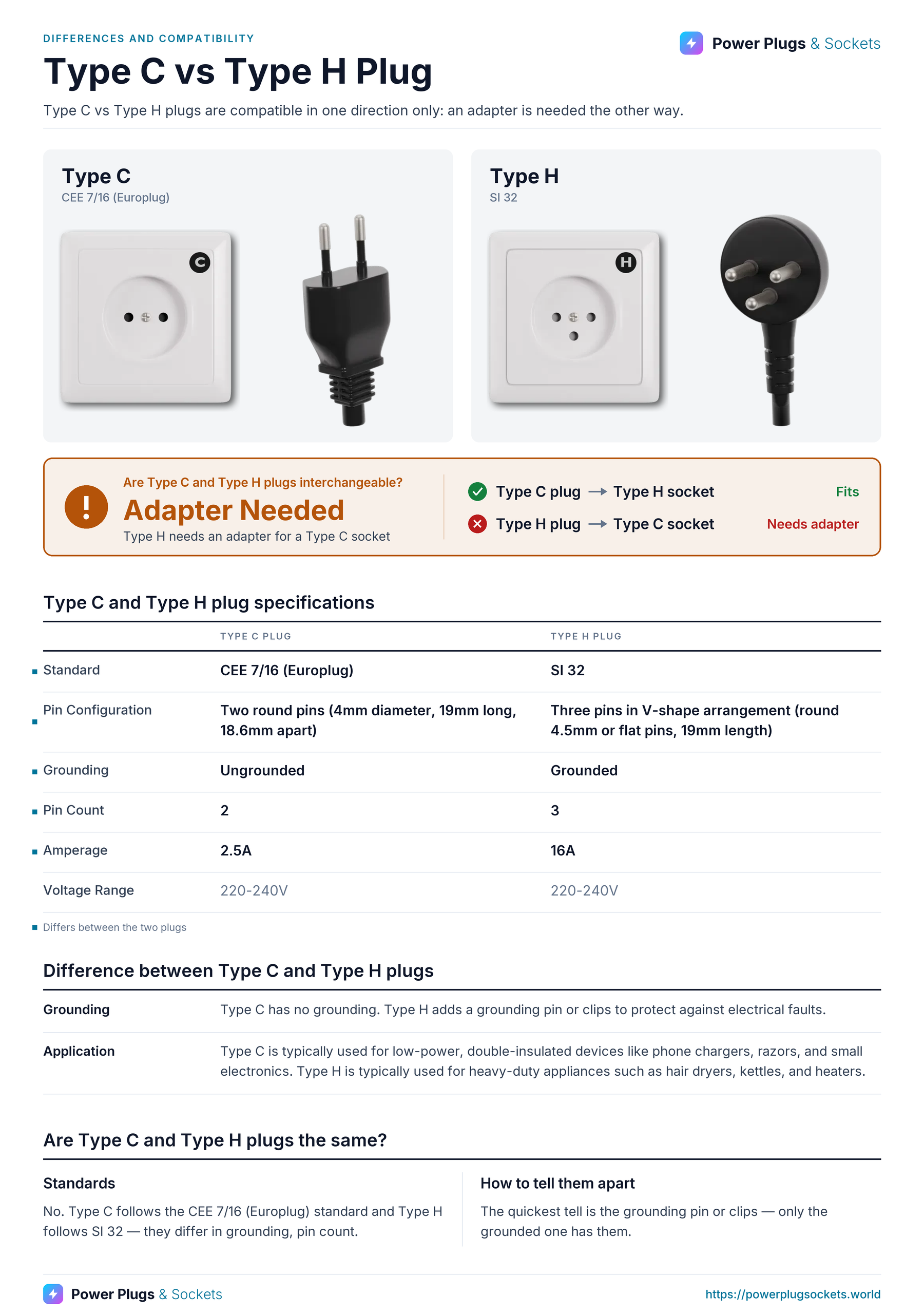
| Feature | Type C (Europlug) | Type H (Israel) |
|---|---|---|
| Defining standard | CEE 7/16 Alternative II, EN 50075 | SI 32 (Israeli standard) |
| Pins | 2 round, 4 mm diameter | 3 round, 4.5 mm diameter |
| Rating | 2.5 amps, 250 V | 16 A, 250 V |
| Earthed | No | Yes |
| Polarized | No, fits either way round | Yes, fixed live and neutral sides |
| Insulated pins | Yes, partial sleeves | No |
| Recessed socket | No dedicated socket exists | No, sockets sit flush |
| Maximum load at 230 V | About 575 W | About 3,680 W |
| Main countries | Most of Europe plus parts of Asia, Africa and South America | Israel and the Palestinian territories |
The Europlug is ungrounded and meant for Class II appliances with double insulation. The Israeli plug is earthed, so its grounding pin can power Class I equipment such as a metal-bodied kettle or washing machine.
A kettle sold in Israel carries the three-pin plug; chargers ship with two-pin plugs.
Pin Spacing and Dimensions
Europlug pins are 4 mm thick and 19 mm long, with centres 19 mm apart. The Israeli plug places its 4.5 mm power pins at the same 19 mm distance and adds an earth pin 9.5 mm below, so an Israeli socket takes the Europlug without an adapter.
The Type C Plug (Europlug) Explained
The Type C plug is the most widely used plug in the world, on phone chargers and laptop bricks. Its official name is CEE 7/16 Alternative II, published by CENELEC as EN 50075, and it comes moulded onto a flexible cord. You might also want how the NEMA 1-15 standard for type A compares to IEC 60906-1 for type N.
Type C sockets as such are rare; sockets compatible with Type C plugs include the French Type E, German Schuko or Type F, and British shaver sockets.
Two Round Pins and the 2.5 A Rating
Two pins converge slightly toward their tips for a firm grip, and insulation sleeves cover their bases. The low current rating of 2.5 A suits a 65 W laptop charger drawing about 0.3 A, but a 1,800 W hairdryer would pull close to 7.8 A.
Where You Still Find Type C Outlets
The IEC map shows these plugs across the Middle East, North Africa, much of Asia and parts of South America. Type C plugs & outlets survive as unearthed sockets in older buildings, but many countries ban them in new installations; treat them as suitable for small electronics only.
Israel's SI 32 Standard: The Israeli Plug in Detail
The Israeli plug is defined by SI 32 (also written SI32), and the IEC assigns the letter H to that standard alone. It is rated at 16 A and 250 V, every outlet includes an earth contact, so every Israeli power outlet is grounded, and the plugs are polarized.
Looking at the socket, the neutral contact is on the left, the earth pin at the bottom and the live contact on the right, giving it defined polarity; the ground pin is no longer than the others.
Three Pins Set in a Triangle
The current version has three round pins forming a triangle, each 4.5 mm thick and 19 mm long. The round prongs form a triangular face, once called a V shape, and the two upper holes line up with a Europlug.
Flat Prongs Before 1989
The first Israeli plugs had three flat pins in a Y pattern, flat-bladed, and pre-1989 sockets taking only those are rare and obsolete. The late-1980s revision swapped them for round pins in the same positions, and newer sockets accept both plus the Europlug.
Israel, the West Bank and Gaza
Type H is used in Israel and Palestine, covering the West Bank and the Gaza Strip, at 230 V and 50 Hz (the 220 – 240 V group, against 60 Hz in North America), the same as most of Europe.
Type H Sockets and Europlug Compatibility
Type H plugs & outlets are accommodating in one direction only: an Israeli socket takes Israeli plugs old and new, plus Type C plugs, and nothing else officially. A hybrid socket or universal socket may accept more, but a cheap multi-standard one can skip the earth connection or accept 120 V appliances. For a related pairing, see do you need a type C to type N plug adapter.
Plugging a Europlug into Type H Outlets
A Europlug slides into the two upper holes without an adapter, and the earth hole stays empty, which is fine for a Class II device. Israelis use it routinely for chargers and lamps.
Why the Reverse Direction Fails
A three-pin Israeli plug has no place for its earth pin in Type C, French or German sockets, so it needs an adapter anywhere outside Israel.
Schuko and Type E Plugs in an Israeli Outlet
Schuko and Type E plugs have pins 4.8 mm thick, wider than the Israeli contacts. They can be forced in but lose the earth connection and may damage the socket, so use a proper adapter.
Safety Differences Between Type H Plugs and Europlugs
The three-pin Israeli plug is more capable, but the Europlug has day-to-day safety advantages in how much bare metal you can touch.
Insulated Pins and Exposed Pin Shanks
Type H pin shanks are bare along their full length, so a partially inserted plug can leave pins live and touchable, a real risk of electric shock and electrocution. Sleeved Europlug pins avoid this.
Recessed Sockets and Child Protection
Many European sockets are recessed to keep fingers away from pins; Israeli sockets sit flush, so child protection covers over the wall socket are common, and pins must grip the socket contacts firmly. The Type H earth contact is a safety feature the Europlug lacks.
Travelling to Israel with Type C Plugs: Adapters and Voltage
For travelers from Europe, Israeli mains electricity runs at 230 V and 50 Hz, so voltage and frequency match. Travellers from North America or Japan face both a fit and a voltage problem: a US appliance rated only for 120 V needs a voltage converter, while a charger marked 100-240V is dual voltage and needs only an adapter.
Check the voltage rating of cords and adaptors too, as some are rated only for 125 V.
When a Travel Adapter Is Worth Packing
If every device ends in a Europlug, leave the adapter at home; with a Schuko, French, British or US plug, pack a plug adapter for Israel. A universal adaptor with built-in USB ports cuts down the plugs you need, but the large Type M plug used in South Africa will not fit an Israeli socket.
A multisocket adaptor or power strip rating covers the total load: a 16 A strip handles about 3,680 W, while a Europlug-ended extension cord is limited to 2.5 A. Keep high-power appliances on their own power outlet.