Type E vs Type H Plugs: Differences & Compatibility
Type E vs Type H plugs are not compatible: an adapter is needed in both directions. Type E is a 2-pin, grounded plug rated 16A at 220-240V, while Type H is a 3-pin, grounded plug rated 16A at 220-240V. The two differ mainly in pin design, which is what decides compatibility — whether a Type E plug fits a Type H socket, and vice versa. You might also want comparing type C and type H plugs for international travel.
Swipe to compare
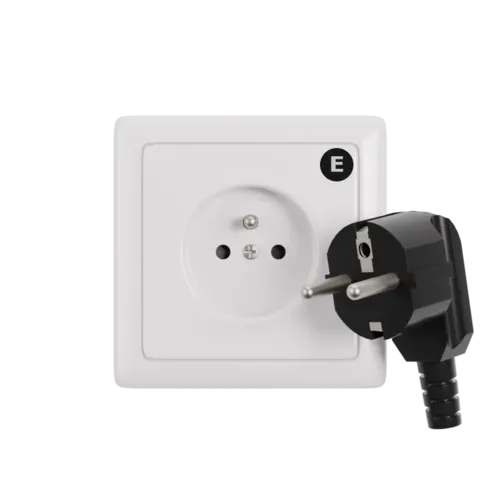
Type E
|
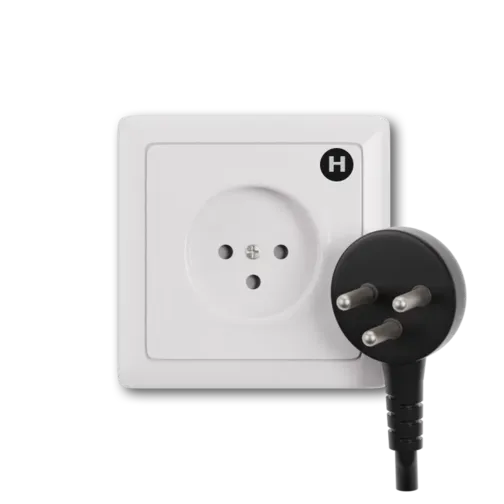
Type H
|
|
|---|---|---|
| Standard | CEE 7/5 | SI 32 |
| Pin Configuration | Two round pins (4.8mm diameter) plus hole for socket grounding pin | Three pins in V-shape arrangement (round 4.5mm or flat pins, 19mm length) |
| Grounding | Grounded | Grounded |
| Pin Count | 2 | 3 |
| Amperage | 16A | 16A |
| Voltage Range | 220-240V | 220-240V |
Packing for France and Israel on the same trip? The type E vs type H plug question comes down to where the earth connection lives.
The French system puts a metal pin in the wall socket, the Israeli system a third pin on the plug, so the two power plugs look alike by plug shape but only partly share an electrical outlet and power sockets. Here is a side-by-side comparison of pins, ratings, earthing and which plug fits which socket to keep your electricity supply safe.
Type E vs Type H Plug: The Key Differences at a Glance
Both systems run on 230 V mains electricity, carry the same current rating and accept the flat two-pin Europlug. A type E plug has two round pins and a hole for the earth pin in the socket; a type H plug has three pins of its own in a triangle.
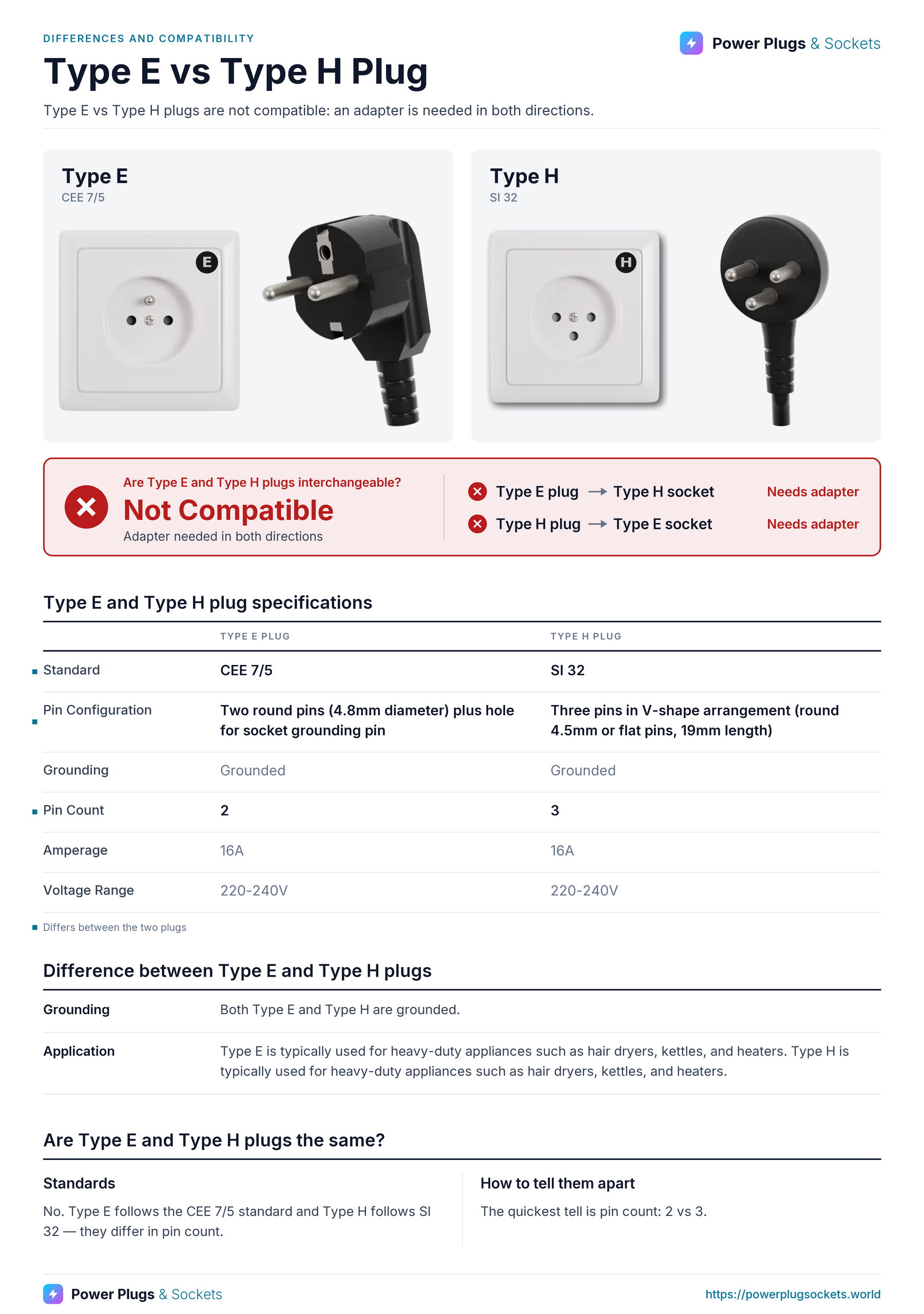
| Feature | French system (Type E) | Israeli system (Type H) |
|---|---|---|
| Standard | CEE 7/5 socket and CEE 7/6 plug | SI 32 plug and socket |
| Pins on the plug | Two round pins, 4.8 mm, 19 mm apart | Three pins in a triangle, round 4.5 mm since 1989 |
| Where the earth sits | Earth pin mounted in the socket | Earth pin on the plug |
| Rating | 16 A, 220 – 240 V | 16 A, 220 – 240 V |
| Grounded | Yes | Yes |
| Polarized | Partially (one-way fit, no wiring rule) | Yes |
| Recessed socket | Yes | No |
| Socket accepts | Type C, E and F (F only with a pinhole) | Type C and H; E and F only partially and unsafely |
| Main country of use | France, Belgium, Poland, Slovakia, Czech Republic | Israel, West Bank, Gaza Strip |
The letters come from a classification now used by the IEC (International Electrotechnical Commission), which documents the national designs in IEC TR 60083; the binding document is each country's national standard.
Each socket and full-size plug is rated at 16 A on a nominal 220 – 240 V supply at 50 Hz, roughly 3,680 W. The shared Europlug is only rated 2.5 A. Frequency is 50 Hz in both, so a phone charger or laptop runs on either.
Earthing and safety features differ: the French earth contact is a fixed pin in the socket; the Israeli earth pin is on the plug. The French recess keeps fingers from half-inserted pins, while Israeli sockets have none, raising the risk of electrocution.
Older plugs lack insulated pins, and neither plug is fused.
Inside the CEE 7/5 Socket and Its Plug
The French connector is the CEE 7/5 socket with the CEE 7/6 plug. Type E plugs are built to the French standard; today the type E socket, or power outlet type E, is the main wall outlet in five European countries and several in North Africa. Compare this with packing an adapter for a trip that has both type L and type M sockets.
A French plug goes in one way round, but the French standard has no rule about live and neutral, so polarization is effectively absent and it is unpolarized; the Israeli system is genuinely polarized, so type H plugs fit one way only.
Round Pins and the Socket's Grounding Pin
The plug carries two round pins 4.8 mm thick on 19 mm centres. The grounding pin projects from the socket face, and a Europlug slides in but a French plug won't enter a Europlug-only outlet.
Recess Depth and the Pinhole Design
The socket is a round recess about 15 mm deep, and the plug has a pinhole to receive the earth pin. That hole lets a hybrid plug work in both French and German sockets.
Where You Will Find Type E Outlets
The system is standard in France, Belgium, Poland, Slovakia and the Czech Republic, and in former French territories such as Tunisia and Morocco.
How the SI 32 Plug Is Built
The Israeli connector is set out in SI 32 from the Standards Institution of Israel: a compact plug with three pins in a triangle, live and neutral on top. Older sites call the wall socket power outlet type H. Also see can i use a type C adapter with a type N socket.
Flat Pins in a V Shape Before 1989
The original Israeli plug used three flat pins in a V shape. In 1989 the standard moved to round pins in the same positions, and sockets now take both.
The Round-Pin Israeli Design Used Today
Modern plugs have three round pins about 4.5 mm thick, with live and neutral holes spaced to accept a Europlug. The third hole gives a ground connection to the building's earth.
Type H Use in Israel, the West Bank and Gaza
The Israeli connector is used only in Israel, the West Bank and the Gaza Strip, so a single-country adapter is the simplest option; it rarely appears on adapter packs.
Type M Sockets for Heavy Appliances
Some Israeli homes have a larger type M-style socket for air conditioners and water heaters. A visitor won't need it for devices.
CEE 7/6 Plug Compatibility With Other Socket Types
A French CEE 7/6 plug is a poor fit in an Israeli socket, and an Israeli plug won't go into a French socket at all. Forcing foreign plugs in is unsafe because the earth may not connect.
Europlug and Type C Fit Both Sockets
The Europlug (CEE 7/16, type C) works in both countries, provided the device is under 2.5 A, so two-pin chargers need no adapter.
Schuko, Type F and the CEE 7/7 Hybrid Plug
The German Schuko (type F, short for Schutzkontakt, protective contact) earths through two earth clips, has notches on each side and can't enter a French socket, so the CEE 7/7 hybrid has clips and a central hole. In an Israeli socket its 4.8 mm pins are too thick, a partial and unsafe fit.
Why an Earth Pin Blocks Some Plug Types
The French earth pin acts like a key, admitting only type C, the French plug and CEE 7/7. The Israeli earth hole is passive, so a two-pin plug enters without engaging earth.
Grounded and Unearthed Connections
A grounded appliance needs the full-size plug or a properly earthed adapter. An unearthed Europlug device is double-insulated and doesn't need it.
Travel Adapter Advice for SI32 and French Outlets
The SI32 and French sockets accept different full-size plugs, but both use the same voltage, so international travel across Europe and Israel is a plug-shape problem only; travel adapters need planning.
Picking a Plug Adapter for Both Countries
A plug adapter changes only pin shape. For a grounded appliance in Israel, use an earthed adapter with an Israeli output; for an Israeli plug in France, one with a pinhole.
Many compact adapters are rated 10 A, below the 16 A wall socket.
When You Need a Voltage Converter
Both grids deliver 230 V at 50 Hz, so no converter is needed. A voltage converter matters only for 100 – 127 V gear; phones and laptops marked 100 – 240 V are dual voltage.
A US hairdryer overheats in seconds on 230 V.