Type C vs Type M Plugs: Differences & Compatibility
Type C vs Type M plugs are not compatible: an adapter is needed in both directions. Type C is a 2-pin, ungrounded plug rated 2.5A at 220-240V, while Type M is a 3-pin, grounded plug rated 15A at 220-240V. The two differ mainly in grounding, amperage and pin design, which is what decides compatibility — whether a Type C plug fits a Type M socket, and vice versa. You might also want type I versus type L plug shape and socket design compared.
Swipe to compare
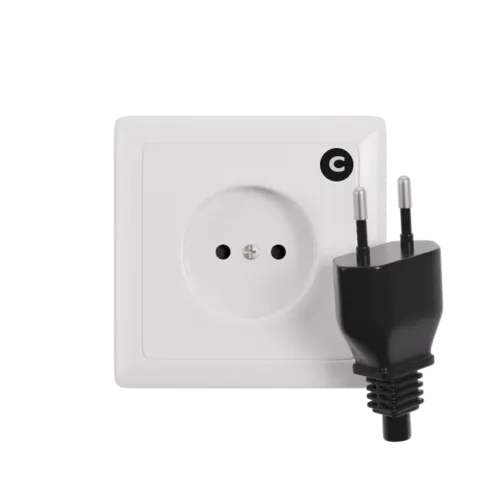
Type C
|
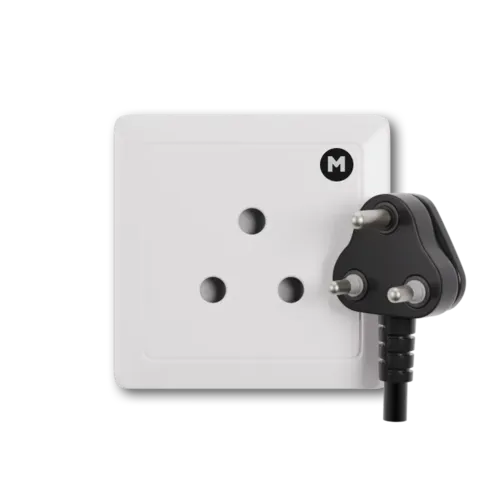
Type M
|
|
|---|---|---|
| Standard | CEE 7/16 (Europlug) | BS 546 (15A) |
| Pin Configuration | Two round pins (4mm diameter, 19mm long, 18.6mm apart) | Three large round pins in triangular pattern (earth 8.7mm diameter, live/neutral 7.1mm diameter) |
| Grounding | Ungrounded | Grounded |
| Pin Count | 2 | 3 |
| Amperage | 2.5A | 15A |
| Voltage Range | 220-240V | 220-240V |
The type C vs type M plug question comes down to size, earthing and current. The slim two-pin Europlug carries 2.5 A and has no earth, while the chunky South Africa three-pin plug carries 15 A or 16 A with a grounded earth pin, so one never fits the other's electrical outlet without a plug adapter.
Both run on the same 220 – 240 V supply, so you usually need a shape adapter, not a voltage converter.
Type C vs Type M Plug at a Glance
The Europlug follows the European CEE 7/16 sheet and EN 50075; the three-pin plug is the 15 A size of the British BS 546 standard.
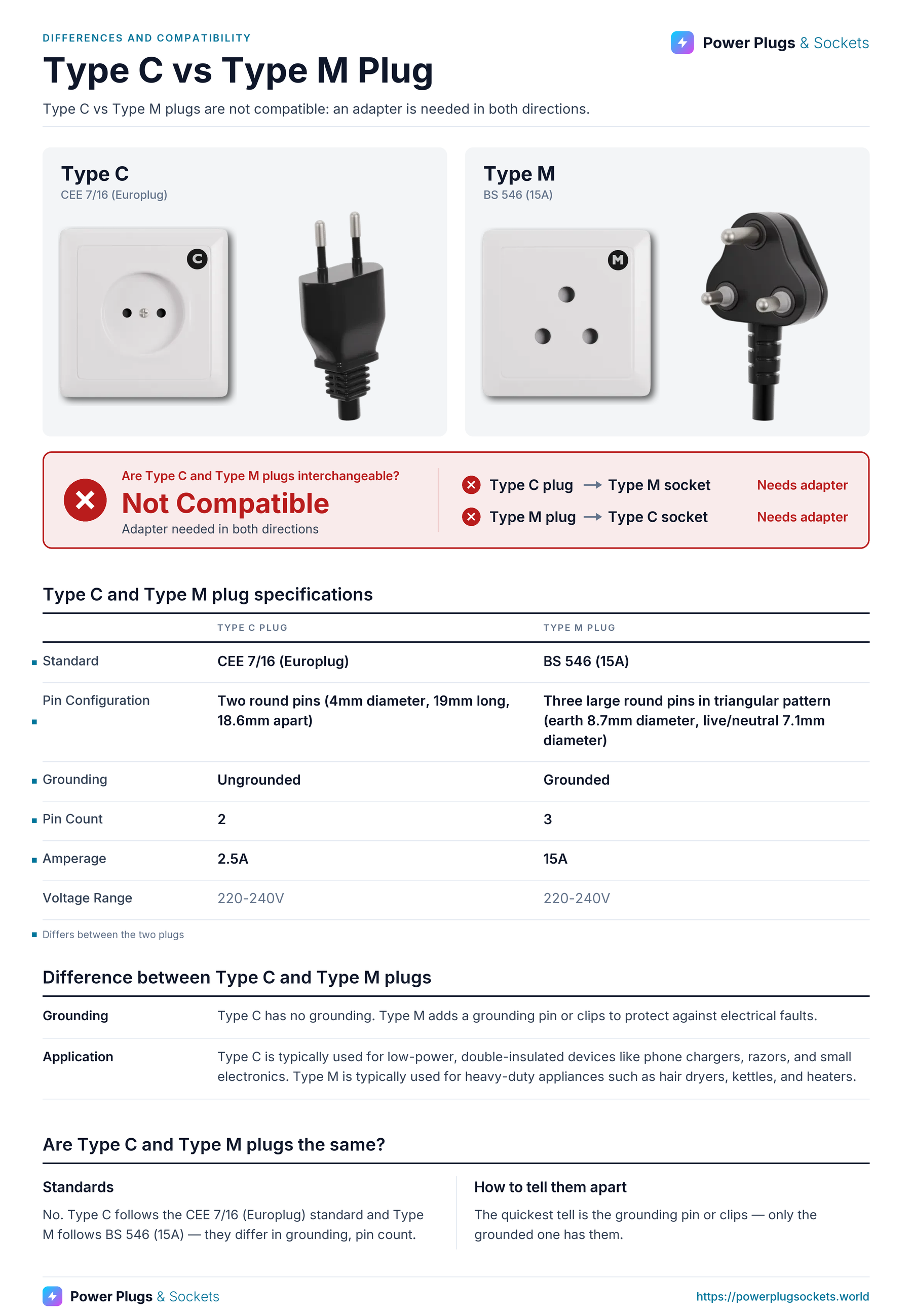
| Feature | Europlug (C) | BS 546 / SANS 164-1 (M) |
|---|---|---|
| Pins | Two round pins, not grounded | Three round pins set in a triangle, grounded |
| Live and neutral pin diameter | 4.0 mm, slightly tapered | About 7.1 mm |
| Earth pin | None | About 8.7 mm, the longest and largest pin |
| Current rating | 2.5 A at 250 V | 15 A (BS 546) or 16 A (SANS 164-1, IS 1293) at 250 V |
| Typical supply | 220 – 240 V, 50 Hz | 220 – 240 V, 50 Hz |
| Outlet it plugs into | Any socket compatible with round 4 mm pins on a 19 mm centre: Type E, F, J, K, L, N, H, O | Only a matching 15 A or 16 A round-pin socket |
| Main regions | Europe, South America, Asia, Middle East, Africa | Southern African countries and parts of South Asia |
Everything on the right is bigger.
Two Round Pins or Three: The Visual Difference
The Europlug has two round pins that converge slightly and no third contact; the South African plug has three large round pins in a triangular pattern, with a fatter earth pin on top.
Outlet Style by Region and Countries
The Europlug works across Europe (except the UK, Ireland, Cyprus and Malta), South America, Asia, the Middle East, Israel and much of Africa. The three-pin plug is used in about 15 countries: South Africa, Lesotho, Eswatini (listed as Swaziland in many guides), Namibia, Botswana, Mozambique, and as the high-current option in Pakistan, Sri Lanka, Nepal and Bangladesh.
Plug type C suits chargers; plug type M is the heavy plug of southern Africa.
Europlug Pin Dimensions and Current Rating
EN 50075 fixes the pin dimensions: two round pins 4.0 mm across and 19 mm long, centres 19 mm apart, moulded onto the cable. Its current rating is 2.5 A at 250 V.
Sockets are usually rated 10 A or 16 A, so the plug and cord are the weak link.
Why the Type C Plug Is Limited to 2.5 A
Power is voltage times current: 230 × 2.5 = 575 watts. That is ample for low power devices such as a 65 W laptop charger or a phone, but a 1,800 W kettle needs about 7.8 A. Heavy loads cause overload behind the power outlet.
Because it has no earth and is unearthed by design, the plug is allowed only on Class II equipment protected by double insulation, such as shavers and chargers; plugging it into an earthed Schuko socket is safe.
Insulated Pins and the Flexible Cord
The first 10 mm of each pin is covered by insulating sleeves (insulated pins), so no bare live pin is exposed, and the flexible cord is non-rewirable. Flexible pins give plug retention in worn sockets.
Type C plugs stay safe as long as they are used on Class II electronics.
The BS 546 15 A Plug: Three Round Pins and an Earth Pin
BS 546, introduced in Britain in 1934, covers three-pin round plugs rated 2 A, 5 A, 15 A and 30 A; the 15 A plug became the large household plug of South Africa. In the UK, BS 1363 (Type G) replaced it, though BS 7671 still lists round-pin sockets. Compare this with which countries use type B plugs versus type D plugs.
The sizes are non-interchangeable. The BS 546 plug is polarized by its triangle and unfused, so protection relies on the breaker; a Type C plug is not polarized, which is fine for Class II equipment.
The earth pin is the longest, connecting first and breaking last. Older plugs with bare brass pins add an electric shock risk and a danger of electrocution, so push the plug fully home; the live pin of a half-inserted plug may be exposed.
Pin Diameter and Pin Spacing on a Type M Plug
The live and neutral pins have a pin diameter of about 7.1 mm and the earth pin 8.7 mm, with 25.4 mm pin spacing, and the larger pins mean small pins would rattle loose, so no partial fit exists.
SANS 164-1 in South Africa and Neighbouring Countries
In South Africa the plug is published as SANS 164-1, rated 16 A at 250 V, also found in Lesotho, Eswatini, Namibia and Botswana.
IS 1293 and 16 A Sockets in India for Heavy Appliances
India's IS 1293 defines a 6 A three-pin plug (the Type D size) and a 16 A version of the large plug, used for heavy appliances such as air conditioners and geysers, and larger appliances generally.
Which Power Outlet Is Socket Compatible With Each Plug
The Europlug was designed to be socket compatible with nearly every round-pin wall socket in Europe, while the 15 A plug only goes into its own socket-outlet.
Sockets That Accept the Europlug: Type E, Type F and Type N
The slim plug fits the French Type E, German Schuko Type F, Swiss Type J, Danish Type K, Italian Type L, Israel's Type H, Thailand's Type O and Type N used in Brazil and southern Africa; the socket's earth pin or clips go unused.
Grounding Pin Shutters and Why the Small Plug Will Not Fit
Many 16 A South African sockets have shutters that open only when the long grounding pin pushes in first. Some are recessed, and two-pin pins are too thin.
Type D Sockets and the Larger 15 A Version
Type D is the 5 A (6 A Indian) member of the BS 546 family, used in about 40 countries, with the same triangle at a smaller size. It does not fit the 15 A socket.
Choosing a Travel Adapter or Voltage Converter for Plugs and Sockets Abroad
Most travelers need only a shape adapter, because plugs and sockets in Europe and southern Africa share a supply. Taking a two-pin Euro charger to Johannesburg needs an adapter with three large pins, or the two-pin opening on a newer hybrid wall plate; South Africa's SANS 164-2 (IEC Type N) is preferred in new buildings and also takes the Europlug, sold locally as SANS 164-5. Also see can i use a type D adapter with a type G socket.
Hybrid multi-standard plates differ from a cheap universal socket.
Why Worldwide Travel Adapters Often Skip the M Plug
Worldwide travel adapters and a universal adapter with USB ports usually leave out the large three-pin plug because its pins are too big to fold away. Buy a dedicated South African adaptor before international travel.
Adapters change only shape, never the supply; voltage and frequency match at either end. From the US at 120 V, check for "100-240 V, 50 or 60 Hz": that is a dual voltage device needing only an adapter.
A 120 V hairdryer and other hair appliances need a voltage converter, since 230 V mains electricity burns out the element in seconds. Avoid chaining an extension cord or power strip through an adaptor.
Plug and Socket Safety: Earthed Versus Unearthed Connections
The large plug is earthed and grounded, tripping the breaker on the circuit in a fault; the two-pin plug is ungrounded and allowed only on double-insulated devices, with live and neutral reversible. Every plug and socket combination is tested as a pair, and the safest plug is the one made for the device.