Type B vs Type D Plugs: Differences & Compatibility
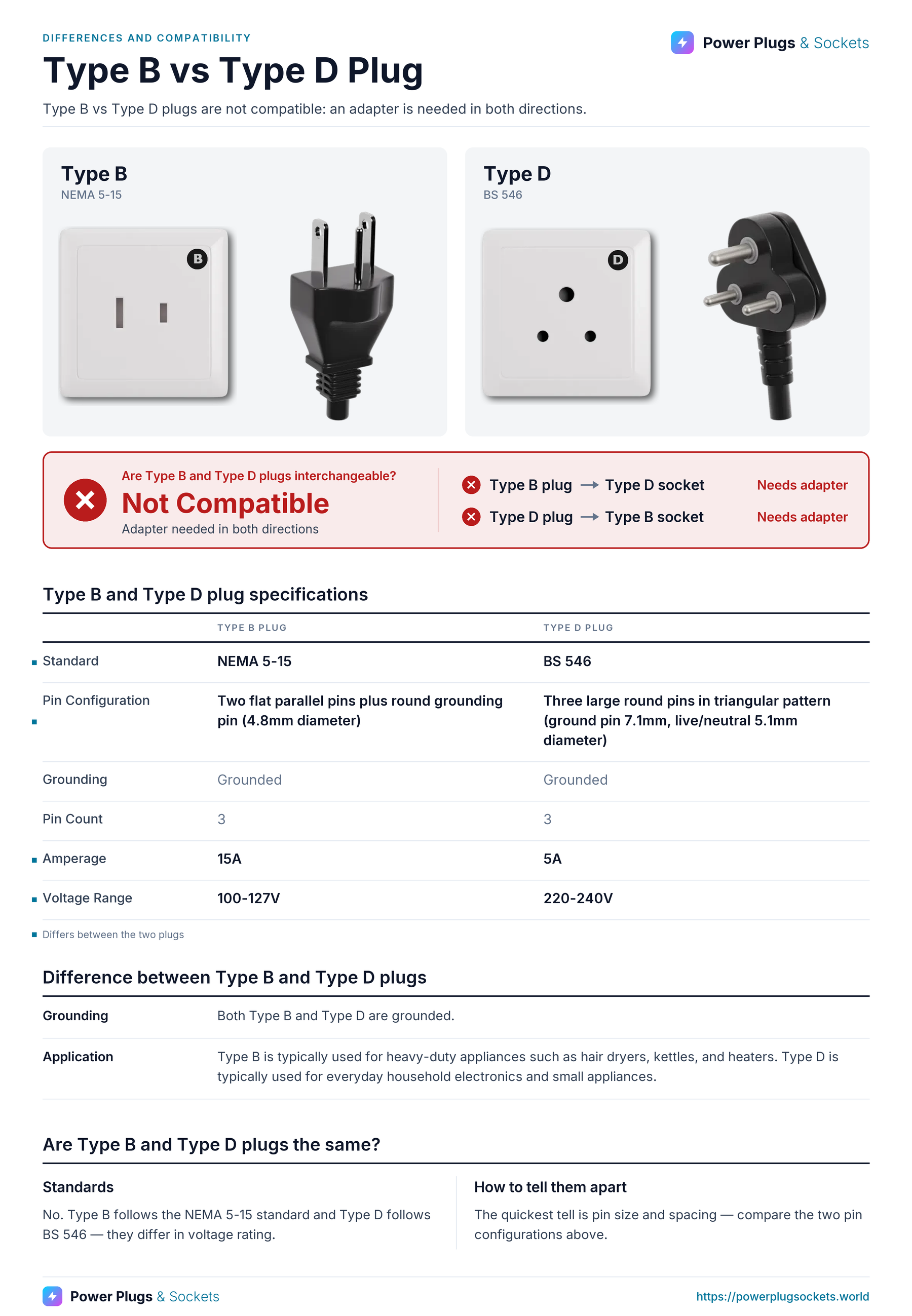
Type B vs Type D plugs are not compatible: an adapter is needed in both directions. Type B is a 3-pin, grounded plug rated 15A at 100-127V, while Type D is a 3-pin, grounded plug rated 5A at 220-240V. The two differ mainly in voltage, amperage and pin design, which is what decides compatibility — whether a Type B plug fits a Type D socket, and vice versa. For a related pairing, see how the BS 546 standard for type D compares to BS 1363 for type G.
Swipe to compare
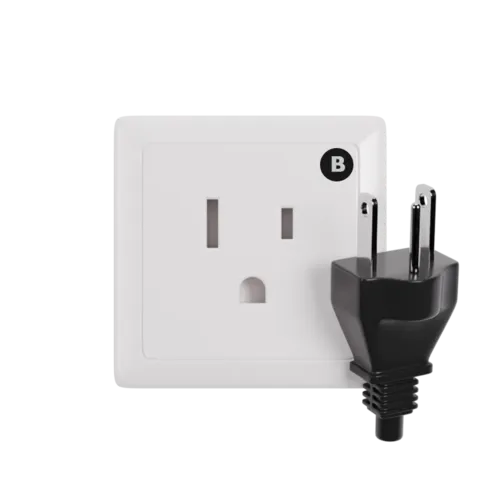
Type B
|
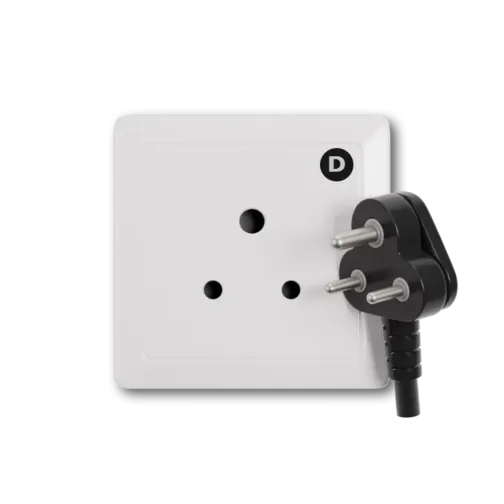
Type D
|
|
|---|---|---|
| Standard | NEMA 5-15 | BS 546 |
| Pin Configuration | Two flat parallel pins plus round grounding pin (4.8mm diameter) | Three large round pins in triangular pattern (ground pin 7.1mm, live/neutral 5.1mm diameter) |
| Grounding | Grounded | Grounded |
| Pin Count | 3 | 3 |
| Amperage | 15A | 5A |
| Voltage Range | 100-127V | 220-240V |
Packing a laptop charger from Toronto for a month in Pune comes down to one question: the type B vs type D plug split. The American plug has two flat blades and a round grounding prong, built for roughly 120 volts, while the Indian plug has three chunky round prongs set in a triangle, built for 230 to 240 volts.
Neither plug fits the other's electrical outlet, so you'll need a plug adapter, and sometimes a step-down unit as well, before your devices draw electricity safely.
Type B vs Type D Plug: Side-by-Side Specifications
Both are three-pin, earthed plug and socket designs. Type B is the American NEMA 5-15 standard, a grounded version of the two-blade Type A. Type D is the old British BS 546 5-amp standard, which India adopted as its own IS 1293 standard with a 6-amp rating.
The IEC files them as two unrelated families of plug types and socket types.
| Feature | Type B (flat blade) | Type D (round pin) |
|---|---|---|
| Standard | NEMA 5-15 (US), Japanese Class I equivalent | British 5 A standard, Indian 6-amp standard |
| Pins | Two flat blades plus one round or D-shaped earth prong | Three round prongs, earth pin largest |
| Current rating | 15 A | 5 A (British), 6 A (Indian) |
| Plug voltage rating | 125 V | 250 V |
| Typical mains supply | 100–127 V | 220–240 V |
| Mains frequency | 60 Hz (50 or 60 in Japan) | 50 Hz |
| Earthed | Yes, earth connects first | Yes, earth connects first |
| Polarized | Yes | Yes |
| Fused plug | No | No (unfused) |
| Insulated pin sleeves | No | Optional |
| Socket also accepts | Type A plug | No other plug safely (Type C, E and F fit loosely) |
The North American power socket expects current through flat blades, the Indian power socket through round prongs about twice as thick.
North America, Central America and Japan
The Type B socket is the everyday outlet across the United States, Canada and Mexico, Central America and the Caribbean, and in Japanese homes at 100 V. The United States and Canada sit at 120 V, but the Philippines fits Type A, B and C sockets on a 220-volt supply.
India, Sri Lanka, Nepal and Neighbouring Countries
About 40 countries use Type D and 15 countries its Type M sibling, mainly on the Indian subcontinent, in Bangladesh and the Maldives, and in parts of Africa and the Middle East. Indian mains supply 230 V, and a few countries in the group run at 220 V.
Countries Using Both Socket Types
A handful of countries, including Guyana, Jordan, Lebanon, Niger and Saint Kitts and Nevis, list both the American and the round-pin power socket, because older buildings and hotels follow different plug types. Every one supplies 220 to 240 V, so an American appliance plugged straight into its American-style socket would receive about twice its rated voltage.
NEMA 5-15 Design: Flat Parallel Pins and a Ground Pin
A type B plug has two flat parallel pins (blades) set half an inch apart, plus a round ground pin below them. The earth prong is longer than the blades, so the appliance is grounded before the live blade touches power through the earth contact; the ground hole is D-shaped.
The American design is polarized: the neutral blade fits only the wider slot, so polarity reversal is designed out. A duplex socket gives two outlets on one faceplate, and new homes add tamper-resistant sockets with shutters.
Type B Variants: NEMA 1-15, NEMA 5-20 and JIS C 8303
Plug type B has close relatives worth knowing:
- NEMA 1-15 (Type A): the same blades without the earth pin; it fits any 15 A grounded socket.
- NEMA 5-20: a 20-amp socket (up to 20 amperes) with a T-shaped neutral slot that still accepts a 15 A plug.
- JIS C 8303, Class I: the Japanese earthed version; since 2005, new Japanese homes must provide grounded sockets for domestic appliances.
BS 546 and IS 1293: Three Round Pins in a Triangle
Plug type D comes from a British standard introduced in 1934; the 5-amp size is Type D and the 15-amp size is Type M. Britain moved its everyday sockets to the fused BS 1363 standard (Type G) after the Second World War, though the round-pin plug still appears in BS 7671 for lighting circuits. Earthing carries fault currents away, so a short circuit trips the breaker. Compare this with how does the amperage rating of a type C plug compare to a type M plug.
Like Type B, the Indian plug carries no fuse, so protection relies on the building's breaker or fuse board. Both designs depend on earthing for safety, so the electrical wiring behind the socket matters as much as the plug.
Earth Pin, Live Pins and Pin Diameter
The two live pins are about 5.1 mm in pin diameter and roughly 19 mm apart, while the earth pin is thicker, about 7.1 mm, and longer, so the protective conductor connects first. On older plugs the live pins have no insulated sleeves, so a half-inserted plug can leave a live pin exposed and not safe to touch; many newer Indian plugs add sleeves.
The 5 A Round-Pin Plug Versus Type M
The 16-amp version is the same layout scaled up, so the 5-amp plug can't enter its socket and vice versa. Indian homes use the small socket for phones and lamps and the large one for air conditioners, water heaters and other appliances; many faceplates combine both in one "6/16 amp" socket.
Is Either Socket Compatible? NEMA 5-15R Outlets and the Earthed Plug
No. A NEMA 5-15R receptacle cannot physically take round prongs, and an Indian socket won't take a flat blade, so the two are not interchangeable.
- A Type B socket is socket compatible with Type A and Type B plugs only.
- A Type D socket is socket compatible with its own round-pin plug only.
- A Europlug (Type C), and sometimes a Type E or F plug, can be pushed into the Indian socket, a partial and unsafe compatibility: the pins sit loosely and the earth isn't connected.
Travel Adapter Choices
For an American device in an Indian socket, choose an adapter with round prongs on the back and a three-slot American face, so the earth is passed through. Avoid cheap two-slot adapters that leave the third prong hanging, and note that universal sockets, or hybrid sockets, in hotels and multisocket adaptors grip poorly, so keep them to light chargers.
Travel adapters change only the shape, never the supply, and forcing a fit is a real safety hazard.
Voltage and Frequency Abroad With a Grounded Plug
A grounded plug from North America expects about 120 volts at 60 hertz, while Indian mains supply about 230 volts at 50 hertz. Most laptop, phone and camera chargers are dual voltage, marked "100–240 V, 50/60 Hz", and need only an adapter. Compare this with how does the amperage rating of a type E plug compare to a type K plug.
Single-supply 120-volt gear such as hair dryers needs a step-down transformer or voltage converter on Indian mains, and a detachable lead can be swapped for local power cords.
Power is volts times amps: an American socket gives \(120 \times 15 = 1{,}800\) W of load, an Indian six-amp socket \(230 \times 6 = 1{,}380\) W. A 1,650 W hair dryer draws about 7.2 A on Indian mains, so it belongs in the 16-amp socket; the current rating of a 6 A socket cannot carry it, and on an undersized extension cord the same load can start a fire.