Type D vs Type H Plugs: Differences & Compatibility
Type D vs Type H plugs are not compatible: an adapter is needed in both directions. Type D is a 3-pin, grounded plug rated 5A at 220-240V, while Type H is a 3-pin, grounded plug rated 16A at 220-240V. The two differ mainly in amperage and pin design, which is what decides compatibility — whether a Type D plug fits a Type H socket, and vice versa. Also see how the pin configuration of a type G plug differs from a type N plug.
Swipe to compare
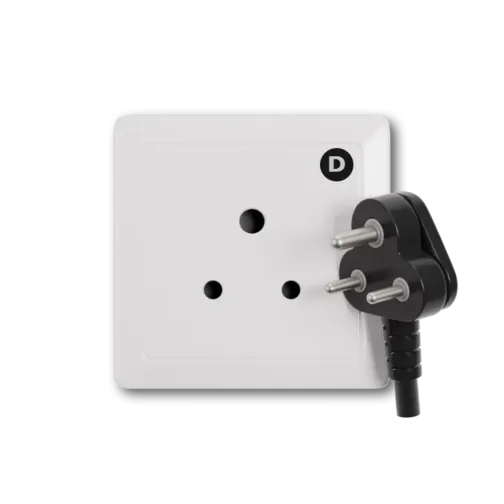
Type D
|
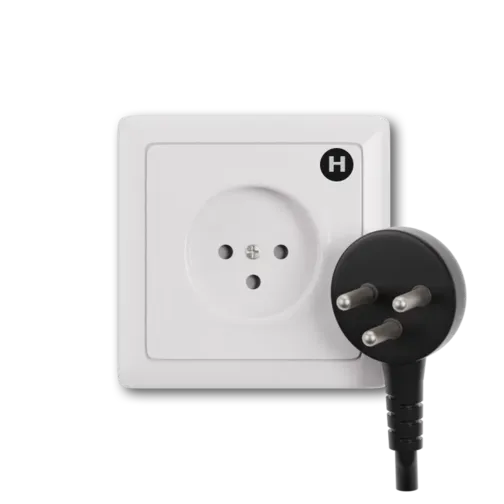
Type H
|
|
|---|---|---|
| Standard | BS 546 | SI 32 |
| Pin Configuration | Three large round pins in triangular pattern (ground pin 7.1mm, live/neutral 5.1mm diameter) | Three pins in V-shape arrangement (round 4.5mm or flat pins, 19mm length) |
| Grounding | Grounded | Grounded |
| Pin Count | 3 | 3 |
| Amperage | 5A | 16A |
| Voltage Range | 220-240V | 220-240V |
Packing a charger for a trip between India and Israel? The type D vs type H plug answer: both carry the same 230 V, 50 Hz domestic electricity, but neither power plug fits the other's power sockets.
You need a plug adapter, not a voltage converter, for most devices, and the right one depends on which country you are leaving and which one you are going abroad to.
Type D vs Type H Plug at a Glance
The type D plug and the type H plug both use three pins and are earthed, yet each plug type comes from a different national standard. Type D descends from the British BS 546 and is defined in India by IS 1293; Type H is defined by the Israeli SI 32 standard. Also see what are the differences between a type A and a type F plug.
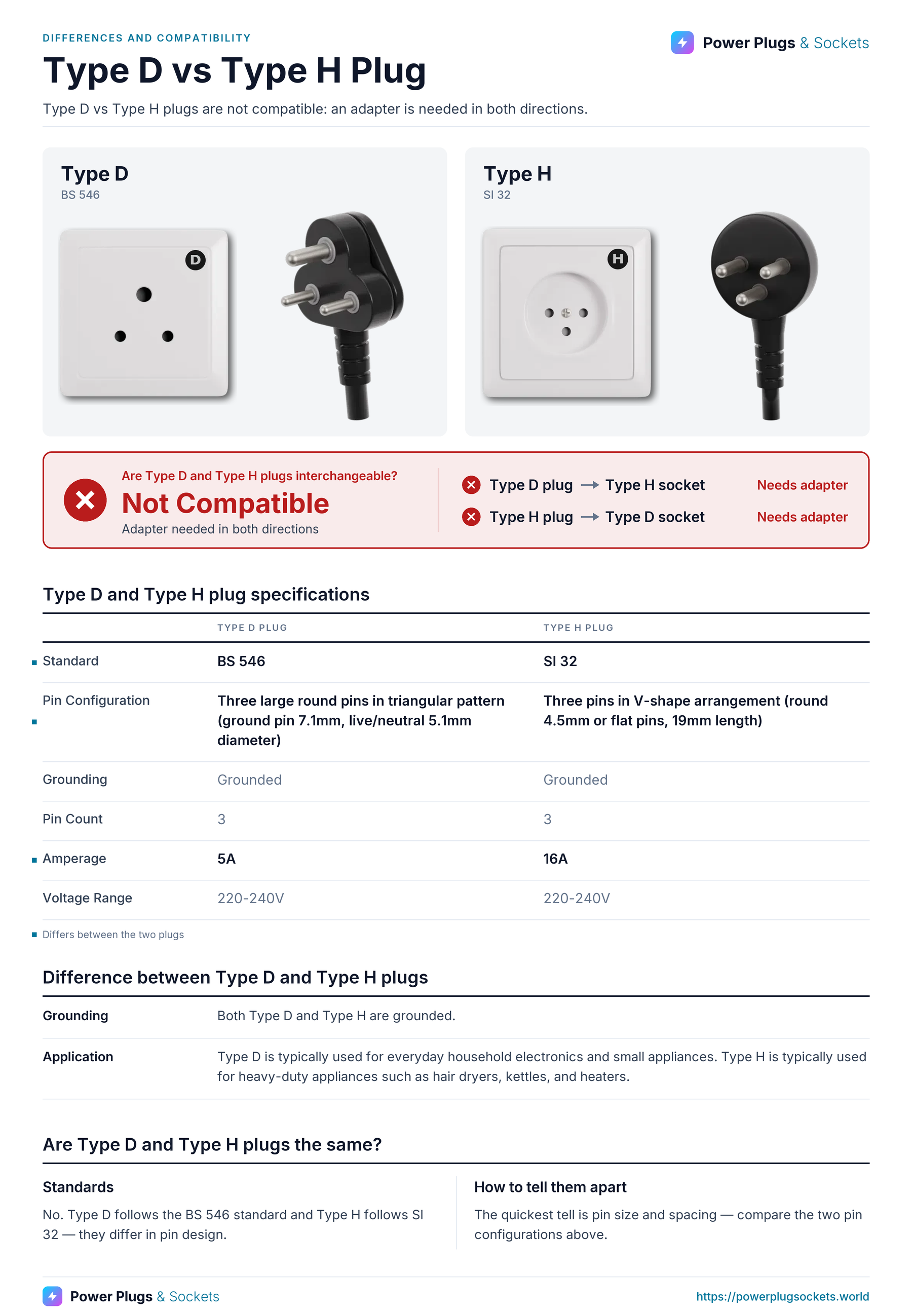
| Feature | Type D | Type H |
|---|---|---|
| Standard | BS 546 (British), IS 1293 (Indian) | SI 32 (Israeli) |
| Pins | Three round pins in a triangle | Three round 4.5 mm pins in a V (flat pins before 1989) |
| Rated current | 5 A (BS 546), 6 A (IS 1293) | 16 A |
| Rated voltage | 250 V | 250 V |
| Earthed | Yes | Yes |
| Polarized | Yes | Yes |
| Fused | Optional | No |
| Insulated pins | Optional | No |
| Recessed socket | No | No |
| Socket accepts Europlug | No (loose, unsafe fit) | Yes |
| Mains supply | 220 – 240 V, 50 Hz | 220 – 240 V, 50 Hz |
| Main countries | India, Nepal, Sri Lanka, parts of Africa | Israel, West Bank, Gaza Strip |
Start with the rated current: Type D sockets are light-duty outlets, Type H sockets general-purpose ones that can feed a kettle. Israeli socket-outlets were designed to take the flat two-pin Europlug; Indian ones were not.
BS 546 Roots of the Indian Plug
BS 546, introduced in 1934, defined round-pin plugs, and the 5 A size is the one the IEC calls plug D. India, Nepal and Sri Lanka kept it, so the power outlet type D remains the most common wall fitting in South Asia.
Three Round Pins in a Triangular Pattern
The Type D plug has three round pins, often described as three large round pins, in a triangular pattern: two power pins about 5.1 mm thick and 19.1 mm apart, and a thicker 7.1 mm earth pin at the top.
5 A in Britain, 6 A in India
The British plug is rated at 5 amps; India's IS 1293 rates the same plug at 6 A. Both are light-duty, and heavier appliances such as geysers use larger sockets.
Countries on the Indian Standard
Around 40 countries use Type D, led by India, Nepal, Sri Lanka and Bangladesh, with Pakistan using it alongside Type C, and Namibia, Botswana and Lesotho having type D plugs and outlets in older buildings.
Type M, the Bigger Sibling
Type M is the 15 A member of the BS 546 family with larger pins, so plug M will not enter a Type D socket. In India it serves heavy appliances and larger appliances; South Africa is moving to SANS 164-2.
The SI 32 Standard Behind Israel's Plug
Israel developed SI 32 (often written SI32), with no close relative elsewhere. Type H plugs are earthed and polarized, and the power outlet type H is the standard wall fitting in Israeli homes. For a related pairing, see how does the amperage rating of a type B plug compare to a type H plug.
Until 1989 the Type H plug used two flat prongs in a V shape, a V-shaped layout. The revision replaced them with three round pins of about 4.5 mm, with the pins in the same locations, so the new sockets take both older and newer Israeli plugs.
16 A Rating and Polarized Wiring
Every Type H plug and socket is rated 16 A and 250 V, enough for a 3,000 W heater, far beyond a Type D outlet. Type H is also polarized, with live and neutral in fixed positions.
Where Israeli Plugs Are Used
They are used in Israel, the West Bank and the Gaza Strip, grouped as Palestine in plug guides. The Thai Type O looks close but is not interchangeable.
Why Israeli Sockets Take Two-Pin Plugs
Type H sockets have round openings spaced like Type C sockets, so they accept non-grounded Europlugs, the Europlug (plug C), rated 2.5 A, which suits chargers and shavers.
Are These Plug Types Compatible With Each Other?
No. The IEC lists a Type D socket as compatible with Type D plugs only, with partial and unsafe compatibility for C, E and F plugs; a Type H socket is socket compatible with C and H plugs. Neither system's sockets take the other's plug.
The Europlug is the shared ground: it fits a Type H socket securely, but in Type D sockets its pins are loose and can arc, and a Schuko plug (type F) or French type E plug may enter an Israeli socket but runs unearthed. Frequency is identical, but hotel universal sockets and multi-standard strips in India accept Type D, Type M and Europlug while often holding thin pins poorly and being ungrounded, so use a dedicated adapter instead.
Can a Type D Plug Fit a Type H Socket?
No. Its 5.1 mm power pins are thicker than the roughly 4.5 mm openings, and the 7.1 mm earth pin has nowhere to go. A Type H plug sits loosely in Type D holes.
Do not force either one, or push anything into an earth pinhole to open a shutter.
Power Plug Safety: Earthing, Insulation and Load
Neither system fuses every plug as the British BS 1363 does, so the wall circuit breaker is your main protection. Check that the earth connects, the pins are insulated and the outlet can take your appliance's current.
Matching appliance wattage to the rating is simple: current is power divided by voltage, so at 230 V a BS 546 outlet carries 1,150 W, an IS 1293 outlet 1,380 W and an SI 32 outlet 3,680 W. A 2,200 W kettle draws 9.57 A, too much for Type D but fine on a 16 A Israeli outlet.
Each standard uses a full-length earth pin, but a cheap adapter may leave the earth unconnected, removing grounding from a kettle or iron. Choose an adapter with a real earth contact.
Uninsulated Pins and Shock Risk
Type H pins have no sleeve, and many Type D pins are not insulated either, so a half-pulled plug creates a real risk of electrocution. Push plugs fully home and pull by the body.
Choosing a Travel Adapter for IS 1293 and Israeli Sockets
The job is mechanical: change the pin shape, keep the voltage. A good travel adapter does that, but a 16 A Israeli socket can feed more current than a cheap adapter was designed for.
India and Israel both supply about 230 V at 50 Hz, so appliances work once the plug fits. Most phone chargers and laptop bricks are rated 100 – 240 V anyway.
When traveling to Israel with Indian devices, a simple type C adapter works for two-pin chargers. Going to India, you need Type H to Type D, with an earth pin for grounded appliances.
Many worldwide travel adapters omit both types.
When the Plug Swap Is Not Enough
A converter is needed only for 110 – 120 V devices such as an American hair dryer. "100 – 240 V" means the device is dual voltage and an adapter alone is enough.
Stay within 6 A for an Indian socket and 16 A for an Israeli one.