Type G vs Type N Plugs: Differences & Compatibility
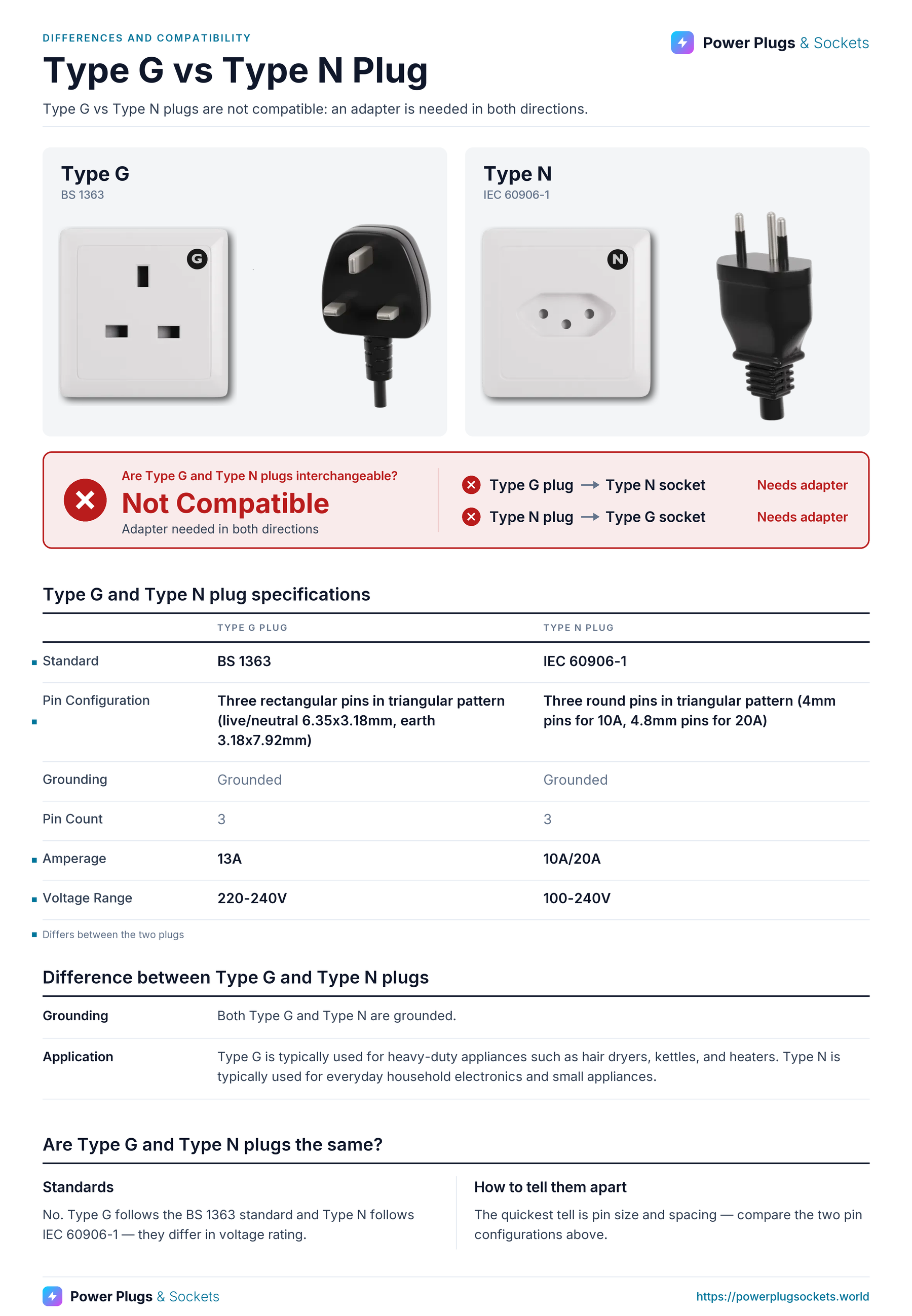
Type G vs Type N plugs are not compatible: an adapter is needed in both directions. Type G is a 3-pin, grounded plug rated 13A at 220-240V, while Type N is a 3-pin, grounded plug rated 10A/20A at 100-240V. The two differ mainly in voltage, amperage and pin design, which is what decides compatibility — whether a Type G plug fits a Type N socket, and vice versa. Next, check do you need a type D to type H plug adapter.
Swipe to compare
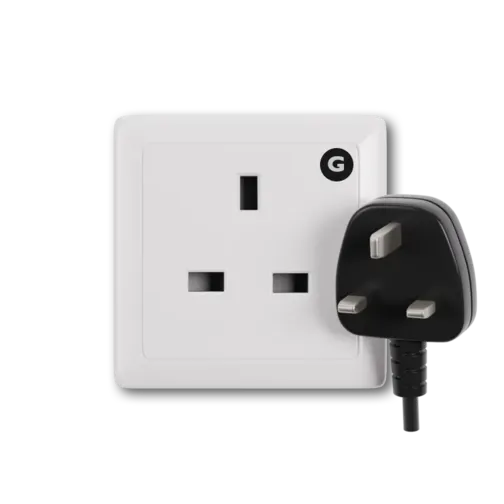
Type G
|
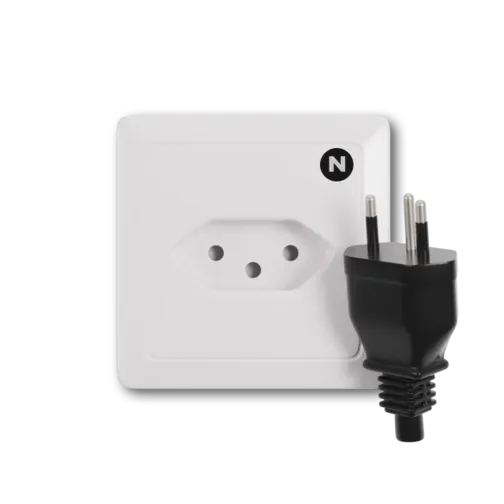
Type N
|
|
|---|---|---|
| Standard | BS 1363 | IEC 60906-1 |
| Pin Configuration | Three rectangular pins in triangular pattern (live/neutral 6.35x3.18mm, earth 3.18x7.92mm) | Three round pins in triangular pattern (4mm pins for 10A, 4.8mm pins for 20A) |
| Grounding | Grounded | Grounded |
| Pin Count | 3 | 3 |
| Amperage | 13A | 10A/20A |
| Voltage Range | 220-240V | 100-240V |
Packing for a trip between London and São Paulo, or shipping appliances from Kuala Lumpur to Cape Town, you will hit the type G vs type N plug question fast. The British type G plug uses three chunky rectangular pins in a triangular pattern with a fused plug and sprung shutters on every domestic outlet, while its rival uses three slim round pins in a compact recessed socket.
Your key takeaway: the two are not compatible with each other, and the safer choice depends on what you plug in.
Type G vs Type N Plug: Differences at a Glance
The letters come from the US International Trade Administration and describe shapes only. Both of these plugs and outlets have 3 pins and both are grounded, but they come from different design ideas. Compare this with should you choose type A or type F for an international travel adapter.
The UK system was built around a fuse inside every plug. The newer system, published by the IEC in 1986 for standardization across 220 – 240 V mains, chases small size, round pins and a deep recess instead.
| Feature | Type G (BS 1363) | IEC 60906-1 / NBR 14136 / SANS 164-2 |
|---|---|---|
| Number of pins | 3 pins, rectangular | 3 pins, round (2-pin unearthed version also exists) |
| Rated current | 13 A per plug (British 13A) | 10 A or 20 A in Brazil, 16 A in South Africa |
| Voltage | 220 – 240 V, plug rated 250 V | 100 – 240 V use, plug rated 250 V |
| Earthed / grounded | Yes, earth pin on top | Yes, offset earth pin in the centre |
| Fused plug | Yes | No |
| Polarized | Yes | Yes |
| Insulated pins | Yes, sleeves on live and neutral | Yes |
| Recessed socket | No | Yes |
| Safety shutters | Yes, opened by the earth pin | Mandatory in the IEC version, not required in Brazil |
| Socket accepts Europlug | No | Yes |
The Type G power socket is built to protect the cord and the person, while a round-pin power socket is built to be small and to stay compatible with the Europlug. Every UK plug has a current rating of 13 A and a voltage rating of 250 V, while UK electricity runs 230V at a frequency of 50Hz and some Brazilian states supply 127 V and others 220 V, at 60Hz, so always check your appliance label.
Rectangular Pins vs Round Pins and Pin Diameter
The British plug carries rectangular pins about 4.0 mm thick in an isosceles triangle, with a longer earth pin at the top; live and neutral sit 22.2 mm apart. In the IEC round-pin version every pin is 4.5 mm across, live and neutral sit on centres 19 mm apart, and the third pin is offset by 3.0 mm.
Brazil changes the pin diameter by rating: thinner pins for 10 A and 4.8 mm pins for 20 A. That 19 mm spacing matches the Europlug; pin dimensions, not looks, decide what fits.
How the BS 1363 British Plug Is Built
The BS 1363 system is the standard plug in the United Kingdom, listed in BS 7671 alongside the older BS 546 round-pin type D and type M plugs and sockets. Polarity is fixed, with the live terminal on the right and the circuit protective conductor on top.
Inside every plug sits a cartridge fuse that gives overcurrent protection to the flexible cord against overload and fire: a 3A fuse for lamps, chargers and computers and a 13A fuse for heaters and kettles. The IEC round-pin rivals carry no cartridge, so their cords rely on the wall breaker.
The long earth pin enters first and pushes back the covers over the live and neutral holes, so a hairpin hits plastic, a form of child protection that also keeps out foreign objects. Insulating sleeves on the live and neutral pins leave no bare metal exposed, and most sockets add a switch.
Where Type G Plugs & Outlets Are Used
According to the IEC, the BS 1363 socket-outlet is used in more than 50 countries, including the United Kingdom, Ireland, Malta, Cyprus, Malaysia, Singapore, Hong Kong, Brunei, Saudi Arabia, the UAE, Qatar and the rest of the Arabian Peninsula, Kenya, Uganda, Ghana and Nigeria. Hotels in former British territories sometimes pair type G outlets with a second power socket of another kind, so check the wall before relying on plug type G alone.
How the IEC 60906-1 Plug and Socket Is Built
The International Electrotechnical Commission published IEC 60906-1 in 1986 as a world plug for 230 V regions. It looks like the Swiss plug used in Switzerland (type J) but is not identical, and is often called the most compact grounded system.
It is rated 16 A 250 V for systems between 200 V and 250 V, and the socket is recessed with mandatory shutters. Europe put adoption on hold in the mid-1990s, so it became a national standard in only a handful of countries.
SANS 164-2 in South Africa
South Africa adopted the design as SANS 164-2 in 1992, in two-pin unearthed and three-pin earthed versions, and named it the preferred standard in 2013. Most homes still have the large round-pin type M sockets and the smaller type D alongside the new 16 A outlet, which also takes the Europlug.
Which Countries Use Type N Plugs & Outlets
Brazil, whose NBR 14136 Brazilian standard became compulsory on 1 January 2010 with 10 A and 20 A versions, is the only large market where the round three-pin system is the everyday standard. A 10 A plug fits a 20 A receptacle, but a 20 A plug will not go into a 10 A socket.
South Africa is in transition, and Paraguay adopted the IEC standard on paper but rarely installs it. Few private Brazilian houses had a proper ground, and large appliances came with a flying earth tail that many owners never connected.
Are UK Plugs Compatible With Brazilian Sockets?
No. No electrical plug of one design fits the other electrical socket: rectangular pins on 22.2 mm centres cannot enter round holes on 19 mm centres. Both regions mostly use 220 – 240 V, apart from the 127 V areas, so most chargers only need a shape change, not a converter.
The plugs and outlets differ; the electricity mostly does not.
Europlug and Type C Fit
The Europlug is the bridge: a two-pin type C plug slides straight into a Brazilian or South African socket, but will not go into a British socket-outlet without forcing the shutter, which you should never do. If your device has a type C plug, you need an adaptor in the UK but none in São Paulo or Johannesburg.
For other devices, travellers should note that choose from travel adaptors rated at least 10 A that carries the ground through, and avoid universal sockets for metal-cased appliances. For hair dryers and kettles, pick an adaptor rated for the full 13 A or 16 A load; for an electric vehicle cable, replace the plug rather than rely on an adaptor.
Electrical Safety: British 13A Design vs the Compact Three-Pin Standard
Which is the safest? The British side points to the fuse in every plug and a solid ground that makes first; the round-pin side points to the deep recess that keeps fingers from a live pin. For a related pairing, see comparing type E and type O plugs for international travel.
Both make an electric shock unlikely when the wiring is installed properly, and both plugs rely on polarization and earthing through a third contact. The bigger risk is cheap adaptors and missing earth conductors, so have an electrician test the earth before plugging a metal-cased appliance into a building you are unsure about.