Type H vs Type L Plugs: Differences & Compatibility
Type H vs Type L plugs are not compatible: an adapter is needed in both directions. Type H is a 3-pin, grounded plug rated 16A at 220-240V, while Type L is a 3-pin, grounded plug rated 10A/16A at 220-240V. The two differ mainly in amperage and pin design, which is what decides compatibility — whether a Type H plug fits a Type L socket, and vice versa. Next, check which countries use type K plugs versus type M plugs.
Swipe to compare
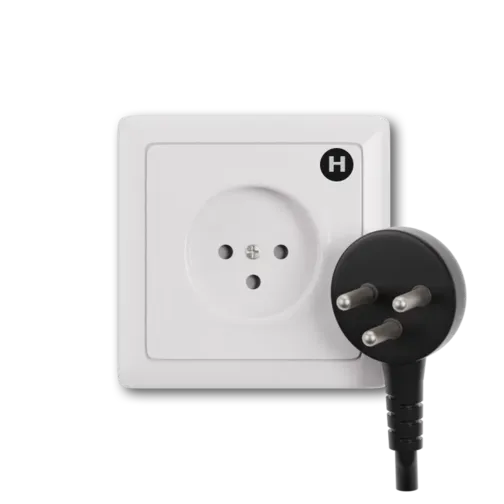
Type H
|
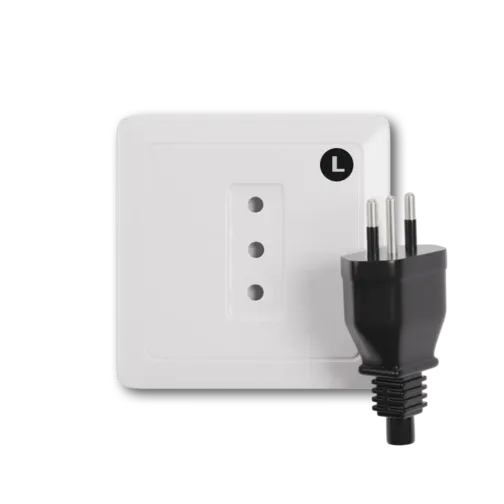
Type L
|
|
|---|---|---|
| Standard | SI 32 | CEI 23-50 |
| Pin Configuration | Three pins in V-shape arrangement (round 4.5mm or flat pins, 19mm length) | Three round pins in a row (10A: 4mm pins 5.5mm apart / 16A: 5mm pins 8mm apart) |
| Grounding | Grounded | Grounded |
| Pin Count | 3 | 3 |
| Amperage | 16A | 10A/16A |
| Voltage Range | 220-240V | 220-240V |
Packing for a trip that takes in both Tel Aviv and Rome, the type H vs type L plug question is about two different pieces of household electricity hardware: one built around a triangle of pins, the other around three pins in a straight line. Both run on the same 230 V supply at any electrical outlet; the one plug that fits both is the two-pin Europlug.
This guide covers both plug and socket types and when you need a plug adapter or a voltage converter abroad.
Type H vs Type L Plug at a Glance
The table sets the plugs and sockets of the Israeli SI 32 standard against the Italian CEI 23-50 standard. Next, check will a type D plug work in a type N socket without an adapter.
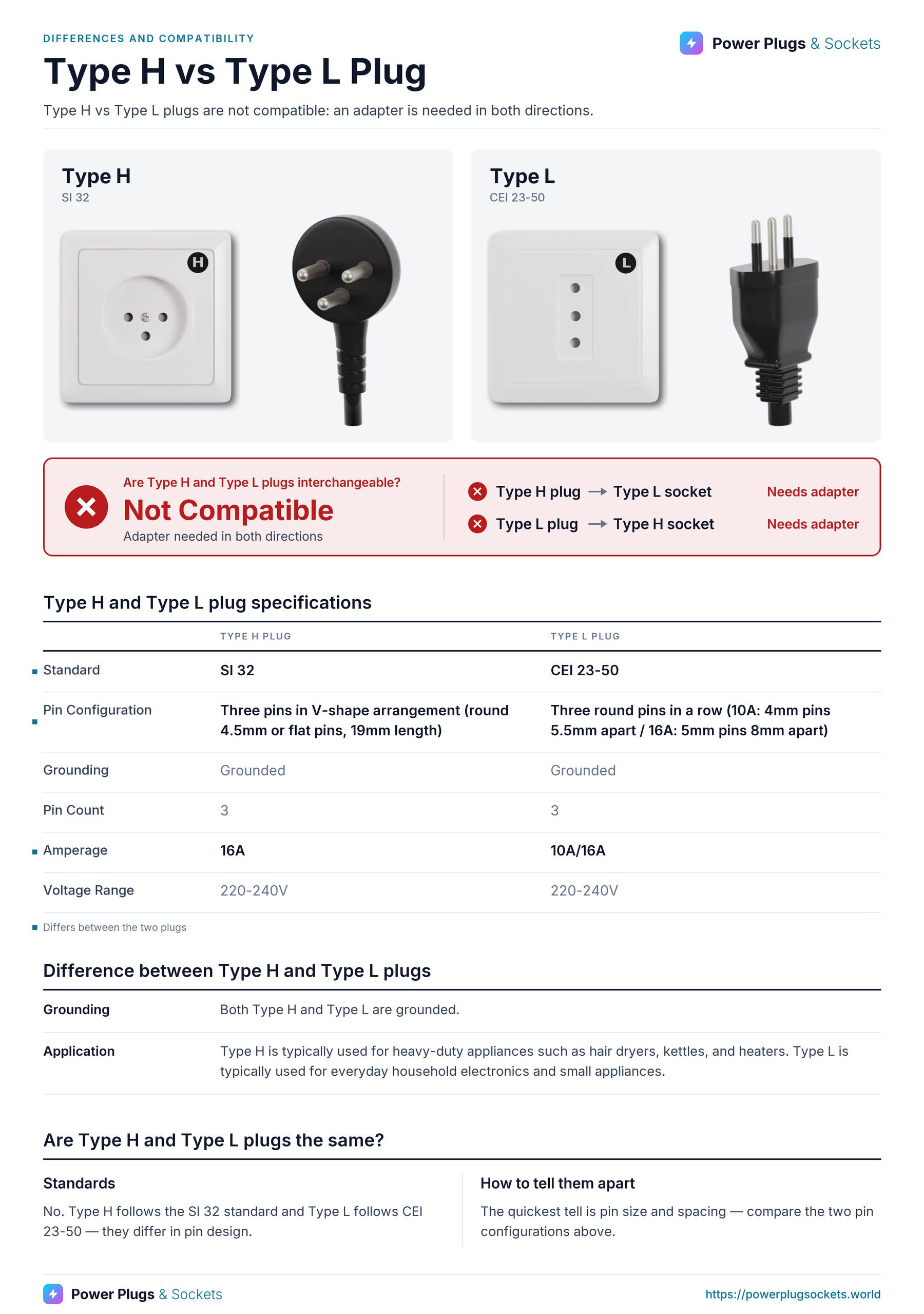
| Feature | Type H (Israel) | Type L (Italy) |
|---|---|---|
| Standard | SI 32 (IS16A-R) | CEI 23-50 (formerly CEI 23-16) |
| Pin layout | 3 pins in a triangle; live and neutral form a V, earth pin below | 3 round pins in a line, earth pin in the middle |
| Pin shape | Flat (pre-1989) or round 4.5 mm (since 1989) | Round: 4 mm (10 A) or 5 mm (16 A) |
| Pin spacing | 19 mm | 19 mm (10 A) or 26 mm (16 A) |
| Current rating | 16 A | 10 A and 16 A versions |
| Voltage and frequency | 220 - 240 V, 50 Hz | 220 - 240 V, 50 Hz |
| Grounded | Yes, grounded through the bottom pin | Yes, grounded through the centre pin |
| Main countries | Israel, West Bank, Gaza Strip | Italy, Chile, Uruguay |
| Socket also accepts | Type C (partial and unsafe fit with E and F) | Type C (10 A socket only) |
The electricity is identical, both sets of plugs and sockets are earthed, and neither plug goes into the other socket. Both sockets are compatible with plug types C and their own.
The Israeli socket has a defined polarity, with neutral on the left, live on the right and earth below, while a Type L plug is symmetrical and its live and neutral swap.
The Israeli Plug: SI 32 in Detail
The plug defined in SI32 never spread beyond its home market. It is rated 16 A, always grounded, and was redesigned once.
Old Flat Pins vs the 1989 Round-Pin Revision
The original plug used flat pins: two flat prongs angled in a V shape with an earth pin below, a Y-shape. The standard was revised in 1989 to three round pins with a 4.5 mm pin diameter in the same positions, so a newer socket takes both and a two-pin Europlug.
Pre-1989 sockets taking only flat pins are rare.
Where the Type H Plug and Socket Is Used
The Type H plug and socket is used in Israel, the West Bank and the Gaza Strip, across Israel and Palestine, and nowhere else; you will not find it in Jordan or Egypt, so a power outlet type H marks that region.
The Italian Plug: CEI 23-50 and the Bipasso Socket
The Italian plug is defined by CEI 23-50, which replaced CEI 23-16. Where the Israeli standard is one plug, the Italian standard is two.
Pin spacing differs by size.
The 10 A Version vs the 16 A Version
- 10 A version: 4 mm pins, centres 19 mm apart, for lamps and chargers.
- 16 A version: 5 mm pins, centres 26 mm apart, for heaters and washing machines.
A 16 A plug cannot be forced into a 10 A-only socket, and both plugs go in in either direction.
Presa Bipasso and the P40 Hybrid Socket
A power outlet type L is often the common presa bipasso (twin-gauge), CEI 23-50 P17/11, has a round centre hole and two figure-8 holes taking the 10 A plug and Europlug at the narrow part and the 16 A plug at the wide part. The larger P40 hybrid adds a Schuko recess, taking CEE 7/4, CEE 7/7 and CEE 7/17 plugs.
Where the Type L Plug and Socket Is Used
The Type L plug and socket is used in Italy and Chile, plus Uruguay and parts of North Africa; San Marino and Vatican City follow Italy. In Chile the 10 A plug type L is the one to plan for, and a single-size hole is usually the 10 A version.
Compatibility With Other Plug Types
Fit ranges from clean to partial and unsafe compatibility to none. You might also want type J vs type N socket.
The Europlug (Type C Plug) Fits Both
The Europlug, the two-pin Type C plug, fits a post-1989 Israeli socket and a 10 A Italian or bipasso socket. It is ungrounded, rated 2.5 A, and will not go into a 16 A-only socket with holes 26 mm apart.
Schuko, Type E and Type F Plugs
The Schuko plug (Type F, CEE 7/4) and French Type E plug have 4.8 mm pins. In Italy they fit only the P40, and in Israel they can be pushed in with no earth, so any earthed European appliance needs an adapter.
The CEE 7/7 hybrid and ungrounded CEE 7/17 contour plug fit the P40 only.
Type J and Type K Sockets Share the Same Limits
The Swiss Type J and Danish Type K accept their own plug plus a Europlug; Type K and the Thai Type O have a partial and unsafe fit with Schuko plugs. Swiss and Danish plugs are not compatible with either wall socket.
Type M for Heavy Appliances in Israel
Ovens in Israel use the 16 A Israeli plug itself, rated in amps by socket. The South African Type M plug fits neither an Israeli nor an Italian socket.
Can One Plug Fit the Other Socket?
No. A Type H plug has its pins in a triangle, every Italian socket wants three in a line, and the 4.5 mm round pin falls between the 4 mm and 5 mm Italian sizes. You need an H-to-L adapter or a Europlug.
Power Outlet Safety: Earthing, Shutters and Voltage
Both standards put safety first, but the differences matter more than shape for a metal-cased device. Both plugs carry an earth pin, so grounding works the same way, and fault current flows to earth rather than through you; a two-pin adapter drops the earthing, so use an earthed adapter for kettles.
Italian sockets commonly have child-safety shutters, while older Israeli pins have no insulation, a recognised electrocution risk when half pulled out. Supply is 230 V at 50 Hz in Israel and Italy, 220 V in Chile; devices from North America at 120 V and 60 Hz need checking, and every Israeli socket is rated 16 A.
Power Plugs on the Road: Travel Adapter or Voltage Converter?
A travel adapter changes the plug shape; a voltage converter changes the voltage. Check the label for an input range such as 100-240V; if it covers 230 V you need only a plug adapter, and if it is 110-120 V only, add a converter rated above its wattage.
Picking a Worldwide Adapter
You need a Type C pin set at minimum, ideally an earthed Italian 10 A option. Many universal models list Italy but not Israel, so travelers often do better with two small single-country adapters.
When You Also Need a Voltage Converter
Laptops and phone chargers are almost always dual voltage. US hair dryers and straighteners are the exceptions, and a 1,800 W dryer needs a heavy converter, so buy a local model.
Is There a Universal Socket?
Hotel universal sockets follow no standard and rarely connect the earth; use one for a charger only.
Why Countries Use Different Socket Outlets
Plugs and sockets were set nationally before any international standard, and replacing millions of each wall socket costs more than adapters. Italy's older electrical systems kept two sizes.