Type E vs Type J Plugs: Differences & Compatibility
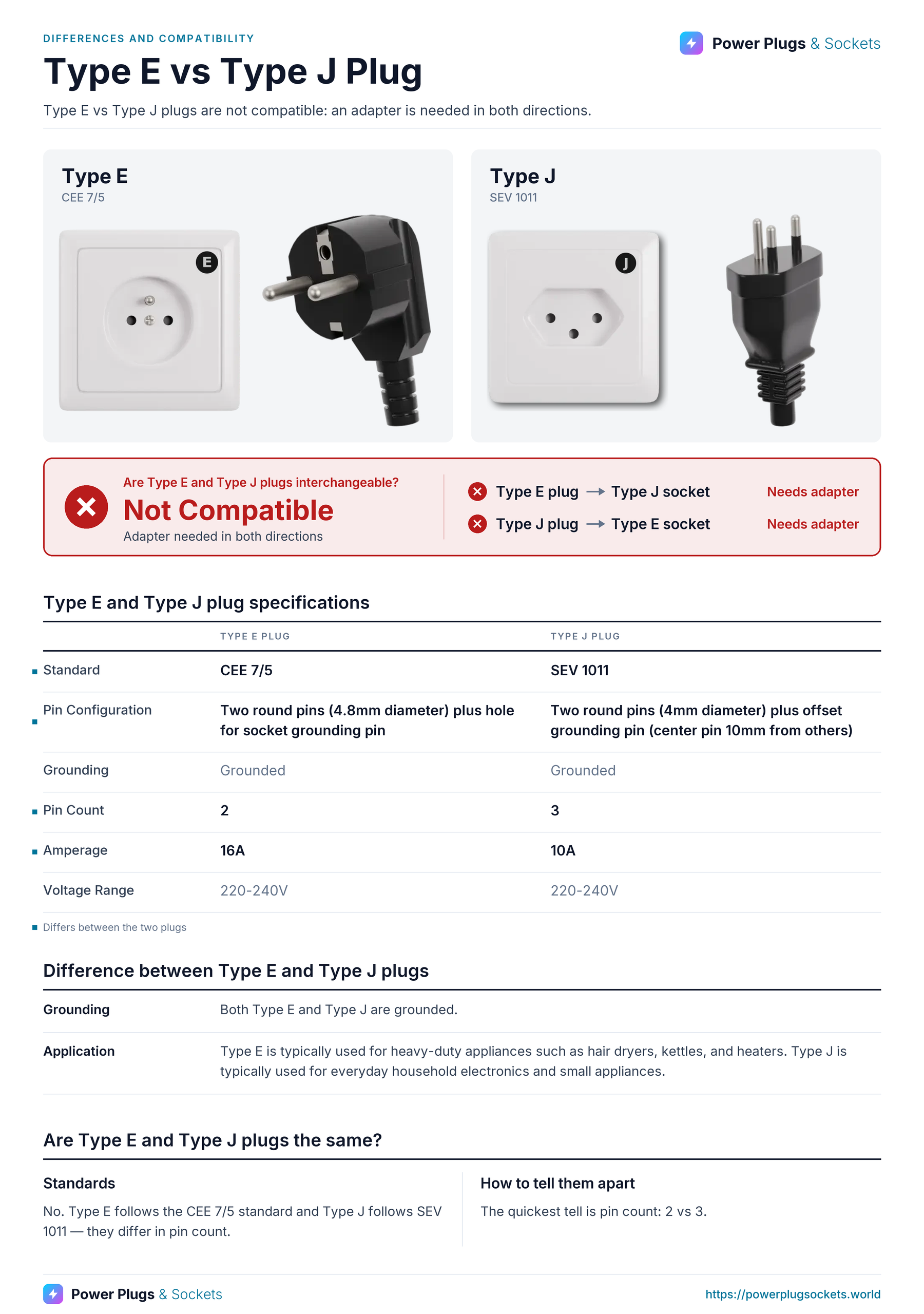
Type E vs Type J plugs are not compatible: an adapter is needed in both directions. Type E is a 2-pin, grounded plug rated 16A at 220-240V, while Type J is a 3-pin, grounded plug rated 10A at 220-240V. The two differ mainly in amperage and pin design, which is what decides compatibility — whether a Type E plug fits a Type J socket, and vice versa. Compare this with type L vs type O socket.
Swipe to compare
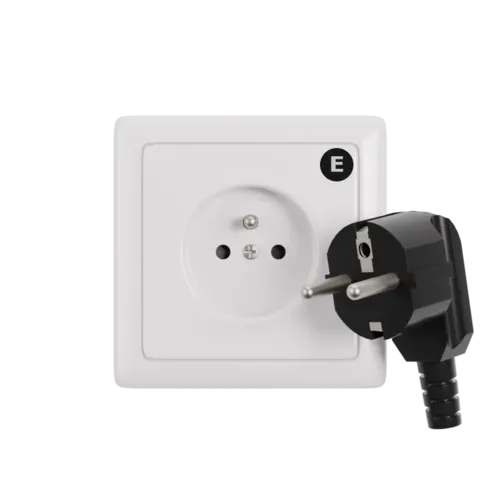
Type E
|
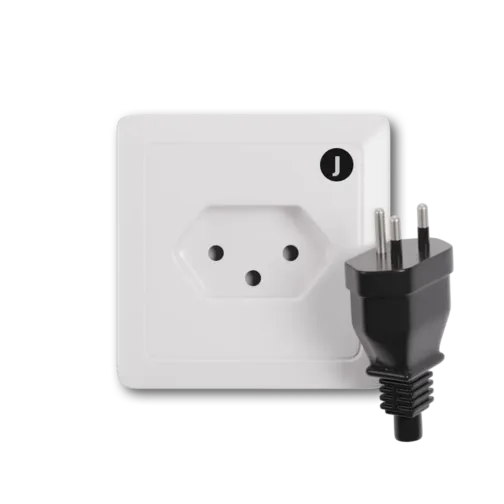
Type J
|
|
|---|---|---|
| Standard | CEE 7/5 | SEV 1011 |
| Pin Configuration | Two round pins (4.8mm diameter) plus hole for socket grounding pin | Two round pins (4mm diameter) plus offset grounding pin (center pin 10mm from others) |
| Grounding | Grounded | Grounded |
| Pin Count | 2 | 3 |
| Amperage | 16A | 10A |
| Voltage Range | 220-240V | 220-240V |
Packing for a trip from Paris to Zurich? The type E vs type J plug question comes down to one thing you can't see from across the room: where the earth contact sits and how thick the pins are.
Both standards carry the same mains electricity for domestic appliances, yet these plugs and sockets are incompatible with each other, so a cord that works in a French flat can be useless in a Swiss one.
Type E vs Type J Plug at a Glance
If you remember one thing, remember this: a type E plug will not go into a type J socket, and a Swiss plug will not go into a French wall either. Each standard runs on the same 220 – 240 V supply (nominally 230V at a frequency of 50Hz), so voltage is never the problem. Next, check why a type G plug is grounded and a type C plug is not.
The physical shape is.
| Feature | Type E (CEE 7/5) | Type J (SEV 1011) |
|---|---|---|
| Pin diameter | 4.8 mm | 4 mm |
| Pin spacing | 19 mm | 19 mm |
| Rated current | 16A at 250V | 10 A at 250V |
| Grounding method | Pin fixed in the socket, hole on the plug | Third pin on the plug, hole in the socket |
| Socket recess | Round, about 15 mm deep | Shallow hexagonal outline |
| Polarized | Yes, plug fits one way | Yes, three pins fix the direction |
| Fits into the other socket? | No | No |
Pin Diameter, Pin Spacing and Rated Current
Both systems use round pins set 19 mm apart, which is exactly why people expect them to be compatible. Pin thickness breaks that idea: type E uses 4.8 mm pins, while type J uses slimmer 4 mm pins that the French ones can't follow into a Swiss hole.
The current rating differs too. A French outlet takes 16 A, while the common Swiss socket stops at 10 A. Using \(P = V \times I\):
$$P_{E} = 230 \times 16 = 3{,}680\ \text{W} \qquad P_{J} = 230 \times 10 = 2{,}300\ \text{W}$$
So the French system feeds a much larger load through one plug. Both designs are polarized, and neither plug body suits the other system's recess, which settles the matter before the amps come into play.
Grounding Method: Where the Earth Contact Sits
The biggest split is the grounding method. In the type E system the earth pin is part of the socket and the plug only carries a hole.
In the type J system the plug carries the third grounding pin and the socket carries the hole. Both are fully grounded designs, built for the same safety reason: if a live wire touches a metal case, the fault current flows to earth and trips the breaker instead of passing through you.
Plugging a grounded appliance into an ungrounded path removes that protection and raises the risk of electrocution. Grounding is the whole point of the third contact, whichever side it lives on.
How the Type E Socket Works (CEE 7/5)
The type E socket is the French answer to earthing: a round, recessed cup with two holes and a metal pin sticking out of the top edge. Next, check type I vs type N socket.
The Protruding Earth Pin and Make-First, Break-Last
That protruding pin is longer than the live and neutral contacts inside the cup. As you push a plug in, its earth hole (some makers call it a ground hole) slides over the pin before the power pins touch anything.
During insertion the earth connects first, and on removal it breaks last. Engineers call this make-first, break-last, and it keeps grounding in place at the moments a fault is most likely.
The trade-off is that a French plug enters the wall socket in only one orientation.
Type F, Schuko and the CEE 7/7 Hybrid
Germany solved the same problem differently. The type F socket, known as Schuko, has no pin at all.
Two spring earth clips sit on the sides of the recess, and the plug's metal strips press against those side clips. A plain Schuko plug has no hole, so it won't enter a French socket.
The fix is the CEE 7/7 hybrid: side strips for a type F socket plus a hole for the type E pin. Almost every corded appliance sold across Germany, France and the rest of continental Europe ships with one, so it is compatible with both type E and type F outlets.
Schuko-style 4.8 mm pins still won't enter a type J socket, so don't assume a "European" plug works everywhere.
How Type J Plugs Work Under SEV 1011
Type J plugs follow the Swiss standard SEV 1011. Think of a Europlug with a third pin added: three round pins, each 4 mm thick, arranged in a shallow triangle.
Offset Third Pin and Insulated Sleeves
The Swiss earth pin isn't in line with the other two. It sits offset by 5 mm from the centre line joining live and neutral, which gives the plug its slightly bent, hexagonal look.
The live and neutral pins carry 10 mm insulated sleeves next to the plug body, so your fingers can't touch a live pin while the plug is half out. Older versions used unsleeved pins, and you'll still find them on decades-old lamps.
The 10 A Limit and High Power Appliances
The standard Swiss connector is rated for 10 amps. Above that, equipment has to be wired permanently with its own branch circuit protection, or connected through a high power industrial connector.
A 16 A variant with rectangular pins exists for bigger loads. In practice, a 2,400 W kettle draws about 10.4 A, above the rating, while a 1,600 W hair dryer draws about 7 A and sits comfortably within it.
Type J vs Type N: A Close Lookalike
The Brazilian type N plug also has three round pins in a triangle, but its earth pin sits closer to the centre, so it won't line up with a Swiss socket. Treat Brazil and the Swiss system as separate.
Which Power Plug Fits Which Socket
Here's how each power plug behaves in the other country's wall. Only one plug fits perfectly in both, and it's neither of the two in the title.
Type E Plugs in a Type J Outlet
Type E plugs fail in a Swiss outlet because:
- The 4.8 mm pins are too thick for the 4 mm holes.
- The round plug body is too wide for the hexagonal recess.
- The plug's earth hole has nothing to meet, since the Swiss socket has no earth pin.
Forcing one in only damages the contacts. Use an adapter.
Taking a Swiss Appliance to France or Belgium
Going the other way fails too. A Swiss plug has a third pin where a French socket has no hole, and that socket's own pin blocks the plug body.
In France or Belgium, you need an adapter that takes a type J plug on the front and has type E pins on the back.
The Type C Plug: Why the Europlug Fits Both
The two-pin type C plug, the Europlug (CEE 7/16), fits both. Its two round pins, 4 mm thick with tapered tips, slide into French and Swiss sockets, plus those in Italy and Denmark.
The catch: it is ungrounded and rated at only 2.5A, so it suits phone and laptop chargers, not a kettle. If your device came with one, it is compatible with both countries without any adapter.
Countries Using Each Plug Type
Each plug type belongs to a small group of countries, so the list tells you which plugs & outlets to expect before you land.
Type E Outlets in France, Belgium and Beyond
You'll find type E outlets mainly in:
- France, including its overseas regions
- Belgium
- Poland and the Czech Republic
- Slovakia
- Tunisia and Morocco, at 220 – 240 V
Older buildings in Poland sometimes still have type F Schuko sockets, but the CEE 7/7 plug on most appliances in Europe handles either.
Switzerland and Liechtenstein: Type J Only
Type J is used almost only in Switzerland and Liechtenstein, one of the few standards in Europe that doesn't match its neighbours, so a German type F or French adapter won't help you there. Older hotels may mix sockets, but the plugs & outlets you'll actually meet in Swiss homes are type J.
Travel Adapters for a Type E or Type J Power Outlet
For most travel, the right travel adapter depends on which power outlet you'll face and what you plug in. A universal travel adapter with a slim Swiss insert covers both, but check the box: many universal designs only offer a Europlug output, which fits but doesn't earth.
Travelers on a French and Swiss trip are best served by a universal adapter that lists type J, or by two small single-country adapters. Seasoned travelers follow three steps:
- Check whether your device has two pins or three.
- Read the input line on its label for the voltage range.
- Pick an adapter that matches the power outlet and keeps grounding if your plug has an earth contact.
When You Need a Grounded Adapter (Class I vs Class II)
Two-pin devices with the square-in-a-square symbol are Class II, meaning double-insulated, and never need earth. Three-pin Class I devices such as a CPAP machine, a desktop computer or studio audio gear do.
For those, use a grounded adapter that passes the earth through, or buy a local power strip on arrival and plug your devices into that.
Tip: an adapter that fits without passing the earth through turns a grounded appliance into an ungrounded one. Three pins on your plug means you need three contacts in the adapter.
USB-C and GaN Chargers Sidestep the Earth Question
Most phone chargers and laptop bricks today are USB-C and nearly all are Class II. A compact GaN charger with several USB-C ports needs only two pins, so the grounding difference stops mattering for your electronics and other travel devices.
One USB-C charger plus one Europlug-style travel adapter powers a phone, tablet and laptop in both countries.
Plug Adapter or Voltage Converter?
A plug adapter only changes the pin shape; a voltage converter changes the voltage. Both countries run at 230V, so you need a converter only for a 120V-only appliance from North America.
If the label reads 100-240V, the device is dual voltage and the adapter alone is enough for your travel bag.