Type L vs Type O Plugs: Differences & Compatibility
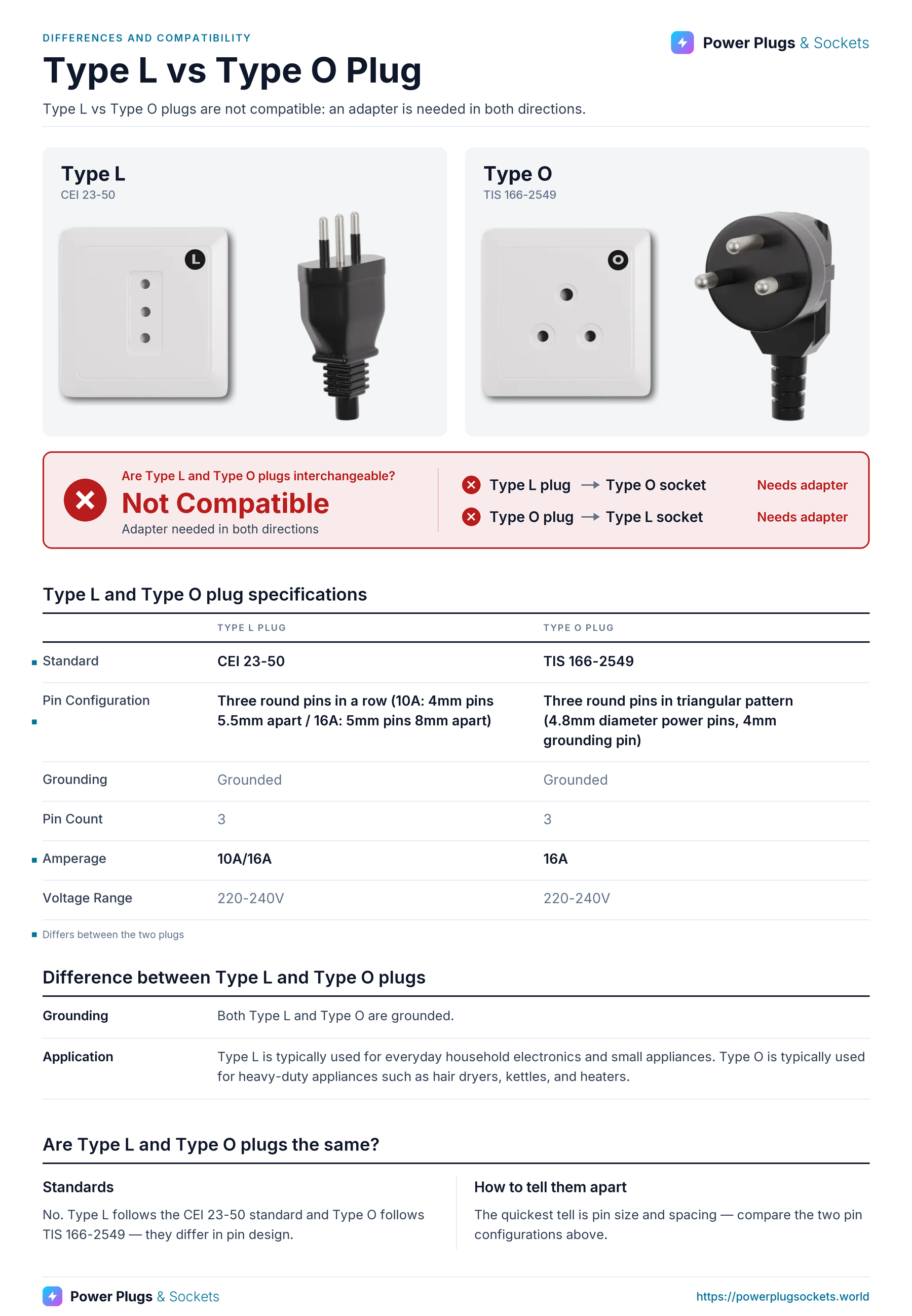
Type L vs Type O plugs are not compatible: an adapter is needed in both directions. Type L is a 3-pin, grounded plug rated 10A/16A at 220-240V, while Type O is a 3-pin, grounded plug rated 16A at 220-240V. The two differ mainly in amperage and pin design, which is what decides compatibility — whether a Type L plug fits a Type O socket, and vice versa. You might also want what are the differences between a type I and a type K plug.
Swipe to compare
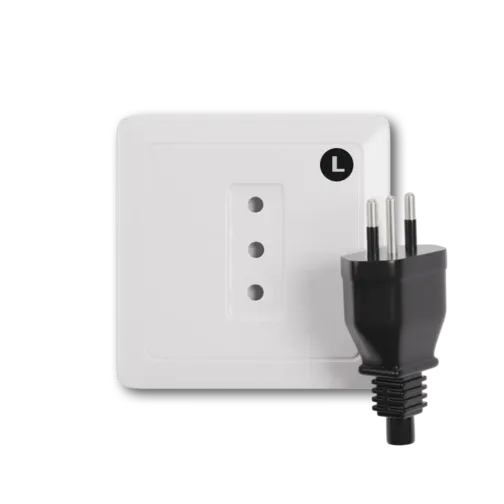
Type L
|
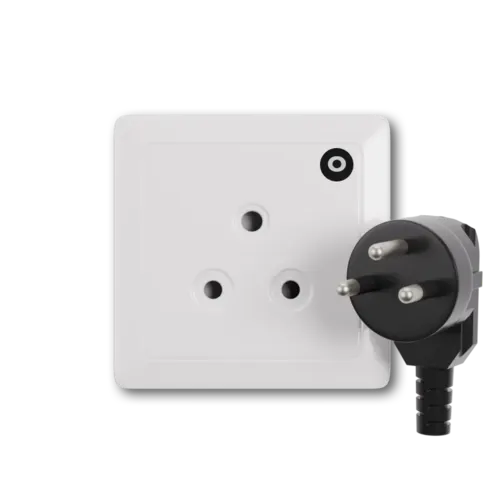
Type O
|
|
|---|---|---|
| Standard | CEI 23-50 | TIS 166-2549 |
| Pin Configuration | Three round pins in a row (10A: 4mm pins 5.5mm apart / 16A: 5mm pins 8mm apart) | Three round pins in triangular pattern (4.8mm diameter power pins, 4mm grounding pin) |
| Grounding | Grounded | Grounded |
| Pin Count | 3 | 3 |
| Amperage | 10A/16A | 16A |
| Voltage Range | 220-240V | 220-240V |
Flying from Rome to Bangkok with a laptop, a phone charger and a hair dryer? The type L vs type O plug question decides which will work the moment you land, because the two designs look alike, three round pins on a 220 – 240 V supply, yet neither fits the other country's outlets.
The short answer: the Italian plug keeps its earth pin in line between the power pins, the Thai plug drops it below them, and the one plug that fits both is the two-pin Europlug.
Type L vs Type O Plug at a Glance
Type L is of Italian origin and used almost exclusively in Italy, Chile and Uruguay, with pockets in North Africa and Europe; Type O is used exclusively in Thailand and is unique to Thailand. Both are grounded three-pin plug designs on domestic 220 – 240 V mains electricity at a frequency of 50 Hz, and each national standard fixes the shape of every outlet.
| Feature | Type L (Italy) | Type O (Thailand) |
|---|---|---|
| Standard | CEI 23-50 | TIS 166-2549 |
| Pins | 3 pins, three round pins in a line | 3 pins, earth pin offset below the power pins |
| Rating | 10 A and 16 A versions | 16 A |
| Power pin diameter | 4 mm (10 A) / 5 mm (16 A) | 4.8 mm |
| Pin spacing (centres) | 19 mm (10 A) / 26 mm (16 A) | 19 mm |
| Grounded | Yes, middle earth pin | Yes, offset earth pin |
| Polarized socket | No, symmetrical | Yes |
| Voltage | 220 – 240 V (230 V in Italy) | 220 – 240 V (220 V in Thailand) |
| Socket compatible with | Plug types C & L (10 A socket) | Plug types C & O, partial E and F |
| Main countries | Italy, Chile, Uruguay | Thailand |
The power plug spacing of the 10 A Italian plug and the Thai plug is the same 19 mm, but the earth pin position is not, so each needs an adapter in the other's electrical outlet. These plug and socket types differ in the grounding pin, a safety feature to keep.
The letter system was first used by the US Department of Commerce, now its International Trade Administration, to help travellers recognise foreign outlets. The letters are arbitrary and say nothing about safety; the IEC uses the same letters, and the binding rules live in each national standard.
Inside the Italian Plugs: CEI 23-50 in Two Sizes
Italian plugs and sockets are defined by CEI 23-50, covering type L sockets and wall outlets. The "type L system" is two plug sizes sharing one layout, so when you buy type L plugs & outlets, know which plug type L rating an appliance's power cords carry. You might also want what is the difference between type C and type G electrical sockets.
The 10 A Version and Its Pin Spacing
The plug rated at 10 A has 4 mm pins with centres spaced 19 mm apart and the earth pin in the middle; the contact diameter is small and live and neutral go in either direction. That spacing matches the Europlug, so a 10 A Italian socket accepts plug types C & L, and you find it on chargers, lamps and laptops.
The 16 A Version and Its Two Form Factors
The 16 A version uses 5 mm pins 26 mm apart. A 16 A plug cannot enter a 10 A socket, and older 16 A-only sockets reject a 10 A plug or Europlug.
Washing machines, heaters and ovens usually carry this form factor.
The Thai Plug Explained: TIS 166-2549
The Thai plug is defined by Thai Industrial Standard TIS 166-2547 and its update, TIS 166-2549. Thailand's mains electricity is 220 V at 50 Hz, and catalogues list the design as type O plugs & outlets.
Pin Diameter, Length and the Earthing Pin
The two round pins have a pin diameter of 4.8 mm, are 19 mm long and are insulated for the first 10 mm. The earthing pin is longer, 21.4 mm, so it connects first, and sits 11.89 mm below the line joining the power pins.
That offset is why the Type O socket rejects an Italian plug.
How the Thai Design Grew Out of NEMA 5-15
Thailand once used outlets based on NEMA 1-15 and NEMA 5-15, the North American Type A and Type B. The new plug kept the earth pin offset of NEMA 5-15, so it fits the existing hybrid sockets.
Thai Hybrid Outlets and the NEMA Phase Out
Many Thai homes and hotels have hybrid outlets that accept flat Type A blades, Type B, Europlugs and the round Type O plug. Thailand plans to phase out the NEMA-compatible receptacle shapes; if an outlet has only two holes, assume nothing plugged into it is earthed.
Bipasso, P40 and Other Hybrid Sockets
Modern Italian installations rarely use a single-size socket; hybrid power sockets accept several plug types.
The Presa Bipasso Twin-Gauge Socket
The presa bipasso (CEI 23-50 P17/11) has a round centre hole flanked by two figure-8 holes, so this twin-gauge socket takes the 10 A plug, the 16 A plug and the Europlug.
The larger P40 socket adds a German-style recess and side earth clips for CEE 7/4 Schuko, CEE 7/7 hybrid and CEE 7/17 contour plugs. A Thai Type O plug does not fit it.
Europlug Compatibility Between These Plug Types
No outlet in either country takes both grounded plug types, so the overlap is the unearthed Europlug. The Italian 10 A socket takes C and L 10 A; the 16 A socket only 16 A; the bipasso and P40 both Italian sizes and Type C; the Thai socket C and O.
Type C Plugs in Both Systems
The two-pin Type C plug is rated 2.5 A and fits the Italian 10 A socket, every bipasso and every Thai outlet. With no earth pin, it should power only double-insulated equipment.
Schuko, Type E and Type F: Partial and Unsafe Fits
A Schuko (Type F, CEE 7/4) or French Type E plug can be pushed into a Thai socket, but the earth contacts have no match, so the appliance runs unearthed: partial and unsafe compatibility. In Italy it needs a P40 socket or an adapter.
Lookalikes: Israel SI32 (Type H), Type J, Type K and Type N
The Israeli SI32 (Type H) plug has an offset earth pin like Type O but different dimensions. The Swiss Type J, Danish Type K and Brazilian Type N also offset the earth, and none fits a Thai or Italian socket safely.
Europlug-Ready Packing for Italy and Thailand
For travelers moving between the two countries, bring devices with a Europlug or one universal adapter. You might also want should you choose type E or type J for an international travel adapter.
- A Type L 10 A plug in Thailand: a travel adapter with a Type O or Type C output.
- A Type L 16 A plug: a plug adapter rated 16 A; many slim adapters are only 10 A.
- A Type O plug in Italy: an adapter with a Type L output, or Schuko output for a P40 socket.
- A Europlug: no adapter in either country.
Do You Need a Voltage Converter?
No. Italy runs at 230 V and Thailand at 220 V, both 50 Hz. A label reading 100-240 V means dual voltage; a voltage converter is needed only for 110-120 V appliances from North America or Japan.
Safety Checks Before You Plug In
- Never force a plug into the wrong outlet.
- Use grounded adapters for metal-bodied appliances to avoid an electric shock.
- Check the rating: a 16 A heater on a slim 10 A adapter can overheat.
- A cracked bipasso or loose Thai hybrid socket is a safety risk.