Type I vs Type N Plugs: Differences & Compatibility
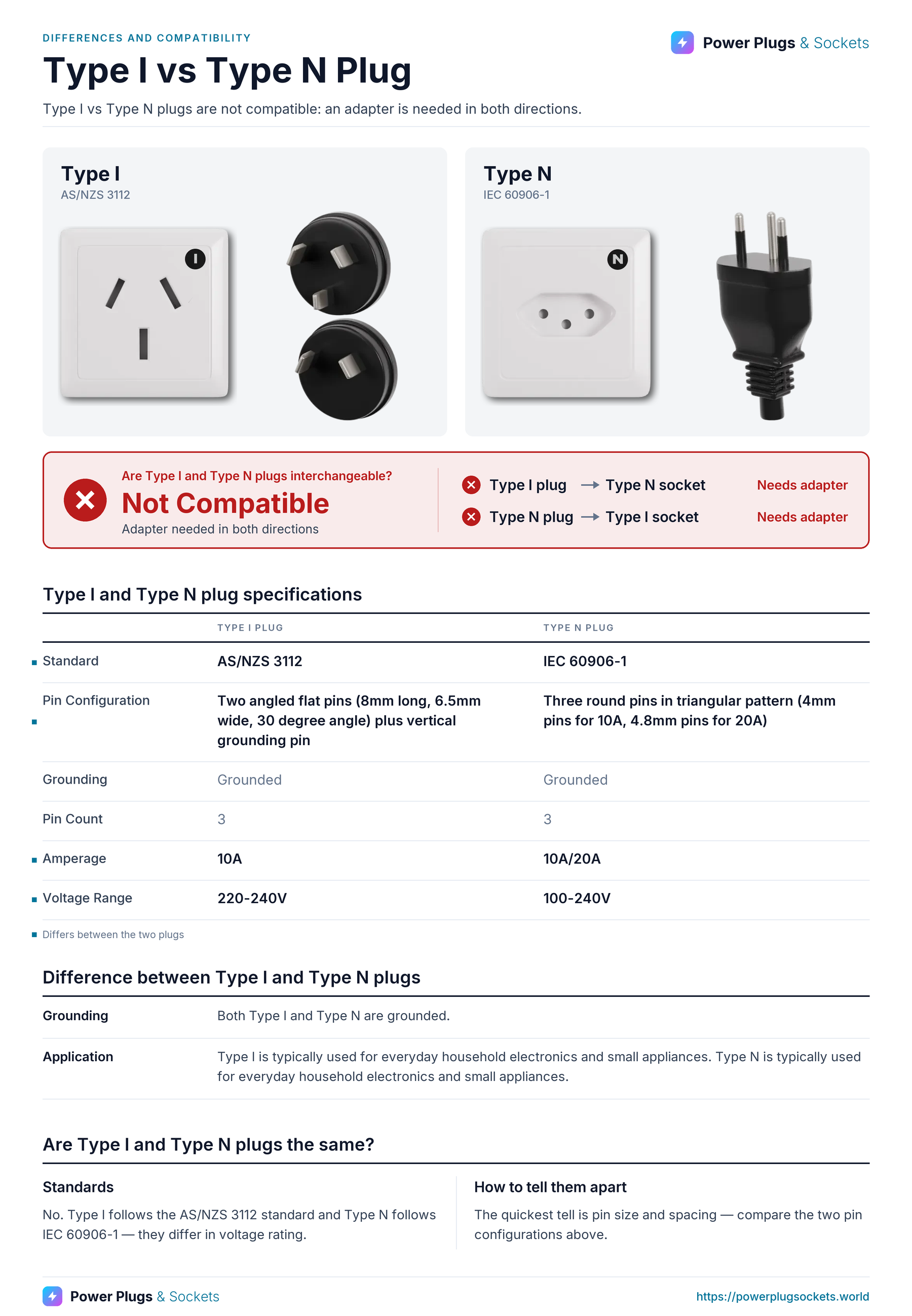
Type I vs Type N plugs are not compatible: an adapter is needed in both directions. Type I is a 3-pin, grounded plug rated 10A at 220-240V, while Type N is a 3-pin, grounded plug rated 10A/20A at 100-240V. The two differ mainly in voltage, amperage and pin design, which is what decides compatibility — whether a Type I plug fits a Type N socket, and vice versa. Next, check what are the differences between a type E and a type J plug.
Swipe to compare
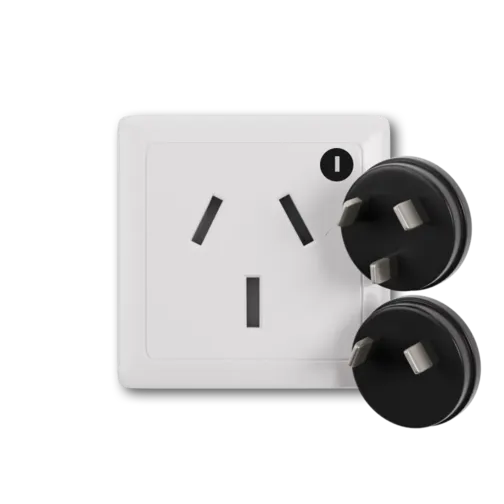
Type I
|
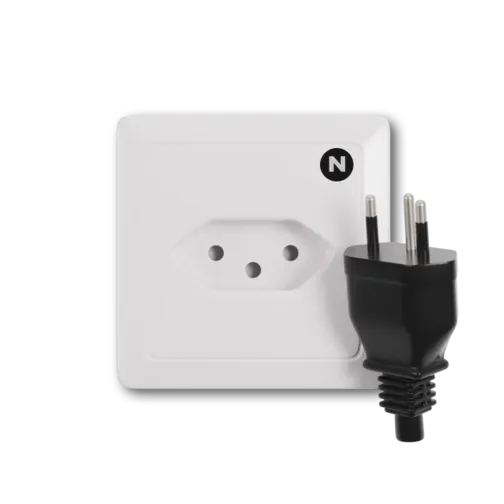
Type N
|
|
|---|---|---|
| Standard | AS/NZS 3112 | IEC 60906-1 |
| Pin Configuration | Two angled flat pins (8mm long, 6.5mm wide, 30 degree angle) plus vertical grounding pin | Three round pins in triangular pattern (4mm pins for 10A, 4.8mm pins for 20A) |
| Grounding | Grounded | Grounded |
| Pin Count | 3 | 3 |
| Amperage | 10A | 10A/20A |
| Voltage Range | 220-240V | 100-240V |
Carrying a laptop charger from Sydney to São Paulo, or shipping a kettle from Johannesburg to Buenos Aires, turns the type I vs type N plug question into a practical one. These two plugs and sockets never mate, because one family uses angled flat blades and the other round pins, so you always need an adapter, and sometimes a check of the voltage.
Type I vs Type N Plug: How the Two Designs Differ
The letters come from the International Electrotechnical Commission (IEC) World Plugs guide, which gives each family of roughly compatible plugs a letter for travellers. Letter I groups the Australasian AS/NZS 3112 plug with its Chinese and Argentine cousins, while letter N groups the Brazilian NBR 14136 and the South African SANS 164-2, both derived from IEC 60906-1.
Across the two letters the plugs are mutually incompatible, and no national standard defines a plug and socket that takes both. A socket outlet in one family accepts plugs only from that family.
| Feature | Letter I (Australasian family) | Letter N (round-pin family) |
|---|---|---|
| Pin shape | Flat blades in an inverted V, flat earth blade | Round prongs in a shallow triangle |
| Earth pin | Vertical blade below the plug centre | Round pin offset 3 mm from the power-pin line |
| Current ratings | 10 A, with larger sizes up to 32 A | 10 A and 20 A (Brazilian), 16 A (South African) |
| Rated voltage | 250 V | 250 V |
| Insulated pins | Required in Australasia, optional elsewhere | Yes, on every power pin |
| Recessed socket | Optional, rarely fitted | Yes |
| Accepts the Europlug | No | Yes |
| Main countries | Australia, New Zealand, China, Argentina, Fiji, Papua New Guinea | Brazil, South Africa |
V-Shape Flat Pins Against Round Pins in a Triangle
The Australasian plug has two flat pins forming an inverted V-shape plus a flat vertical grounding pin; each blade on the 10 A plug is 6.25 mm wide and 1.55 mm thick. The Brazilian and South African plug uses round pins on centres 19 mm apart.
The earth pin is longest on the V-pin plug, so it connects first. On the round design the earth pin is offset by only 3 mm from the line of the power pins, unlike the Swiss plug (type J) at 5 mm.
The pin length is 19 mm on every round-pin version, a size set in the 1986 era of injection moulding. Australian outlets are usually flush, switched wall plates, while the round-pin outlet is a recessed socket with a hexagonal profile that also takes the Europlug.
The AS/NZS 3112 Family Across Oceania, China and Argentina
The standard is used across Oceania (Australia, New Zealand, Fiji, Tonga and Papua New Guinea). The same shape is used in China and Argentina, so type I plugs from Perth, Shenzhen and Rosario share one letter.
Australian ratings run 10 A to 32 A and are one-way compatible: a socket takes plugs of equal or lower rating.
Argentine plugs follow IRAM 2073 and are rated for 10 A or rated for 20 A, a current rating that suits air conditioners and other high-power appliances. They put the live pin on the right, so polarity is reversed against Australia and live and neutral swap, and a 10 A plug cannot fit into a 20 A socket of the other size.
China's GB 1002 mirrors the Australian shape, so those plugs are compatible with each other. Older dual socket outlets there pair a grounded outlet with an unearthed one, which risks electric shock for 120 V gadgets on the 220 V supply.
The IEC 60906-1 Design Behind Brazil and South Africa
In 1986 the IEC published a 16 A, 250 V plug with a pin diameter of 4.5 mm, meant as a common household plug system for 230 V mains. The EU shelved it in the mid-1990s, and Paraguay adopted it only voluntarily, so a type N plug today is a national adaptation. Compare this with type D plugs run on 220-240V while type E plugs run on 220-240V.
Brazil's NBR 14136, compulsory from 2010, defines 4.0 mm 10 A and 4.8 mm 20 A versions and needs no shutters. Few Brazilian homes have an earth, so a flying earth tail was once common.
South Africa adopted SANS 164-2 in 1992 and is replacing older round-pin outlets with the new type N socket. It also accepts type C plugs and the Europlug, a transition that helps safety in the country.
Brazilian Plugs and Australian Plugs Compared on Pin Dimensions
The pin dimensions explain why nothing joins them: Australasian and Argentine 10 A blades measure 6.25 × 1.55 mm, the Argentine 20 A 8.0 × 1.9 mm, while Brazilian plugs have round 4.0, 4.5 and 4.8 mm pins. Mains electricity is 220-240 V at 50 Hz in the Australasian countries and South Africa, but Brazil runs 127 V or about 220 V at 60 Hz, and type N plugs are used on both.
An Australian hair dryer can run at half its voltage there, and a Brazilian appliance can burn out on a 230 V socket. Check the frequency and voltage on the label.
Insulated Pins, Shutters and Earthed Wiring in SANS 164-2 Sockets
Australian rules make insulated pins compulsory, and only licensed electricians may remove a socket. The IEC round-pin original requires shutters that open only when both pins push in, a feature the South African version keeps and the Brazilian one drops, giving child protection. For a related pairing, see what is the difference between type A and type D electrical sockets.
Plug retention and temperature rise are tested, which cheap universal sockets skip. Since few Brazilian circuits are earthed, an earth-fault breaker matters more there.
Older Brazilian homes also have 20 A outlets for air conditioners that are physically identical to the Argentine plug, some wired as split-phase.
Class I appliances, such as kettles, need the three-pin plug, with 3 pins grounded. Class II appliances use two pins, unearthed.
Both families follow this split, with 2 pins for Class II and three pins for Class I.
Insulating Sleeves and the Partially Inserted Plug
A partially inserted plug is the classic shock risk, since the pins are live while fingertips can still reach them. Australian plugs carry insulating sleeves on the power pins, optional in Argentina.
Insulated sleeves of 10 mm on Brazilian and South African plugs plus a recessed hexagonal socket make the round-pin design among the safest.
Will an Argentine Plug Fit a Brazilian Socket? Compatibility and a Travel Adapter
No, in either direction: flat blades cannot enter round holes, and round prongs cannot enter slots. Plan on an adapter for every power plug, and pick travel adapters that fit into the socket and keep the earth.
A plug adapter only changes the shape and should carry the earth through. For dual-voltage chargers rated 100-240 V an adapter is enough, but a single-voltage 220-240 V appliance needs a voltage converter in Brazilian 127 V outlets.
Where Plug Type C or N Questions Come From
Travellers heading to Rio ask: plug type C or N? Usually either works, since the hexagonal outlet was designed around type C. The Europlug's 4 mm pins on 19 mm centres line up with a Brazilian or South African socket, but Australasian slots accept none, so a European visitor to Auckland needs an adapter too.
In Switzerland, Europe's other plugs differ again, and in every country the national standard counts for safety.