Type E vs Type K Plugs: Differences & Compatibility
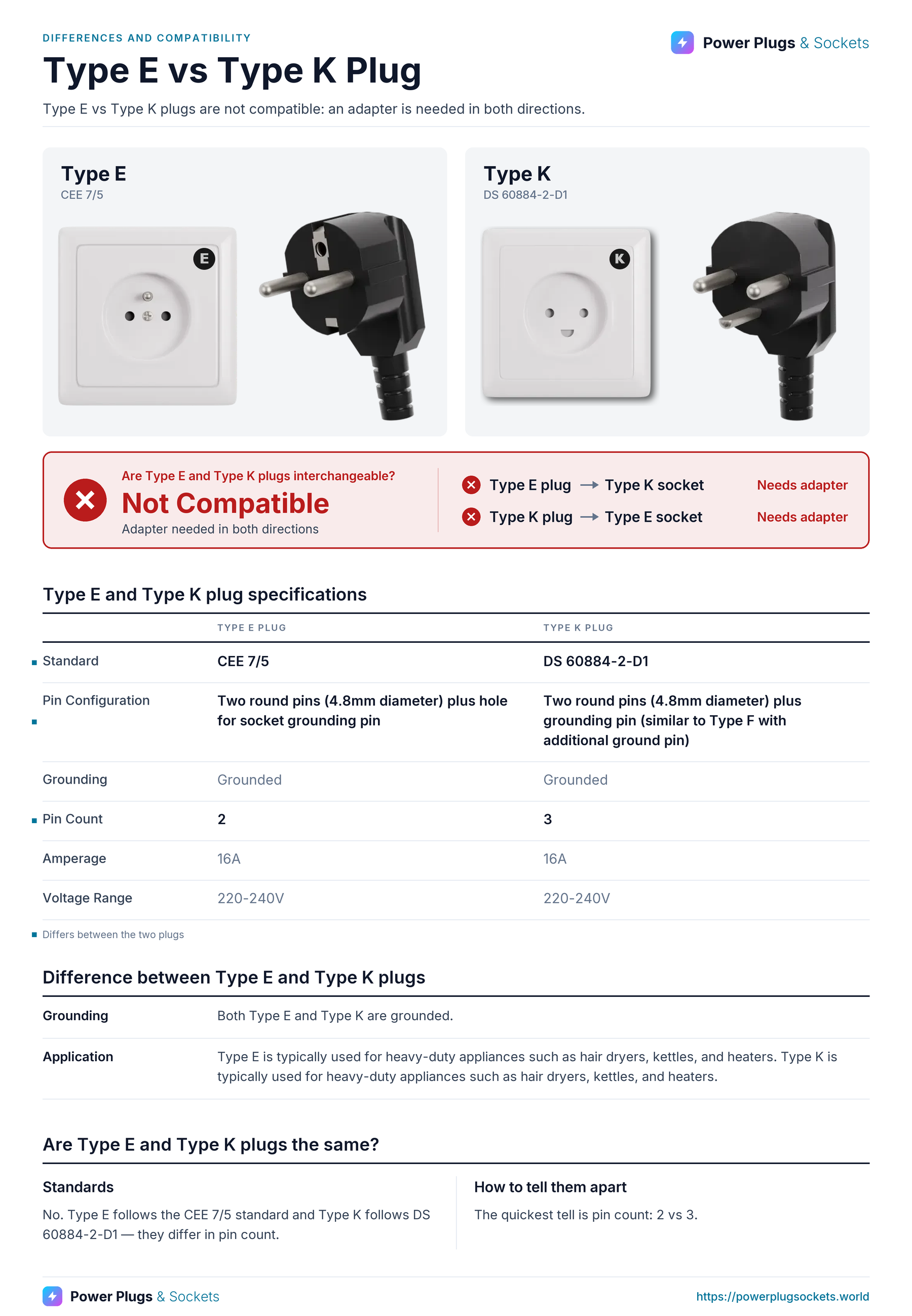
Type E vs Type K plugs are not compatible: an adapter is needed in both directions. Type E is a 2-pin, grounded plug rated 16A at 220-240V, while Type K is a 3-pin, grounded plug rated 16A at 220-240V. The two differ mainly in pin design, which is what decides compatibility — whether a Type E plug fits a Type K socket, and vice versa. For a related pairing, see type G vs type J plug.
Swipe to compare
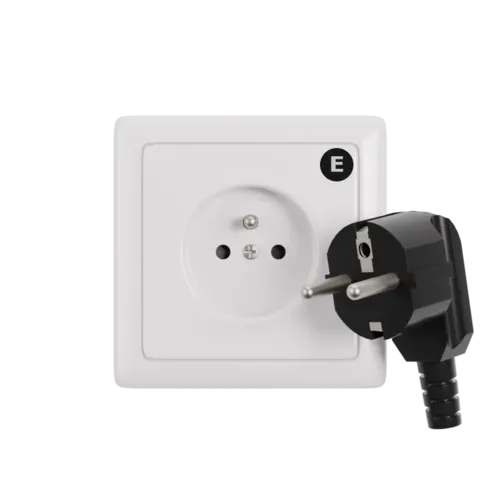
Type E
|
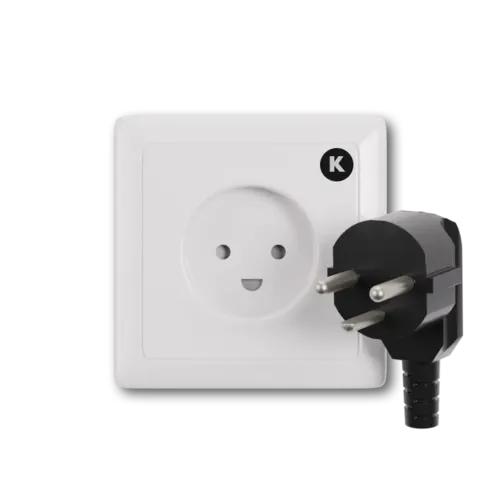
Type K
|
|
|---|---|---|
| Standard | CEE 7/5 | DS 60884-2-D1 |
| Pin Configuration | Two round pins (4.8mm diameter) plus hole for socket grounding pin | Two round pins (4.8mm diameter) plus grounding pin (similar to Type F with additional ground pin) |
| Grounding | Grounded | Grounded |
| Pin Count | 2 | 3 |
| Amperage | 16A | 16A |
| Voltage Range | 220-240V | 220-240V |
Moving a toaster from a Paris flat to a Copenhagen one? The type E vs type K plug question comes down to where the earth pin lives.
A Type K connector carries its own earth prong, while the French system puts that pin in the wall, so the same round-pin power plug can slide into both outlets yet stay safely earthed in only one.
Type E vs Type K Plug: The Key Difference at a Glance
Both belong to the European family of round-pin connectors, labelled by the IEC in IEC TR 60083: two round live contacts, a 16 A rating and a 250 V ceiling. The difference is a mirror image: the French socket has a male pin and the plug a hole, while the Type K plug carries a spade grounding pin and the socket has the hole. For a related pairing, see which countries use type D plugs versus type G plugs.
| Feature | French (CEE 7/5 socket, CEE 7/6 plug) | Danish (Type K) |
|---|---|---|
| Governing standard | NF C 61-314 and other national standards | 107-2-D1, today DS 60884-2-D1 |
| Earth contact | Pin fixed in the socket, earth hole in the plug | Pin on the plug, hole in the socket |
| Live and neutral contacts | Two pins, 4.8 × 19 mm | Two pins, 4.8 × 19 mm |
| Current and voltage | Rated 16 A, 250 V | Rated 16 A, 250 V |
| Polarized wiring | Only mechanically, no wiring convention | Yes, live on the left with earth at the bottom |
| Accepts the Europlug and Type C | Yes | Yes |
Side-by-Side Specs for the Earth Pin and Power Pins
The two power pins are interchangeable between the systems and only the earth pin is not: a type K electrical plug sends its earth through a third prong, a French plug has a hole that slides over the wall's pin.
Type K and CEE 7/5 Pin Dimensions Compared
The Danish standard plug connector was drawn in standard sheet 107-2-D1 and is now DS 60884-2-D1; the French CEE 7/5 and CEE 7/6 follow NF C 61-314. The live side matches exactly: 4.8 mm pins, 19 mm long, 19 mm apart.
The Danish earth prong is 14 mm long and 6.5 mm across, 13 mm from the line of the power pins, against 10 mm for the French pin. It is called U-shaped or D-shaped, both meaning a half-round blade.
Round Pins, Pin Spacing and the Earthing Pin Offset
Because the round pins, pin spacing and pin diameter are shared, either socket grips the other's live pins. What changes is the position and gender of the earthing pin, so a plug built to one standard has nowhere to put the other's earth.
Danish Plug Pin vs Belgian Socket Pin: Where the Earth Sits
The French design puts the earth pin in the socket; the Danish design puts it on the plug. The French version likely began as a Belgian product from the 1930s by Vynckier and Niko, never patented, while Siemens patented the German alternative in 1929, earthing through earth clips.
Both continental sockets sit in a circular recess.
The Male Ground Pin on the Plug
The Danish male ground pin is part of the plug body, so the cable decides whether an appliance is earthed; no grounding pin on the cable means nothing in the wall supplies one.
The Earth Hole and Projecting Pin on the French Side
The socket's projecting earth pin stands between the apertures and is longer than the live contacts, so earthing connects first. German CEE 7/3 sockets use earthing clips, and the notches on a CEE 7/4 plug stop a French plug fitting.
Type K Socket Compatibility With Schuko, Europlug and CEE 7/7 Plugs
A type K socket physically accepts many plugs, but only unearthed ones are safe. The Europlug (CEE 7/16, 2.5 A) fits every socket here and needs no earth.
Which Plugs Are Compatible With Each Socket
- Europlug (CEE 7/16) and contour plug (CEE 7/17): compatible with both, unearthed by design.
- French CEE 7/6 and German CEE 7/4: fit a Danish outlet but make no earth.
- Danish three-pin plug: earthed only in its own socket; the French pin stops it entering.
Hybrid Plug Fit in Type E Outlets
The CEE 7/7 hybrid plug carries a hole for the French pin and side contacts for German clips, so it works in both, rated 16 A; a plain type E plug is French-only. In a Danish socket the hybrid fits but makes no earth.
Type C and Type F Plugs in Each Socket
A Type C plug is the safe common denominator. A Type F plug cannot enter a French socket and enters a Danish one without its earth.
Why the Grounding Connection Fails in a Type K Receptacle
A type K receptacle expects the plug to bring the earth, and continental plugs don't, so the appliance runs but its metal casing is untied from earth. In the early 1990s the European Union pushed Denmark to drop its plug rule for imported goods, citing the free movement of goods, and most equipment now arrives with a Schuko plug. Next, check type B vs type D plug.
Users report a buzzing sensation on a dishwasher, toaster or laptop case, and an electric shock risk that is life-threatening after a fault. The Danish Safety Technology Authority permitted French sockets from 2008.
Earth Connection Loss and Earthed Appliances
The missing earth connection matters only for class I, metal-bodied household appliances such as kettles and washing machines. Fit them with type K plugs or have an electrician change the outlet.
Countries Using Each Plug Type
The plug types differ by region. The Danish standard is used in Denmark, Greenland and the Faroe Islands, with some directories adding Bangladesh, the Maldives, Senegal and Tunisia.
The French standard covers France, Belgium, Poland, Slovakia and the Czech Republic, plus Morocco and Tunisia, with the German socket dominating the rest of Europe.
Type K Electrical Outlet Voltage, Frequency and Electrical Power
A type K electrical outlet and a French outlet supply the same electrical power: 220 – 240 V mains electricity at 50 Hz (50 hertz), rated 16 A at 250 V, so you never need a voltage converter between them. Gear from a 120 V country needs a step-down electrical transformer, as an adapter fixes only the shape.
Danish Socket vs French Socket Safety Rules
The Danish standard provides child-resistant shutters, and older outlets had a switch to kill the contacts during insertion. Earthed sockets are required in new installations, and since 1 July 2008 every socket must have an earth-fault interrupter (RCD in English, HFI in Danish), the safety net when a Schuko appliance runs unearthed.
French rules require shuttered sockets and 30 mA protection. Danish sockets are polarized with live on the left; the French plug is not truly polarized.
Recessed Sockets on Both Sides
Modern Danish outlets must be recessed, giving the child protection the CEE 7/5 recess always has. A Danish computer socket built to DK 2-5a accepts only its own tilted-pin plug.
Choosing a Travel Adapter or Power Plug for Denmark and France
A traveler rarely needs a dedicated type K travel adapter plug, since a Europlug or hybrid fits Danish and French wall outlets. A type K plug adaptor matters for a three-pin UK or US appliance whose earth must survive, so check that it names the Danish system or IEC letter K, not just "EU", and prefer changing the plug over adapting it.
Plug Adapter Options for Grounded Appliances
For a grounded laptop brick or kettle, choose a plug adapter with a real earth prong on its Danish face; a type K adapter without it behaves like plugging a Schuko plug into the wall. Two-pin power plugs need nothing more.