Type E vs Type N Plugs: Differences & Compatibility
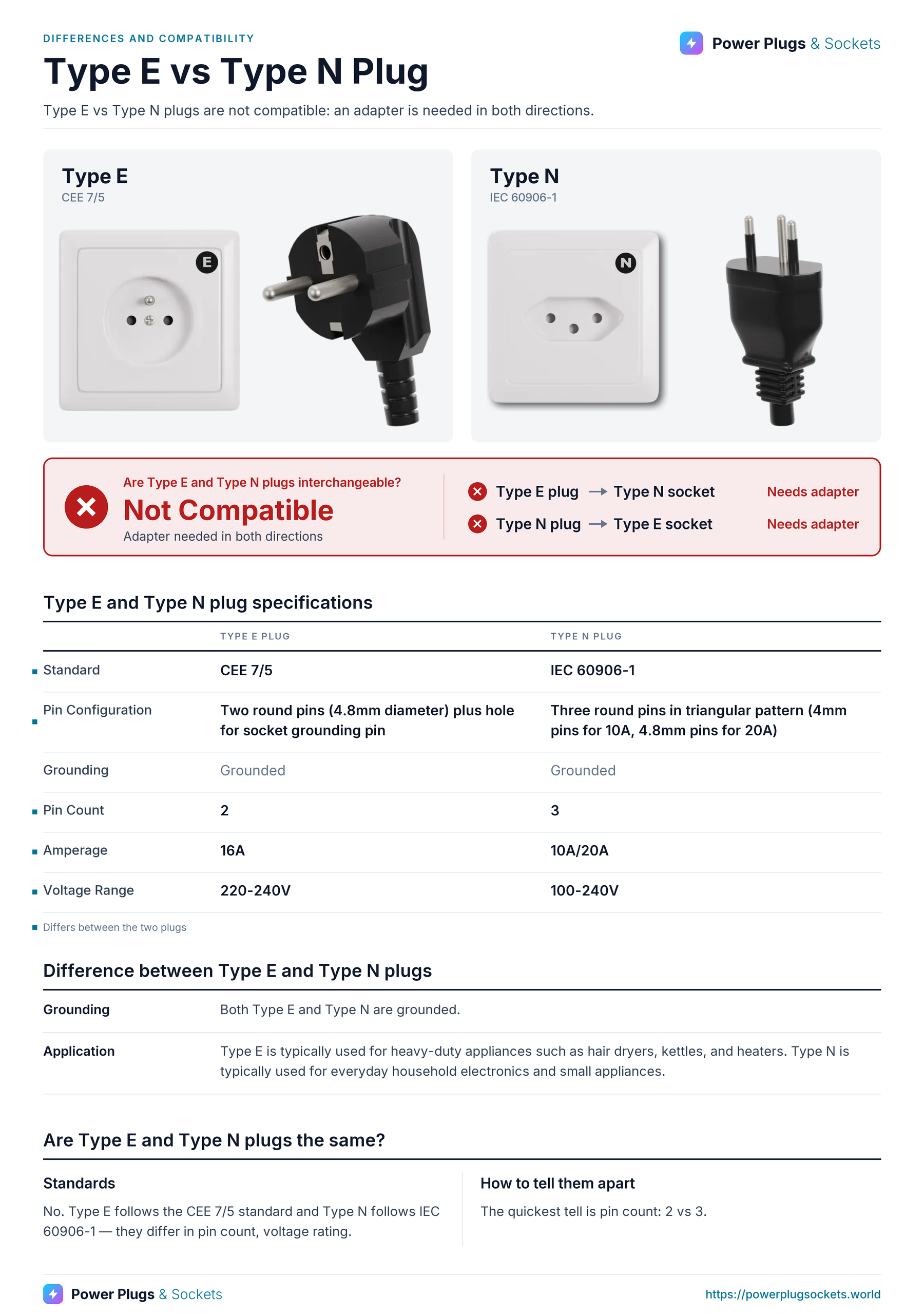
Type E vs Type N plugs are not compatible: an adapter is needed in both directions. Type E is a 2-pin, grounded plug rated 16A at 220-240V, while Type N is a 3-pin, grounded plug rated 10A/20A at 100-240V. The two differ mainly in voltage, amperage and pin design, which is what decides compatibility — whether a Type E plug fits a Type N socket, and vice versa. Next, check is a type A plug compatible with a type E socket.
Swipe to compare
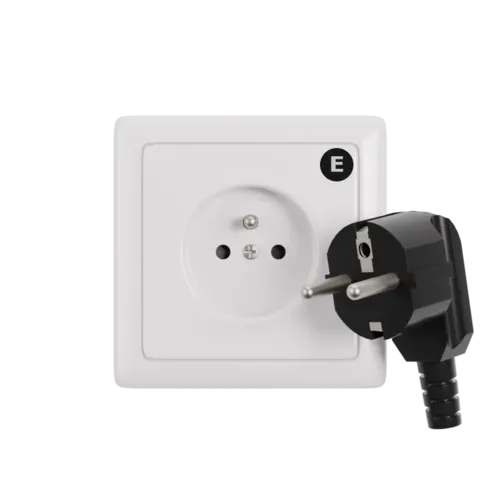
Type E
|
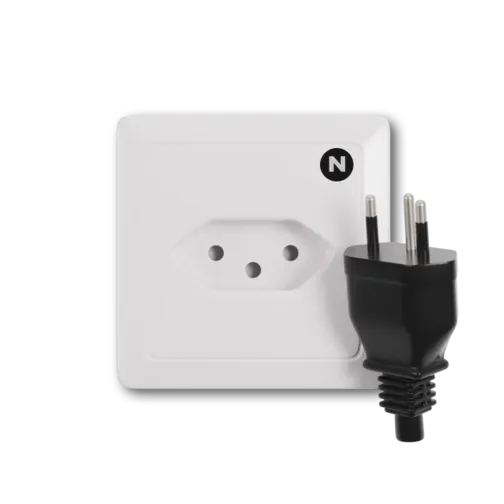
Type N
|
|
|---|---|---|
| Standard | CEE 7/5 | IEC 60906-1 |
| Pin Configuration | Two round pins (4.8mm diameter) plus hole for socket grounding pin | Three round pins in triangular pattern (4mm pins for 10A, 4.8mm pins for 20A) |
| Grounding | Grounded | Grounded |
| Pin Count | 2 | 3 |
| Amperage | 16A | 10A/20A |
| Voltage Range | 220-240V | 100-240V |
Packing for Paris with a charger bought in São Paulo? The type E vs type N plug question comes down to one fact: both use pins on 19 mm centres, yet neither fits the other's wall socket.
A French plug has two round pins and a hole for the socket's earth pin, while Brazil and South Africa use a compact three-pin design with a hexagonal recess. Below, see how the plugs and sockets differ and what each appliance needs abroad for safe electricity and electrical compatibility.
Type E vs Type N Plug: Key Differences at a Glance
Type E is defined by the CEE 7 standard sheets and national rules in Belgium and France; Type N comes from the IEC standard published in 1986 and the Brazilian and South African versions of it. Pin diameter and current rating differ: the 19 mm apart pin spacing is shared, but a 4.0 mm pin diameter is only the Brazilian 10 A pin.
| Feature | Type E (CEE 7/5 socket, CEE 7/6 plug) | Type N (IEC 60906-1, NBR 14136, SANS 164-2) |
|---|---|---|
| Power pins | Two pins, 4.8 mm diameter, 19 mm long | Three pins: power pins 4.0 mm (Brazilian 10 A), 4.5 mm (IEC and South African 16 A) or 4.8 mm (Brazilian 20 A) |
| Earth contact | Male pin fixed in the socket; hole in the plug | Third pin on the plug; hole in the socket |
| Socket shape | Round recess, about 15 mm deep | Hexagonal recess |
| Rating | 16 A, 250 V | 10 A or 20 A (Brazilian), 16 A (IEC and South African), 250 V |
| Grounded | Yes | Yes (three-pin version); an unearthed two-pin version also exists |
| Polarized | Partially (one-way entry, no wiring convention) | Yes |
| Shutters | Depends on the national standard | Mandatory under IEC; not required by the Brazilian standard |
| Compatible with a type C plug | Yes | Yes |
The two designs share a pin pitch, so a type C Europlug is compatible with both, but every earthed plug is locked to its own socket outlet. Both are grounded systems for Class I appliances; type N is polarized, so live and neutral always land on the same terminals, while Type E is only partly polarized and Schuko plugs are unpolarized.
A plug and socket pair of one type cannot take the other,.
How the Type E Socket and CEE 7/6 Plug Are Built
The Type E design, the Belgian or French plug, most likely began in Belgium in the 1930s with makers such as Niko and was never patented. In CEE 7 the wall socket is CEE 7/5 and the plug CEE 7/6, each rated 16 A at 250 V; France publishes it as NF C 61-314 and Belgium as NBN C 61-112.
The earthing pin is part of the socket, offset 10 mm, and is longer so it connects first. The pin length of the power pins is similar on both, and the current rating follows the standard.
Two Round Pins and a Circular Recess
The plug carries pins 4.8 mm thick on 19 mm centres. The outlet has a circular recess that the plug body sits inside, so a recessed socket covers a partially inserted plug, and a fully seated plug never exposes a live pin, avoiding accidental contact, a key safety feature.
Schuko, CEE 7/7 and the Hybrid Plug
Germany and most of Europe use the Schuko system, type F, with a CEE 7/3 socket and CEE 7/4 plug that earth through two earth clips on the sides. A Schuko plug has no hole for the earth pin, so the CEE 7/7 hybrid plug, with both clips and the hole, is compatible with type E and type F sockets.
The unearthed CEE 7/17 contour plug fits all CEE 7 sockets but suits only double-insulated, low-power devices.
Type N Socket Design Under IEC 60906-1
In 1986 the International Electrotechnical Commission published IEC 60906-1, a 16 A, 250 V plug with three pins and the earth pin offset by 3 mm, forming a shallow triangle (the earth pin is offset from the power pins). The EU never adopted it, so the type N socket is the main standard only in Brazil and South Africa.
Brazil's NBR 14136 (1998, compulsory from 2010) has 10 A and 20 A versions, no required child-resistant shutters, and older Brazilian homes had a flying earth tail; Paraguay also adopted the IEC sheet. South Africa adopted the design as SANS 164-2 in 1992 and made it the preferred system in 2013.
Designed for injection moulding, the power pins carry insulated sleeves about 10 mm long, and the IEC sheet makes shutters mandatory in the hexagonal profile socket, which guards against electric shock and makes it often called the safest domestic system, with its own insulation.
Countries Using Type E Plugs and Type N Plugs
Type E plugs are used in France, Belgium, Poland, the Czech Republic, Slovakia, Tunisia, Morocco and much of French-speaking Africa, and Denmark allows them beside its type K. Type N plugs are found only in Brazil and South Africa, where Brazil also uses Type C outlets and South Africa Type M.
Voltage and 50Hz vs 60Hz Supply
Every Type E country runs mains electricity at 220 to 230 volts and a frequency of 50 Hz, and South Africa matches that. Brazil runs at 60 Hz with either 127 V or 220 V depending on the city.
Devices marked 100-240 V, 50/60 Hz cope with either; a single-voltage hair dryer does not.
Will a Type E Plug Fit a Brazilian or South African Socket?
No. The round French plug body is too wide for the hexagonal Type N recess, and the Type N earth pin has nowhere to go in a Type E socket. The two earthed designs are incompatible in both directions.
The flat Europlug (type C) is the exception, since its slim 4 mm pins fit both recesses; Europlugs suit Class II chargers but are rated only 2.5 A, so power sockets accept them but not a kettle. Universal sockets and multi-plug adaptors meet no national standard and can overload an outlet or leave pins exposed.
Why the Swiss Type J Is Not Interchangeable
Type N looks almost identical to type J from Switzerland, but the earth offset is 3 mm on Type N against 5 mm on Swiss sockets, so an adapter bought for Zurich will not cover Rio.
Travel Adapter and Voltage Converter Advice for SANS 164-2 and CEE 7/5 Sockets
A travel adapter changes only the plug shape. Travellers going from France to South Africa need just the adapter, since both run near 230 V at 50 Hz. Next, check type B versus type G plug shape and socket design compared.
A 220 V device in a 127 V Brazilian city needs a voltage converter. Pick a grounded plug adapter that keeps the earth path and states its rating, and never stack an adaptor on another for a high-power load.
Power Plug Ratings and What Your Appliances Draw
The amp rating on the power plug sets the most power an appliance can draw: 3,680 W for a 16 A plug at 230V, 1,270 W for the Brazilian 10 A plug at 127V, 2,200 W at 220V and 4,400 W for the 20 A version. A 2,000 W heater drawing about 15.7 A at 127 V would exceed the 10 A plug, which is why Brazilian kettles use the 20 A version.
Grounding Pin Checks in Older Brazilian Homes
A three-pin Type N outlet in Brazil doesn't prove the grounding pin is connected, since many homes built before 2010 were wired without an earth. A cheap socket tester will show whether a metal-bodied device is truly grounded; an old installation may lack the earth entirely.