Type B vs Type G Plugs: Differences & Compatibility
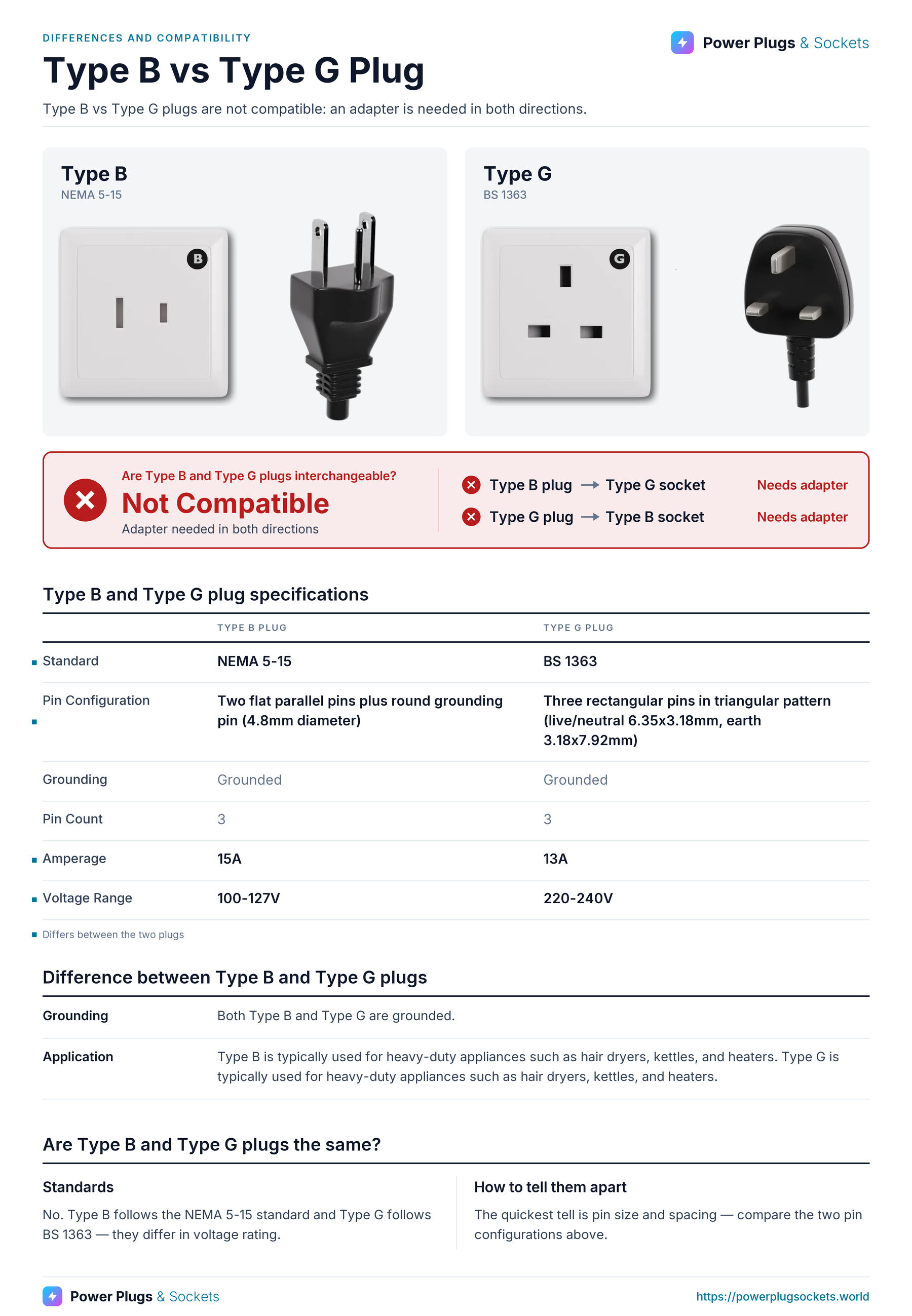
Type B vs Type G plugs are not compatible: an adapter is needed in both directions. Type B is a 3-pin, grounded plug rated 15A at 100-127V, while Type G is a 3-pin, grounded plug rated 13A at 220-240V. The two differ mainly in voltage, amperage and pin design, which is what decides compatibility — whether a Type B plug fits a Type G socket, and vice versa. You might also want what are the differences between a type D and a type F plug.
Swipe to compare
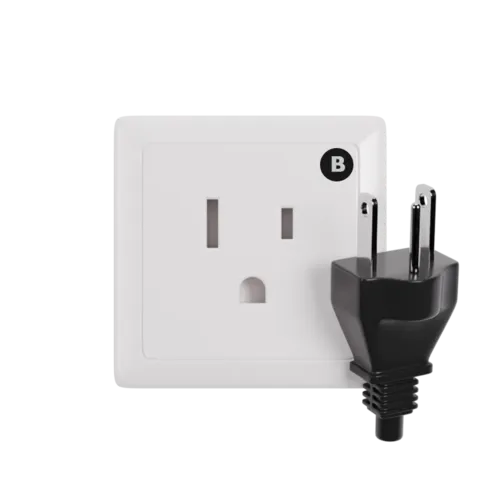
Type B
|
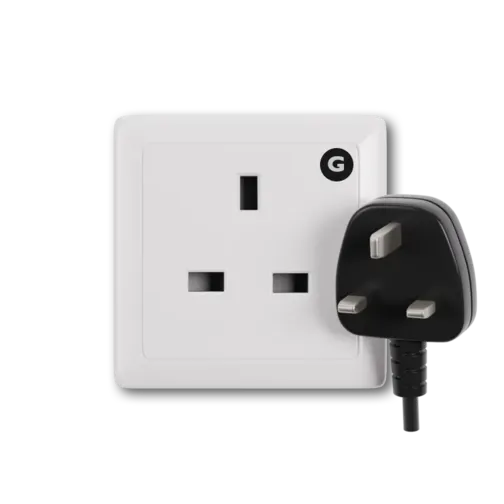
Type G
|
|
|---|---|---|
| Standard | NEMA 5-15 | BS 1363 |
| Pin Configuration | Two flat parallel pins plus round grounding pin (4.8mm diameter) | Three rectangular pins in triangular pattern (live/neutral 6.35x3.18mm, earth 3.18x7.92mm) |
| Grounding | Grounded | Grounded |
| Pin Count | 3 | 3 |
| Amperage | 15A | 13A |
| Voltage Range | 100-127V | 220-240V |
Packing for London with a laptop bought in Boston? The type B vs type G plug question decides whether your charger even reaches the wall.
The Type B plug (NEMA 5-15) pairs two flat parallel pins with a round earth pin and runs on 120 V, while the Type G plug (BS 1363) uses three rectangular pins, a fused body and 230 V mains. Neither fits the other's socket, so you need the right adapter to move electricity between the two systems.
Type B vs Type G Plug: Key Differences at a Glance
The letters were assigned by the US Department of Commerce's International Trade Administration as traveller's shorthand, and the IEC now publishes the same lettering. A letter says nothing about the supply behind the wall. Also see does a type E plug fit into a type N socket.
| Feature | Type B (NEMA 5-15) | BS 1363 (British) |
|---|---|---|
| Pins | Two flat blades plus a round grounding pin | Three rectangular pins in a triangle |
| Plug rated current | 15 A | 13 A maximum, set by the fitted cartridge |
| Plug rated voltage | 125 V | 250 V |
| Typical mains supply | 100 – 127 V, 60 Hz | 220 – 250 V, 50 Hz |
| Earthed | Yes | Yes |
| Polarized | Yes, wider neutral blade | Yes, fixed live and neutral positions |
| Fused in the plug | No | Yes |
| Insulated pin sleeves | No | Yes |
| Power socket also accepts | Type A plugs | No other plug type |
A device built only for a Type B power socket can be destroyed on a British supply, and a plug from the two systems cannot be pushed together even by force, a deliberate safety feature.
The British design was published in 1947 for ring circuits; American codes required grounding-type receptacles from the 1960s.
How the NEMA 5-15 Grounded Plug Is Built
Plug type B is NEMA 5-15, while NEMA 1-15 is ungrounded. NEMA stands for the National Electrical Manufacturers Association: in NEMA 5-15, the 5 is the grounded pin configuration and the 15 the current rating, with P for plug and R for receptacle, so the wall outlet is the NEMA 5-15R.
Flat Pins and a Round Grounding Pin
Type B plugs carry two flat blades, 6.35 mm wide and 12.7 mm apart. Below them sits a round, slightly U-shaped grounding prong that makes contact first and breaks last; American outlets are two-pronged or three-pronged.
The third hole is what turns an outlet into a grounded one.
Ratings of 15 Amps at 125 Volts
Every NEMA 5-15 plug is rated at 15 A and 125 V, about 1,800 W at the nominal 120 volts. Most American electrical outlets sit on 15 A or 20 A circuits, and a 20 A power socket (NEMA 5-20) still accepts the ordinary 15 A plug.
On a polarized plug the wider neutral blade fits one way, so a lamp switch breaks the live side and polarity reversal is impossible; the grounded third contact is a protective conductor sending fault current to ground, though older US homes may be unearthed.
Where North America and Central America Use It
The Type B outlet is standard across North America: the United States, Canada and Mexico (127 V), plus most of Central America. Japan uses a near-identical earthed version at 100 V, and Colombia, Ecuador and Venezuela use it too.
How the BS 1363 Plug Is Built
The BS 1363 standard covers the plug, the socket and the adaptors that fit them. Ireland, Malaysia and Singapore publish national versions; plug type G covers all of them.
Rectangular Pins, Insulated Sleeves and a Longer Earth Pin
The live and neutral pins are 4 by 6 mm and sit 22.2 mm apart; the earth pin is larger and longer. Since 1984 the live pins have carried insulated pins sleeves, so a partly withdrawn plug never exposes live metal.
The earthing pin is bare, and a built-in fuse, a BS 1362 cartridge of 3 A or 13 A, gives overcurrent protection to the power cord against a short circuit or overload. Each socket outlet (socket-outlet) has a shutter system opened by the earth pin, a circuit protective conductor, and polarity is fixed.
Where the United Kingdom and the Arabian Peninsula Use It
The design is standard in the United Kingdom, Ireland, Malta, Cyprus, Malaysia, Singapore and Hong Kong, and across most of the Arabian Peninsula, including the UAE, Qatar and Oman. Saudi Arabia adopted it after moving to 230 V.
Plug Types Compatibility Between American and British Sockets
Compatibility has two layers: physical fit and electrical fit; an adaptor solves only the first. A hotel universal socket that takes American, British and Type C plugs such as the Europlug is a multi-standard hybrid dual socket that usually meets no official standard, so a three-pin plug can end up unearthed.
Type I is the angled Chinese plug.
Physical Fit: Why Neither Plug Enters the Other Socket
The American blades are 12.7 mm apart and the British pins 22.2 mm apart, in a different shape. A NEMA plug cannot open British shutters, and a British earth pin has no hole in American electrical outlets, so you need an adapter in both directions, one that keeps the earth contact.
Dual Voltage Devices and When You Need a Voltage Converter
Most phone chargers, camera chargers and laptop AC adapters say 100–240 V, 50/60 Hz: they are dual voltage and need a plug adaptor alone. A label reading only 120 V means voltage mismatch; a 1,650 W American hair dryer would try to run at roughly 6,000 W in London, so you need a step-down voltage converter rated above its wattage, or a local replacement; check the voltage rating of the cord too, and note frequency matters less.
Socket Types in Countries That Use Both
Belize, Guyana, Jordan, Lebanon and Saint Kitts and Nevis list both socket types; check the voltage first, since a Type B outlet there can be on a 230 V circuit.
Travelling With a Commonwealth Plug or an American Appliance
Travellers (or travelers) between the two systems face two checks for their appliances and devices: the plug shape and the voltage on the label. You might also want which countries use type A plugs versus type E plugs.
Extension Cords and Power Strips Abroad
A plug adapter only changes the pin shape, while a travel adapter bundles several shapes; neither changes voltage. Travel adaptors should carry the earth and be fused.
An American extension cord or power strip is rated for 125 V, so buy a local British power strip, fused at 13 A, instead.
Safety Standards Behind the British Plug and Its American Rival
Both standards aim at electrical safety against electric shock and fire; the British plug puts protection in the plug and socket, the American approach in breakers, GFCI outlets and the wiring code. The IEC sets the international safety standards both reference, including IEC 60884; ask a licensed electrician if unsure.
Earthing, Class I and Class II Appliances
Class I equipment must be earthed through the plug, so it needs the third pin on both designs. Class II equipment uses double insulation (is double insulated) and needs no earth; look for the double-square symbol.
In America it comes with a two-blade Type A plug, in Britain a three-pin plug with a plastic earth pin.
Tamper-Resistant and Recessed Sockets
Since 2008, US installation standards have required tamper-resistant receptacles in new homes, with spring shutters like the British ones.
British Sockets That Are Not BS 1363: BS 546 and BS 4573
Older hotels and theatres may have round-pin BS 546 sockets, the 5 A Type D and 15 A Type M, which neither a NEMA plug nor a standard British adaptor fits. The BS 4573 shaver socket in a bathroom often takes an American two-blade plug and the Europlug, but only for shavers and toothbrushes, never a hair dryer.