Type E vs Type O Plugs: Differences & Compatibility
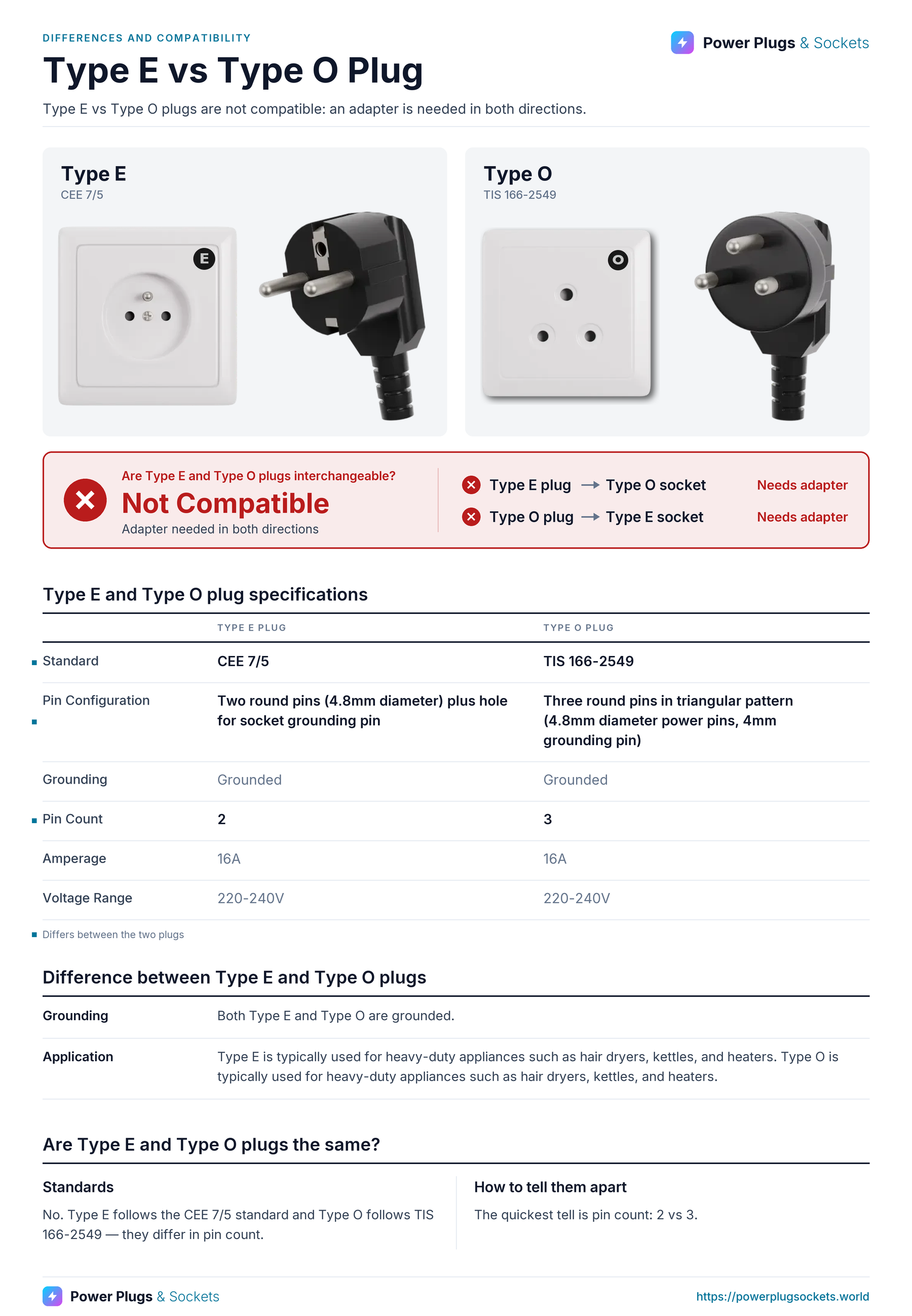
Type E vs Type O plugs are not compatible: an adapter is needed in both directions. Type E is a 2-pin, grounded plug rated 16A at 220-240V, while Type O is a 3-pin, grounded plug rated 16A at 220-240V. The two differ mainly in pin design, which is what decides compatibility — whether a Type E plug fits a Type O socket, and vice versa. For a related pairing, see what are the differences between a type A and a type F plug.
Swipe to compare
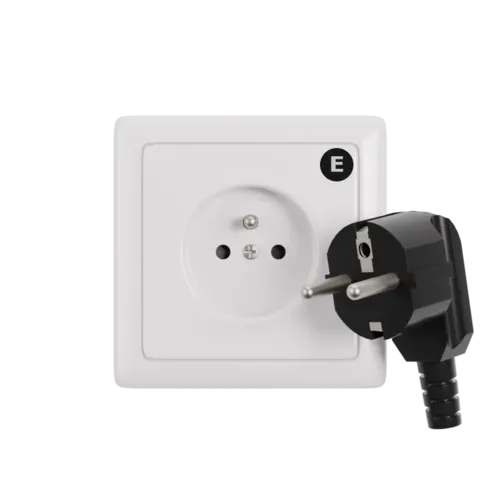
Type E
|
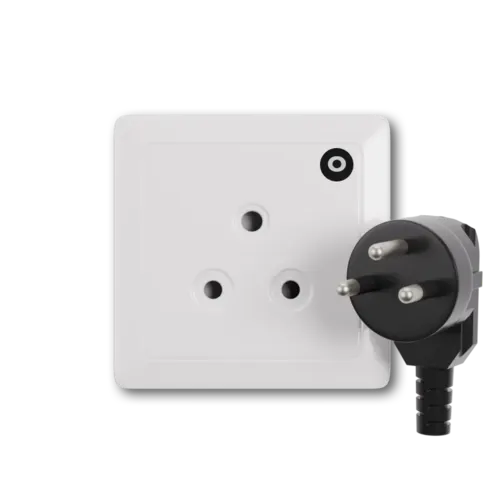
Type O
|
|
|---|---|---|
| Standard | CEE 7/5 | TIS 166-2549 |
| Pin Configuration | Two round pins (4.8mm diameter) plus hole for socket grounding pin | Three round pins in triangular pattern (4.8mm diameter power pins, 4mm grounding pin) |
| Grounding | Grounded | Grounded |
| Pin Count | 2 | 3 |
| Amperage | 16A | 16A |
| Voltage Range | 220-240V | 220-240V |
Packing for a trip from Paris to Bangkok, the type E vs type O plug question is really about where the earth lives. A type E plug has two round pins and a hole, because the type E socket carries a male earth pin inside a deep round recess, while the Thai design puts a third round pin on the plug.
Both run on the same voltage and frequency, so you usually need a plug adapter, not a voltage converter, to use your domestic power plugs in the other country's electrical outlet.
Type E vs Type O Plug: Key Differences at a Glance
The IEC World Plugs list assigns every domestic plug and socket a letter; these letters are labels only, and the IEC publishes the underlying standard as IEC TR 60083. Both systems use 4.8 mm round power pins, are rated 16 A, and feed 220 – 240 V mains.
What separates them is the earth and the socket shape.
| Feature | Type E | Type O |
|---|---|---|
| Standard | CEE 7/5 socket and CEE 7/6 plug (French) | TIS 166-2549 (Thai) |
| Pins on the plug | Two round pins plus a hole | Three round pins, or a two-pin unearthed version |
| Where the ground connection sits | Pin in the socket | Pin on the plug |
| Rating | 16 A, 250 V | 16 A, 250 V |
| Socket shape | Recessed round well | Flush face with three holes |
| Socket accepts | Type C, its own plug, CEE 7/7 hybrid | Type C, its own plug |
| Main countries | France, Belgium, Poland, Czechia, Slovakia | Thailand |
Where the protective contact sits decides almost everything else, as across all outlet types in the IEC list.
Round Pins, 16 A Rating and 220 – 240 V Supply
Each standard allows a current of up to 16 A at a rated voltage of 250 V on 50Hz networks: Type E has 2 pins grounded through the socket's own pin, Type O 3 pins grounded through the plug's own pin, and Type F, for reference, is grounded through side clips. Pin diameter (4.8 mm) and 19 mm centres match, so the ground arrangement is where the designs part ways.
How the French Socket Works: The CEE 7/5 Standard
This system is defined in the European CEE 7 standard, first published in 1951. The CEE 7/5 sheet describes the wall socket and CEE 7/6 the matching grounded plug; its unearthed counterpart is the flat CEE 7/16 Europlug, a type C plug.
Countries That Use Type E Sockets
The defining projecting earth pin is fixed in the socket, giving an earth contact before the power pins engage; the design began in Belgium (Belgian/French origins) with Vynckier and Niko, while Siemens patented Schuko. Type E outlets spread across Europe and Asia.
Type E sockets are the primary standard in the Czech Republic, Slovakia, France, Belgium and Poland, and spread through former colonies, including Tunisia, Morocco and Mongolia, usually beside the unearthed type C power socket. Denmark allows this power socket alongside its own Type K. The supply is 220-230 volt, 50Hz, and power pins sit on centres spaced 19 mm apart either side of the plug centre.
How the Thai Plug Works: TIS 166-2549
Thailand's plug is set by the Thai Industrial Standard TIS 166-2549, which updated TIS 166-2547 in 2006 and replaced earlier rules based on NEMA 1-15 and NEMA 5-15 patterns. The IEC lists the result as type O.
Why Type O Plugs Are Only Found in Thailand
Type O plugs are a national standard, not a regional one, so the type O plugs & outlets pairing is a single-country system. The grounded three-pin plug has insulated pins; a two-pin unearthed version exists for double-insulated appliances, and the Thai dual socket also accepts Type A and Type B plugs and the Europlug, though Thailand uses 230 V; its earth pin spacing follows NEMA 5-15 from the older hybrid three-pin sockets, which the plan is to phase out.
Cross-Compatibility Between French and Thai Sockets
Between these plugs and sockets, compatibility runs in only some directions; plug types are socket compatible only where the ground pin allows. The power pins line up, but each system's earth pin blocks the other's plug. Also see can i use a type C adapter with a type O socket.
The type E plugs & outlets column assumes the CEE 7/5 version.
| Plug | In a type E socket | In a Thai socket |
|---|---|---|
| Europlug (type C) | Fits safely | Fits safely |
| French grounded plug | Fits, earthed | Unsafe, no earth |
| CEE 7/4 Schuko (type F) | Blocked by the pin | Unsafe, no earth |
| CEE 7/7 hybrid | Fits, earthed | Unsafe, no earth |
| Grounded Thai plug | Blocked by the pin | Fits, earthed |
Schuko, CEE 7/7 and the Hybrid Plug
The German Schuko system (CEE 7/3 socket, CEE 7/4 plug, type F) earths through two earth clips, so a plain Schuko plug will not enter a CEE 7/5 socket. The CEE 7/7 hybrid plug has side clips and a hole for the socket pin, so it works in both, and most European appliances ship with it.
Europlug and Type C in Both Sockets
The flat two-pin Europlug, rated 2.5 A, is the one type C plug that fits both systems. The round CEE 7/17 contour plug fits every CEE 7 socket but not the Thai one.
A plug type C fitting works in Lyon or Chiang Mai with no adapter.
Partial and Unsafe Compatibility in Other Sockets
Some sockets physically take type E plugs but give no earth connection. The Thai dual socket accepts round European plugs unsafely, with live pins possibly exposed when partially inserted, and the same partial and unsafe compatibility applies to Type D sockets in India, Type H in Israel and Type K in Denmark.
Treat it as a danger for a kettle or heater, and use a proper adapter instead.
Safety and Grounding: CEE 7/6 Plugs vs Thai Outlets
Each standard treats the earth as non-negotiable but takes the opposite route: the European socket owns the earth pin, while the Thai outlet relies on the plug's pin. In both designs the protective contact is made before current flows.
The type E plug fits only one way because the hole must meet the socket pin, so it is mechanically polarized, but French wiring rules do not fix live and neutral. The Thai plug is polarized by its ground pin.
The type E socket is a recessed socket, protecting fingers from a half-inserted plug, while the Thai socket sits flush and its plugs use sleeved pins. Many newer outlets add child-safety shutters, an electrical safety feature over the mains electricity contacts.
Travelling Between a Thai Socket and European Outlets
Both countries run near 230 volts at 50Hz, so only the physical shape needs solving. Check the electrical rating on your appliances' labels first. Next, check type G versus type N plug shape and socket design compared.
Going to Bangkok with an earthed laptop, buy a travel adapter that takes a CEE 7/7 plug and presents a grounded Thai plug; coming back, a Thai plug needs a plug adapter with a hole for the socket pin. Hotels often fit universal hybrid socket outlets that rarely earth a European plug properly, so a multisocket adaptor with its own earthed plug is safer.
When a Voltage Converter Is Needed
Almost never between these two. A voltage converter is only needed for an appliance built for 110-127 volts, such as an American hair dryer; most chargers print 100-240 volts.