Type C vs Type O Plugs: Differences & Compatibility
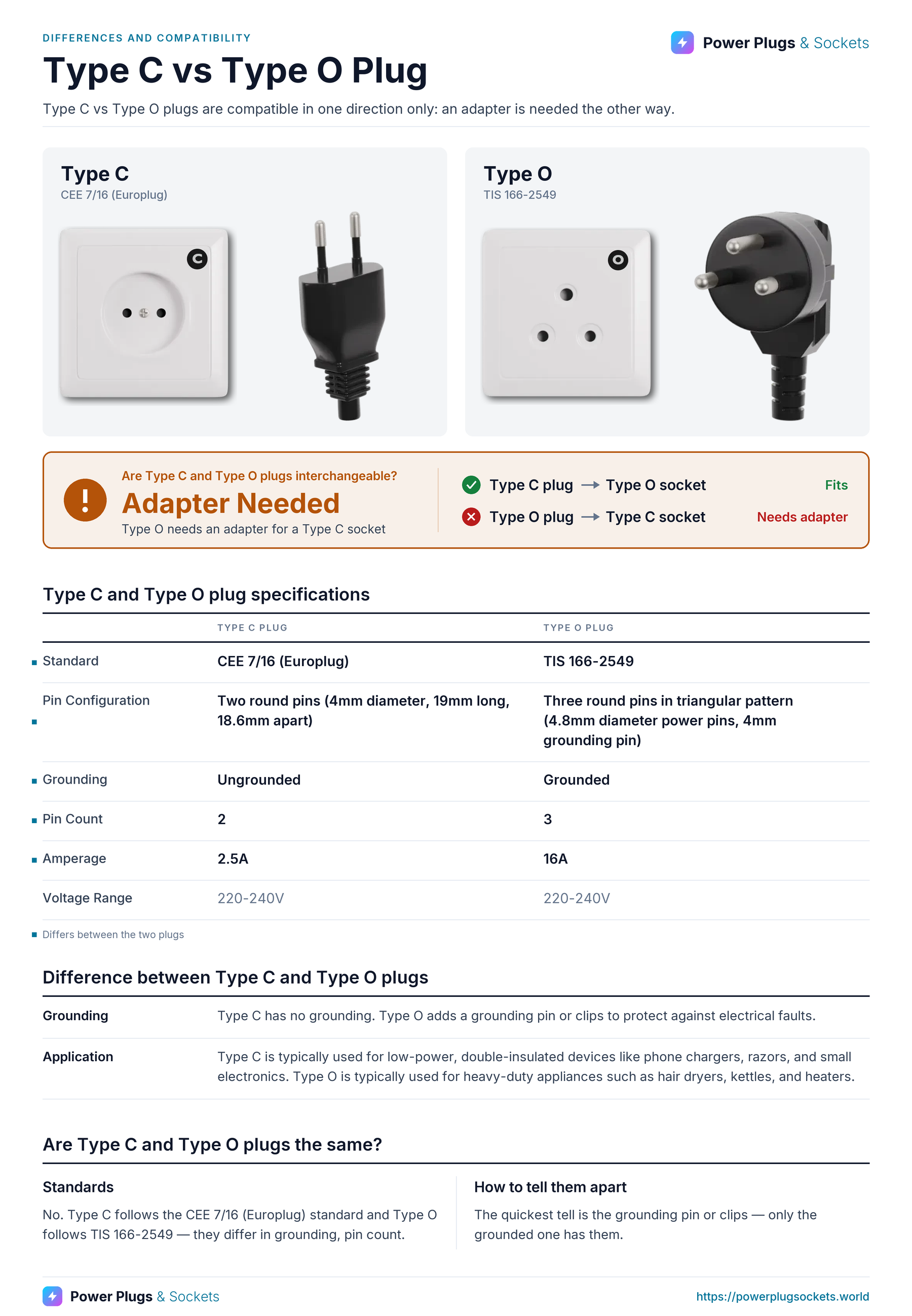
Type C vs Type O plugs are compatible in one direction only: an adapter is needed the other way. Type C is a 2-pin, ungrounded plug rated 2.5A at 220-240V, while Type O is a 3-pin, grounded plug rated 16A at 220-240V. The two differ mainly in grounding, amperage and pin design, which is what decides compatibility — whether a Type C plug fits a Type O socket, and vice versa. Compare this with how the pin configuration of a type F plug differs from a type L plug.
Swipe to compare
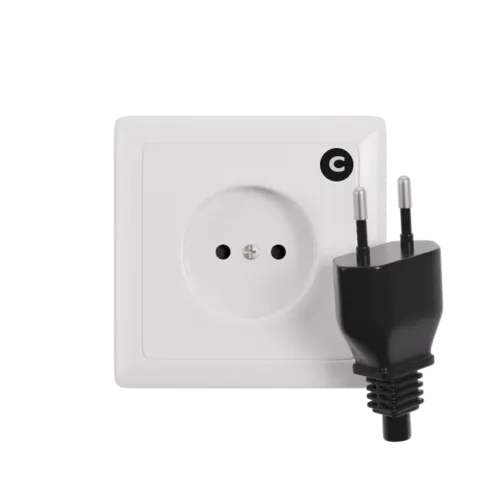
Type C
|
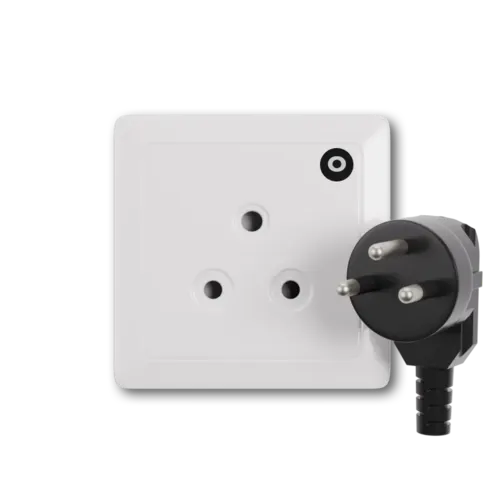
Type O
|
|
|---|---|---|
| Standard | CEE 7/16 (Europlug) | TIS 166-2549 |
| Pin Configuration | Two round pins (4mm diameter, 19mm long, 18.6mm apart) | Three round pins in triangular pattern (4.8mm diameter power pins, 4mm grounding pin) |
| Grounding | Ungrounded | Grounded |
| Pin Count | 2 | 3 |
| Amperage | 2.5A | 16A |
| Voltage Range | 220-240V | 220-240V |
Packing a European charger for Bangkok, the type C vs type O plug question comes down to one pin: the earth. Both plug types use round metal pins and draw 230-volt electricity, yet one is a slim unearthed plug for low-power devices and the other a grounded plug built for full household power.
This guide shows which plug fits which outlet and when a single adaptor is all you need.
Type C vs Type O Plug: Side-by-Side Comparison
The IEC World Plugs list gives every household plug a letter. Letter C is the family of unearthed round-pin plugs, best known as the flat Europlug; letter O is the Thai standard plug.
| Feature | Europlug (IEC letter C) | Thai three-pin (IEC letter O) |
|---|---|---|
| Defining standard | CEE 7/16, EN 50075 | TIS 166-2549 |
| Pins | 2 round pins | 2 power pins plus 1 earth pin |
| Pin diameter | 4.0 mm | 4.8 mm |
| Pin length | 19 mm | 19 mm (earth pin 21.4 mm) |
| Earthed | No | Yes (a two-pin version is unearthed) |
| Current rating | 2.5 A at 250 V | 16 A at 250 V |
| Polarized | No, fits either way round | Yes, the socket fixes live and neutral |
| Insulated pins | Yes, sleeved near the base | Yes, sleeved for 10 mm |
| Socket accepts Europlug | Not applicable | Yes |
| Where you find it | Most of Europe and parts of Africa and Asia | Thai homes, offices and hotels |
The type C plug family is everywhere but carries little current, while the Thai design is rated for a full 16 A.
Plug Types by Pin Count and Rating
Every plug and socket pair has a live pin, a neutral pin and an optional earth. Plug types fall into two-pin plugs that rely on insulation and three-pin plugs with an earth, like type A and type B in North America, and the type tells you which socket types are compatible.
The Europlug (CEE 7/16) Explained
The Europlug is the slim plug on phone chargers and small lamps, defined by EN 50075. It is moulded onto a flexible cord and designed to fit almost every round-pin outlet on the continent. You might also want how does the amperage rating of a type M plug compare to a type O plug.
It carries two round pins, 4.0 mm across and 19 mm long, partly covered by insulating sleeves. The heavier CEE 7/17 contour plug is rated at 10 A or 16 A.
The Europlug is not grounded because it is meant only for Class II appliances, which rely on double insulation. A metal-bodied heater is not built that way, so never fit it with this plug.
Outlet Types That Accept a Two-Pin Round Plug
If a country uses plug type C, all type C plugs are compatible with its type C outlets, across Europe, Africa, the Middle East, Asia and South America. It fits all three CEE 7 sockets: the unearthed round outlet, the German Schuko socket (type F) and the French and Belgian type E socket, plus Swiss, Danish, Italian and Israeli sockets.
The Thai Plug and the TIS 166-2549 Standard
Thai Industrial Standard 166 created a national plug in the mid-2000s, first as TIS 166-2547 and then the updated 2549 edition, which the IEC lists as letter O. Earlier Thai sockets copied American designs despite a 230 V supply. The grounded design has two power pins, 4.8 mm in diameter, 19 mm long and sleeved for 10 mm, with a 21.4 mm earth pin that connects first and lets go last; this earthing pin sits 11.89 mm from the line joining the power pins. You might also want what adapter converts a type E plug to a type O socket.
Its pin spacing matches the NEMA 5-15 ground pin position, keeping type O plugs usable in older combination sockets. Thai sockets are polarized, so live and neutral sit in fixed positions; polarization is absent on the symmetrical Europlug, which fits either way round, and harmless for a double-insulated charger.
The standard defines a grounded three-pin plug for Class I appliances and an unearthed two-pin version; both are rated for 16 A, more than six times the 2.5 A European limit.
How Thailand Moved Away from NEMA Sockets
Thailand once used NEMA 1-15 and NEMA 5-15 sockets made for 120 volts. The plan is to phase out NEMA-compatible sockets, first through a combination outlet and later a plain three-round-pin socket.
The grounded Thai design resembles the Israeli SI32 plug but is not interchangeable.
Types C and O Compatibility in Practice
Compatibility runs mostly one way: a Thai outlet takes European pins, but a European socket has no hole for the Thai earth pin. A Europlug fits the Thai hybrid socket directly and the plain three-round-pin outlet too, though it stays limited to 2.5 amps.
A Thai three-pin plug won't enter Schuko or French sockets; never snap off the earth pin, but use an adaptor that carries the earth through.
The Danger of Type E and Type F Plugs in a Dual Socket
The Thai dual socket often accepts a French type E or German type F plug, but only partially and unsafely, an unsafe fit: pins can be exposed and no ground contact is made, risking electric shock. Use a grounded adaptor instead.
Two-Pin Plug vs Grounded Thai Design: Safety Compared
The European approach puts safety on the appliance, which must be double-insulated; the Thai approach adds a protective contact, polarized sockets, sleeved pins and a 16 A rating.
Earthing, Class I and Class II Appliances
The grounding pin gives fault current a path to earth and trips the circuit breaker. Earthed appliances such as kettles and washing machines need a grounded plug like the Thai three-pin, while Class II appliances never do, so the European two-pin design loses no safety.
Shutters, Insulated Pins and Recessed Sockets
Sleeved pins on both plugs keep metal away from fingers. Many European sockets are a deep recessed socket, and some require child-resistant shutters; Thai outlets are shallower and lean on the pin sleeves.
Voltage Rating and Current Rating Limits
Both plugs have a 250 V voltage rating, but the Europlug is limited to 2.5 amps and the Thai design handles 16 A. At 230 volts, a 65 W charger draws about 0.28 A, while a 1,800 W hair dryer draws about 7.83 A, so it needs a 16 A plug.
Thai Socket Travel Adaptor Tips for Europlug Devices
For most travellers the news is good: European chargers fit Thai outlets as they are, and a travel adaptor is needed only for earthed appliances or plugs from other systems. A plug adapter only changes shape; a voltage converter is needed only for 120 V equipment.
Universal sockets and multi-standard adaptors sit outside most national standards and can leave live pins exposed or skip the earth, so a grounded adaptor rated 16 A is safer. A two-pin charger labelled "100-240 V, 50/60 Hz" works in both places.
Mains Voltage, Frequency and 50 Hz
Thai and European supplies both deliver roughly 220 to 240 volts at 50 Hz. Hybrid sockets still accept 120-volt NEMA devices, which can be damaged within seconds, so check the label.