Type F vs Type H Plugs: Differences & Compatibility
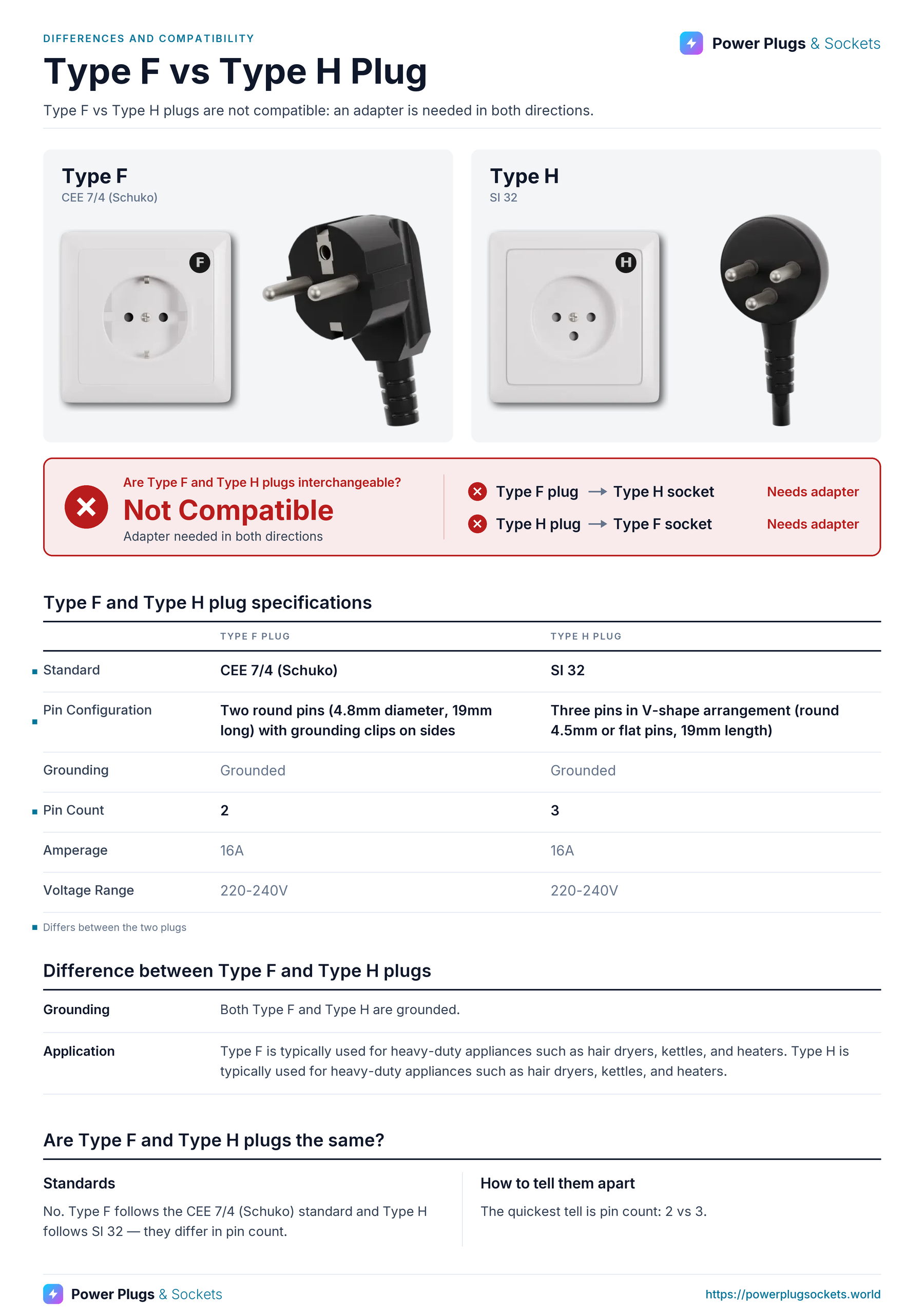
Type F vs Type H plugs are not compatible: an adapter is needed in both directions. Type F is a 2-pin, grounded plug rated 16A at 220-240V, while Type H is a 3-pin, grounded plug rated 16A at 220-240V. The two differ mainly in pin design, which is what decides compatibility — whether a Type F plug fits a Type H socket, and vice versa. Also see type A vs type B plug.
Swipe to compare
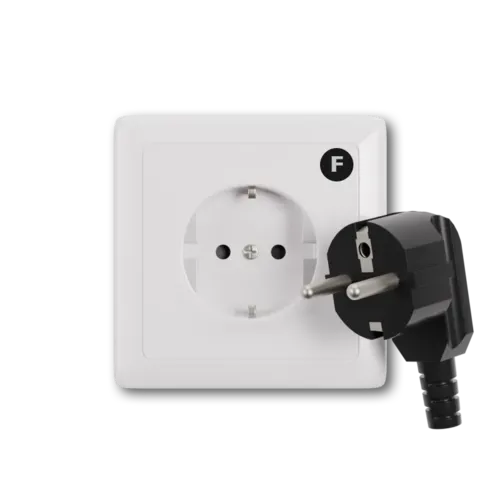
Type F
|
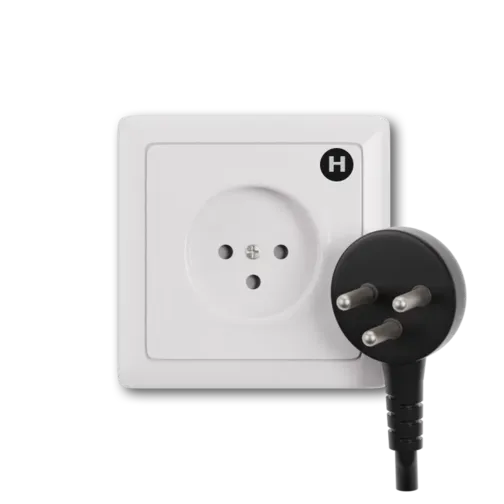
Type H
|
|
|---|---|---|
| Standard | CEE 7/4 (Schuko) | SI 32 |
| Pin Configuration | Two round pins (4.8mm diameter, 19mm long) with grounding clips on sides | Three pins in V-shape arrangement (round 4.5mm or flat pins, 19mm length) |
| Grounding | Grounded | Grounded |
| Pin Count | 2 | 3 |
| Amperage | 16A | 16A |
| Voltage Range | 220-240V | 220-240V |
Packing German or Dutch chargers for Tel Aviv? The type F vs type H plug question decides whether you need a plug adapter first.
Both systems run on 230 V mains electricity (mains electricity), but the power sockets differ in pin size, earthing and safety. A German earthed plug will not go into an Israeli wall socket safely, but a flat two-pin Europlug fits both, so you adapt to the Israeli side.
Type F vs Type H Plug at a Glance: 16 A, 250 V and Earthed
Each is an earthed connector rated at 16 A and 250 V with power pins 19 mm apart. The IEC World Plugs reference (IEC TR 60083) lists the national standard behind each letter. You might also want type J vs type M socket.
| Feature | Type F (Schuko) | Type H (Israeli) |
|---|---|---|
| Standard | CEE 7/4 plug, CEE 7/3 socket | SI 32 (also written SI32) |
| Current and voltage rating | 16 A, 250 V | 16 A, 250 V |
| Power pins | Two round 4.8 mm pins, 19 mm long | Two round 4.5 mm pins, 19 mm long |
| Earth method | Clips in the socket, contact strips on the plug | Third round earth pin, offset 9.5 mm |
| Earthed | Yes | Yes |
| Polarized | No, plug reverses | Yes, fixed by the pin layout |
| Insulated pin shanks | No | No |
| Recessed socket | Yes | No |
| Socket accepts the Europlug | Yes | Yes |
The rating is identical, so either standard draws the same power; the physical fit and safety design differ.
Pin Size, Spacing and the Other Plug Types
Both keep a pin spacing of 19 mm, so a Europlug fits either, but type F pins are 4.8 mm thick and Israeli pins 4.5 mm. The Israeli earth pin sits below the power pins in a triangle.
Among plug types, F and H sit in the 16 A group with Danish type K and Thai type O.
The Type F Plug: How the Schuko System Works
Schuko is short for Schutzkontakt, or protection contact or safety contact, patented by Siemens-Schuckertwerke in Germany in 1929. The plug is CEE 7/4 and its socket CEE 7/3, part of the CEE 7 standard.
A Schuko plug has two round prongs and no earth pin; two earth clips, the grounding clips, in the socket press against strips on the plug, earthing before the live contact. It can be turned 180 degrees, so it is unpolarized.
Where Type F Sockets Are Used in Europe
Type F outlets are standard in Germany, Austria, the Netherlands, Sweden, Norway, Finland, Spain, Portugal, Russia, Turkey and Eastern Europe; type F outlet designs also appear in South Korea and Indonesia. For travelers to Tel Aviv, it is always your plug that needs the F-to-H adapter.
The CEE 7/7 Hybrid Plug and Type E Sockets
Belgium, France and Poland use type E, with a male earth pin in the socket. The CEE 7/7 hybrid has side strips for type F and a rear hole for type E, so it is compatible with both, though not with Israeli sockets.
Some Italian and Danish installations add a hybrid socket for these Schuko plugs.
SI 32 Explained: How the Israeli Plug Is Built
The Standards Institution of Israel publishes it. Live and neutral sit side by side with the earth pin 9.5 mm below, forming a V shape (V-shaped, as older references say), in a 16 amp earthed connector.
Because the earth pin sits off the centre line, the Israeli standard is polarized: the plug goes in one way, fixing live and neutral to a known side, while a type F socket is not polarized. In practice this matters little for a charger.
From Flat Prongs to Round Pins in 1989
Before 1989 Israeli plugs used flat prongs; the revision brought cylindrical pins in the same positions, and outlets accept both plus the Europlug. Flat-blade plugs are now obsolete.
Where Type H Outlets Are Found
Type H outlets are used only in Israel, Palestine, the West Bank and the Gaza Strip. No other country adopted the standard, so it rarely appears on worldwide adapters.
Schuko and Israeli Socket Compatibility
It comes down to the socket contacts. A German pin is too thick for an Israeli socket, and a type F socket has no hole for the Israeli earth pin, so the two are incompatible in both directions.
Cheap multisocket adaptors and universal adaptors often make no earth connection, so for earthed appliances a dedicated adapter that carries the earth is safer.
Is a Type F Plug Compatible With an Israeli Power Outlet?
Not properly. You may force type F plugs into an Israeli power outlet, but nothing touches the side strips, so there is no earth contact, and the outlet is left loose.
Type H plugs have the same problem in type F sockets. The two plug shapes are not interchangeable; use an adapter.
The Europlug: The Type C Plug Both Sockets Accept
The Europlug (CEE 7/16, IEC type C) is a flat, unearthed two-pin connector with tapering 4 mm pins that fits both. Type C plugs on phone and tablet chargers plug in directly, within its 2.5 A rating.
Power Plug Safety: Recessed Schuko Sockets vs Exposed Israeli Pins
Type F protects you through socket shape; the Israeli design relies on careful use. Earthing and grounding differ too: type F earths through socket clips and Israeli earthing uses a third pin, so any adapter must carry earthing across, or the appliance loses protection.
Flush Faces: Why Israeli Outlets Are Not Recessed
A Schuko socket sits in a deep well, so fingers cannot reach the live pins. Israeli outlets are flat, so a plug pulled halfway out still has live pins in reach.
Insulated Pin Shanks and Children
On type H the pins are not insulated and the socket is flush, a real danger for small children. The risk of electrocution is low in adult use, though electrocuting yourself on a partly pulled plug is a known electrical hazard, so push plugs fully home and fit socket covers.
Travel Adapter Advice for Type F Plugs in Israel
For travel between these plugs and sockets, you need a travel adapter taking a type F or CEE 7/7 plug on one side and three pins in the Israeli layout on the other.
No. Europe and Israel both supply 230 V at a frequency of 50 Hz, so a voltage converter is unnecessary. A converter is needed only for 120 V appliances from North America.
When choosing a plug adapter for Type H sockets, look for one tested to IEC 60884-2-5, rated 16 A, 250 V, with a German-style receptacle and a proper earth pin. Avoid adapters with two pins on the Israeli side, since they drop the earth.
Dual Voltage Appliances, Laptop and Phone Chargers
Most chargers are dual voltage and use a Europlug, so a camera, tablet or laptop charger plugs straight in. Earthed type F appliances need an F-to-H adapter carrying the earth; kettles and heaters are better bought locally.