Type J vs Type M Plugs: Differences & Compatibility
Type J vs Type M plugs are not compatible: an adapter is needed in both directions. Type J is a 3-pin, grounded plug rated 10A at 220-240V, while Type M is a 3-pin, grounded plug rated 15A at 220-240V. The two differ mainly in amperage and pin design, which is what decides compatibility — whether a Type J plug fits a Type M socket, and vice versa. Also see will a type A plug work in a type B socket without an adapter.
Swipe to compare
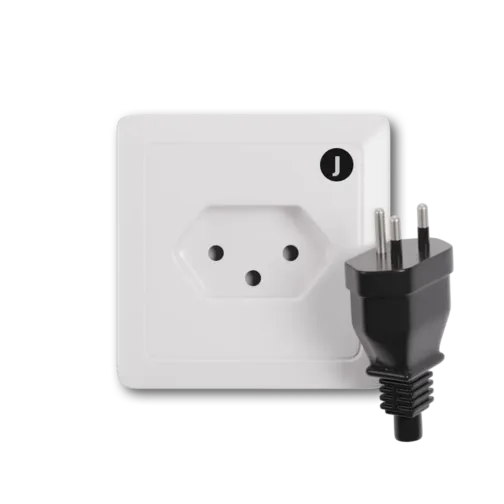
Type J
|
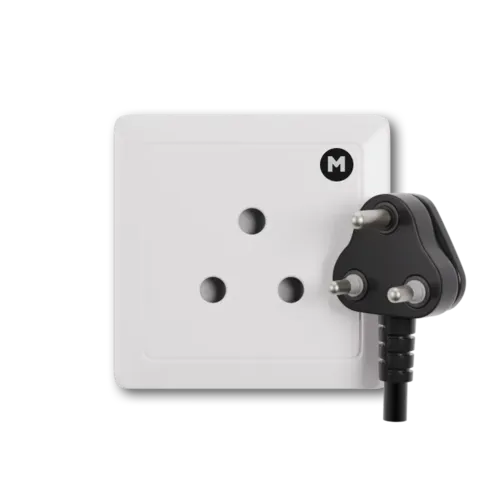
Type M
|
|
|---|---|---|
| Standard | SEV 1011 | BS 546 (15A) |
| Pin Configuration | Two round pins (4mm diameter) plus offset grounding pin (center pin 10mm from others) | Three large round pins in triangular pattern (earth 8.7mm diameter, live/neutral 7.1mm diameter) |
| Grounding | Grounded | Grounded |
| Pin Count | 3 | 3 |
| Amperage | 10A | 15A |
| Voltage Range | 220-240V | 220-240V |
Travellers packing electronics for a trip between Zurich and Johannesburg? The type J vs type M plug answer: neither plug fits the other's socket, even though both countries run on the same household 230 V electricity.
You need a plug adapter in both directions but no voltage converter, and the big South African plug is the one travel kits forget.
Type J vs Type M Plug at a Glance
Both are three-pin, grounded designs for 220-240 V circuits with round pins. The letters come from a guide by the International Trade Administration, now maintained by the IEC; they describe rough physical families, not a technical standard.
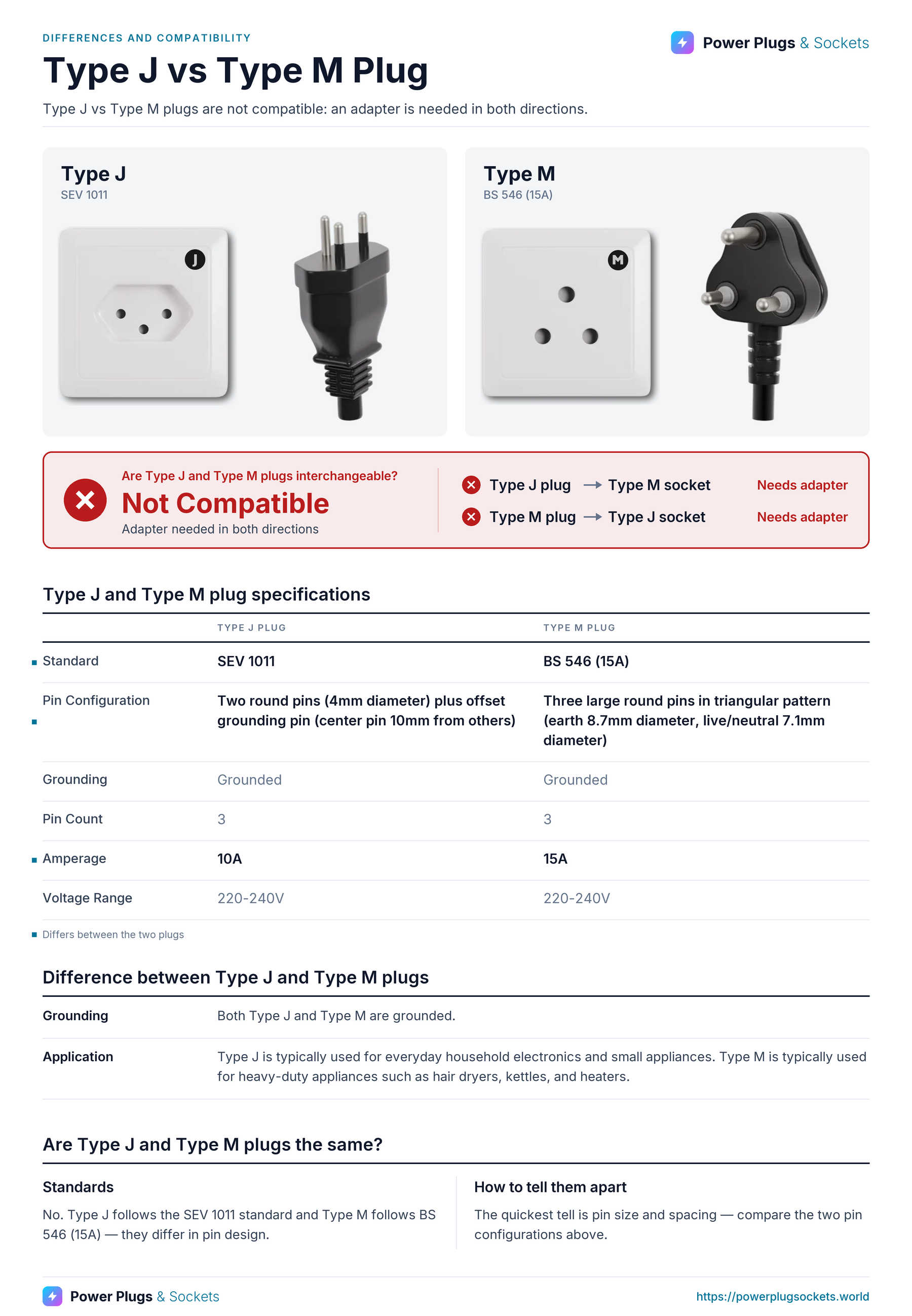
| Feature | Swiss plug (J) | South African plug (M) |
|---|---|---|
| Governing standard | SN 441011 (Swiss) | BS 546 15 A, SANS 164-1 (South African), IS 1293 (Indian) |
| Pins | Three round pins, 4 mm diameter | Three round pins in a triangle, about 7 mm live/neutral and 8.7 mm earth |
| Live-to-neutral spacing | 19 mm | 25.4 mm |
| Current rating | 10 A | 15 A or 16 A |
| Voltage and frequency | 230 V, 50 Hz | 230 V, 50 Hz |
| Earthing (grounding) | Grounded through the offset earth pin | Grounded through the large top pin |
| Polarized | Yes | Yes |
| Insulated pins | Yes, sleeved | Optional |
| Recessed socket | Yes | No |
| Socket accepts the Europlug | Yes | No |
| Main countries | Switzerland, Liechtenstein, Rwanda | South Africa, Lesotho, Eswatini, Namibia, Botswana (alongside other outlet styles) |
No. The two designs are physically incompatible: the larger pins of an M plug are almost twice as thick as a Swiss socket's holes, and a J plug would rattle in a plug type M socket. Only the Europlug (a type C plug) is compatible with a type J socket.
The Swiss Plug and Its SN 441011 Standard
The Swiss plug is defined by SN 441011, known as SN SEV 1011 until 2019, a hierarchical system of plugs with two, three or five pins rated at 10 A or 16 A. A socket accepts any plug with the same or fewer pins and the same or lower rating. The 10 A series runs from unearthed type 11 to earthed type 12, with a type 15 plug for three-phase power; a 16 A series (type 23) takes every 10 A plug, but a 16 A plug fits neither an M socket nor a 10 A socket. For a related pairing, see comparing type F and type H plugs for international travel.
4 mm Pins and the Offset Earth Pin
The type 12 plug has two round pins of 4 mm pin diameter 19 mm apart, plus a 4 mm earth pin shifted 5 mm off the line, which makes it polarized and a match for the Europlug's spacing.
The Recessed Socket and Europlug Fit
Modern outlets use the type 13 socket, a recessed socket with a hexagonal well. It takes the type 11 plug, the type 12 plug and the 2.5 A Europlug, but not Schuko; older sockets may lack child protective shutters.
Where the Swiss Socket Is Used
The standard is used in Switzerland and Liechtenstein, and Rwanda lists it alongside the Europlug, so a power outlet type J may sit next to two-pin C sockets.
The South African Plug and BS 546
BS 546, introduced in 1934, defines round-pin plugs rated 2 A, 5 A, 15 A and 30 A. The 5 A became the IEC's Type D and the 15 A became M; South Africa writes it today as SANS 164-1 at 16 A.
Three Round Pins in a Triangle
Live and neutral sit 25.4 mm apart at the bottom with the larger earth pin above: about 7 mm for live and neutral and close to 8.7 mm for earth. The longest earth pin opens the shutters first.
Why the 15 A Plug Is Bigger Than Type D
It is a scaled-up type D with a triangular pattern. The smaller plug is rated 5 A (6 A in India) for lamps and chargers; M carries 15 A or 16 A for heavy appliances such as geysers, air conditioners and stoves.
Countries That Use the Large Round-Pin Outlet
About 15 countries use it, mainly South Africa, Lesotho, Eswatini (formerly Swaziland) and Namibia, and in India, Sri Lanka and Nepal outlet type M is the heavy-appliance socket. Israel uses its own Type H. All share 230 V, 50 Hz.
South Africa's Move to Type N and SANS 164-2
In 1992 South Africa adopted IEC 60906-1 as SANS 164-2, type N, the preferred standard in 2013, a gradual transition; Brazil uses a related variant. It looks like a J plug, but its earth pin is offset 3 mm instead of 5 mm, so neither fits the other's socket.
Swiss Standard vs 15 A Plug: Safety and Ratings
Both are earthed, which matters for electrical safety. The Swiss side relies on a recessed socket and sleeved pins; the BS 546 side on size and shutters. Next, check how the NEMA 1-15 standard for type A compares to SI 32 for type H.
Every type 12 and M plug is grounded through a dedicated pin, but a Swiss socket also takes unearthed plugs. If you use a travel adapter, check that it carries the earth through.
Older Swiss plugs had bare pins, a shock hazard when partially inserted; current ones have insulated pins and a recessed well. BS 546 sleeves are optional, so pull the plug straight out to keep the risk of electrocution low.
Both plugs are polarized and neither is fused in the standard version (both unfused), unlike the British BS 1363, so the distribution board circuit breaker is the only overcurrent protection.
A 10 A Swiss socket outlet delivers about 2,300 W and a 16 A M socket about 3,680 W. A 2,000 W hairdryer draws 8.7 A, but a 3,000 W kettle draws about 13 A, over a Swiss socket's current rating. The plug rating limits what power cords can carry, and a travel adapter does not raise it.
Travel Adapter Advice for SEV 1011 and SANS 164-1 Countries
Because voltage and frequency match, the power supply is no concern and travel is only about plug shape: check the plug types and socket types at each stop and pick the adapter for your direction. Using South African appliances in Switzerland, use an adapter with M sockets and a J plug (the plug is rated at 10 A), keep the load under 10 A, and for gear with a detachable IEC cable buy a Swiss cord locally.
A hotel universal socket or dual socket meets no standard: the thick M plug sits loosely with no earth contact, so a dedicated J-to-M adapter is safer.
Plug Adapter for Swiss Devices in Southern Africa
You need a plug adapter with a J plug on the front and the large three-pin M on the back, sold at South African airports. Chargers with a Europlug fit newer SANS 164-2 sockets without one.
Why Worldwide Travel Adapters Skip It
Most worldwide travel adapters omit the large round-pin plug because its pins are too thick and far apart. If South Africa is on your route, buy a dedicated M adapter.
Voltage Converter Needed? 230 V at 50 Hz
No. Switzerland and South Africa both supply 230 V mains at 50 Hz. A voltage converter only matters for 110-120 V devices from the US; most chargers accept 100-240 V.