Type F vs Type N Plugs: Differences & Compatibility
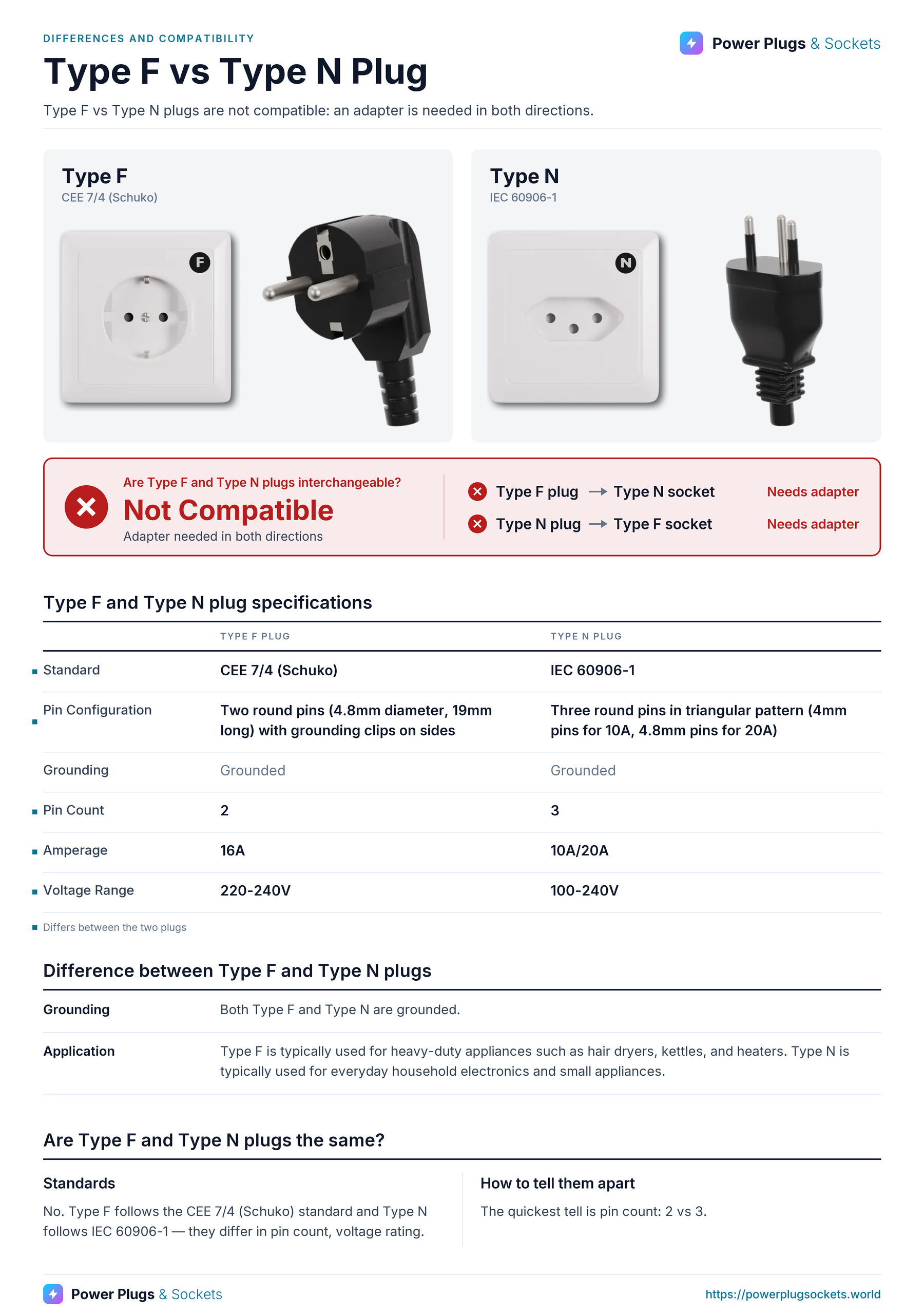
Type F vs Type N plugs are not compatible: an adapter is needed in both directions. Type F is a 2-pin, grounded plug rated 16A at 220-240V, while Type N is a 3-pin, grounded plug rated 10A/20A at 100-240V. The two differ mainly in voltage, amperage and pin design, which is what decides compatibility — whether a Type F plug fits a Type N socket, and vice versa. Next, check how the CEE 7/16 (Europlug) standard for type C compares to CEI 23-50 for type L.
Swipe to compare
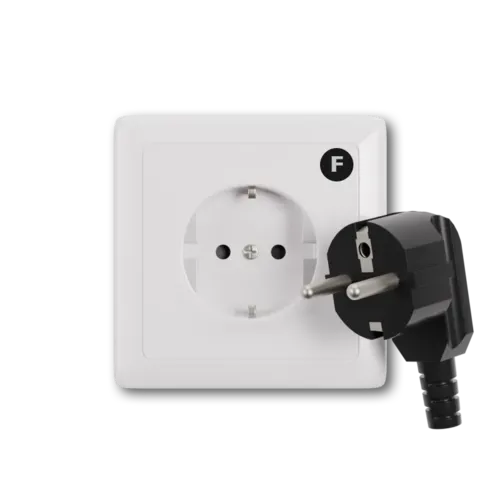
Type F
|
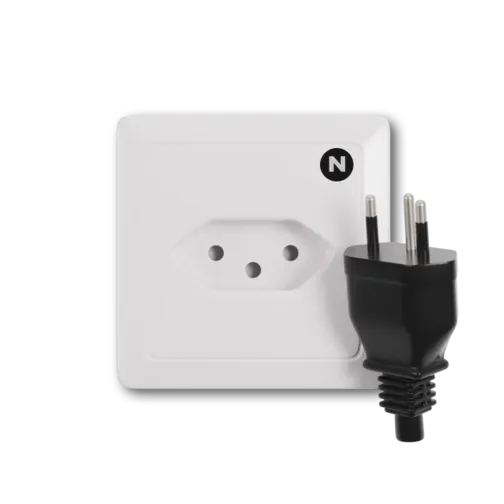
Type N
|
|
|---|---|---|
| Standard | CEE 7/4 (Schuko) | IEC 60906-1 |
| Pin Configuration | Two round pins (4.8mm diameter, 19mm long) with grounding clips on sides | Three round pins in triangular pattern (4mm pins for 10A, 4.8mm pins for 20A) |
| Grounding | Grounded | Grounded |
| Pin Count | 2 | 3 |
| Amperage | 16A | 10A/20A |
| Voltage Range | 220-240V | 100-240V |
Pack a charger from Hamburg for São Paulo and the type F vs type N plug question is about one thing: whether your plug's earth contact matches the wall socket. The round two-pin Schuko serves domestic power sockets across most of Europe, while the three-pin design is the electrical outlet standard in Brazil and South Africa.
Which power plugs your appliances can use depends on these plug types and socket types. This guide compares their pins, earthing, ratings and voltage and frequency.
Type F vs Type N Plug: Side-by-Side Specs
Both designs are 230-volt plugs and sockets that share a pin spacing but refuse each other's socket. The differences lie in how each reaches earth and which standard defines it.
| Feature | Schuko (Type F) | Type N (IEC 60906-1 family) |
|---|---|---|
| Defining standard | CEE 7/4 plug, CEE 7/3 socket | NBR 14136 (Brazilian), SANS 164-2 (South African) |
| Pins | Two round pins, 4.8 mm | Two pins plus a central earth pin |
| Live-to-neutral spacing | 19 mm | 19 mm |
| Earthing method | Two clips on the socket rim | Earth pin offset 3 mm from the pin line |
| Current rating | 16 A | 16 A (South African), 10 A or 20 A (Brazilian) |
| Polarity | Not polarized | Polarized |
| Socket shape | Round recess with side clips | Recessed socket (Brazilian version) |
| Typical voltage | 220 – 240 V | 100 – 240 V |
| Accepts a Type C Europlug | Yes | Yes |
Pin Spacing and Round Pins Compared
Both plugs share a pin spacing of 19 mm between line and neutral centres. The Type F design has two round pins 4.8 mm across; the three-pin design, with three pins in a shallow triangle, adds an earth pin just off the line, so a matching spacing does not mean a matching fit.
Ratings differ too: Schuko is 16 A, while Brazil uses a 10 A plug and a 20 A plug, and a 20 A plug will not go into a 10 A socket.
The Schuko Plug and CEE 7/3 Socket
The type F plug is formally the CEE 7/4, with a CEE 7/3 socket. Its name comes from Schutzkontakt, "protective contact", patented by Siemens-Schuckertwerke in 1929. Next, check type G vs type I plug.
Type F plugs have two 4.8 mm pins and are symmetrical. The system is unpolarized, so live pin and neutral swap when you turn the plug, while the three-pin design fixes the phase position.
Earthing Clips and the Circular Recess
A German-style electrical socket has two spring earthing clips inside a circular recess; the plug touches them before the pins reach the live contacts. The plug has no ground pin, which is why it cannot find earth in a three-pin socket outlet; the French Type E socket instead has a male earth pin.
Type F outlets are common in Germany, Austria, the Netherlands, Spain and Russia.
Child-Resistant Shutters on the Type F Socket
A type F socket often has child-resistant shutters that open only when both pins press at once, required in new installations in Portugal, Finland, Denmark and Sweden. Brazilian sockets rely on a deep recess instead.
IEC 60906-1: The Standard Behind the Brazilian Plug
In 1986 the International Electrotechnical Commission (IEC) published IEC 60906-1, meant as one common system for 230 V countries. The European Union standard plan was shelved in the mid-1990s, but Brazil and South Africa adopted it.
Travellers will almost never see type N plugs in a European wall.
Brazilian NBR 14136: Two Pin Diameters
Brazil made its national standard NBR 14136 compulsory in 2011: 4 mm pins for the 10 A plug and 4.8 mm for the 20 A plug, in a deep recess. Homes run on 127 V or 220 V at 60 Hz, so check the label.
SANS 164-2 in South Africa
South Africa adopted the design as SANS 164-2 in 1992 and made it the preferred standard in 2013, though many buildings keep the large round-pin Type M socket, also used in Lesotho. South African sockets also accept the Europlug.
A Polarized Earth Pin in a Triangle
The three-pin design is polarized: the earth pin sits 3 mm off the line, so the plug goes in one way and gives a solid metal-to-metal earth, unlike spring clips.
Schuko and Europlug Compatibility: Which Plugs Fit
Compatibility differs most when you mix plugs & outlets from different regions. The Europlug (Type C, 2.5 A, with insulating sleeves) fits a Type F, a French Type E and a three-pin socket alike, so it needs no adapter.
Most European appliances ship with the CEE 7/7 hybrid plug, which fits Type F and Type E, and the unearthed CEE 7/17 serves lamps, but neither fits a three-pin outlet. A Schuko plug does not fit a Brazilian or South African socket, nor does a three-pin plug fit a Type F socket.
Why a Swiss Plug Is Not the Same
The IEC design is mistaken for the Swiss plug, but a Swiss Type J socket uses a 5 mm earth offset instead of 3 mm, so they need different adapters.
Earthing Safety: Schuko Clips vs a Third Pin
Both systems are built for safety and reach protective earth before the live contacts close. The practical difference is grounding through adapters: a Type F plug in a cheap converter without earth clips loses its earth yet still powers up, and an ungrounded adapter hides the missing contact.
A three-pin plug on a bad adapter has the same problem, though its third pin makes it obvious.
Contact Order and Electric Shock Risk
A metal-bodied kettle on an unearthed two-pin adapter in São Paulo can leave the casing live, the real electric shock risk. Use a grounded adapter for any appliance with a three-core cable, and never force a plug into the wrong socket.
Countries Using Schuko vs NBR 14136 Sockets
Schuko covers far more countries: continental Europe outside France, Belgium, Italy, Switzerland and Denmark, plus Central Asia and the Middle East. Brazil and South Africa are the main three-pin markets. Also see type E vs type G socket.
Continental Europe and South Africa run 220 – 240 V at 50 Hz, Brazil 127 V or 220 V at 60 Hz. The voltage rating of the plug is not the issue; whether your device runs on local mains electricity is.
Chargers labelled "100–240V, 50/60Hz" work anywhere.
Travel Adapter Options for CEE 7/4 Plugs
A travel adapter changes the plug shape, not the supply, so bridging foreign plugs & outlets needs a CEE 7/4 end on one side and a three-pin plug on the other, earthed for each system.
Choosing a Plug Adapter for Each Socket
Match the plug adapter to the device: Europlug chargers need none, grounded Schuko plugs need a grounded adapter rated 10 A for Brazil or 16 A for South Africa, and the Brazilian 20 A plug needs a 20 A adapter.
When a Voltage Converter Is Needed
You need a voltage converter only for single-voltage devices on a different supply, such as a 230 V appliance on Brazil's 127 V.