Type F vs Type O Plugs: Differences & Compatibility
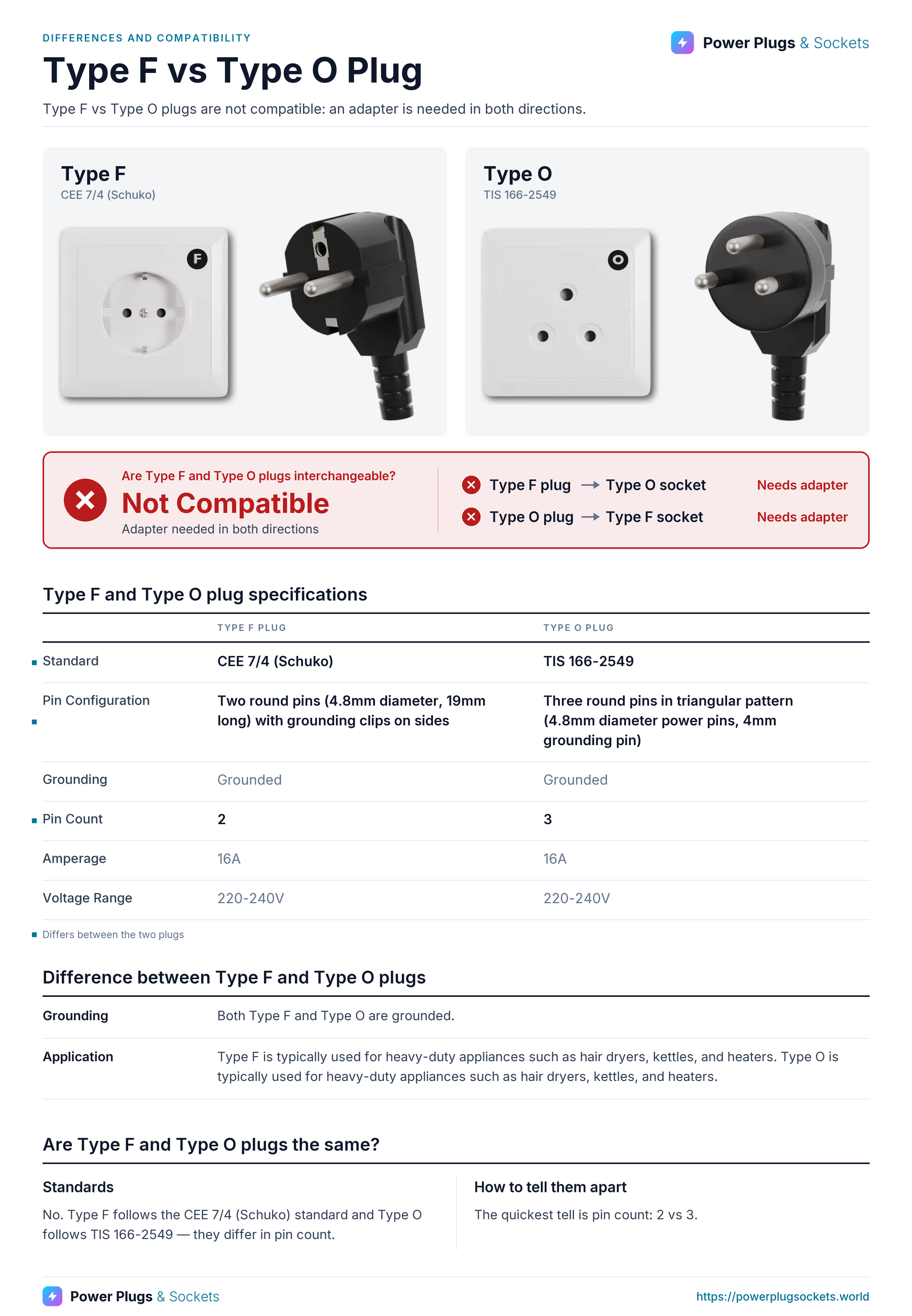
Type F vs Type O plugs are not compatible: an adapter is needed in both directions. Type F is a 2-pin, grounded plug rated 16A at 220-240V, while Type O is a 3-pin, grounded plug rated 16A at 220-240V. The two differ mainly in pin design, which is what decides compatibility — whether a Type F plug fits a Type O socket, and vice versa. Also see what are the differences between a type A and a type N plug.
Swipe to compare
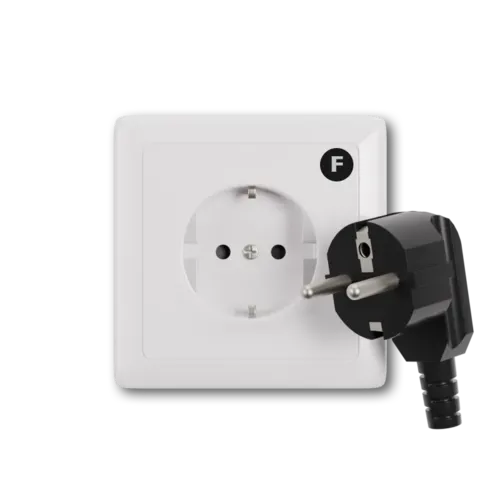
Type F
|
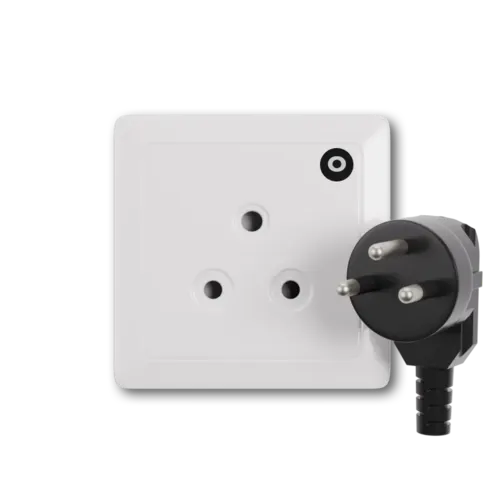
Type O
|
|
|---|---|---|
| Standard | CEE 7/4 (Schuko) | TIS 166-2549 |
| Pin Configuration | Two round pins (4.8mm diameter, 19mm long) with grounding clips on sides | Three round pins in triangular pattern (4.8mm diameter power pins, 4mm grounding pin) |
| Grounding | Grounded | Grounded |
| Pin Count | 2 | 3 |
| Amperage | 16A | 16A |
| Voltage Range | 220-240V | 220-240V |
Packing for a trip between Germany and Bangkok, you will meet the type F vs type O plug question. The Schuko plug and the Thai plug share pin size and spacing, but earth connects differently.
A Schuko plug physically enters a Thai socket but loses its earth connection, and a grounded Thai plug does not fit a Schuko socket at all.
Type F vs Type O Plug at a Glance
Both connectors are rated 16 A on the same household supply. Type F puts the earth on two metal clips inside recessed sockets; type O puts it on a third round pin on the plug.
The letters of these plug types and socket types come from the IEC World Plugs guide, while real dimensions sit in the Thai Industrial Standard and other electrical standards for plugs and sockets.
| Feature | Type F (Schuko) | Type O (Thai) |
|---|---|---|
| Governing standard | CEE 7/3 socket, CEE 7/4 plug | TIS 166-2549 |
| Main region | Europe (except UK and Ireland), Russia, parts of Asia | Thailand only |
| Pins on the plug | 2 round power pins | 2 round power pins plus a round earth pin |
| Pin diameter and length | 4.8 mm × 19 mm | 4.8 mm × 19 mm (earth pin 21.4 mm long) |
| Pin spacing | 19 mm centres | 19 mm centres |
| How it is grounded | Two earthing clips in the socket recess | Earth pin on the plug |
| Insulated pins | No | Yes, first 10 mm sheathed |
| Recessed socket | Yes, about 15 mm deep | No, flat socket face |
| Polarized | No | Yes |
| Current rating | 16 A | 16 A |
| Voltage | 220 – 240 V | 220 – 240 V (230 V nominal) |
| Socket also accepts | Type C, type E (via CEE 7/7), type F | Type C, type O; type E and F only partially and unsafely |
How the Schuko Plug (CEE 7/4) Is Built
Schuko is short for Schutzkontakt, "protection contact" or safety contact. A type F plug has two round pins, each 4.8 mm thick and 19 mm long, and metal strips on its edges that touch the earth contacts in the socket.
With a patent through Siemens in 1929, the obsolete original (a rewireable version survives among electrical accessories) had no hole for an earth pin, so the CEE 7/7 hybrid plug, which added a female contact to fit type E sockets.
Clip Earthing and the Recessed CEE 7/3 Socket
The CEE 7/3 socket is a round well about 15 mm deep with two spring earthing clips that touch the plug's strips, an earth contact, before the power pins reach live parts; indentations on the well line up with notches on the plug, which helps plug retention. A type F outlet is a wall socket receptacle.
The recess keeps fingers away from the pins during connection.
Where Schuko Sockets Are Used
Type F is the default across continental Europe: Germany, Austria, the Netherlands, Spain, Portugal, Sweden, Norway, Finland, Eastern Europe and Russia, plus South Korea and Uruguay. It is absent from the UK, Ireland, Switzerland, and France and Belgium, which use type E.
How the Thai Plug Is Built
Thailand defines its plug in TIS 166-2549 (2006), replacing older rules based on American NEMA plugs, for a country with a 230 V power supply. It is backward-compatible with the existing hybrid socket, which takes NEMA 1-15 plugs, Europlugs and Thai plugs in one face, though dual sockets also accept 120 V plugs, so a fit does not mean the supply suits the device.
Insulated Power Pins and the Third Pin
The two power pins are round pins 4.8 mm by 19 mm on 19 mm spacing, each sheathed with insulation sleeves for the first 10 mm, so a partially inserted plug is no shock hazard. Below them sits a round earthing pin 21.4 mm long, placed to match a NEMA 5-15 earth hole.
Any Class I appliance relying on protective earth in Thailand has this three-pin version; type O plugs also come unearthed.
The Two-Pin Ungrounded Version
TIS 166-2549 also defines an ungrounded two-pin plug for Class II appliances with double insulation. Unlike the 2.5 A Europlug, it is rated up to 16 A, and with no third pin it usually seats in the European socket that the grounded version cannot enter.
Schuko and Thai Socket Compatibility
Because the pins match, people assume plugs swap both ways. They do not: You might also want how the pin configuration of a type H plug differs from a type O plug.
- Type F plug into a type O socket: goes in, but no earth connection, so it is partial and unsafe compatibility.
- Grounded type O plug into a type F socket: does not fit.
- Two-pin Thai plug into a type F socket: usually seats.
- Type C Europlug: fits both sockets safely.
Using a Type F Plug in a Thai Socket
Type F plugs in a Thai socket make contact on their power pins only, so an earthed metal case has no earth ground; outlets differ and travellers should know. The flat Thai face and uninsulated Schuko pins can also leave live pins exposed while the plug is half in, which is why it is classed as unsafe.
Using a Type O Plug in a Schuko Socket
The grounded Thai plug cannot enter, because its longer earth pin hits solid plastic at the bottom of the CEE 7/3 well. For a plug F user, one direction works badly and the other not at all.
Europlug, Type C and Type E Plugs in Both Sockets
The Europlug (type C, CEE 7/16) has thin 4 mm insulated pins that fit both sockets, but its 2.5 A current rating suits a charger, not a kettle. A type E plug acts like a type F plug in a Thai socket and works in a Schuko socket only as a CEE 7/7.
Voltage, Frequency and Safety: Schuko vs TIS 166-2549
Thailand's mains electricity power supply is 230 V at 50 Hz, like Germany and Spain, and Russia runs 220 V at 50 Hz, inside the 220 – 240 V band both plugs are rated for. South Korea uses Schuko sockets at 60 Hz. For a related pairing, see is a type C plug compatible with a type N socket.
The earth is the real difference: it lives in the Schuko socket clips but on the Thai plug pin, so a mismatched pair supplies no path to ground. Schuko is unpolarized and line and neutral can swap, while the Thai system is polarized, so live and neutral stay put.
Schuko relies on its recess and Thailand on insulated pins, so a partially inserted bare Schuko plug in a flat Thai socket loses both protections and risks electric shock; child-resistant shutters on newer sockets cannot restore the circuit's ground path.
Picking a Travel Adapter for Schuko and Thai Sockets
Because voltage matches, you only need a plug adapter, one that keeps the earth connection; cheap universal adaptors often skip it.
Travelling From Germany to Thailand
Europlug chargers need nothing. For a Schuko or CEE 7/7 plug on a metal-bodied Class I appliance, use a travel adapter with a Schuko socket on one side and plug type O on the other, rated 16 A with insulated pins.
Travelling From Thailand to Europe
A grounded Thai plug needs an adapter with a Thai socket ending in a plug type F or CEE 7/7. Both regions sit at 220 – 240 V, so no converter is needed for normal household gear.
When You Need a Voltage Converter
You need a voltage converter only for a device built for 100 – 127 V, such as one from the US or Japan. A "100 – 240 V" label means an adapter alone is fine.
Anything above 16 A needs a dedicated IEC 60309 connector. The type F vs type O plug choice comes down to one rule: keep the earth.